How the Los Angeles Kings Can Fine-Tune Their Penalty-Killing Unit in 2014-15
The Los Angeles Kings are a stellar five-on-five squad. In 2013-14, they finished fourth in the NHL with a plus-0.5 rating over 60 such minutes. In the postseason, they posted a league-best plus-0.8 on the way to a second Stanley Cup in three years.
On special teams, however, they didn’t fare quite as well.
Marian Gaborik’s arrival at the trade deadline did push the team’s power-play efficiency from 15.1 percent (27th in the league) in the regular season to 23.5 percent (sixth) in the playoffs, which is promising.
TOP NEWS
NHL Star Booed Amid Trade Request

Mark Scheifele Landing Spots 📍

Every Team's Odds to Win the Cup 🏆
Meanwhile, the penalty kill remained disappointing for such a defense-oriented club.
LA held opponents off the scoreboard on 83.1 percent (11th) of its short-handed situations in the regular season, and that mark more or less trod water in the postseason (83.3 percent, ninth).
In the fierce Western Conference, an improved penalty kill would greatly benefit the Kings’ repeat bid.
Considering how exhausting the club’s recent playoff run was—three Game 7s on the road—the coaching staff should place a strong emphasis on this area of the game to carve an easier path to the top in 2014-15.
LA’s penalty kill doesn’t need a full-on reconstruction. It can fortify this unit with a couple of simple tweaks.
Personnel

This seems fairly obvious, but it bears repeating: Penalty-killing differs from even-strength defense.
A three-zone standout at five-on-five is not necessarily a short-handed dynamo.
Anze Kopitar is a prime example of this. The Selke Trophy finalist is a superb two-way pivot who can suffocate opponents with his blend of puck possession and sound positioning.
Head coach Darryl Sutter rightfully leans on Kopitar at even strength, assigning him the most minutes and toughest matchups around.
On the penalty kill, though, he isn’t as effective as other Kings:
| Time on Ice | Corsi Against/20 Minutes | Shots Against/20 Minutes | Goals Against/20 Minutes | ||
| Anze Kopitar | 154:50 | 33.84 | 19.38 | 2.97 | |
| Jarret Stoll | 153:26 | 34.02 | 16.94 | 1.43 | |
| Trevor Lewis | 136:10 | 29.96 | 15.72 | 2.50 | |
| Mike Richards | 124:42 | 27.91 | 13.47 | 1.76 | |
| Jeff Carter | 106:48 | 30.52 | 16.10 | 1.68 |
In 2013-14, he posted the worst plus/minus per 60 four-on-five minutes among LA forwards who averaged at least one short-handed minute per game. In 2013, he ranked second-worst in that category.
When he’s on the ice, the Kings aren’t preventing or producing goals. They’re conceding a fair number of shot attempts, shots and scoring chances, too.
On the flip side, Mike Richards—whose overall five-on-five performance has fallen off of late—remains a brilliant penalty-killer.
As noted by Jewels from the Crown’s Andrew Leafman, the much-maligned center has been the team’s finest short-handed forward ever since he joined LA in 2011-12:
"LRT: Mike Richards has allowed 4v5 shots against at the lowest rate of all Kings forwards three years in a row. Really good PKer.
— Andrew Leafman (@andrewleafman) July 7, 2014"
This boils down to their respective mindsets.
Kopitar seemingly approaches the penalty kill as though it’s an even-strength shift, staying on the right side of the puck and hoping to wait out the opposition. Unfortunately, there’s simply too much space on a power play for this tactic to work.
Take this play against the Buffalo Sabres as an example:
With Dwight King in the vicinity, Kopitar takes a wide turn toward the middle of the ice rather than pressuring the puck. As a result, Buffalo is granted an unchallenged entry into the zone.
At even strength, this would be palatable, as Kopitar and the Kings could methodically smother the Sabres and eventually regain possession. On the penalty kill, this is a recipe for disaster.
Seconds after the entry, Kopitar doesn’t recognize Cody Hodgson as a net-front threat soon enough, and LA consequently finds itself in a 2-1 hole.
In the quarterfinals against the San Jose Sharks, a conservative approach at the blue line leads to a Joe Pavelski marker:
Richards, for his part, is aggressive in his aim to break up plays before they can materialize.
He understands that minimizing zone time is the key, and he plays accordingly, taking risks in the hopes of intercepting passes and subsequently creating offense.
In late October, he sniffs out Phoenix’s drop-pass setup in the neutral zone and pounces:
After stealing the puck, he neatly tucks it by Thomas Greiss for the game-winner.
During Game 2 of the Stanley Cup Final, Richards deflects Derick Brassard’s pass just outside the blue line due to his smart positioning—he funnels Brassard toward his fellow penalty-killers while closing off the weak-side lane—and active stick (starts at 3:40):
He then outworks Brad Richards for a loose puck and dishes to Dwight King for what should have been the deciding tally.
A slower pace after his concussions has curtailed his uncanny short-handed production, but his hockey sense and competitiveness still allow him to make opponents uncomfortable with the man advantage.
Kopitar seemingly deals with lulls every year. Perhaps a smaller role on the penalty kill would keep him fresher during the dog days of the season.
Meanwhile, Richards’ enhanced presence would add some bite to the Kings’ penalty kill by hounding the opposition in the neutral and defensive zones so that merely establishing possession on offense would prove arduous.
Conventional wisdom might suggest that the Selke Trophy finalist is the superior penalty-killer, but the numbers don’t lie.
In terms of shot attempts, shots, scoring opportunities and something as black-and-white as goals against, Richards is the better choice. He always has been, really.
Awarding him a heavier short-handed load could become a real win-win scenario: Kopitar would have more energy to devote to his even-strength excellence, whereas Richards could become more involved by seeing more time in situations where he’s the alpha male.
Concerted Effort
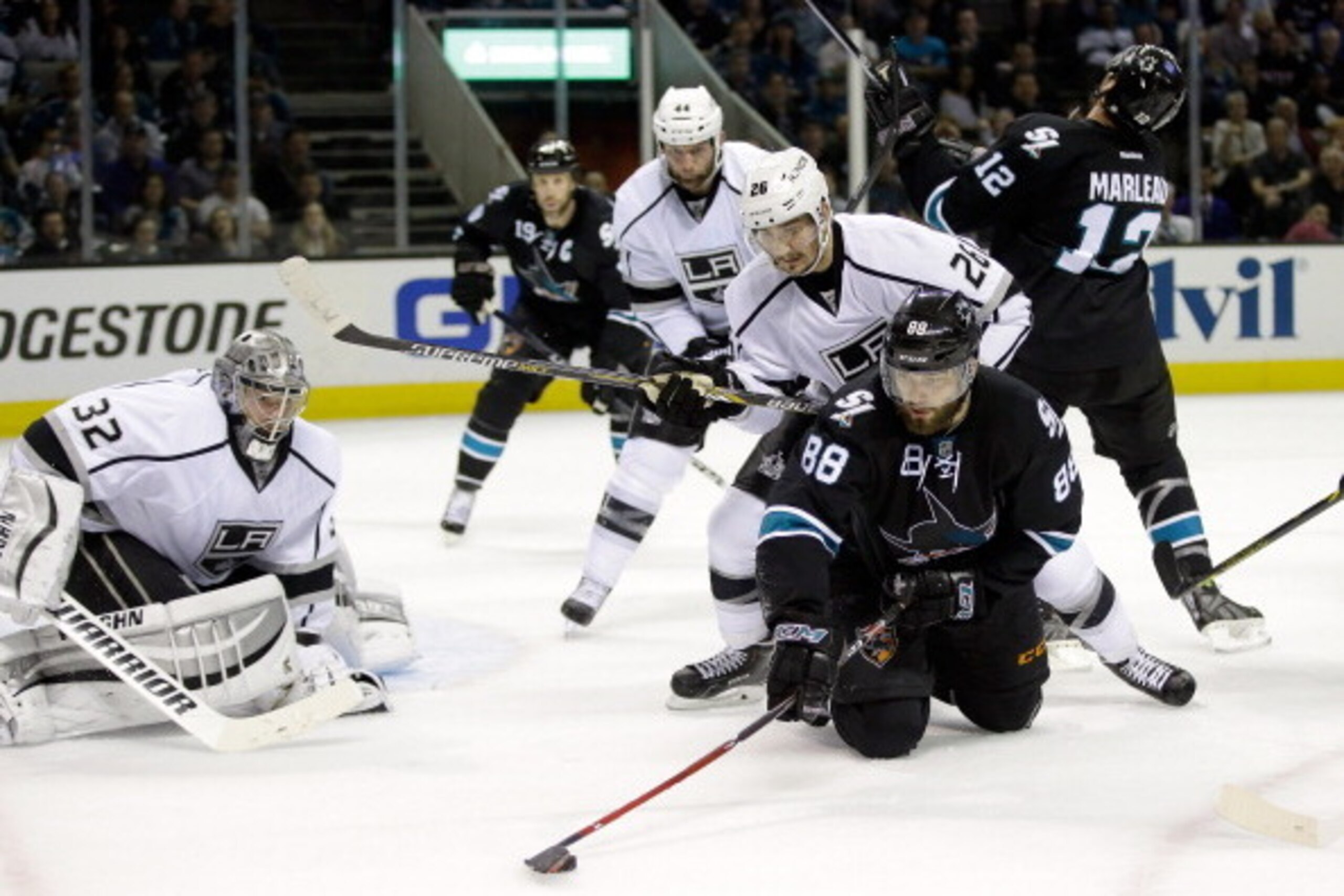
Given how many moving parts are involved in a penalty kill, moving in cohesive fashion is vital.
The core idea is limiting damage. That means keeping defensive-zone time to a minimum and holding opponents to the perimeter rather than allowing the puck to travel through the ever-fluid box.
When the short-handed unit isn’t operating as a well-oiled machine, seams and high-percentage real estate open up.
That was the case a bit too often for the Kings last season, as misreads caused a number of entirely preventable goals against.
With only four—sometimes three—skaters on the ice to kill off penalties, a single error becomes that much more glaring. The odds of being bailed out by a teammate are far slimmer.
Moreover, Jonathan Quick isn’t at his best in these situations. Of the 27 netminders who faced more than 200 four-on-five minutes in 2013-14, LA’s starter ranked 23rd in save percentage.
His incredibly aggressive style can produce dominant stretches at even strength, but since power plays are granted much more room to work with than five-on-five units, they can exploit his daring approach with cross-ice designs and extra passes.
As such, denying the favorable areas of the ice should be the team’s priority.
First and foremost, the Kings must be stronger at the defensive blue line. They need to stand their ground more frequently and at least hamper the power play’s entry.
In both the regular season and playoffs, LA players struggled with crossed wires, converging on the same mark and thus allowing the opposition to capitalize on the empty space elsewhere.
Facing the Pittsburgh Penguins in late January, Trevor Lewis and Slava Voynov are drawn to Evgeni Malkin just inside the blue line. With his vision and talent, the lanky All-Star delivers a cross-ice pass to Jussi Jokinen:
King isn’t quite set, and before the Kings can recover, the puck is in the back of the net.
A similar turn of events played out in the Stanley Cup Final:
Matt Greene and Jeff Carter flock toward Chris Kreider along the boards. That cannot happen. One of them must sag back in case the play isn’t nipped in the bud.
It isn’t. Two passes later, Martin St. Louis scores on a gifted two-on-one break.
Success for LA on the penalty kill will boil down to understanding one’s responsibilities at all times—they do change dramatically, shifting from holding the blue line to blocking shots at the point to covering seams in the slot to split-second rotations.
In December, Colorado Avalanche forwards Matt Duchene and Ryan O'Reilly play a bit of give-and-go, attracting Robyn Regehr's attention and biding their time for the right window:
There's no way Regehr can handle both players, but Kopitar doesn't pick up on that in time to fend off O'Reilly, who sneaks between the Kings defenders, cradles the puck and filters a shot through Martin Jones for a 3-2 goal.
LA's defensive instincts are generally quite strong. Penalty-killing is a separate can of worms, though, and it's more demanding from a read-and-react standpoint. Group coordination is thus pivotal, as top power-play units have a knack for detecting weaknesses and cracking a single fissure wide open.
If Sutter’s men can’t display a more united front in 2014-15, they’ll once again put forth a mediocre short-handed showing.
Outlook
When examining their roster, it's clear the Kings should be better on the penalty kill. A top-five finish in this category is entirely feasible—they ranked fourth in 2011-12—but it will require some alterations.
Sutter must deploy the right troops while stressing precisely where he wants his players to be at all times.
An aggressive, cohesive unit is awfully hard to score on. It wouldn't suddenly thwart all power plays, but it would weed out the goals that breach the heart of LA's formation—the most preventable ones. If opponents are going to score, the Kings must make them dig and fight for it.
After all, nothing is supposed to come easy against them.
Where playoff seeding is concerned, the penalty kill could determine whether the squad will enjoy home-ice advantage or enter another gauntlet on the road. If LA is truly intent on defending its latest championship, it will take the strides needed to ensure a less daunting path to Lord Stanley.
In the brutal Western Conference, every goal will count.
Advanced statistics courtesy of Behind the Net, Stats.HockeyAnalysis.com and Jewels from the Crown.



.jpg?w=2560 "Insiders: Cowboys Overpaid for Porter")
.jpg?w=2560 "Every Trade's Best Trade Asset 🔁")
.jpg?w=2560 "Top NFL Trade Targets")
.jpg?w=2560 "Daniels Eyeing Week 5 Return")
.jpg?w=2560 "No Rift Between Maye, Vrabel")