Drew Doughty Still Has Room to Grow with Los Angeles Kings in 2014-15
Drew Doughty was recently named the world’s best defenseman by NHL.com, but he has probably deserved the distinction since a jaw-dropping postseason showing in 2012.
His impressive resume contains two Stanley Cups and two Olympic gold medals, and he was at the heart of each of those triumphs. When the chips are down in high-stakes tournaments, the linchpin of the Los Angeles Kings’ blue line consistently delivers the goods.
For the league’s 29 other clubs, the terrifying part of this narrative is that he’s still only 24 years old.
TOP NEWS
NHL Star Booed Amid Trade Request
Mark Scheifele Landing Spots 📍

Every Team's Odds to Win the Cup 🏆
He hasn’t come close to peaking yet.
While Doughty is already a superb three-zone rearguard and the top big-game defenseman around—maybe the top big-game player around—a few refinements could vault him into even more rarefied air.
Forget outlandish point totals and laughable Norris Trophy voting: This is about how Doughty can attain his otherworldly ceiling within the Kings’ team-first system.
Power Play
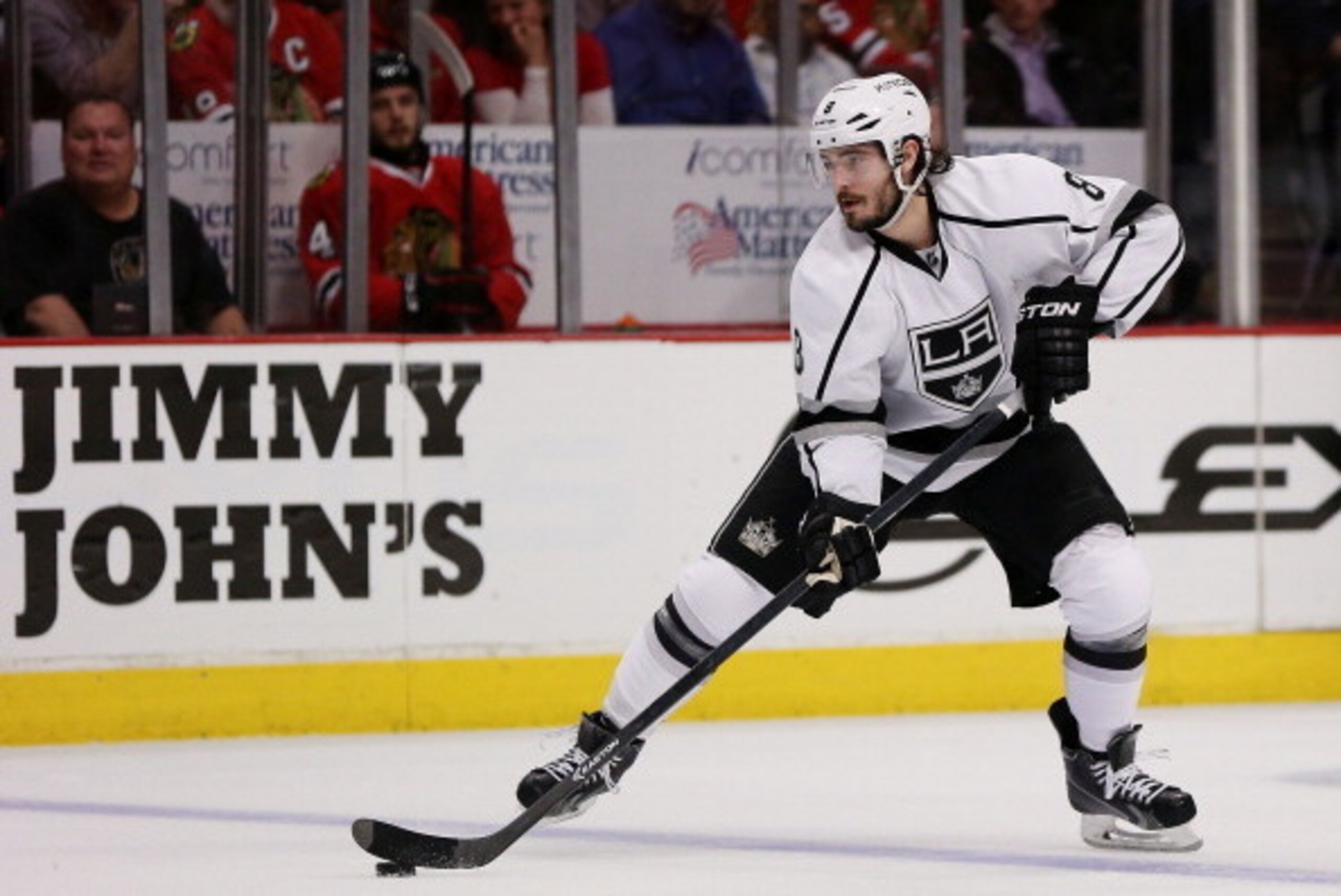
Though few can dictate the flow of the game like Doughty at even strength, his performance on the man advantage leaves something to be desired.
The additional space afforded by a power play seems to unsettle the typically poised blueliner, bringing forth slower and more apprehensive choices in lieu of the conviction he displays in other situations.
One gets the impression that he’s petrified at the thought of making the wrong play.
Doughty’s hesitancy is reflected in his puck-possession metrics.
At five-on-five, he’s earned a reputation as one of the finest possession defensemen around, continually driving play toward the opposition’s net.
At five-on-four, his on-ice Corsi (plus-85.28) and relative on-ice Corsi (minus-13.0) ranked last and second-last respectively among Kings who averaged more than two minutes of power-play ice time per game in 2013-14.
In a curious turn, one of the NHL’s most confident two-way players becomes gun-shy on the power play.
He simply isn’t decisive enough, often hanging on to the puck for too long and allowing penalty-killers to clog his shooting lanes. He’s then forced to pass off to a teammate.
That’s a real shame because Doughty’s point shot is terrific. When there’s traffic in front of the opposing goaltender and he actively looks to fire away rather than second-guess himself, L.A. reaps the rewards:
Unfortunately, these sights aren’t as familiar as the Kings would prefer.
He averaged 2.71 points and was involved in 8.2 chances per 60 five-on-four minutes last season. Overall, he finished 22nd in power-play points among NHL defensemen. These are positively mediocre marks for a player of Doughty’s caliber.
In a nutshell, he has allowed Anze Kopitar, Mike Richards and Jeff Carter to shoulder the load more frequently than he's quarterbacked the power-play unit.
That won’t cut it. The points are crucial areas in these situations, and the Kings need Doughty to present himself as a more authoritative figure at five-on-four—someone who coordinates the offense.
He must take the game to the opposition as opposed to taking what it gives him.
This would change the entire makeup of L.A.'s power play, generating deflection, rebound and screened chances off shots while subsequently opening up passing lanes for teammates to exploit.
Doughty offered a glimpse of how dynamic he can be on the power play against the Chicago Blackhawks in the Western Conference Final:
Faced with the checking of a tremendous two-way winger in Marian Hossa, Doughty does not merely defer to another King. He attacks, faking a shot and carrying the puck into the middle of the ice, which pulls the weak-side forward (Michal Handzus) off his spot.
After Doughty soaks up everyone's attention and executes a nifty no-look pass, Alec Martinez is left alone to lean into a shot from a prime location. As a result, the Kings seize a 3-2 lead.
Going forward, the puck cannot die in Doughty’s possession. Whether it’s through a shot, a pass or penetration, L.A.’s power play is significantly more dangerous when its blue-line leader is dialed into the importance of movement.
Not only would a smarter and crisper effort on the man advantage yield more points for the player in question, but it would bolster a Kings offense that occasionally needs the extra boost.
Simplicity

One of Doughty’s signature moments of the playoffs came in Game 1 of the Stanley Cup Final when he pulled the puck through his legs before patiently finding a hole in Henrik Lundqvist’s armor.
It was a spectacular effort to be sure, but it was also a direct response to a massive gaffe he committed in the first period:
While Doughty is generally very dependable with the puck on his stick, he could stand to keep things more straightforward at times.
Especially when L.A. needed to catch up on the scoreboard, the talented rearguard slipped into selfish tendencies in 2013-14, trying too hard to take the game over when a safer option was available.
Considering how heavily the Kings rely on him (nearly 26 minutes of ice time per game, seventh in the NHL), particularly on the breakout, each of his mistakes seems egregious.
Thankfully, this isn’t an old habit that has dogged him for years and will prove hard to kick. He hasn’t been risk-prone in the past, so head coach Darryl Sutter and the coaching staff should find it fairly easy to correct these hiccups.
In fact, much of Doughty’s excellence stems from his decision-making.
Detroit Red Wings and Team Canada head coach Mike Babcock echoed that sentiment to reporters when lauding the then-21-year-old following the 2010 Olympics. “What I like about him is when he creates offense it’s not foolish. He’s not a risk-taker, he’s a game-breaker,” he said.
Doughty isn’t one of those “take the good with the bad” offensive defensemen—think Erik Karlsson, Kris Letang, Mike Green, etc.
He thrives in nearly all situations and is as fundamentally sound as they come. He may not produce as much as P.K. Subban or play as ferocious a shutdown game as Shea Weber, but his complete, three-zone package is unrivaled.
Fine-tuning his choices with the puck would turn him into an even more formidable presence.
He shouldn’t feel as though he can’t join or lead the rush—it’s one of his greatest assets, as seen in his phenomenal rate of offensive-zone entries per 60 minutes and carry-in percentage—but he must be more judicious.
In crunch time, when the urge to launch into a full-scale attack wells up, Doughty must remember to harness his talents in service of the team.
If that means opting for a short outlet pass or a dump-in over a flashy deke in the neutral zone, so be it.
Decisions such as this one from Game 3 of the second round are unacceptable:
With the forwards due for a line change and little support or space to capitalize on, Doughty cannot try to dangle through Ben Lovejoy at the offensive blue line. The puck is immediately stolen and headed the other way for a 3-1 dagger.
Pairing sharper puck-moving proclivities with his ever-improving possession and defense would create an absolute monster on the back end.
It’s hard enough scoring on the Kings in the regular season. Throw in a more polished Doughty, and it’ll become virtually impossible for opposing top lines to find the twine.
Outlook

In addition to his all-around prowess, Doughty is one of the sport's true gamers. He's a fierce competitor who—health permitting—has risen to the occasion every time the playoffs or Olympics have rolled around.
By that same token, he does let his temper get the better of him now and again.
Establishing a firmer hold of his composure while maintaining his high level of play when it matters most would lead to an understated albeit pivotal improvement.
As it stands, Doughty is a great defenseman. He's skilled, he's physical, he's a one-man breakout, he's equally adept at generating chances and locking down star forwards, and he's clutch.
With another dash of poise as well as a more assured effort on the power play, Doughty would have the ingredients to reign over the league's blue-line corps for the next decade.
He's just that good.
Advanced statistics courtesy of Behind the Net and Jewels from the Crown.


.jpg?w=2560 "Insiders: Cowboys Overpaid for Porter")
.jpg?w=2560 "Every Trade's Best Trade Asset 🔁")
.jpg?w=2560 "Top NFL Trade Targets")
.jpg?w=2560 "Daniels Eyeing Week 5 Return")
.jpg?w=2560 "No Rift Between Maye, Vrabel")