1 Win Earned Elston Howard Impossible MVP Votes in Boston's Dream Season
Second in an 11-part series examining the vagaries of awards voting.
Finishing 17th in an MVP vote normally would not rate a second glance. However, Elston Howard’s 17th-place finish in American League MVP voting in 1967 stands as a perplexing example of bias toward a pennant-winning team.
Howard, an excellent catcher/outfielder on nine New York Yankees pennant winners and already the 1963 MVP, was reaching the end of the line by 1967. Injuries limited him to 108 games that season, and after hitting .196, New York, far out of the pennant race, peddled Elston to the Boston Red Sox on August 3.
_1.png?w=2560)

In the midst of its “Impossible Dream” after having placed ninth the previous year, Boston stood only two games behind the front-running Chicago White Sox when it acquired Howard. A smart, successful veteran, Howard was expected to shore up a receiving corps that, like him, was hitting under .200.
Considering the anemic numbers he put up in New York, it is irrefutable that the seven MVP points Howard garnered were earned solely by his 42 games in Boston. Yet Howard performed even worse in red socks than in pinstripes, hitting .147 and slugging a horrid .198 with just one home run.
True, his fielding numbers improved significantly after the trade, but over 41 games behind the plate, could a backstop’s fielding have any real influence on an MVP voter, especially in light of Howard’s punchless stickwork?
Howard’s real worth lay in anchoring the young Boston pitching staff down the stretch and providing the calming guidance of a savvy veteran—a fact confirmed by Reggie Smith, who gave much credit to the ex-Yankee for keeping Sox hurlers on an even keel and the team cool in the heat of a pennant race.
Still, eventual Cy Young Award winner Jim Lonborg went just 7-5, not including three no-decisions in which he did not pitch effectively, after the Sox acquired Howard. As well, Gary Bell, Boston’s No. 2 starter, posted a 6-4 mark with two saves over the same span—numbers no better than before Howard came aboard. (Third starter Lee Stange went 1-4, 2.77 ERA after the trade.)
Yes, reliever and spot starter Jose Santiago went 6-0 down the stretch and was probably as responsible as Lonborg for keeping Boston in a white-knuckle, four-team race that came down to the season’s final day. Yet Boston, nine games over .500 when Howard made his Red Sox debut, played just 23-19 ball the rest of the way.
I wouldn’t dare diminish Elston Howard’s intangible contribution to Boston’s Impossible Dream. Renowned for his character and team play, the know-how of nine successful pennant races that Elston brought to Boston surely balanced his −0.8 WAR over the remainder of the season (−1.3 overall).
However, it’s obvious Howard made it onto several writers’ MVP ballots solely because Boston edged out the Detroit Tigers and Minnesota Twins by a single game on the season’s final day (a game Howard entered in the seventh inning as a defensive replacement). Had Boston been one of the two teams that came up a game short at the wire, likely no writer would have selected Howard on his ballot.
Owing to that win, several players far more deserving of MVP votes than Howard collected even fewer simply because their teams barely missed the pennant.
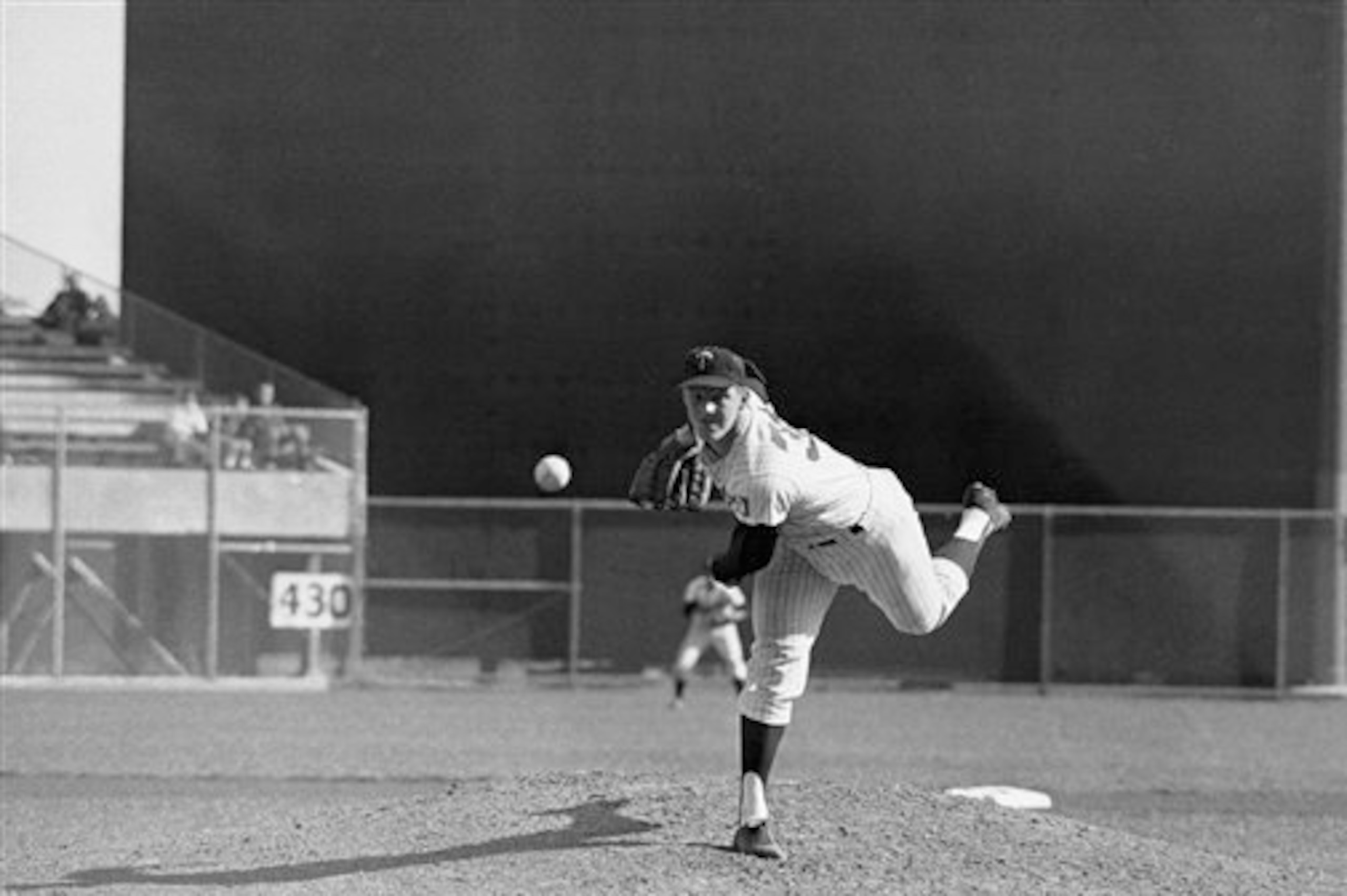
With his Twins losing the pennant in Fenway Park in Game 162, Jim Kaat (who did not pitch in that game) was essentially ignored at ballot time. From September 1 to season’s close, Kaat hurled a sizzling 7-0, with a 1.52 ERA and 65 strikeouts against only six walks.
He went only 16-13 for the season and did not deserve serious consideration, but 16 wins and 263.1 innings is a helluva lot more valuable than Howard’s near-invisible .478 OPS (which incidentally was less than Kaat’s).
Virtually the same can be said of Detroit’s Mickey Lolich: After an injury forced him from the rotation for two and a half weeks, Lolich returned on August 11 and fireballed his way to a 9-1 record down the stretch, abetted by a 1.31 ERA, 84 whiffs and four shutouts, including 28.2 scoreless innings to end the season.
How anyone could consider Howard more valuable than Lolich in that same time frame is utterly baffling.
As well, Minnesota’s Tony Oliva, despite an off year, still managed to lead the AL in doubles and arguably had his best year in the field.
It bears mentioning now—and it should have been better appreciated at ballot time—that not only did Oliva hit .345 and slug .540 in September thanks to 11 multiple-hit games, but during a five-game September series in Baltimore, Oliva demolished Baltimore Orioles pitching with five consecutive multi-hit games, swatting .714, including five doubles and a triple (Minnesota took four of five from the Birds).
Even one of Howard’s own pennant-winning teammates somehow got short shrift: Despite clubbing 17 home runs and being one of the top shortstops in the league (fielding .970), Rico Petrocelli—who tied with Howard in the vote—was adjudged to be no more valuable to the Red Sox over 142 games than was Howard over just 42.
(Amazingly, Jose Santiago, 12-4, with an AL-best .750 winning percentage as well as five saves, didn’t receive a single MVP vote despite not taking a loss after July 5.)
There’s a lot to be said for intangible contributions—but there’s a lot more to be said for those that are tangible.
In a season in which Carl Yastrzemski snared a near-unanimous and well-earned MVP for his Triple Crown and his Atlas-like effort in bringing Boston the pennant, it’s easy to understand why writers weren’t putting much thought into their selections halfway down the ballot—which is probably true in any year’s vote—but it is hard to imagine an MVP vote-getter doing any less at the plate than Elston Howard.
Curiously, Howard also finished 17th in the 1958 AL MVP race. But hitting .314 and driving in 66 runs in only 103 games for the eventual world-champion Yankees, that 17th place is, in context, a lot more befitting of Howard’s contribution.

.jpg?w=2560 "York Responded to Ad on Prostitution Site Before Arrest")

.jpg?w=2560 "Players with Shocking Career Earnings 😳")

.jpg?w=2560 "NFL Panic Meter for Every Fanbase's Anxiety Levels")