What Position Should Clint Dempsey Play for the USMNT in Brazil?
Over the past eight months, with the World Cup in Brazil looming, the form of United States men’s national team captain Clint Dempsey has become a major concern for U.S. fans.
In August of last year, only 15 months removed from breaking the record for goals scored by an American in a single season in Europe, Dempsey came home to Major League Soccer. However, his 2013 MLS campaign was far from a rousing success, as he scored only one goal in 12 games.
Then came his winter loan to Fulham, in which he managed zero goals in seven games. During that same period, he only tallied once for the USMNT—on a penalty kick.
TOP NEWS

BS Meter on Transfer Buzz 🕵️♂️
B/R 99: Best Football Players Ever 🐐

Haaland Wedding Viking Row 🤣
That poor run of form has led some U.S. fans to question whether or not Dempsey should retain his position in the starting XI for the U.S. as the team gets ready for Brazil.
But, barring an even greater drop in form, Dempsey will be in the starting squad for the World Cup. He’s still an indispensable player for the United States men’s national team and a proven international goalscorer.
He’s also the captain and was recently singled out by head coach Jurgen Klinsmann as part of the USMNT’s “spine.” It’s also worth noting that Dempsey did score a nice goal this weekend for the Seattle Sounders which could be the beginning of a return to his previous form.
What is worth questioning, however, with only three months left until the World Cup, is what position Dempsey should be playing for the USMNT as the team gets ready for its trip to Brazil.
Since the team’s World Cup qualifier against Costa Rica last March, Klinsmann has primarily lined the U.S. up in a 4-2-3-1. In that formation, Dempsey plays the role of the withdrawn forward.
Considering the likely World Cup roster, that would mean he would be flanked by Landon Donovan on one side and either Graham Zusi or Fabian Johnson on the other. Jozy Altidore, despite his own poor run of form, is still the favorite to start up top.
The ideal benefit of playing Dempsey in the withdrawn forward role is that he gets to stay high up the pitch in dangerous areas while the wide players and dual No. 6’s operating underneath get him the ball. On paper, this seems to make the most sense as Dempsey leads the team with 14 goals in the Klinsmann era.
On a side note, if Klinsmann starts Zusi and Donovan on the wings, it also has the added benefit of forcing Fabian Johnson into the back line. This would likely put Johnson at left-back over DaMarcus Beasley—who few are convinced is ready to handle the attacking talent the U.S. will be facing in Brazil.
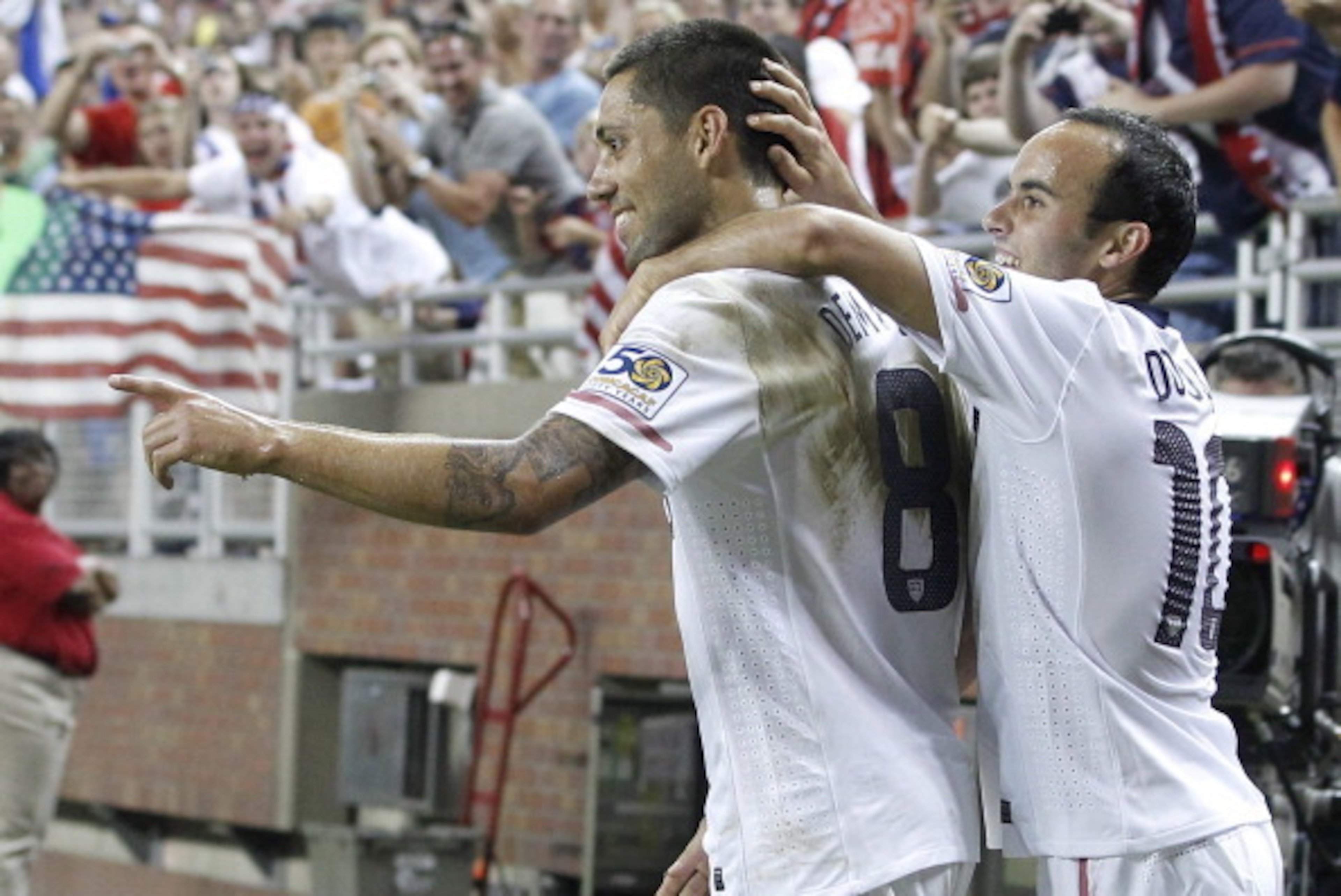
However, there are several problems with Dempsey’s role in the 4-2-3-1 setup. In many games, this formation has led to Dempsey dropping too deep to receive the ball as he often comes as far back as the defensive midfielders. When he does so, he almost always plays the ball negative—rarely facing up to make an incisive pass once he receives it.
This has two negative effects. One, it isolates Jozy Altidore up top, where he struggles to battle the bulk of opponents’ defenders by himself. The other negative effect is that it allows the U.S.’s opponents to pressure higher up the field because the threat of a U.S. counterattack is minimized by only having one attacker up high.
But the underneath role is not the only one Dempsey can play in the 4-2-3-1. For years, with both the U.S. under former coach Bob Bradley and for Fulham in the English Premier League, Dempsey played out wide.
His defensive work rate wasn't always something to write home about—a legitimate concern considering the U.S.’s World Cup group-stage opponents—but his goal-scoring prowess and ability to poach on the weak side was undeniable.
The other benefit of playing Dempsey out wide in the 4-2-3-1 is that it would allow Landon Donovan to slide into the No. 10 role as the U.S.’s playmaker. Donovan is by far the U.S.’s best passer in the attacking third and, despite playing limited minutes under Klinsmann, he has twice as many assists under Klinsmann as any other U.S. player.

The final option in the 4-2-3-1 is playing Dempsey up top as the lone striker. But despite Dempsey’s goal-scoring ability, that option doesn't seem realistic. Dempsey’s tendency to drop deep, as well as his lack of top-class speed, makes the lone forward role a poor use of his strengths.
In the 4-2-3-1, the best use of Dempsey would be out wide with Donovan taking over the No. 10 role. But, is there an even better solution for the USMNT?
In the semifinal round of World Cup qualifying, Klinsmann preferred to line the U.S. up in a 4-1-3-2. It wasn't until the disaster against Honduras—in which Klinsmann used an off-balance formation in San Pedro Sula—that the change to a 4-2-3-1 was made.

The 4-1-3-2 offers the U.S., and Dempsey, many benefits. First, it helps solve the Jermaine Jones-Michael Bradley conundrum. While Klinsmann—as well as a small minority of fans—won’t admit it, Jones and Bradley do not play well together as dual No. 6’s. Jones’ tendency to go forward forces Bradley to stay home and limits his ability to add the attack—something he does far better than Jones.
Playing in the 4-1-3-2 solves that problem because Jones would be given the role of the lone No. 6. This is the role he has played almost his entire club career. Not surprisingly, the majority of Jones’ best games in a USMNT shirt have come when Bradley was out injured and Jones was forced to stay home and help protect and cover the U.S. backline. It’s what Jones is best suited for.
Some might rush to point out that the 4-1-3-2 is less defensive than the 4-2-3-1, and even though that intuitively seems true, it is not. Often in the 4-2-3-1, the dual No. 6’s end up parallel with one another, inadvertently creating a pocket of space in front of the center-backs.
When the center-backs don’t have that cover, one is forced to step into the space and a quick give-and-go can easily open up a chasm in the back line.
Considering how inexperienced the U.S.’s back line is going to be in Brazil, dedicating one midfielder to mind that space will actually help the U.S. do a better job defensively. It is also a far better fit for the “natural” roles of Jones and Bradley.
The 4-1-3-2 also puts Dempsey in the position where he can best help the U.S.—up top in a 2-striker system. Dempsey’s tendency to drop back will still happen, but as he is starting higher up the pitch, it won’t create the gaping holes between the midfield and Altidore that currently open up in the 4-2-3-1.
Dempsey will be able to link with Bradley—who will be freed up to move forward as the team’s No. 8—and both will be able to provide better service to Altidore (or Aron Johannsson) up top.
With two forwards, the U.S.’s opponents will be forced to be more honest defensively and more space will open up for the U.S. midfield. The U.S. will have two dedicated strikers that can play off one another and the added help up top—as well as improved service from the midfield—should help spark Altidore back to his best. It puts Dempsey where he can be most effective for the team—right in front of goal.
Of course, with any switching of personnel, this option does have one minor downside as Donovan would be pushed back outside. But it still gives the U.S. the best chance to win and should be how the team, and Dempsey, line up in Brazil.
Follow me on Twitter @JohnDHalloran
Follow me on Facebook www.facebook.com/AmericanTouchline


.jpg?w=3840 "49ers GM Makes Aiyuk Statement")
.jpg?w=3840 "Kyle Shanahan Injured in Car Crash")