

State of Brazil 2014: Where Do Things Stand in World Cup Host Nation Right Now?
During Brazil’s 5-0 hammering of South Africa in Johannesburg in an international friendly on Wednesday, more than just a footballing spectacle was on show.
Sure, Neymar’s hat-trick—the Barcelona star has hit 30 goals in just 47 caps—inspired the Selecao to a resounding victory over the hosts. And the Samba stars even hit the headlines after the match for all the right PR reasons when they elected to pose and celebrate a young pitch invader, as reported by the Daily Mail.
But this prestige friendly was also the meeting between the most recent World Cup host and the current incumbent, played at Soccer City, the venue of the 2010 final, where Spain beat the Netherlands to win their first-ever World Cup.
TOP NEWS

Ronaldo Quits Portugal Camp 😬

Pep's Message to Man City Fans 🫂

Man City Inflated $1B+ Profits 🤯
It was a passing of the baton—well, of sorts.
In an ideal world, from both FIFA’s perspective and surely the Brazilian Football Association’s, Brazil’s resounding victory would also have represented an analogous reflection of the upcoming World Cup in relation to 2010’s, with Brazilian excellence, preparation and execution not just limited to a five-star performance on the pitch.
In an ideal world, the joy and happiness we saw on the faces of the Brazilian team when they celebrated their victory (and the young pitch invader) would not only be repeated as they take to the stage to win their sixth World Cup on home soil in July, but for generations to come as they soak in the legacy of the “best World Cup ever.”
And in an ideal world, the sense of satisfaction in the Brazilian fans at Soccer City and watching on television at home would precede a sense of immense pride to be realized this summer while they watched a spectacle unfold at home, before they bid farewell to the hordes of tourists who will have created an economic boon for them to enjoy.
But where do things stand right now in the host nation? As we discuss below, things are not quite as rosy as they should be. Let’s look at how Brazil is faring, from different angles.

The team: Ready to pounce
When it comes to matters on the pitch, the Brazil national team seem more than ready to take their chance on home soil this summer.
While a 5-0 drubbing of South Africa, their biggest ever loss at home, was an impressive achievement, and once again highlighted Neymar’s growing stature in world football and importance to his country’s footballing hopes, an arguably more symbolic result than took place last summer.
Brazil’s 3-0 defeat of World Cup champions Spain in the 2013 Confederations Cup final, itself a dress rehearsal for this summer’s World Cup, was courtesy of a match-winning performance by Neymar (and two goals from Fred), in an all-round spectacular performance. They inflicted upon Spain their first defeat in 29 competitive matches.
Luiz Felipe Scolari’s starting XI on Wednesday featured just two changes from his Confederations Cup final win last summer. With Neymar having prospered since his move to Barcelona, the resurgence of Fernandinho at Manchester City and the impressive rise of Oscar at Chelsea, this is a Brazil side as workmanlike as it is flamboyant.
As Brazil prepare to welcome the visit of 31 other teams this summer, they will also revel in the fact that their opponents face a grueling match schedule, made all the more difficult because of the weather and traveling and exacerbated by the hot afternoon kickoff times.
This ESPNFC article lists all the obstacles that Brazil’s rivals will be up against: With the weather conditions of six cities classed as “stifling”—four of them “oppressive”—and high temperatures of over 31 degrees Celsius, the cross-country coverage will ensure startling differences between stadiums and locations.
The sheer largeness of the country means that some participating teams will face extremely tiring travel schedules. The USA team, for example, will travel a total of 8,800 miles for three of their group stage games, spending at least 35 hours commuting in total, while all matches will be played in “oppressive” conditions.
Of course, not all teams face such a demanding schedule, but it’s worth remembering that South American teams generally have a better record in World Cups hosted in the same region: All seven World Cups played in the Americas have crowned South American winners.
The only silver lining for other pretenders is that Brazil only finished as runners-up the last time they hosted a World Cup at home.

The logistics: Another last-minute dash
It seems as if World Cups, despite the spectacle they may be, always involve last-minute madness.
If we thought South Africa’s preparations in the final months leading up to their tournament weren’t a big enough alarm—as FIFA secretary general Jerome Valcke claimed in February 2010 (via Sky)—the situation this year is apparently even worse.
Just this January, FIFA President Sepp Blatter told the Telegraph:
"Brazil just found out what [the scale of work] means and has started work much too late. No country has been so far behind in preparations since I had been at FIFA, even though it is the only nation which has had so much time—seven years—in which to prepare.
"
Not that his public criticism had had the desired effects. Valcke’s latest update in early March reflected the current state of chaos in Brazil’s preparations, as they “are working in conditions where the cement is not even dry,” and all IT and telecommunications systems hadn’t been installed, according to SportBusiness.com.
This was a long time coming.
A grand total of six stadiums, in Sao Paulo, Curitiba, Cuiaba, Porto Alegre, Natal and Manaus, had missed a deadline of Dec. 31, 2013 set by FIFA to allow a suitable preparation window ahead of the summer’s matches.
Since then, Curitiba has flirted with danger, coming close in February to being dropped for the tournament altogether, according to BBC Sport, only for local organizers to bring in hundreds of extra workers to meet building requirements and ultimately earn a FIFA reprieve.
Now Sao Paulo, which is set to host the opening game, might not be ready to hand its stadium over until May, a month before the tournament kicks off on June 12, according to BBC Sport.
Valcke, understandably, is unimpressed: According to the SportBusiness.com article above, he has had more harsh words regarding Brazil’s lax preparations:
"I am not a World Cup specialist, but I will say this has not been easy for sure. We are almost at 100 days before the first game starts in a stadium in Sao Paulo which is still not ready and won’t be ready until May 15.
"
A glaring example of Brazil’s last-minute tendencies was the embarrassing fiasco over the preparation of the Maracana stadium for a high-profile friendly match between Brazil and England, supposedly to mark its grand reopening. Due to concerns over its structural readiness, and thus supporter safety, judicial order suspended the match a few days before it was schedule to take place, according to the Guardian.
The match ultimately resumed and ended in a 2-2 draw, but the warning signs were already there.
The politics: The biggest headache of them all
If FIFA have already suffered enough headaches because of the disorganization in Brazil’s preparations, they’re about to experience even more—and this time the Brazilian FA could feel the heat as well.
It would’ve been all well and good if the issues that were raised before the Brazil-England friendly preceded an ultimately grand spectacle in the Confederations Cup.
But while Brazil’s victory over Spain said plenty about their ambitions to lift their sixth World Cup this year, what happened off the pitch among the local supporters were almost inevitable—yet surprising in equal measure.
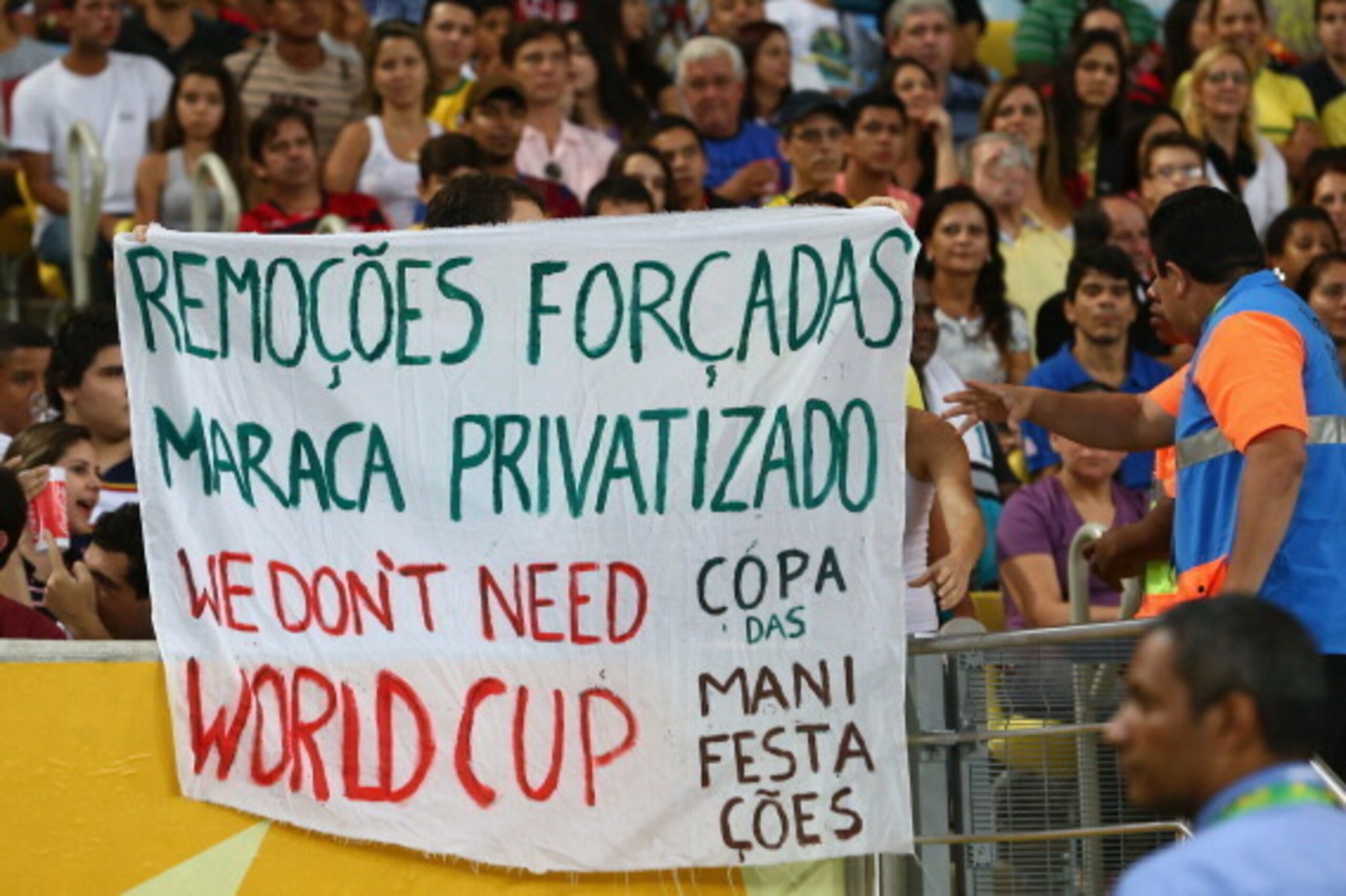
The BBC reported that protesters clashed with police during the final, as demonstrations sparked by transport fare rises snowballed into more and larger grievances about the imminent World Cup and the costs associated with the tournament.
Massive public investment in preparation for the World Cup has irked the Brazilian public, who has witnessed a slowdown in the Brazilian economy and prefers the public money to be channeled into other priorities like health care and education, according to the Telegraph.
The “FIFA Go Home” and “There Won’t Be a World Cup” banners on show last summer weren’t as damning as the massive drop in public support for the tournament. In November 2008, almost 80 percent of the public were reportedly in favor of the World Cup. In March 2013, it had fallen to just 50 percent.
And the public worries are legitimate.
There have long been debates on the actual merits and sustainable benefits to hosting international sporting events like the Olympics and the World Cup due to the financial burden they put on the host countries, and we only have to look at South Africa to see the repercussions and strain that football’s premier tournament can put on a country.
According to the Guardian, the government spent £687 million in new and refurbished stadiums (10 in total) for the World Cup. Since the tournament ended, several struggled for continuous use—much like Beijing’s Bird’s Nest Stadium after the 2008 Olympics—and required continuing subsidies from hard-pressed local authorities.
A South African government report has said that the month-long tournament cost the country more than £2 billion, while FIFA earned £2.2 billion and came away with a handsome £394 million profit. Several of their stadiums have since been branded white elephants, an accusation that has since been leveled at Brazil’s own construction efforts, according to another Guardian report.
So all this talk of a legacy off the pitch, as FIFA and organizing bodies often claim World Cups can leave, could very well be seen by the public as pure rhetoric and a lofty dream as they end up bearing the economic brunt.
Which will put an even bigger burden on the shoulders of the Selecao stars.
A record sixth World Cup success on home soil would bring joy to their legions of loyal fans, but in the end, might just serve to placate the growing unrest across the nation.
Now imagine if they didn’t win.
Luiz Felipe Scolari still has plenty of work to do yet.
You might also be interested in: Why Stadiums Are Increasingly Crucial to Football Clubs’ Commercial Strategies
.JPEG?w=2560 "Marshawn Reveals Scary Stat 🚗")
.jpg?w=2560 "AEW Dynamite Recap 🔠")

.jpg?w=2560 "Harbaugh Would Get CFB Buzz")
.jpg?w=2560 "WWE X AAA Worlds Collide Highlights & Reaction 💥")