American T.J. Oshie King of Sochi as United States Ices Russia in Olympic Hockey
T.J. Oshie spun his stick down like an Old West gunfighter and glided back toward the bench after burying his fourth shootout goal in six tries for team USA.
The Minnesotan from the small but mighty northern hockey town of Warroad reminded the Russians of what a team of predominately North Star skaters had done to the unbeatable Soviets in 1980 in Lake Placid.
Oshie's final goal, a sniper's shot that split through Russian goalie Sergei Bobrovksi's five-hole before popping out the back of the net, gave the Americans a 3-2 shootout victory over Russia at the Bolshoy Ice Dome on the bright shores of the Black Sea.
.jpg?w=2560 "Rams Seahawks Football")
.jpg?w=2560)
.jpg?w=2560 "Panthers Buccaneers Football")
"I wanted to keep the tender guessing, which I think I did a pretty good job of," said Oshie to NBC correspondent Pierre McGuire after the game. "I told a couple of the boys on the last couple that I'm running out of moves here."
Clearly, he hadn't. Oshie's final score came at the end of a teeth-grinding shootout that took eight rounds, five more than the initial three used to decide such matters, to vanquish Bobrovski. American goalie Jonathan Quick was just able to stave off prolific Russian scorers Pavel Datsyuk and Ilya Kovalchuk to protect Oshie's goal.
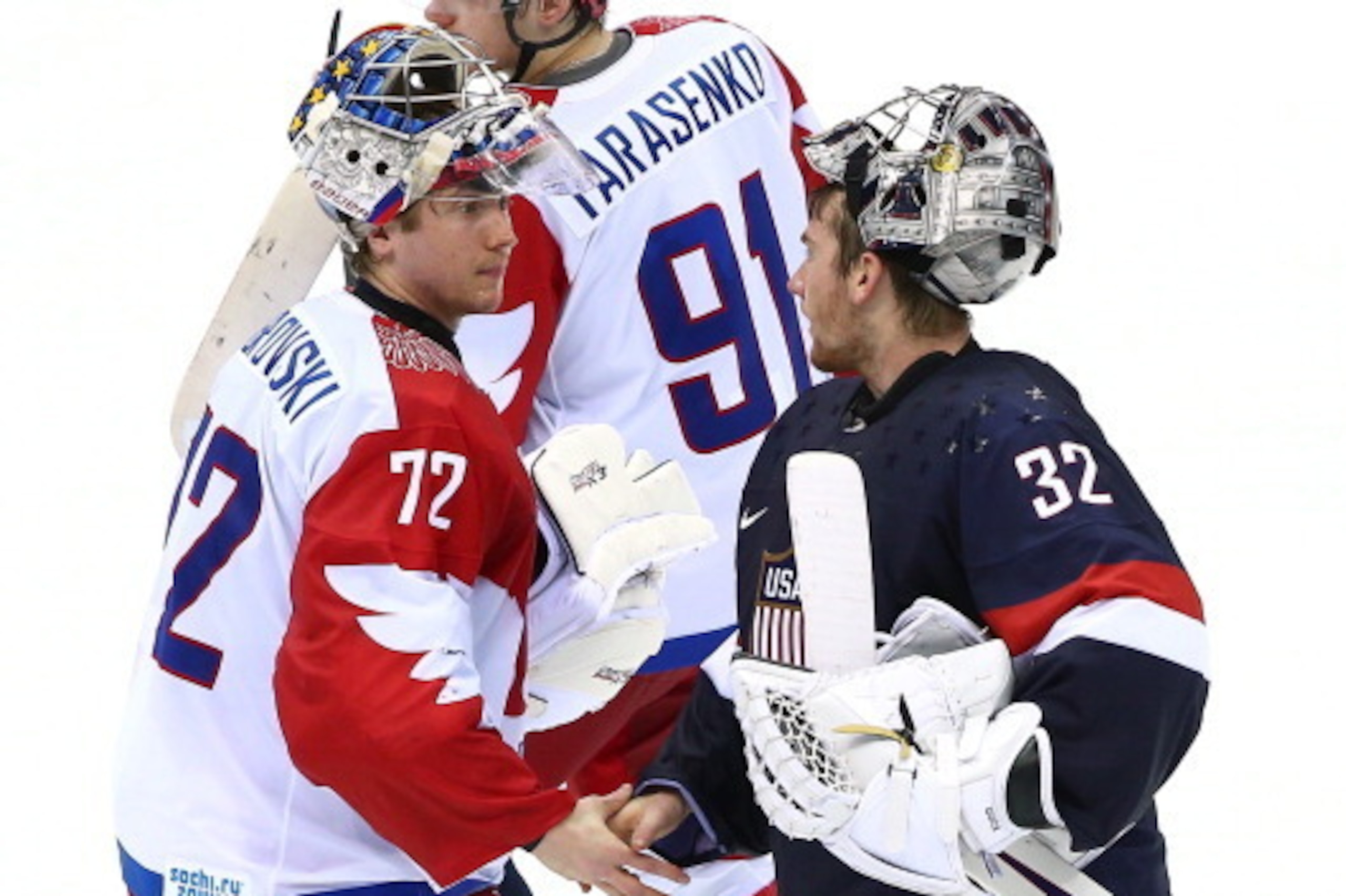
The United States moved to 2-0 with five total points to put themselves atop Group A. The Russians fell to 1-1, but earned a point in the overtime loss and are alone in second place with four points.
The pairing, which faced off at 6:30 a.m. in the central time zone, was a dazzling back-and-forth game predicated on momentum swings caused by 11 overall penalties (six on the U.S. and five on Russia). It was a hard-hitting, fast-moving, high-skill skate that was every bit as emotional as the old USSR-United States pairings of the Cold War era.
"It's a hard hitting game, everybody who touches the puck seems to be getting hit," said NBC analyst and former NHL star Jeremy Roenick after the first period. "You can feel the tension, you can tell they don't like one another."
Americans were especially rough with Russian superstar Alex Ovechkin. He was crunched into the half-boards and bullied in the open ice for most the 60 minutes of game time. Ovechkin, a powerful and superlative all-ice player, had no points but managed to put seven shots on goal.
For most of the three periods it was the artistry and elite goal scoring of Datsyuk, who notched both of Russia's regulation goals, plus two more in the shootout, against the deft passing of Americans James van Riemsdyk and Patrick Kane, who set teammates up for two beautifully executed scores.
Datsyuk scored the game's first goal at 9:15 of the second period. He skated swiftly up the center of the ice with the speed and blinding, deft stick-handling that made him famous and feared in the NHL. He worked up the left slot into the heart of America's defense, and just inside the circle snapped off a streaking wrist shot that beat Quick stick-side and banked of the right post before circling the back of the net.
The big pro-Russian crowd of 11,678 at the Ice Dome erupted into a thundering roar, bouncing up and down in Federation red and blue as their many air horns sounded into the rafters while scarves and flags waved overhead.
American Cam Fowler muted the crowd about seven minutes later when he tied the game at one apiece on a power-play goal. The Anaheim Ducks defenseman had jumped into the scoring rush and stuffed in a perfectly placed crossing pass from van Riemsdyk that reached his blade at the arc of Russia's blue goal crease.
"We've played a lot together and I know what to expect when he's on the half wall," van Riemsdyk told McGuire between periods. "I saw him backdoor and sent it over to him."
The Americans scored a second time at 9:27 of the third on yet another power play. Joe Pavelski received a roped, fast-moving crossing pass from Kane just after the U.S. won a faceoff in the Russian zone. Pavelski crushed a one-timer passed Bobrovski to put the United States ahead 2-1.
Just over three minutes later, Datsyuk struck again, this time on a Russian power play. The goal, a hard driving, pinpoint shot that blew by a cluster of American players before beating Quick, was the sporting heir of Vasily Zaitsev, the legendary Russian sniper at Stalingrad in WWII.
Despite two more penalties on each side before the period was out—a hooking and kneeing call against the Americans, and a hooking and interference against the Russians—the clock ticked to zero in regulation with the game at 2-2.
For a minute in the third period it looked like the Russians had gotten the lead on a blast by defenseman Fyodor Tyutin from just inside the blue line. The heavy slap shot went high and hard over Quick's shoulder and slammed off the back pipe inside the goal before ricocheting back onto the ice with 4:40 left to play.
It was one of those goals that, if it stands, is the equivalent of having your best player viciously dunked on in a basketball game. It could have changed everything. But after conferring on what looked like a possible high-stick tip in by a Russian, the referees called off the goal because the Americans' net had come off its moorings and was slightly askew of the goal line.
The net had been dislodged when Quick, scrambling back to the crease after a barrage of Russian shots had sent him desperately side-to-side and out of control, slammed into the post and bounced off the heavy goal. It was clearly accidental, and ironically it was the extreme assault being made by the Russians that had caused it to happen. The goal shot came a moment later.
It was a somewhat unusual game in that the Russians seemed to be controlling longer stretches than the Americans and forcing an exceptionally fast up-and-down game, which favors their high-performance goal scorers like Ovechkin and Evgeni Malkin.
But the Americans made the most of their power-play chances. After Alexander Radulov inexplicably took a run at Dustin Brown near center ice—a full 90 feet from the puck—Fowler scored his tying goal.
The second goal came again on a power play gifted to the United States by Radulov, who was sent to the box for two minutes on a hooking charge at 8:27 of the third period.
Datsyuk's second goal came on a power play as well. He scored :18 seconds after Brown had been banished to the penalty box for kneeing.
Both teams generated solid scoring chances. For the Americans, Kane's "ladling sauce"—a metaphor for a well-dished pass—to Pavelski appeared to be a winning combination. It resulted in one goal and nearly a second when Pavelski missed the net on another shot.
Kane had also a wide-open breakaway in overtime that looked like it was going to serve the Russian team the cruel sudden-death fate of the extra period, but Bobrovski denied his play at the maw of the net.
The Russians launched 31 shots on goal, many of them of high quality, but Quick managed to block 29. While the Russians did not have any glaring missed opportunities—beyond the goal that was taken away—their steady assault on the net gave the impression of perilous danger all game through.
Bobrovski finished with 31 saves on 34 shots for Russia.
When the shootout ended, everybody let out their breath. The entire contest had been played with a steady nerve and high skill. It is everything Olympic hockey has led the fan to expect since professionals began playing regularly in 1998.
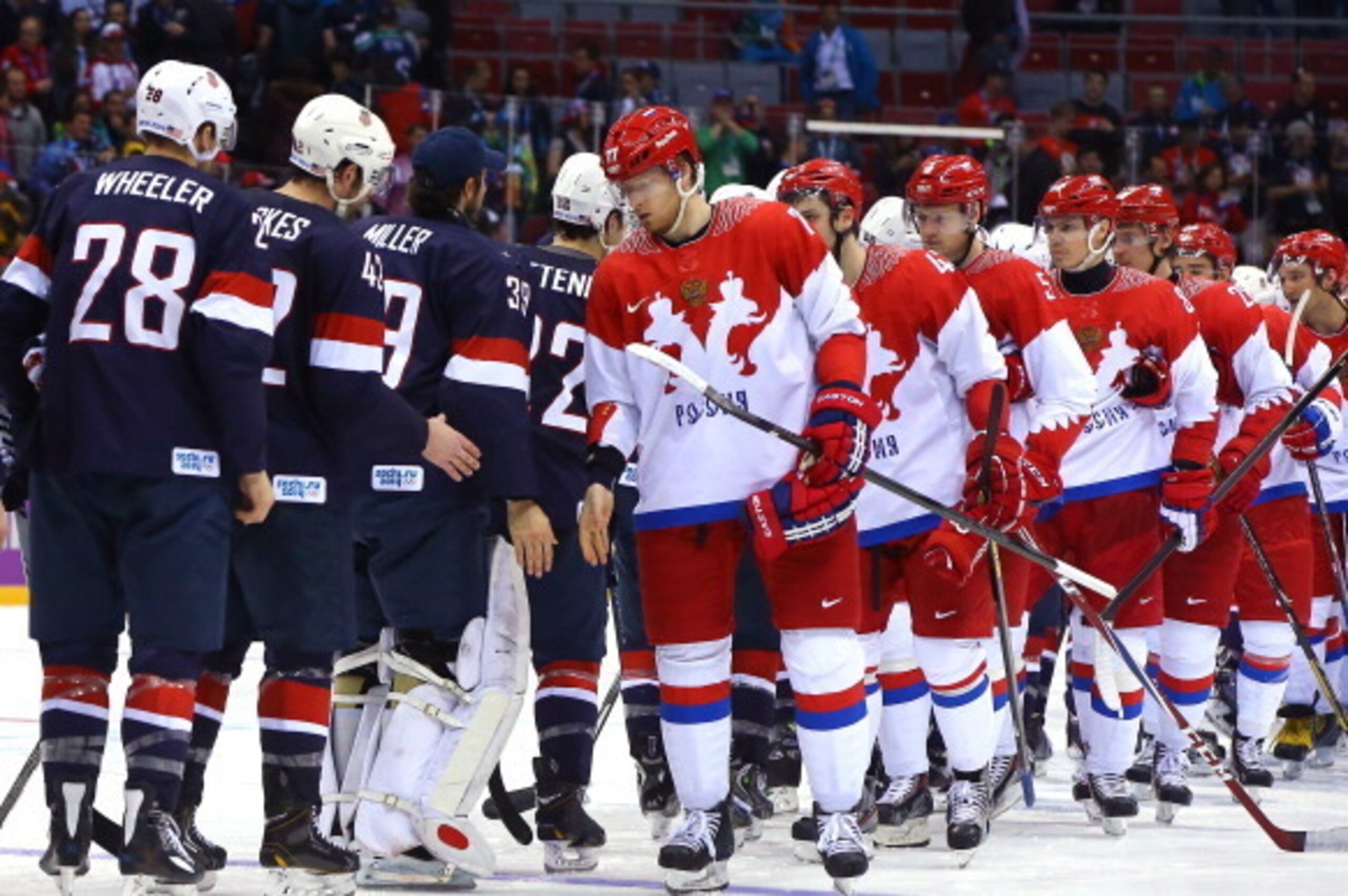
And in the Olympic spirit, no matter what the politics and relationship between nations is in the real world, afterward the teams lined up to shake hands and bid each other good game. With luck, these teams will meet again in Sochi, but just now we do not know where and we don't know when.
.png?w=2560 "Madden 99 Club Revealed")