Detroit Red Wings: Most Important Moments in Team History
As one of the Original Six franchises in the NHL, the Detroit Red Wings have a long and rich history. They rank second in Stanley Cup final appearances (24) and third in wins (11).
With a team that has been around for so long, there are many big moments in its history. In chronological order, here are the biggest moments in the team's history.
1927: A Home in Detroit
1 of 10The franchise moved to Detroit the year before, but had no home arena to play in. Instead, it played its season in Windsor.
In 1927, it played its first true season as Detroiters when Olympia Stadium opened. After a bad 12-28-4 season in 1926, it was able to hit the .500 mark in Detroit. At this time, it is still called the Cougars.
Once in Detroit, the franchise would steadily improve until it would become a dominant force in the league.
The Hiring of Trader Jack
2 of 10While all is not good in the history of Jack Adams, there is no doubt he left his mark on this franchise. He spent 36 years with the organization as a coach and general manager.
Under his leadership, the team would win seven Stanley Cups and become a force in the league. Through the farm system, he developed players such as Gordie Howe, Terry Sawchuk, Alex Delvecchio, Sid Abel, Ted Lindsay and Red Kelly.
He is the only coach to have been suspended from a Stanley Cup game after he punched a referee. He is also known for trading Ted Lindsay away due to his efforts to form a player’s union. As part of his attempt to break the union, he also spread lies about Lindsay which eventually led to Adams being fired.
1932: A New Name
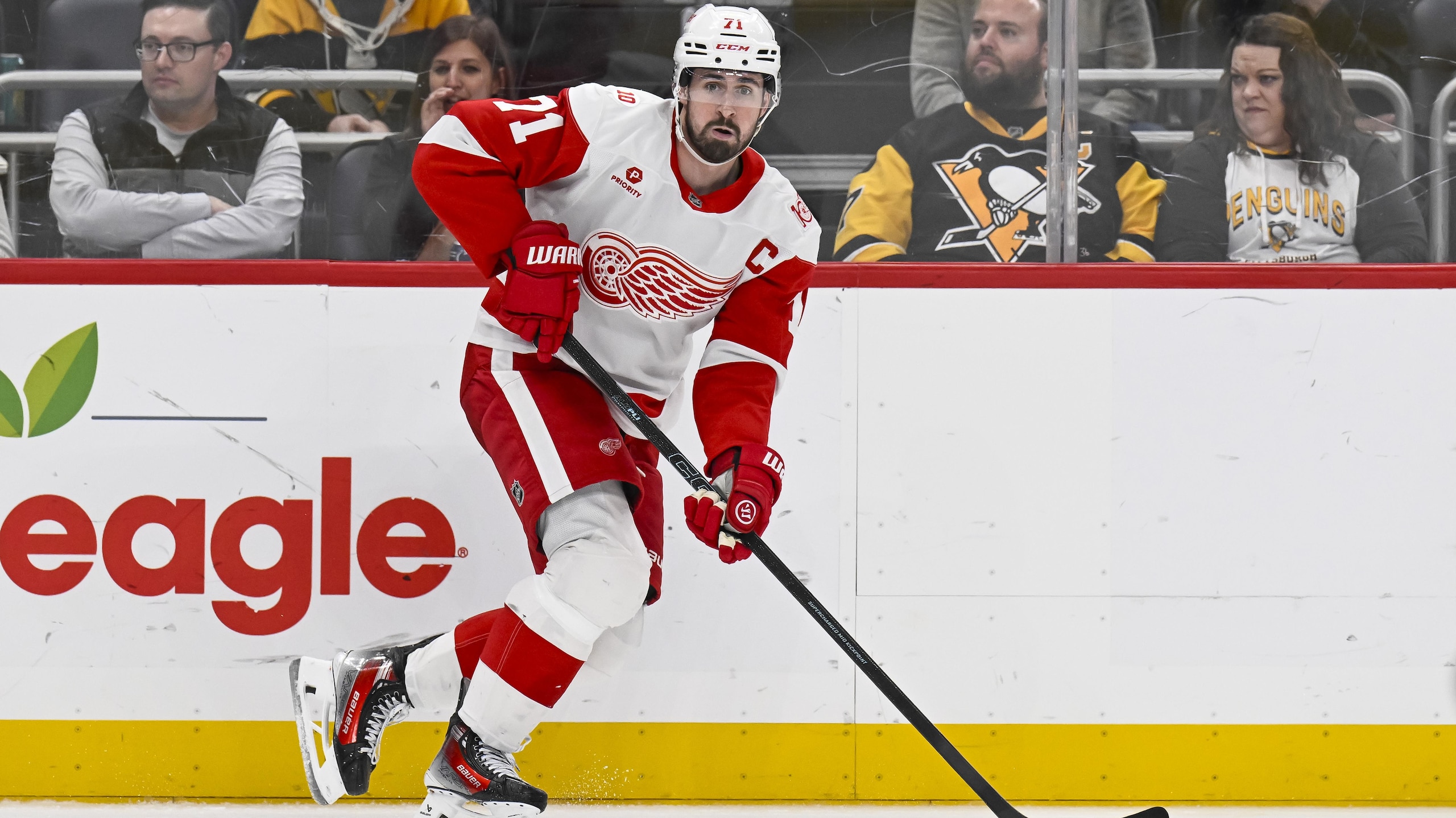
3 of 10The Detroit franchise had been known as the Cougars and Falcons, but in 1932, it was purchased by James Norris, and he made the final name change. He decided to name them the Red Wings after a team he played on when he was younger.
With the name change also came one of the most iconic logos in sports. The Red Wings' winged wheel has stood the test of time.
The new look and name bode well for the team, as it tied for first in its division and would go on to win its first playoff series.
.png?w=2560)
1936: The First Cup
4 of 10You cannot win 11 Stanley Cups without winning your first. After 10 years in the league, the Red Wings finally win their first Cup in 1936.
Some bold moves before the season helped pushed the team over the top. It traded All-Star player Cooney Weiland for Boston’s Marty Barry. Barry would finish second in league scoring. He was teamed with Larry Aurie and Herbie Lewis to form one of the most dangerous lines in the league.
After making its first finals appearance two year before, the team wanted to seal the deal this time. It swept the Montreal Maroons and Toronto Maple Leafs in order to raise the Cup.
The Production Line
5 of 10The Original Production line consisted of Gordie Howe, Ted Lindsay and Sid Abel. While the signing of any of these players could be seen as a moment itself, the joining of these three hockey greats onto the same line is what made history.
Collectively, they became known as the Production Line, the most dominating line in NHL history. Most know they that were able to take the top three spots in league scoring in 1949-50. The two years following that, they would all finish within the top eight.
The aging Sid Abel was traded away to make room for Alex Delvecchio, who would join the line which would be called Production Line II. They would go on to each finish in the top five in league scoring their first year together.
These four players are not only among the greatest in Red Wing History, but also in hockey history.
Illich Buying Team: 1982
6 of 10The once-proud franchise that had won seven Stanley Cups had fallen apart. The Red Wings were known as the Dead Wings and had missed the playoffs 14 times in 16 seasons.
Mike Ilitch bought the team, and while it did not bring overnight success, the team did start improving. Two years later, it made the playoffs, and soon after, was winning divisions and making the conference finals.
One of the best moves Ilitch made early on was to hire Jimmy Devellano to be the team’s general manager.
The first Stanley Cup would not come until 1997, but the ground work laid under Ilitch’s ownership helped it to win four Stanley Cups while becoming one of the most successful franchises in the NHL.
New York Islanders Draft Pat LaFontaine
7 of 10Now, this may seem like an odd title to list another team’s draft as a big moment for the Red Wings. However, if not for the Islanders, Steve Yzerman would not have been a Red Wing.
In 1983, the Islanders traded up in order to grab the third pick in the draft. With that pick, they selected Pat LaFontaine. This was the first draft for new owner Mike Ilitch. The team had decided that LaFontaine, who was from the Detroit area, would not only be a good fit, but also would help spark interest in the team.
While LaFontaine went on to have a great career for the Islanders, Sabres and Rangers, he is no Yzerman. The Red Wings selected Stevie Y with the fourth pick and have never looked back since.
Yzerman would go on to become one of the greatest players and leaders in NHL history. It is rare to find a player of his talent and ability that would be so willing to change their game in order to help the team.
Many don’t realize he is one of only three players to score 155 or more points in a season. He had five 50-plus goal seasons with two over 60, yet he completely changed his game under Coach Scotty Bowman.
The new defensive-minded Yzerman would never top 40 goals again, but he would win a Selke Trophy for best defensive forward, as well as three Stanley Cup Championships.
Helping Fedorov Defect
8 of 10Sergei Fedorov may be one of the most purely talented players to ever hit the ice. His speed, skating ability, puck handling and shot made for a lethal combination. He would win the Hart Trophy and Selke Trophy in the same season. He would win three Stanley Cups while playing for Detroit.
All of that would have never happened if not for his defection. He played for the CSKA Moscow team under Communist Russian rule. Teammate and high-profile player Alexander Mogilny defected in 1989 and found success in the NHL.
A year later, while his team was playing the Goodwill Games in Seattle, Washington, Fedorov would make his move. The Red Wings helped fly him out of Seattle and to Detroit, where he quickly signed a contract.
Scotty Bowman
9 of 10The hiring of Scotty Bowman changed the history of the franchise. After the dreadful 70s, the team started to show some life in the late 1980’s and early 90’s, but it could never quite do enough.
Enter Scotty Bowman and a new attitude.
Bowman had the pedigree with six championships as a manager. When he became the coach in 1993, he brought a new defensive focus to the team. As discussed in an earlier slide, he had Steve Yzerman change his style of play in order to help the team.
In his second year in Detroit, he ended a 29-year drought when the team made the Stanley Cup finals. Although it would lose to the New Jersey Devils, it proved that his way was right.
The team would make the playoffs under Bowman all nine years, and it would win three Stanley Cups. The Cup win in 1997 ended a 42-year championship drought for the Red Wings.
He would also win in 1998 and during his final season in 2002.
The End of the Drought
10 of 10The team had once been one of the best in the league, as it won seven Stanley Cups between 1936 and 1955. It would make it to the finals 14 times from 1934 to 1956.
After reaching the finals four times during the 60s, only to lose each time, the bottom fell out.
The teams would spend the 1970s and early 80s as the Dead Wings, missing the playoffs 14 times over a 16-year period.
In the mid 80’s, it started to show signs of life again and started to regularly make the playoffs. As the team improved, fans returned to the team. In 1995, it would finally reach the finals again, but were swept by the New Jersey Devils.
Years of disappointment and heartbreak ended in 1997, when the team was finally able to bring the Stanley Cup back to Detroit. It has added three more championships since then and has been able to remain as one of the best teams in the league year after year.
PJ Sapienza is a featured columnist covering the Detroit Red Wings as well as many other sports.
You can follow him on Twitter.


.jpg?w=2560 "Bears Shopping Starting DT")

.jpg?w=2560 "Shedeur Out Preseason Finale")
.jpg?w=2560 "Players with Shocking Career Earnings 😳")

.jpg?w=2560 "BTJ Suffers Shoulder Injury")