
B/R CFB 250: Top 29 Offensive Linemen
Bleacher Report's CFB 250 is an annual ranking of the best players in college football, regardless of NFL potential. Through interviews with B/R Experts Matt Miller, Michael Felder, Barrett Sallee and Adam Kramer, authors Brian Leigh and Brian Pedersen have studied, ranked and graded the top athletes in the country, narrowed that list to 250 and sorted by position. Today, we present the Top Offensive Linemen.
Other CFB 250 Positions
It's a rebuilding year for college offensive linemen.
Only four of 25 blockers return from last year's CFB 250, and all four are offensive tackles. The top 13 interior linemen all left school this offseason.
However, there are reasons for optimism.
Of the four offensive linemen who return from last year's list, three could have declared for the draft but didn't. And it wasn't for a lack of opportunity: All three were mentioned as top-50 prospects. They just chose to return to college.
Additionally, three of four left tackles return from the College Football Playoff, including two rising sophomores. And the one playoff team that loses a left tackle (Oregon) returns the player projected to start there last season before tearing his ACL in spring camp.
It's not like the well has run dry.
But before we dig into that, a disclaimer. The linemen who follow were graded as college prospects, not as NFL prospects.
Targeted skills such as run blocking are important at both levels, but there is a difference between college run blocking and professional run blocking. If a lineman can open holes in the SEC or the Big 12, it doesn't matter if he can open holes in the NFC North. At least not here, it doesn't.
This is all about college performance.
Note: If two players finished with the same grade, a subjective call was made based on whom we would rather have on our team right now. Also, all recruiting info refers to the 247Sports composite rankings.
29-22. Halter, Skipper, Theus, Kozan, Ifedi, Martin, Johnson, Seumalo
1 of 15
29. OT Mason Halter, Florida
Power: 15/20; Lateral Quickness: 17/20; Pass Protection: 24/30; Run Blocking: 23/30.
Mason Halter started for three years at Fordham—twice winning some sort of FCS All-American honor—before transferring this summer to Florida. He is slightly undersized (6'6", 295 lbs) but quick and has a ton of experience. Call this an optimistic projection, considering how well FCS offensive linemen sometimes fare in the NFL. If Halter was a two-time All-American, he deserves to be taken seriously.
28. OT Dan Skipper, Arkansas
Power: 17/20; Lateral Quickness: 15/20; Pass Protection: 22/30; Run Blocking: 26/30.
Dan Skipper brings uncommon size (6'10", 331 lbs) to an uncommonly large Arkansas line. He started last year at left tackle but will move to the right side this season, which is probably for the best given his limitations in pass protection. Still, despite his occasional stiffness, he is strong at the point of attack and can toss around defenders in the running game.
27. OT John Theus, Georgia
Power: 16/20; Lateral Quickness: 16/20; Pass Protection: 23/30; Run Blocking: 26/30.
After slumping through his first few years in Athens, John Theus improved as a junior and positioned himself for a big senior year. The former 5-star recruit fared better at left tackle than right tackle, although he'll need to add some weight (6'6", 303 lbs) to combat the SEC's more physical pass-rushers. Still, he gets the job done as a run-blocker for an offense that doesn't mind ignoring the pass.
26. OG Alex Kozan, Auburn
Power: 17/20; Lateral Quickness: 16/20; Pass Protection: 23/30; Run Blocking: 25/30.
Alex Kozan was a Freshman All-American two years ago but missed 2014 with a back injury. Auburn's offense got by without him, but there were times it sorely missed one of the best young guards in college football. He has adequate size (6'4", 300 lbs) and moves well in space, which is essential in Gus Malzahn's offense.
25. OT Germain Ifedi, Texas A&M
Power: 16/20; Lateral Quickness: 17/20; Pass Protection: 23/30; Run Blocking: 25/30.
Germain Ifedi enters 2015 with less hype than his predecessors—and that might be a good thing. The spotlight shone too bright on Cedric Ogbuehi last season, which led to frequent struggles and a move away from left tackle. Now Ifedi inherits the position, and he definitely has the frame (6'5", 335 lbs) and athletic tools to handle it. The former right guard and right tackle needs to shore up his pass-blocking, but his upside is considerable.
24. C Nick Martin, Notre Dame
Power: 16/20; Lateral Quickness: 17/20; Pass Protection: 24/30; Run Blocking: 24/30.
Nick Martin emerged from his brother's shadow last season, earning captain honors and starting all 13 games. He's not as physically gifted as Zack was, but he's a tough, cerebral player who keeps the Notre Dame offense on track. At 6'4 ½" and 301 pounds, he has just enough strength to open creases up the middle, and he showed well against a physical LSU defense in the Music City Bowl.
23. OT Roderick Johnson, Florida State
Power: 17/20; Lateral Quickness: 17/20; Pass Protection: 24/30; Run Blocking: 24/30.
Roderick Johnson saved Florida State's offense last season, replacing Cameron Erving at left tackle so that Erving could replace the hole at center. Although he was just a true freshman, Johnson proved he belonged from the minute he stepped on the field and gave the 'Noles a big young body (6'7", 323 lbs) to build around. Whoever starts at quarterback will not have to worry about his blind side.
22. C Isaac Seumalo, Oregon State
Power: 18/20; Lateral Quickness: 16/20; Pass Protection: 24/30; Run Blocking: 24/30.
Isaac Seumalo missed last season with a foot injury but returns to a nice situation. He is moving from guard to center, where his instincts can make a bigger impact, and will learn under a new run-friendly coaching staff. The physical tools have always been there, and he has great length (6'5", 298 lbs) and strength for his new position. If he shores up a few minor mechanical issues, he's an All-Pac-12 type of talent.
21-14. Brendel, Murphy, Marz, Kelly, Turner, Pyke, Spriggs, Tretola
2 of 15
21. C Jake Brendel, UCLA
Power: 15/20; Lateral Quickness: 17/20; Pass Protection: 25/30; Run Blocking: 25/30.
When Jake Brendel plays, UCLA's offensive line runs smoothly. When he doesn't, it becomes a sieve. He has decent size for a center (6'4", 305 lbs), and plays smart, disciplined, technically sound football. There's a reason this offense falls apart without him.
20. OT Kyle Murphy, Stanford
Power: 17/20; Lateral Quickness: 17/20; Pass Protection: 24/30; Run Blocking: 24/30.
Kyle Murphy started last year at right tackle while his classmate, Andrus Peat, manned the left. This year he gets to replace Peat on the blind side, where his long frame (6'7", 301 lbs) should serve him well. He's a flexible blocker with surprising power considering his lack of girth. If he plays as well as Stanford fans expect him to, we've ranked him too low on this list.
19. OT Tyler Marz, Wisconsin
Power: 18/20; Lateral Quickness: 15/20; Pass Protection: 24/30; Run Blocking: 26/30.
No term better describes Tyler Marz than "Wisconsin offensive lineman." He's a limited athlete with impressive size (6'7", 325 lbs), imposing strength and a blue-collar disposition. He's started the past two years at left tackle, and while that hasn't always required a lot of pass protection, the Badgers have rushed for roughly 10 trillion yards. Marz has been a big reason why.
18. C Ryan Kelly, Alabama
Power: 16/20; Lateral Quickness: 16/20; Pass Protection: 26/30; Run Blocking: 25/30.
When Ryan Kelly plays, the Crimson Tide offense hums. When he sits, the Crimson Tide offense sputters. Is he as good as the man he replaced, future College Football Hall of Famer Barrett Jones? Of course not. But given all the change Alabama has undergone at quarterback, where it's breaking in its third starter in as many years, one could argue he's been just as important.
17. OG Landon Turner, North Carolina
Power: 18/20; Lateral Quickness: 16/20; Pass Protection: 23/30; Run Blocking: 27/30.
Landon Turner has started 28 games the past three seasons, including all 13 as a sophomore in 2013. That year he shared the field with Jonathan Cooper, whom the Arizona Cardinals drafted No. 7 overall—higher than any guard since 1986. In other words: North Carolina knows how to develop linemen, and Turner is the latest in what has subtly been a very consistent trend. He is big (6'4", 325 lbs), physical and sure to entice a long look from NFL scouts.
16. OG Greg Pyke, Georgia
Power: 18/20; Lateral Quickness: 15/20; Pass Protection: 23/30; Run Blocking: 28/30.
Greg Pyke is a run-blocking specialist with NFL size (6'6", 313 lbs) and power. He is perfect for an offense with quarterback issues but no shortage of running backs. He is not as skilled in pass protection, which is where scouts will focus as Brian Schottenheimer installs his pro-style offense, but if he shores up those issues there's a chance he goes All-American.
15. OT Jason Spriggs, Indiana
Power: 16/20; Lateral Quickness: 17/20; Pass Protection: 24/30; Run Blocking: 27/30.
Running back Tevin Coleman was awesome, but it's not like he didn't have help. Indiana's offensive line is one of the best-kept secrets in college football, and Jason Spriggs is at the heart of that phenomenon. He is lean for a left tackle (6'7", 305 lbs) but combats that with a strong anchor and hand placement. He's a four-year starter with great quickness, technique and instincts, and the production at Indiana speaks for itself.
14. Sebastian Tretola, Arkansas
Power: 18/20; Lateral Quickness: 15/20; Pass Protection: 23/30; Run Blocking: 28/30.
Sebastian Tretola has great size for a guard (6'5", 334 lbs) and even better size for a quarterback. After starting his career at Nevada, he worked his way to Fayetteville and landed in the perfect situation. Head coach Bret Bielema loves big, chunky, earth-moving linemen who take no prisoners in run blocking. Tretola fits that description like a glove.
13. OT Tyler Johnstone, Oregon
3 of 15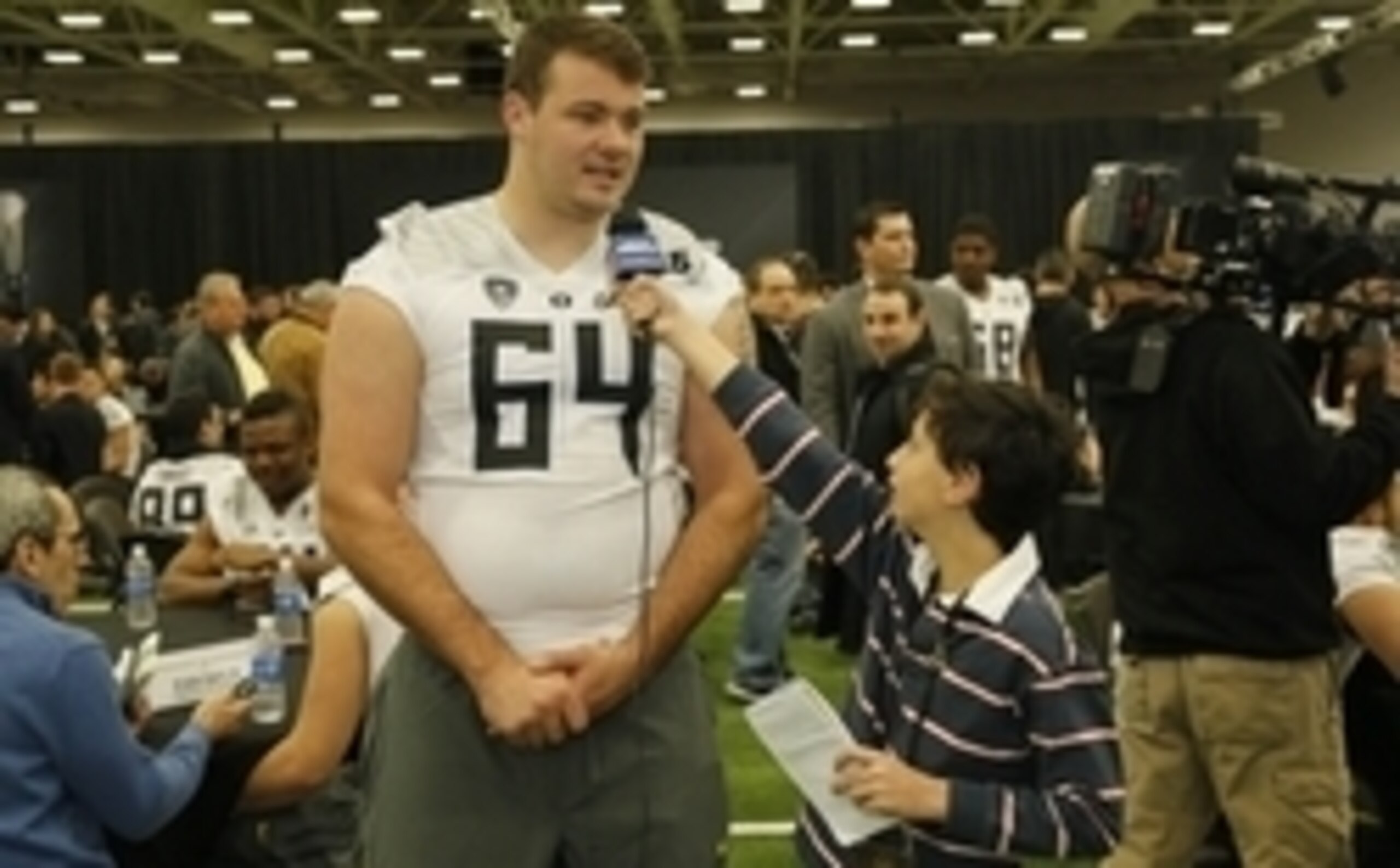
B/R Expert Scouting
"I want to see him healthy this year because we could legitimately be looking at back-to-back big-name tackles coming out of this Oregon Ducks program that everyone keeps calling soft."
—Michael Felder
Power
Johnstone is not a "power tackle." His lean build (6'6", 295 lbs) and wiry frame leave him vulnerable against expert bull-rushers. He mitigates those issues with strong hands and proper leverage, but this is still by far the weakest part of his game.
Lateral Quickness
Fortunately, Oregon doesn't ask Johnstone to be a "power tackle." They are happy with him being an "Oregon tackle." In other words: He has uncommon speed and quickness, and it shows whenever the Ducks leak him out into space. It also shows when he's protecting against speed-rushers, who have a hard time beating him outside.
Pass Protection
Based on the previous two sections, you can probably guess how Johnstone fares in pass protection. Bigger, stronger, more physical defensive ends can push him off his spot and collapse the pocket, but smaller, faster, quicker defensive ends and linebackers find no daylight. He earns this high of a grade because he's better than he should be against power-rushers, thanks in large part to his long arms and technique. His biggest weakness isn't that much of a weakness.
Run Blocking
Johnstone gets under defenders' pads and drives them off the line of scrimmage. It's a surprising power element to his run blocking, but it exists because of his speed off the ball. He fires from his stance with rare acceleration and is so good when he gets into space. If he fared better in the short area on obvious rushing downs—when Oregon doesn't have the benefit of spreading out the defense—he would grade even higher than he does.
Overall
Johnstone missed last season with a torn ACL after starting two straight years at left tackle. His injury depleted Oregon's line depth, which showed when Jake Fisher suffered a subsequent injury and the offense sputtered in a loss to Arizona. The secret of Oregon's offense is that everything starts up front—not with the quarterback or skill players. Not having Johnstone was a big loss last season, but his return should be an equally big gain.

.jpg?w=2560)
12. OG Pat Elflein, Ohio State
4 of 15
B/R Expert Scouting
"I have him as the second-best guard in college football. A little bit short, but he moves well, has good hand use, and he finishes plays."
—Matt Miller
Power
Even though he's short (6'3", 300 lbs), Elflein displays good power for a guard. He's a fighter who understands leverage and uses hand placement to drive defenders backward. He might be overpowered by the biggest defensive tackles in America—but anything short of that, he can handle.
Lateral Quickness
Elflein moves well in space, which is essential in Urban Meyer's offense. He can pull or leak on screen plays and has the balance to finish blocks on linebackers and safeties. He doesn't move his feet as well in pass protection, where he's susceptible to agile interior rushers, but quickness is still a strength.
Pass Protection
As mentioned in the previous section, Elflein's quickness shows in run blocking more than pass protection. He's not a bad pass-blocker by any means, but he can be exploited when a tackle explodes off the line. Still he gets the job done more often than he doesn't, and he demonstrates great awareness against stunts, twists and blitz packages.
Run Blocking
Elflein improved throughout last season—his first as a starter—and eventually became a dominant run-blocker. He was the best player on the field in the College Football Playoff National Championship, where he paved holes for running back Ezekiel Elliott (the game's awarded MVP) and made Oregon's defensive front seven look soft. His no-nonsense mentality, combined with his versatility, allow him to truck opponents in a variety of ways.
Overall
Elflein made great strides as a sophomore and ended the year on a hot streak. Big boys get none of the credit, but he was every bit as vital to the rout of Wisconsin and the wins over Alabama and Oregon as Elliott, Devin Smith and Cardale Jones. Ohio State won the title from the inside out; by controlling the line of scrimmage. Elflein was a huge reason why.
11. OT Vadal Alexander, LSU
5 of 15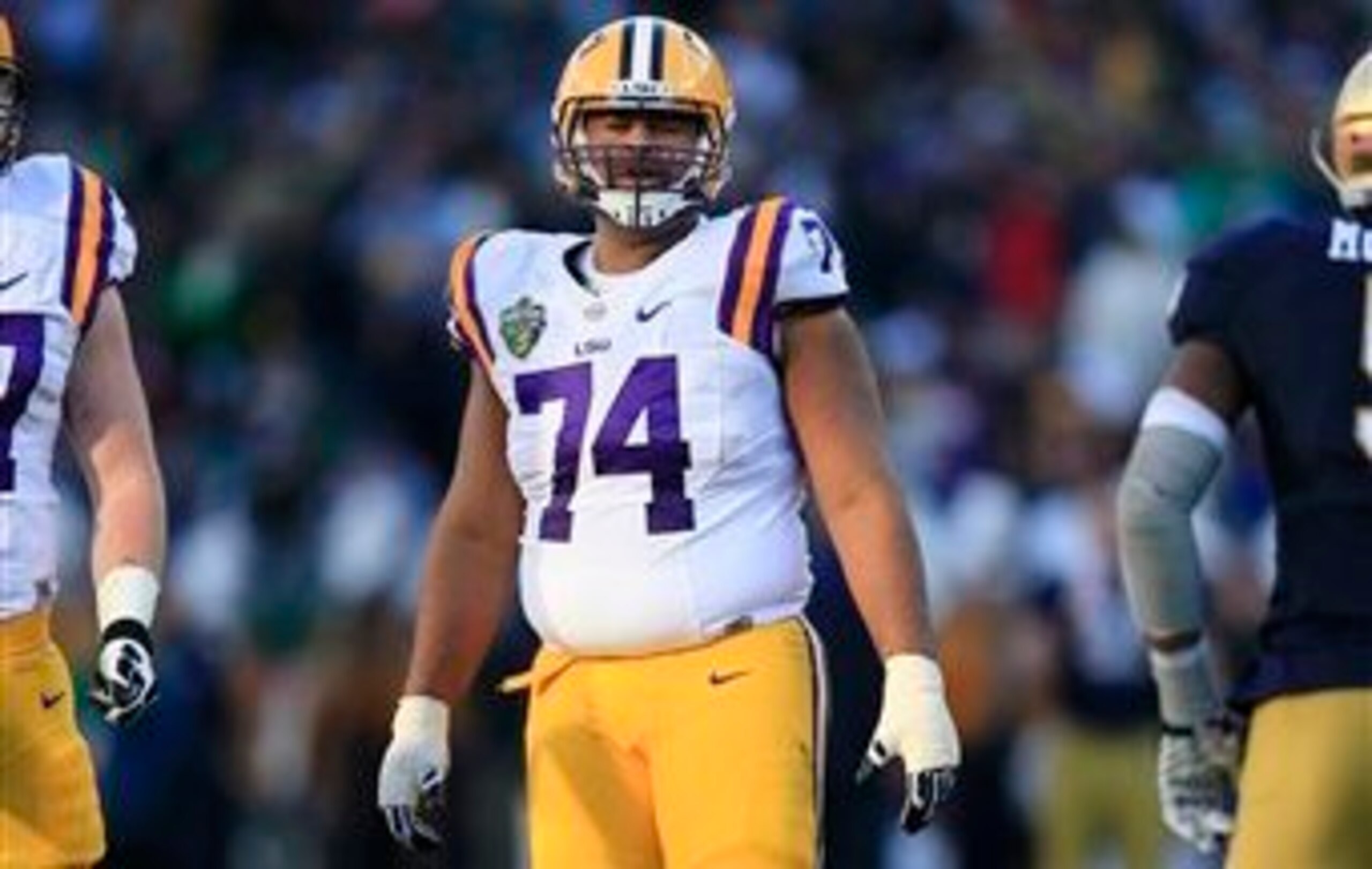
B/R Expert Scouting
"I think he's a much better run-blocker than a pass-blocker, but he does both pretty well. And he is so good for [running back] Leonard Fournette."
—Barrett Sallee
Power
Alexander displays impressive natural power. He uses every fiber of his 6'6", 329-pound frame to move the pile or drive defenders off their marks. He previously served LSU at left guard, lining up next to La'El Collins to form the most powerful blocking wall in America. As a freshman he played right tackle, where he'll serve again this season and provide Fournette with a bulldozer to the right.
Lateral Quickness
Like most guards who move outside to tackle, Alexander faces questions about his quickness. He dropped 15-20 pounds this offseason, per Ben Love of Scout.com, but it remains to be seen if that will significantly improve his foot speed. Either way, it's not like Alexander is a stiff or anything; his positional versatility attests to that. He's just not the quickest lineman you'll encounter.
Pass Protection
Alexander doesn't "struggle" as a pass-blocker as much as he "doesn't excel." Speedy pass-rushers such as Auburn's Carl Lawson, whom Alexander will face in September, might potentially cause problems off the edge. But once Alexander gets his hands on someone—which is often, because he has such long arms—he typically controls them through the play.
Run Blocking
As previously mentioned: Alexander is a bulldozer. His power, technique and willingness to participate at the second level make him a spectacular run-blocker. For a team like LSU that has quarterback issues, sliding such a talent from guard to tackle is a luxury. The Tigers might have to double down on the running game this season, but they have the personnel to make it work.
Overall
Alexander typifies the modern LSU lineman: strong enough to play guard and just quick enough to play tackle. He dominates the short area and helps the Tigers field a dangerous power running game. Even when the defense (plus the announcers, plus the fans, plus the popcorn vendors) knows it's a handoff, the Tigers get a push off the line. That is Alexander in a nutshell.
10. OT Denver Kirkland, Arkansas
6 of 15
B/R Expert Scouting
"Jonathan Williams and Alex Collins are running through the Grand Canyon because of him. He is just an absolute mauler."
—Barrett Sallee
Power
NFL.com ranked Kirkland the No. 2 "biggest" player in college football. He ranks about the same in terms of power. He bullies defensive linemen off the line of scrimmage, making the most of his massive frame (6'5", 340 lbs) in the short area. He's the perfect offensive lineman for Arkansas head coach (nee Wisconsin head coach) Bret Bielema.
Lateral Quickness
Arkansas is betting on Kirkland's quickness by shifting him from right guard to left tackle. The coaching staff seems to think he can handle it, so by the end of the year this rating might be higher, but based on what we've seen he's neither quick nor smooth enough to handle speedy defensive ends. In the past he has won with strength only, and the past is all we have to go on. If there's more to his game (which there might be), let's see it.
Pass Protection
Kirkland hasn't spent much time in pass protection. He's played guard the past two seasons, and last year Arkansas had roughly 200 more run attempts (557) than pass attempts (359). He does have the long arms, strong hands and thick base to succeed in pass protection, especially against power-rushers, but for now let's consider this grade a work in progress.
Run Blocking
Arkansas has one of the best rush offenses in college football; the key to that rush offense is its offensive line; and the key to that offensive line is Kirkland. He's a people-mover who can open up an inside gap or seal the edge for runs on the perimeter.
Overall
Bielema has coached some great offensive linemen. Joe Thomas, Gabe Carimi, Travis Frederick—the list goes on. But the way Bielema speaks about Kirkland makes it seem as if he's right at their level. It's hard to say for sure because he's never played tackle, and the move to Brandon Allen's blind side brings so many questions, but keep an eye on Kirkland as a potential breakout player. NFL scouts are already watching closely.
9. C Max Tuerk, USC
7 of 15
B/R Expert Scouting
"I really like the athleticism he's shown when he gets on the move. He can pull, he can reach the second level and track defenders, and he's awesome when they put him in space on screen passes."
—Michael Felder
Power
Tuerk looks too lean to be a lineman (6'6", 285 lbs) and struggles against legitimate nose tackles. He's stronger than those numbers indicate but not by much. Another year in USC's weight program should help him add muscle—which he'll need before a season in which the Trojans play Sheldon Day (Notre Dame), Lowell Lotulelei (Utah) and Kenny Clark (UCLA).
Lateral Quickness
Tuerk combats his size concerns with rare athletic gifts. He's a nimble, fleet-footed lineman in the mold of what Chip Kelly coached at Oregon. He is smooth executing down blocks and rumbles down the field to spring his running backs at the second level.
Pass Blocking
Prior to playing center, Tuerk made starts at left guard, right tackle and left tackle. The left tackle starts came in 2012, when he was only a true freshman, but he was advanced enough to hold his own in pass protection. No interior lineman in college football displays better mirroring skills than Tuerk. He can be pushed back by nose tackles, but he's not as often as he probably should.
Run Blocking
Although he's obviously limited in the short area, Tuerk is a very good run-blocker. USC plays to his strengths by asking him to pull or get to the second level and bulldoze. It helps to play with guards such as Toa Lobendahn and human giants such as tackle Zach Banner (6'9", 360 lbs), who can handle power linemen on their own. The help he receives is a part of his assessment, but Tuerk still plays well in his role.
Overall
Tuerk is one of the most versatile and athletic offensive linemen in the country. His experience paid off for USC last season, when despite integrating three true freshmen in the trenches, the Trojans' offense ran smoothly. It's difficult to overstate the importance of a veteran center. Tuerk isn't the best player on USC's roster, but he might be the most important.
8. OT Le'Raven Clark, Texas Tech
8 of 15
B/R Expert Scouting
"I think he moves really well for a big guy. Executing down blocks, firing out of his stance, getting good depth. I don't see him protecting on five-step or seven-step drops, so the upside is questionable, but the talent is definitely there."
—Matt Miller
Power
Clark has a big but skinny frame (6'6", 307 lbs) and still feels like he's growing into himself. He plays with adequate power but is sometimes driven back in pass protection. He is strong moving forward in the running game once he gets a head of steam but must improve his base strength and anchor.
Lateral Quickness
Clark moves more like a tight end than a tackle. He has quick feet in pass protection, which allow him to gain depth off the line and mirror speedy edge-rushers. In the running game he seals the edge and makes plays at the second level. It's a treat to watch him get out in space.
Pass Protection
It's hard to evaluate pass blocking in a scheme such as Texas Tech's. The quarterback delivers the ball so quickly that the tackles only protect for so long. From what Clark has shown, he's an above-average pass-blocker with room to grow as he adds muscle and improves his footwork. He fares well against smaller, quicker rushers but gets knocked off his base against power moves.
Run Blocking
Texas Tech doesn't run often, but it is quietly very efficient. The ballast of a tackle like Clark has been a big reason why. His speed, length and finishing make him a perfect fit for the scheme in which he plays. He excels in space but can also open creases on the inside.
Overall
Clark is a four-year starter who hasn't missed a game since 2012. He began his career at guard, which made sense despite his lack of girth because he's so good in the running game. He's been more valuable to Texas Tech at left tackle, where most teams put their best offensive lineman, and he's a nice fit for the air raid offense. With a little more strength and refinement, he for sure has an NFL future.
7. C Jack Allen, Michigan State
9 of 15
B/R Expert Scouting
"That team very rarely makes mistakes up front and a lot of that has to do with Allen recognizing what's going on and helping the Spartans get set to protect the quarterback. Very curious to watch him this year because between him, [offensive tackle Jack] Conklin and the rest of the offensive line, they're going to have to make one of those running backs a star."
—Michael Felder
Power
Allen doesn't boast great size (6'2", 296 lbs) but plays with adequate power. He stays low enough to win off the line and has registered 207.5 career knockdowns, per his official team bio. Bigger defensive linemen can knock him off his spot and get him off-balance when they attack him one-on-one. For the most part, though, Allen is solid.
Lateral Quickness
Michigan State doesn't ask Allen to play much in space. He is a perfect fit for the offense in which he plays, where he has just enough agility to stay in front of interior defenders and form a stable pocket for quarterback Connor Cook. When he does leak into space, he demonstrates above-average (but unremarkable) flexibility, quickness and balance.
Pass Protection
Allen makes the pre-snap reads and distributes the blocking assignments for one of the best offensive lines in college football. The Spartans ranked No. 4 in the country with just 11 sacks allowed last season, thanks in large part to Allen's instincts and leadership. He fares just as well when the ball is in play, having not allowed a single sack last season.
Run Blocking
Allen was a high school wrestler who plays with a brawler's mindset and a nuanced understanding of leverage. He attacks defenders with excellent hand placement and impedes them from executing run fits. Despite his less-than-ideal size, he consistently succeeds in run blocking.
Overall
Allen has started 35 games for the Spartans and played a big role in their recent ascent. His wrestling background informs his hand usage, but he's just as smart before the snap as he is when the ball is in play. Younger brother Brian Allen starts at guard beside him and was a Freshman All-American last season. Consider this another of those Michigan State First Families.
6. OT Spencer Drango, Baylor
10 of 15
B/R Expert Scouting
"I don't like him as much as a draft prospect. I think that scheme really helps him cover some things up. So he needs to take a step this year—I think he needs to be a better finisher. I wouldn't be surprised if he plays guard in the NFL."
—Matt Miller
Power
Drango has a tall, lean frame (6'6", 310 lbs) but plays with good power. He engages defensive ends and never lets them out of his grasp. For someone who plays a mauling style of football, he is prone to bouts of sluggishness. But when he's on and completely engaged, he will crush you.
Lateral Quickness
Drango is not a special athlete at the tackle position. He lacks some of the quick-twitch stuff required to stay in front of speedy edge-rushers. His lower body (footwork) is quicker than his upper body (handwork), which is good because the former is harder to teach. He slides to stay in front of defenders but sometimes struggles hitting them in space.
Pass Protection
It's hard to scout a tackle in a timing-based offense. That's why the NFL is so wary of Baylor linemen. As a college prospect, though, Drango succeeds protecting the quarterback's blind side. At some point his lack of quickness might hurt him, but that is not for us to project. From what he's shown, he's earned this lofty grade.
Run Blocking
Drango does the dirty work in the running game, dispelling all misconceptions of the "finesse" Baylor lineman. He controls defensive ends to seal the edge on either side, paving big holes for his running backs to dart through, and he's not afraid to hit the second level. He could stand to be a better finisher—he doesn't always connect once he reaches the second level—but that's mostly a minor concern.
Overall
Scouting and grading Drango induced a headache. His profile results in so many conflicting thoughts. Based on physical tools (strength and speed), he's good. Based on game film (success rate), he's great. Based on the history of Baylor linemen (think Jason Smith)…who knows? In the end we deferred to the game film, since we're not scouting Drango as an NFL prospect. We're scouting him as a college prospect. And in college, there's no denying he gets the job done. He's the rock of a very good Baylor line.
5. OT Taylor Decker, Ohio State
11 of 15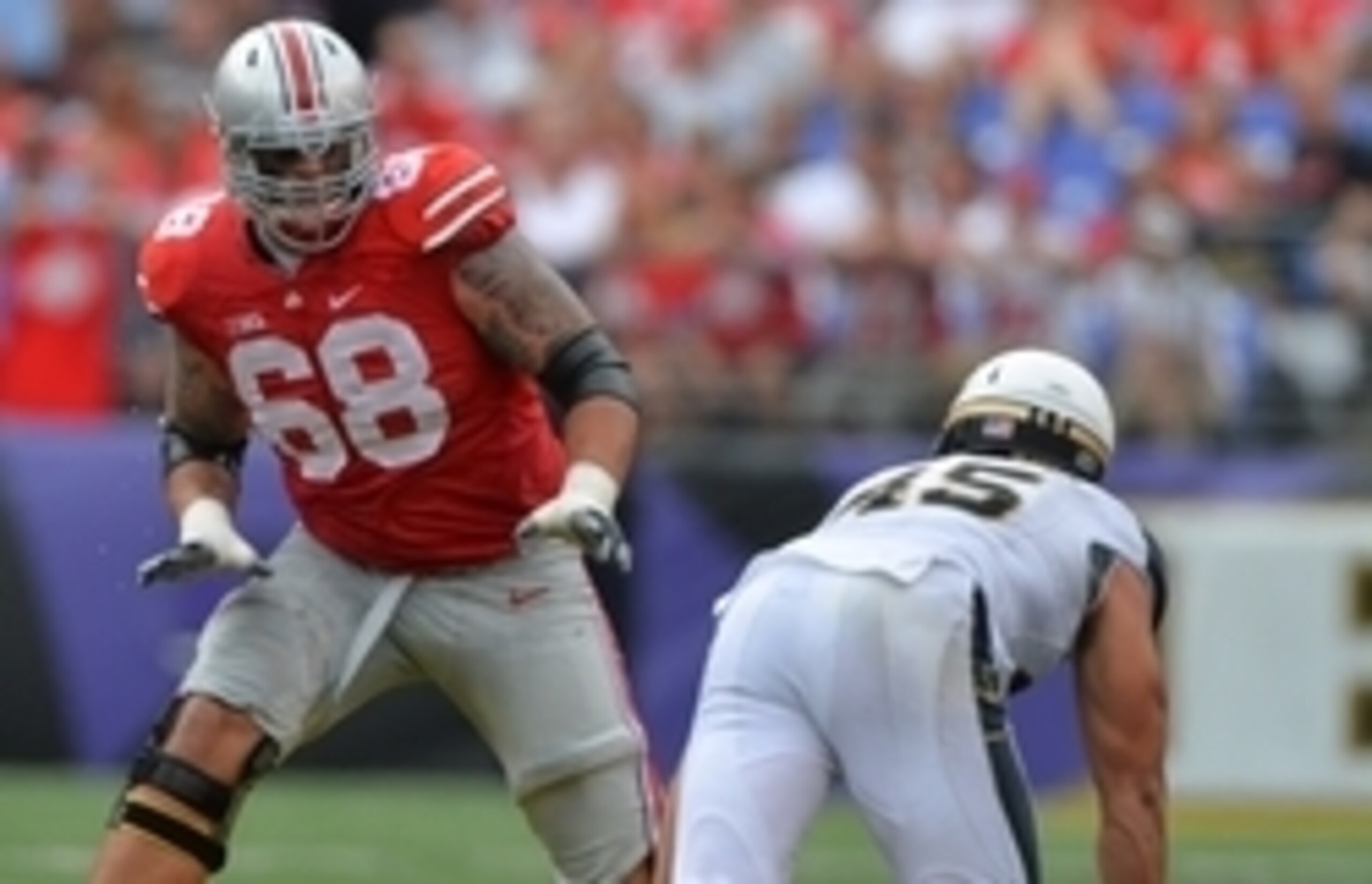
B/R Expert Scouting
"Their offense makes it hard to evaluate tackles, but in the run game he is still pretty special. He's very physical but also agile with good balance."
—Matt Miller
Power
Decker is humongous (6'8", 315 lbs) and plays like it. He dominates opponents off the line and gets moving downhill. Certain taller tackles can be exploited by low-rushing ends, but Decker bends his knees, transfers power through his base and uses leverage to his advantage instead of his detriment.
Lateral Quickness
Decker impressed with his agility and light-footed movement last season. It seemed like even Ohio State's coaches underestimated him, and once they realized his abilities as a downfield run-blocker, that's when the Buckeyes offense opened up. He's still more of a power guy than a speed guy, but he's quick enough to not be exploited in pass protection.
Pass Protection
At the start of last year, Decker struggled. He was new to the left tackle position, having started the previous season at right tackle, and sometimes came up late from his stance. But as the season went on and he became more comfortable, you could see the makings of an excellent pass-blocker. He might need to play right tackle at the next level, but in college he is fine on the left.
Run Blocking
Ohio State boasts the most dangerous ground game in America. And while some of that has to do with scheme, and a lot of it has to do with Ezekiel Elliott, nothing plays a bigger role than blocking. Decker is the leader and best run-blocking tackle on Ohio State's line, which is vital in a scheme such as Urban Meyer's. He is just as good near the line of scrimmage as he is moving downfield, and versatility makes him perfect for this offense.
Overall
Entering last season, Ohio State faced huge offensive line questions. After squeaking by Navy and losing to Virginia Tech, those questions reached DEFCON 1. Decker was the only returning starter, and his leadership helped bring the group together and improve throughout the year. By the end of the season, Ohio State's offensive line was not just not a weakness but a strength. A big strength. It carried the Buckeyes to a national title.
4. OT Cam Robinson, Alabama
12 of 15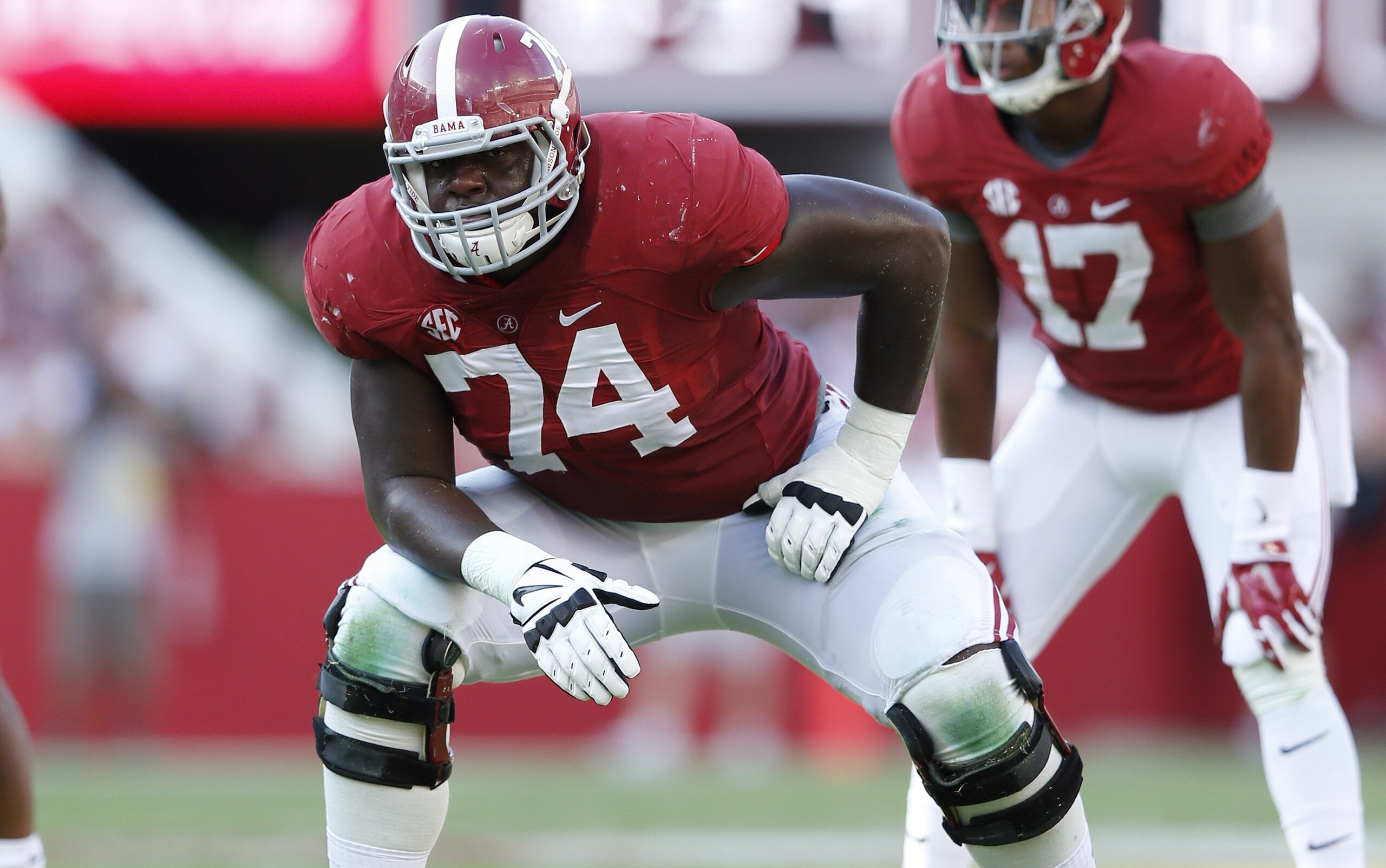
B/R Expert Scouting
"It says a lot that Alabama asked him to be the starting left tackle from Day 1. It didn't really have a lot of options, but still: That's not something Nick Saban typically likes to do."
—Barrett Sallee
Power
Cam Robinson wears a big frame (6'6", 326 lbs) and packs a powerful punch. He's an excellent lead blocker who pancakes defensive ends and drives back defensive tackles. When an 18-year-old true freshman is pushing around SEC upperclassmen, you know that his power is real.
Lateral Quickness
Robinson is not an Oregon-type, works-best-in-space offensive tackle, but he's remarkably quick for his size. He fires off the line of scrimmage, gains depth with his first step in pass protection and reaches the second level on handoffs and screens.
Pass Protection
According to his official team bio, Robinson allowed just three sacks in 861 snaps last season. That is a remarkable number for any SEC tackle; but for a freshman, it's out of this world. His speed moving side to side, which allows him to mirror and stay in front of pass-rushers, was best on display against Texas A&M, when he put Myles Garrett on lockdown. Garrett dominated Robinson at the Under Armour All-America Game nine months earlier, so watching those roles reverse showed how much Robinson has improved.
Run Blocking
At the first level, Robinson dominates. He owns the line of scrimmage with a strong lower body that allows him to drive defenders backward. He is quick enough to make plays at the second level also, although he doesn't always land a clean blow. If he upgrades his balance and vision, he can dominate all over the field. But even if he doesn't, he's already a heck of a run-blocker.
Overall
Robinson became the first Alabama true freshman to start at offensive tackle since Andre Smith in 2006—the year before Saban's arrival. As a sophomore, Smith won the Jacobs Blocking Trophy; as a junior, he was a unanimous All-American, and then he promptly became a top-10 NFL draft pick. Robinson is on a similar trajectory, except he's even more athletic than Smith was. It's scary to think how good he might become.
3. OT Jack Conklin, Michigan State
13 of 15
B/R Expert Scouting
"The competition he goes against is phenomenal. Kind of like [former Iowa lineman] Brandon Scherff. I think Conklin is gonna be so battle-tested from playing Ohio State, Penn State, Oregon—just that schedule. He'll be a first-round pick if he's healthy."
—Matt Miller
Power
Jack Conklin dropped 30 pounds of fat last offseason, but he did so without sacrificing power. Even at 6'6", 303 pounds, he held his own. Now his official team bio lists him at 6'6", 325 pounds, and if the 20 pounds he added are good pounds—muscle instead of fat—there's a chance this score moves higher throughout the season. He already demonstrated impressive raw strength, so a beefed-up frame would put him over the top.
Lateral Quickness
It's easy to forget Conklin's size once you see him move in space. His reach step allows him to attack the line of scrimmage on outside runs, and his quick-twitch mirroring skills allow him to stay in front of all types of pass-rushers. Let's see if he maintains those things with more weight on his frame this season. He fared well at a bigger weight as a freshman in 2013, so there's reason to be confident.
Pass Protection
Conklin is one of the best pass-blockers in America. He didn't allow a sack as a freshman, and last year he allowed just 2.5. Considering the long list of pass-rushers he's gone up against—Joey Bosa, Randy Gregory, Shawn Oakman, Arik Armstead, Trent Murphy, Stephon Tuitt and Frank Clark…just to name a few—that is a remarkable feat. He is so smart and technically sound.
Run Blocking
Conklin was a walk-on (hard as that is to believe) and plays with a walk-on attitude. He grinds and fights and always works his butt off. When you're big, strong and fluid, and you combine that with a walk-on attitude, of course you'll get the job done in run blocking. Conklin puts his body into every block, finishes with authority and moves well enough to reach the second level.
Overall
When Michigan State turned the corner in 2013, it was largely attributed to Connor Cook replacing Andrew Maxwell at quarterback. But while Cook has obviously played a huge role, that's not the entire story. Michigan State's improvement coincided with Conklin—at the time just a redshirt freshman—becoming one of the best left tackles in the country. Not bad for a guy who had zero Division I scholarship offers.
2. OT Ronnie Stanley, Notre Dame
14 of 15
B/R Expert Scouting
"This kid is amazing. I think he would have been the best tackle in last year’s draft. I compared him to [Dallas Cowboys left tackle] Tyron Smith. He’s close to flawless as a left tackle."
—Matt Miller
Power
Ronnie Stanley is not as imposing—physically—as some of the other tackles on this list, but he still checks the box for his size (6'5" ½, 315 lbs) and his power. He'll need to add strength at the next level, but for now he drops low enough to protect against the bull rush and gets a strong push on short-area runs.
Lateral Quickness
Stanley is a former basketball player who played for a nationally ranked team at Bishop Gorman High School in Las Vegas. He has the nimble feet and quickness associated with former basketball players—athletes who had to run up and down a court—and parlays that into offensive line skill. You'll rarely see him beat off the line, no matter how fast his opponent.
Pass Protection
Because of that aforementioned quickness, Stanley keeps his quarterback clean. He stays on the balls of his feet, adjusts to what he sees, bends his knees and delivers aggressive hand punches. Pro Football Focus graded three Notre Dame games last season, and Stanley didn't allow a single QB pressure.
Run Blocking
Stanley improved as a run-blocker as he gained confidence throughout last season. He learned to trust his size and started sealing the edge with authority. With Malik Zaire replacing Everett Golson at quarterback, the Irish figure to run more in 2015. As long as Stanley continues his improvement, they'll have no problem running behind him.
Overall
Notre Dame charged Stanley with a difficult task: replace first-round draft pick Zack Martin. It seemed like he was being set up for failure, but while Martin went on to make the Pro Bowl for the Dallas Cowboys, Stanley made folks in South Bend forget about him (almost). And then he did the unthinkable and returned despite lofty draft projections. We'll see how that works out for his personal stock, but it couldn't have gone better for Notre Dame.
1. OT Laremy Tunsil, Ole Miss
15 of 15
B/R Expert Scouting
"Tunsil is the centerpiece of that team. He's the most important player on that team. He's the most indispensable player on that team. Without him, Ole Miss would not be a serious SEC contender."
—Barrett Sallee
Power
Laremy Tunsil is not the thickest offensive tackle (6'5", 305 lbs), but he generates easy power. He can trigger a push on short-yardage plays, and he's strong enough to protect against bull-rushing 3-4 ends. Most of his power comes from a wide, sturdy base, but he also uses great hand placement and leverage.
Lateral Quickness
When he's healthy, Tunsil has once-in-a-generation quickness for a player his size and with his strength. He's a lot like Jason Peters of the Philadelphia Eagles in how fluidly he slides around the field. He only grades this "low" because he broke his leg in last year's Peach Bowl. Broken legs are easier to recover from than knee injuries, so we're optimistic about his outlook, but we need to see him healthy and back in action before he push him up to 19 or 20.
Pass Protection
With a quick first step and kick slide, fantastic length to protect against the bull rush and a sophisticated understanding of footwork, Tunsil locks things down on the blind side. He bends his knees to generate power and initiates first contact against speed-rushers, knocking them off their path and often demoralizing them into stopping their pursuit. Power-rushers don't fare much better.
Run Blocking
Tunsil is Ole Miss' best run-blocker, which might not be saying much but still means something. The Rebels have struggled to run the past two seasons, but in Sallee's words, "That's not Tunsil's fault." He has strength to push defenders in the tackle box and quickness to seal the edge on outside runs.
Overall
Now that Tunsil and his stepfather have dropped the domestic violence cases against one another, only injuries stand to derail his junior season. As long as he's recovered from his broken leg—which wasn't his only injury in 2014—he's a top-five NFL draft pick waiting to happen. "He's the best offensive tackle in the country," said Sallee. "No doubt about it."
Note: All slides written by B/R contributor Brian Leigh. You can contact the author on Twitter or find his email address on his profile page.


.jpg?w=2560 "Best NFL Free Agent Fits 📝")

.jpg?w=2560 "Week 2 Start 'Em, Sit 'Em Decisions")