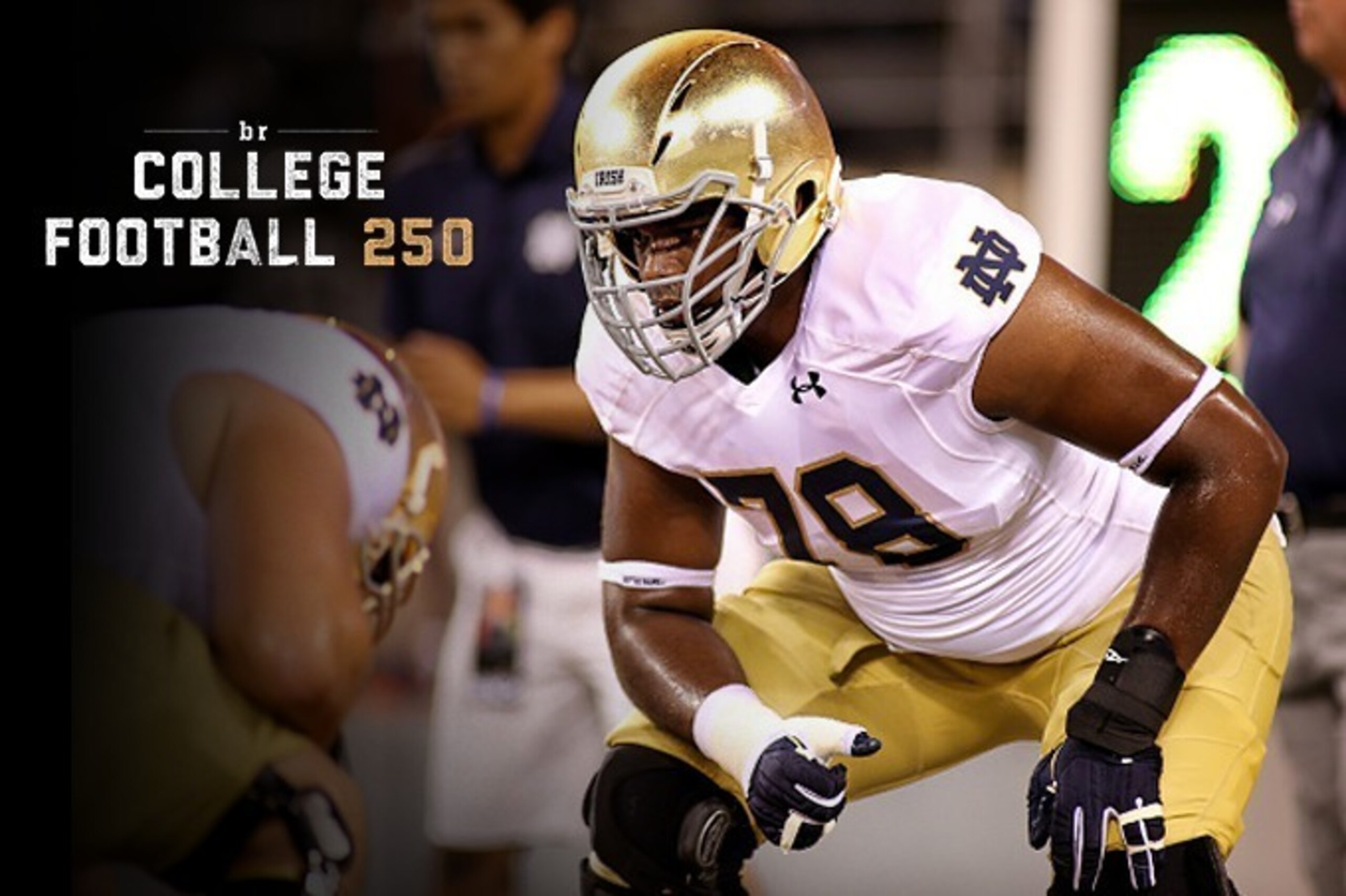

B/R CFB 250: Top 12 Offensive Tackles
Bleacher Report's CFB 250 is an annual ranking of the best players in college football. Brian Leigh and Kynon Codrington have studied, ranked and graded the top athletes in the country, narrowed that list to 250 and sorted by position. Today, we present the Top 12 Offensive Tackles.
Other CFB 250 Positions
Offensive tackles almost never become superstars.
Unlike their skill-player teammates, they are often at their best when they are talked about the least. The more a tackle gets mentioned on a broadcast, the more likely it is he messed up.
But don't let their anonymity fool you. Any fan worth his salt knows that having a great tackle is just as important as having a great quarterback. Without the former, the latter cannot exist.
Even Heisman Trophy winner Marcus Mariota did not look right when his blind-side blocker—whom we'll get to in a bit—was injured in 2014.
Before we start, please take note that these players were graded as college tackles, not on how they project as NFL tackles.
Targeted skills such as power are important at both levels, but there is a difference between college power and professional power. If a tackle can drive defenders backward in the SEC or the Big 12, it doesn't matter that he can't drive defenders backward in the NFC North. At least not here, it doesn't.
This is all about college performance.
Note: If two players finished with the same grade, a subjective call was made based on whom we would rather have on our team right now.
12-7. Clemmings, Williams, Fisher, Flowers, Drango, Tunsil
1 of 7
12. T.J. Clemmings, Pittsburgh
Hands: 20/25; Power: 12/15; Lateral Quickness: 23/25; Pass Protection: 22/25; Run Blocking: 7/10.
T.J. Clemmings is a converted defensive lineman who might, at some point, end up being the best player on this list. He has a unique mixture of size (6’6”, 315 lbs) and athleticism, and he's come along fast in terms of technical development and discipline. He just needs a little more fine-tuning.
11. Daryl Williams, Oklahoma
Hands: 21/25; Power: 13/15; Lateral Quickness: 20/25; Pass Protection: 21/25; Run Blocking: 9/10.
Daryl Williams is a snowplow in the running game, clearing the streets for Oklahoma’s backfield. He is not an off-the-charts athletic specimen, but at 6’6”, 329 pounds, he does enough things well that he doesn’t have to be.
10. Jake Fisher, Oregon
Hands: 22/25; Power: 12/15; Lateral Quickness: 22/25; Pass Protection: 22/25; Run Blocking: 8/10.
Jake Fisher proved to be a lynchpin—if not the lynchpin—in Oregon’s explosive offense. When he missed two games with a knee injury during the middle of the season (against Washington State and Arizona), the Ducks fell apart. As soon he returned, they put themselves back together. Like breathing or reading, Oregon never knew how much it needed Fisher until it lost him.
9. Ereck Flowers, Miami (Fla.)
Hands: 22/25; Power: 12/15; Lateral Quickness: 22/25; Pass Protection: 22/25; Run Blocking: 8/10.
Prior to injuring his knee against Virginia Tech, Ereck Flowers was enjoying a career year at left tackle for Miami. He played through pain the rest of the way, and even though he wasn’t quite as impressive, he still ate up defensive linemen with his long arms, broad shoulders and deceptive foot speed for a man so exceptionally massive (6’6”, 324 lbs).
8. Spencer Drango, Baylor
Hands: 22/25; Power: 12/15; Lateral Quickness: 22/25; Pass Protection: 23/25; Run Blocking: 8/10.
Spencer Drango anchors a Baylor offensive line that goes overlooked each season. But don’t get it twisted: The 6’6”, 310-pound monster protecting quarterback Bryce Petty’s blind side is just as important to this offense as Petty and all of those skill players that he throws to.
7. Laremy Tunsil, Ole Miss
Hands: 21/25; Power: 13/15; Lateral Quickness: 23/25; Pass Protection: 23/25; Run Blocking: 8/10.
Laremy Tunsil was slowed by a shoulder injury at the end of the regular season, but injuries are about the only thing that can slow him down. After starting at left tackle and allowing only one sack as a true freshman in 2013, he continued to improve in his second season at Ole Miss, justifying his rating as a top-five player in the 2013 recruiting class.
6. Cedric Ogbuehi, Texas A&M
2 of 7
Hands
It is vexing to watch Cedric Ogbuehi struggle with his hands, knowing that he is capable of being so much better than he is. His punch is inconsistent, his placement is hit-or-miss, and his decisions are often reactionary. He does, however, have very good hand strength that allows him to control a defender once he gets a solid grip on them.
Power
Power is not the crux of Ogbuehi’s game, but it’s an underrated part of what makes him successful. He started all 13 games at guard during Johnny Manziel's Heisman Trophy season in 2012, exhibiting enough strength to hold his own—and oftentimes win—against the biggest, strongest, meanest interior defensive linemen in the SEC.
Lateral Quickness
Ogbuehi is the quickest offensive tackle in college football and might be one of the quickest to ever play the position. He is incredibly light on his feet and moves like a tight end in space. Even when he’s beaten off the snap, he is athletic enough to recover.
Pass Protection
Physical tools make Ogbuehi one of the better pass-blockers in college football. The ability to play loose and flexible, the foot speed, the aforementioned recovery time: all of it helps him make plays that other tackles can’t make. Unfortunately, he can’t rise any further up these rankings until he improves his upper-body technique.
Run Blocking
Again, Ogbuehi’s physical tools make him one of the better run-blocking tackles in college football, despite a lack of technical refinement. His power and ability to get upfield—both of which are staples of Texas A&M’s running game—make him a valuable contributor, and maybe even a great one. But he could still be so much better if he ever started playing with a mean streak or refrained from coming too high off the ball.
Overall
Ogbuehi was not one of the six best offensive tackles in the country this season—but only because he spent most of it playing out of position. The switch from right tackle to left tackle did not go as smoothly as anticipated, but once Ogbuehi moved back to his natural spot, he reminded folks of his talent. He is not as good as he should be, but he's still pretty darn good.
5. Andrus Peat, Stanford
3 of 7
Hands
Andrus Peat does not have the strongest hands, at times letting rushers shed his grapple and continue their progression toward the quarterback. But he doesn’t have weak hands either, and he combats his lack of raw grip-strength with smart hand placement.
Power
Because of his “thinner” frame (6’7”, 316 lbs), Peat does not generate the same power as some of the other tackles on this list. He overextends his upper body and does not utilize leverage well enough to compensate for his relative lankiness.
Lateral Quickness
Considering his long, 316-pound frame, it is almost unfair for Peat to have the quickness and coordination he possesses. He moves side to side with natural balance that allows him to mirror and stay in front of oncoming rushers.
Pass Protection
Peat uses the quickness mentioned above to protect the blind side of his quarterback, gaining great depth with his drop and forcing defensive ends to take wide angles. He has a dirty little habit of lunging, though, and needs to learn to play with more patience.
Run Blocking
Despite lacking the power that is typical of dominant run-blockers, Peat grades out fantastically well in the ground game. He doesn’t always drive opponents backward, but he occupies them long enough to open holes off the line of scrimmage. More than that, though, he has the quickness, speed and preternatural blocking instincts to get downfield and excel as a lead blocker.
Overall
Peat was the lone holdover from a Stanford offensive line that dominated in 2013. The group as a whole did not live up to expectations in 2014, and even Peat struggled, on certain occasions, to match his previous production. But for the most part, he continued to play at a level that few in college football can match.


4. Jack Conklin, Michigan State
4 of 7
Hands
Jack Conklin has heavy hands that drive defenders backward. Because of this, he packs a powerful punch in pass protection. In the run game, his hand placement needs a little bit of refinement, as he doesn’t always gain inside position. But once he does, his hands are strong enough to maintain control of his man.
Power
Conklin dropped 30 pounds of fat from his body this offseason but did not sacrifice much (if any) of his power. At 6’6”, 303 pounds, he has long arms and a precocious understanding of leverage that allows him to hold up against defensive ends of any size. He distinctly got the better of Joey Bosa when Ohio State played Michigan State this season.
Lateral Quickness
The weight Conklin dropped this offseason did wonders for his lateral agility. He has a quick reach step that allows him to attack the end man on the line of scrimmage on outside running plays, and he has no trouble moving side-to-side against speed rushers.
Pass Protection
According to most sources, Conklin has never given up a sack. Ever. In 25 career starts, the only debatable play was one in which Connor Cook ran into the defender against Maryland. Either way—zero sacks allowed or one sack allowed—the way Conklin uses his hands, feet and arms to size up and fend off defenders has made him the premier pass-blocker in college football.
Run Blocking
Conklin improved as a run-blocker in 2014 and is a versatile part of Michigan State’s ground game. He is at his best pulling across the line and executing kick-out blocks, using his mobility to excel where many great pass-blockers struggle.
Overall
A former walk-on whose father played ball at Michigan, Conklin has spent the past two years making bigger-name schools look foolish. He was a Freshman All-American in 2013 and only got better as a redshirt sophomore this past season, anchoring the blind side for a resurgent Michigan State offense.
3. Ronnie Stanley, Notre Dame
5 of 7
Hands
Early in the season, Ronnie Stanley struggled to affect defenders at the point of contact. But with time he grew into his new position (left tackle) and developed an assertive punch. Overall, he has strong, heavy hands that allow him to control defenders through the duration of the play.
Power
Stanley lacks the power of his former teammate, Zack Martin, but is powerful enough to get by. He is more determined than strong as a run-blocker, displaying the grit and toughness needed to turn average raw power into better-than-average results.
Lateral Quickness
Stanley is a former basketball player with impressive balance, agility and lateral quickness for an athlete his size (6’5.5”, 315 lbs). He plays on the balls of his feet and demonstrates the proper knee bend to anticipate and react to different types of pass-rushers.
Pass Protection
With long arms and fluid athleticism, Stanley has become one of the best pass-blockers in college football. He did not allow a single pressure in the three games graded by Pro Football Focus, shutting down future NFL defensive linemen against Stanford, Florida State and Arizona State. He has a useful blend of foot speed, hand placement, work ethic and competitiveness that should only improve as he earns more reps at left tackle.
Run Blocking
Stanley comes off the ball smoothly and has the aforementioned nastiness that is refreshing to see in a run-blocker. He also has the mobility to get downfield. If he works on adding strength to his lower body, he could soon become a wrecking ball in the ground game.
Overall
Notre Dame would have been OK with a small drop-off after losing Martin, a first-round NFL draft pick, at left tackle. Instead, Stanley flipped from right tackle to the blind side and gave the Irish way more than a small drop-off. He gave them a moderate improvement.
2. La'el Collins, LSU
6 of 7
Hands
La’el Collins has big, strong hands that allow him to latch onto defenders and never let them out of his grip—provided he engages them high enough. He does, however, sometimes let his hands drop too low, inviting rushers to swim over the top with a counter.
Power
At 6’5”, 321 pounds, Collins has a thick base and rare natural power that allows him to drive opponents off the line. It is rare to see him pushed back in pass protection or even trifled with against the run.
Lateral Quickness
Collins has more quickness than people give him credit for. He is not a rare athlete in a vacuum, but his feet are uncommon for a 321-pounder. He gets depth off the line with a quick-trigger kick-slide against speedier defensive ends.
Pass Protection
Collins is a solid pass-blocker whose best traits are sometimes his worst. Specifically, the aggressive tendencies that define him as a tackle sometimes get him off balance and leave him susceptible to countermoves. For the most part, though, those aggressive tendencies are a positive more than a negative, as is Collins’ pass blocking on the whole.
Run Blocking
Opposing defenses know that LSU wants to run the football but still can’t seem to stop the run. A big part of that is a testament to Collins, who dominates the line of scrimmage and makes SEC defensive linemen look like they belong in the MAC. As good as he is at the point of attack, what makes Collins so special is his ability, as a tackle, to get to the second level.
Overall
Collins was the No. 3 overall prospect in the 2011 recruiting class and developed into everything LSU hoped he would be. He played guard in 2012 before moving to left tackle as an upperclassman and becoming the best all-around blocker in the SEC.
1. Brandon Scherff, Iowa
7 of 7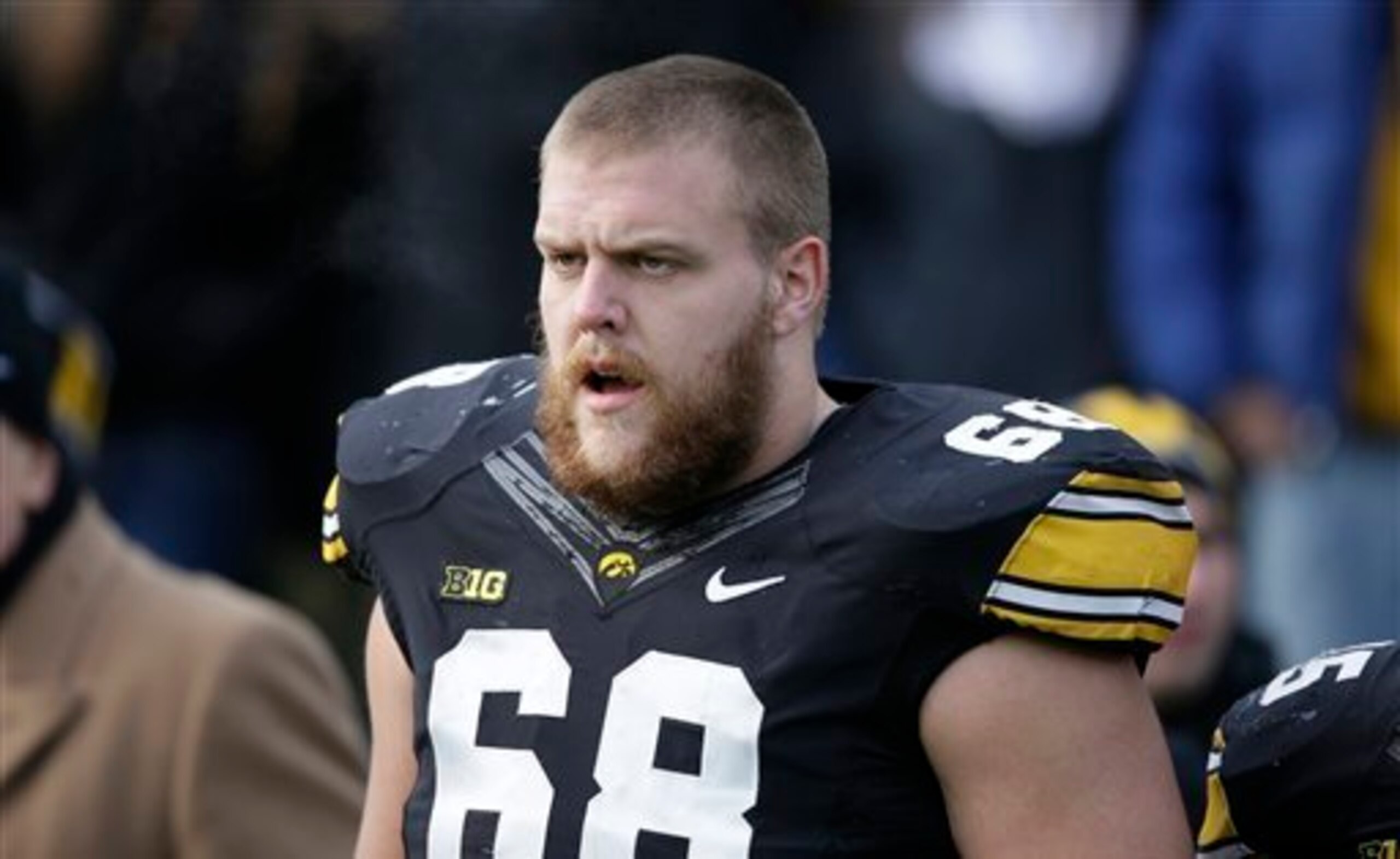
Hands
Brandon Scherff packs a powerful punch and is judicious with his hand usage. He waits for the defender to get close before attacking in one quick motion, not unlike a Venus flytrap. He understands proper hand placement and is able to control oncoming rushers.
Power
Videos of Scherff hang-cleaning 437 pounds went viral this offseason and do not belie how powerful he is on the field. He drives defenders out of the hole against the run and does not give an inch of slack against a bull-rush.
Lateral Quickness
If there’s anything Scherff struggles with, it’s quickness. He shifts his weight well but has tight hips and is sometimes caught off-balance against a speed rush. Overall, though, this isn’t an area of weakness so much as an area of not-strength. For a 6’5”, 320-pound lineman, he has surprisingly nimble feet.
Pass Protection
Scherff is not a lockdown left tackle against the pass, but he’s not far off. He sometimes gets caught playing on his heels and lets a defensive end slip by for a hurry. Those missteps, however, do not happen very often, and Scherff makes up for them with his blitz pickup.
Run Blocking
Scherff is the type of lineman that a team can build a running game around. He is the best drive-blocker in college football, controlling his area and pushing defenders to whatever spot he pleases. His passion, strength and snap-to-snap toughness make him such a good run-blocker that NFL teams have considered moving Scherff to guard.
Overall
Scherff is the latest in a long line of great Iowa tackles, and some think he might be the best. He overcame an injury scare at the start of the 2014 season to play even better than advertised, mauling Big Ten linemen in the passing and (especially) running games.


.jpg?w=2560 "Report: Darnold Could Miss 3-6 Weeks")
.jpg?w=2560 "Grading WWE NXT 🔠")