The SEC's Passing Problem: Why Can't NCAA's Top Conference Develop Top QBs?
ATLANTA — The SEC has just as many NFL quarterback regulars as you've got toes on your right foot.
That's how many regular NFL quarterbacks the SEC has produced in—check this out—17 NFL seasons. You know them because, really, how hard is it to remember five stinking names? Peyton Manning (Tennessee), Eli Manning (Ole Miss), Matthew Stafford (Georgia), Jay Cutler (Vanderbilt) and Cam Newton (Auburn).
The world-renowned—their fans say it is—college football conference called the SEC won seven straight national championships from 2006 to 2012, but just one of those ring-bearing slingers has stuck in the NFL as a regular starter (Newton).

The SEC has figured out 21 of 22 positions, but not the most important position on the field. Quarterback.
Ohio State by itself has three quarterbacks who could start for any team in the SEC in 2015. The QB position in the SEC is so thin going into the 2015 season that Jeremy Johnson, a backup at Auburn in 2014, was voted to the second team of the preseason all-conference team. Was there nobody else who showed anything in 2014? Georgia was so desperate for quarterback help it had to recruit the Virginia backup (Greyson Lambert) when he decided to transfer in the spring.
Maybe you are like me and appreciate college quarterbacks for what they accomplish on Saturdays. Their value should not be diminished by what they do or don't do on Sundays.
But doesn't it make you scratch your head that Tony Romo (Eastern Illinois), Ben Roethlisberger (Miami of Ohio) and Joe Flacco (Delaware), among others, are cashing big checks in the NFL while so many former SEC quarterback heroes are not? Doesn't it make you scratch your head that Philip Rivers had to leave his home state of Alabama to play college football at North Carolina State?
For nine straight years, the SEC has led the major conferences in draft picks. The SEC has had 81 players drafted in the first round those nine years. But the SEC quarterback? There is not so much love from the NFL.
I know you have theories. So do I.
Married too young
The Big Arm shows up on the radar by the ninth grade, sometimes sooner. The suitors line up. They project him four years forward. It's an Atlanta freeway bottleneck of texts on The Big Arm's phone with hosannas popping in from recruiters all over the South. The Big Arm's living room sofa is about to be worn out from so many recruiters sitting there handing mama her favorite piece of gum (because they researched it).
The big schools of the SEC think they invented the position, but they make a way-too-soon offer to The Big Arm.
Here's why it is way-too-soon. The intangibles do not catch up to The Big Arm. He stares down receivers. He waits too long to throw. He is shaky on his feet in a desperate pocket. He can't compete. Pretty soon he is out the door as a transfer because of the intangibles.
"Quarterbacks are the first to commit, sometimes two years in advance," said Tom Lemming, a national recruiting analyst for CBS Sports. "They are the first to go for every conference, but the recruiting is the fiercest in the Southeastern Conference, and they fight for these kids and press for a commitment. They don't always develop."
Just run down your school's roster of quarterbacks from the last five years and see the quarterbacks who sat the bench or transferred. Why name them here for more public shame? You know who they are. There are a bunch.
"Schools feel pressure to take the flyer on the 4- and 5-star recruit in ninth and 10th grade. They get married up with young quarterback," said Phil Savage, the executive director of the Reese's Senior Bowl and former NFL GM and scout. "There are quarterbacks that develop later who were under-recruited, like Tulane's Tanner Lee or the 6'7" Memphis quarterback [Paxton Lynch]."
Lemming said there is one other reason the SEC does not produce NFL-worthy quarterbacks. Goliath has big feet, but a small footprint.
"The traditional southern states of the SEC don't produce as many quarterbacks as California or Texas," he said. "There is a bigger population base out there than in Georgia, Alabama, Mississippi, Tennessee, Florida."
My best friends
Savage said while they were in college, Romo, Flacco and Roethlisberger might have looked to their right before the snap and had to figure out a way to get the ball in the hands of a 5'9" receiver who had trouble beating press coverage. They might have had a 190-pound running back who was not so good at pass protection. They might have had a left tackle whose drop step was a tick too slow to pick up a marauding defensive end.
What did Romo, et al, do? They adapted. They slugged their way through.
The SEC quarterback, Savage said, is given every available asset to do battle with. There is not as much stress.
"The guy from a smaller school has learned how to figure out, how to play with a shorter, slower receiver," Savage said. "They have to manipulate and adapt their game to the circumstance they're in. That's why you see the success of a Roethlisberger. He learned how to play in college. He learned how to play an uphill battle.
"At the traditional football power, those quarterbacks are fighting downhill. I'm not saying it's easy, but it's easier."
But don't the SEC quarterbacks have to deal with the Baddest Men on the Planet, SEC defensive ends? Isn't that a hill to climb?
It is, but SEC programs also have three-deep offensive lines and players like Alabama guard Chance Warmack and LSU's La'el Collins, Savage pointed out.
We all loved Blake Sims, but when a wide receiver like Amari Cooper is creating three car lengths of space between himself and the defensive back and the pass just has to go through a picture window, not a kitchen window, the quarterback can shine. Sims had a spectacular 2014 season; he saved the Tide's season. But the NFL still didn't like him.
Lemming had another theory. "A lot of times, SEC teams will settle for an efficient game manager because their teams are so good at other at other positions," he said. The NFL does not covet game managers.
Indeed, the SEC might not have the superstar quarterbacks the NFL covets, but the conference will settle for just having the "winner" many programs covet (Tim Tebow, David Greene, Nick Marshall, Sims, and the list goes on).
A matter of cycle
We are beating down the SEC quarterback, but wasn't it just two seasons ago that the M&M boys were erasing numbers all over their school's record books and parading around as stars? In 2013, Texas A&M's Johnny Manziel threw for 4,114 yards and 37 touchdowns, Auburn's Nick Marshall collected 1,976 passing yards and 1,068 rushing yards, Georgia's Aaron Murray threw for 3,075 yards, Alabama's AJ McCarron threw for 3,063 yards and LSU's Zach Mettenberger had 3,082 yards passing. The M's were joined in an elite group by Missouri's James Franklin and South Carolina's Connor Shaw.
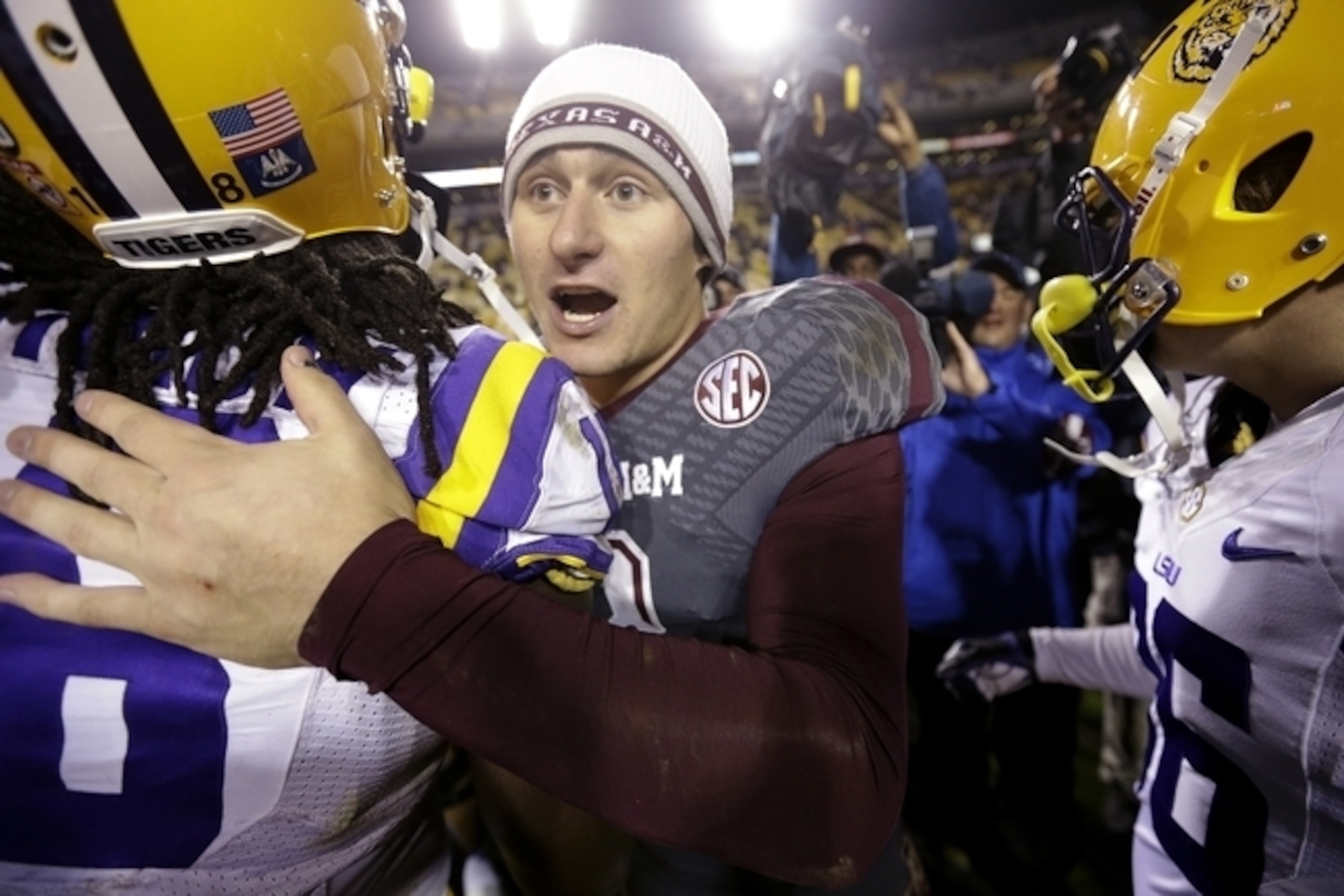
"When you have guys that started three and four years like McCarron and Murray, or Manziel and Mettenberger [two years], it is easy for fans to get spoiled and expect that trend to continue," said David Morris, a quarterback trainer in Mobile, Alabama, who runs QB Country. "In reality, those type guys don't come around often. That class may be the best class in SEC history as far as 'college careers' go."
Morris said the flak SEC quarterbacks are getting may be about to abate. He senses an uptick coming.
"If Dak Prescott continues to develop and grow, he can be one of those guys," Morris said. "Then there are guys oozing with talent like Jeremy Johnson. I think he has a chance to be special, but we won't know for sure for another six months. Across the SEC, besides Prescott, there is Joshua Dobbs at Tennessee, Brandon Allen at Arkansas, and Maty Mauk at Missouri.
"You have a number new guys that have to earn their stripes, guys like Kyle Allen at Texas A&M and Patrick Towles at Kentucky who showed spurts of brilliance. It's too early to predict anything this year."
A matter of style
SEC teams decided about four years ago that the wave of spread offenses and spitting the ball around to five different receivers was the next train to catch in college football. They thought, "Do we want to be on that train, or under it?" The SEC is on it with nine programs featuring the fluffy spread. So prep quarterbacks like Ross Trail went down, well, a different trail.
Trail, a 6'3" pro-style quarterback from Wynne, Arkansas, who graduated from high school in 2015 and was graded a 3-star recruit by 247 sports, said he visited some SEC schools, but he wasn't enamored with their style. Not all the SEC schools were enamored with him, either, so it was easy to look elsewhere for a college program.
"A lot of offenses—like Ole Miss, Auburn, Missouri—they run those gimmicky offenses," Trail said. "For me, I would rather play in a more pro-style offense, like Cincinnati. I feel like the scheme on offense is a big deal.
"The other thing is playing time. There seemed to be a lot more quarterbacks at the big schools in the SEC. More depth."
It wasn't just the style of play that turned off Trail. It was the style of recruiting. You get the impression Trail was slow-played by SEC coaches, held in reserve, while they dated the blue-chipper. Perhaps Trail caught the scent that he was the third or fourth choice, so he went for the love shown by two really charismatic coaches, Memphis' Justin Fuente and Cincinnati's Tommy Tuberville. He chose Tub and UC.
"I took a lot of visits—Vanderbilt, Mississippi State, Arkansas—and I felt like schools like Cincinnati and Memphis, the smaller schools, made you feel more important," Trail said. "They gave you more love. I don't know if it was 'We're the SEC we do what we want,' but schools like Memphis and Cincinnati were a lot more welcoming and warm to recruits."
Here is one more thing to consider: There are just 32 NFL teams. Thirty-two spots for hundreds of college chuckers.
The SEC has not seen one of its quarterbacks ascend into a regular starting role in the NFL since Newton left Auburn in 2010 and joined the Carolina Panthers. Ryan Mallett, who played at Arkansas, is competing to be the Houston Texans starting quarterback, but that could be temporary. There is a groundswell building for Alabama's AJ McCarron to eventually become the guy in Cincinnati over the embattled Andy Dalton. Who knows about Manziel and when (or if) he might bloom for the Cleveland Browns.
For now, the SEC will have to settle for owning a lot of real estate on NFL draft night…and little on the beachfront where the quarterbacks live.
Ray Glier covers college football for Bleacher Report.


.png?w=2560 "WWE NXT Live Grades 🔠")
.jpg?w=2560 "Best From 'Hard Knocks' Episode 2 🔥")
.jpg?w=2560 "UDFAs Pushing for Roster Spots")