Biggest 2015 College Football Storylines 50 Days Away from Kickoff
Fifty days. That's how much longer we have until the 2015 college football season starts. We're well over the offseason hump now.
And, really, if you want to be all "well actually" about it, preseason camp starts in August, which will more than whet the appetite of any college football junkie. The point being, college football is right around the corner.
With such a big milestone until the first game, we thought it'd be timely to shine a spotlight on the biggest storylines for the '15 season—you know, the ones you can't escape, like Ohio State's quarterback competition, or Jim Harbaugh's return to Michigan. If it's dominated the headlines, chances are it's listed here.
TOP NEWS
.jpg?w=2560 "NCAA Eligibility Football")
Breaking News
Week 2 College Football Predictions for Every Game 🔮

Top 12 Breakout Stars After Week 1 ⭐
All of these things and more should make for an exciting season, but the beauty of this sport is that it's wholly unpredictable. We can make all the guesses in the world about what this year will bring, but the reality is we have as much of a clue as the next person.
That's what makes college football hilarious, agonizing, ridiculous and everything in between. It's weird, but dammit, it's our weird. With that said, here are the top storylines we're looking forward to answering this fall.
Ohio State: The Pursuit of Another Title and a Quarterback
August is going to be interesting, isn't it? How often do you have a situation like the one at Ohio State? The Buckeyes are early leaders to repeat as national champions and favorites—and in some cases, massive favorites—to win all their games.
Yet we have no clue who the starting quarterback will be. Will it be Cardale Jones, whose postseason heroics will go down in Ohio State lore for years? Will it be J.T. Barrett, who came out of nowhere to lead the Bucks in their desperate time of need? Or will it be Braxton Miller, the seasoned veteran who didn't transfer after all but hasn't played football in well over a year? (Let us say this: Never, ever forget how good Miller was before he sustained his shoulder injury.)
Not knowing who the starting quarterback will be isn't a prerequisite for success, however. What we do know—or, at least, what we think we know—is that, whichever quarterback ends up starting, the Buckeyes will be in good hands. In one sense, that makes head coach Urban Meyer's decision agonizingly difficult. This is something he's admitted to already, because he knows, just like everyone knows, a tremendous player is going to be disappointed with the outcome.
In another way, though, it's rare that a program finds itself with three quarterbacks with which it can realistically win. Stop reading and think about that for a minute. Really savor it, too, because you probably won't see something like this again for a long, long time.
Think about how little room for error there is when it comes to player health. A key injury can derail an entire season. Yet with its third-string quarterback, Ohio State was playing better than any team in the country by the end of last season.
Now, the question is whether Ohio State can do it all again.
Whatever target the Buckeyes had on their backs before, quadruple it. Even then, that might be a conservative estimate. Being the defending national champs comes with a challenge. We know Ohio State is insanely talented, so talented in fact that next year's NFL draft could have a major scarlet and gray flavor to it. Personnel is not the challenge for Ohio State. Keeping that championship edge is.

To be fair, going undefeated isn't a requirement for playoff inclusion. No team embodied that more last year than Ohio State, which was all but officially counted out of the playoff race when it lost to Virginia Tech in Week 2. But going undefeated is the only way to eliminate any doubt or debate.
Make no mistake: It's not easy being perfect. People, by their very nature, are imperfect. Young men between the ages of 18 and 22 are even more imperfect. Strength of schedule matters far less here than you'd think. The fact that Ohio State won 24 straight regular-season games in 2012 and '13 is mind-boggling.
What's another 15 more, right?
If Ohio State can repeat as national champs, it'll not only mark one of the truly great runs in college football's recent history, it'll take even more pressure off of the Big Ten as the sport's favorite conference pinata.
And after all the hits the Big Ten has taken, it deserves a break.
The Start of the Jim Harbaugh Era
Jim Harbaugh is back and we couldn't be happier about it. His four-year stint in the NFL, during which he led the San Francisco 49ers to a Super Bowl appearance, felt like 40 years.
Harbaugh's return to the college game just feels right, regardless of how long or short it lasts. Harbaugh might be one of the best football minds anywhere at any level, but his unique personality seems to fit naturally with college football's capricious nature.
Unique personalities make any sport interesting, but within college football, there's a special place for people like Harbaugh, Bret Bielema, Steve Spurrier and Mike Leach. These are men who are not only unfiltered, but geniuses at their craft. The result is a unique kind of interesting that very few can actually pull off. In a world of carbon-copied transcripts, Harbaugh is a human art project, so much so that even his worst interviews can be spun as a Jackson Pollock painting. You're not sure what you're looking at, but goodness it has to be worth a lot of money.
It'd be one thing if Harbaugh was a walking sound bite and a lousy coach. Those types tend to come and go quickly. But Harbaugh is a phenomenal coach. It's because of this that it's widely assumed he'll turn Michigan around, perhaps quickly.
Assumptions are the devil's work because they're set up to be proved wrong, but the assumption that Harbaugh will succeed at Michigan feels like the biggest "given" college football has had in a long time.
His track record is too good.
It's been too long since the Wolverines were relevant.
Will Harbaugh get things going in year one? This program is in bad shape. He deserves room to produce results. Stanford, Harbaugh's last college stop, didn't start winning Orange Bowls right away.
Michigan might not reflect Harbaugh's vision right away. That's OK. It will.
In time, Harbaugh's greatest achievement might be bringing back the relevance of its rivalry with Ohio State. College football fans should want The Game between Michigan and Ohio State to matter on the national scale again. Forget about Big Ten haters who have some deep-rooted and probably unexplainable hatred for something that never once affected their lives in a meaningful way. This sport is far more fun with a greater variety of bigger games.
Putting Harbaugh and Meyer—two of the most respected, brilliant and influential minds in the game—on the same field once a year is a gift. But every gift has a shelf life. Enjoy it while you can, because you might wait another four decades before the next Ten Year War.
Is USC "Back"?
Oh, no. The dreaded "B" word. Sorry, USC, we just killed your playoff hopes. End 'em now. They're done. We are so, so sorry.
Kidding aside, there's a lot of interest in the Trojans this year as a potential playoff team, which, for the sake of this conversation, indicates "back." Because we're creatures of the moment, USC's Holiday Bowl win over Nebraska had a lot to do with crafting that narrative. And, as they often are, the narrative was loaded into a cannon and shot off into the beautiful offseason abyss for all to enjoy or dissect meticulously.
That's not to say USC's playoff hopes are totally unfounded. Quarterback Cody Kessler returns after posting one of the most efficient seasons of any signal-caller in the country last year. There's skill talent for days on both sides of the ball. Wide receiver Juju Smith, cornerback Adoree' Jackson and linebacker/safety Su'a Cravens are all world-class talents.
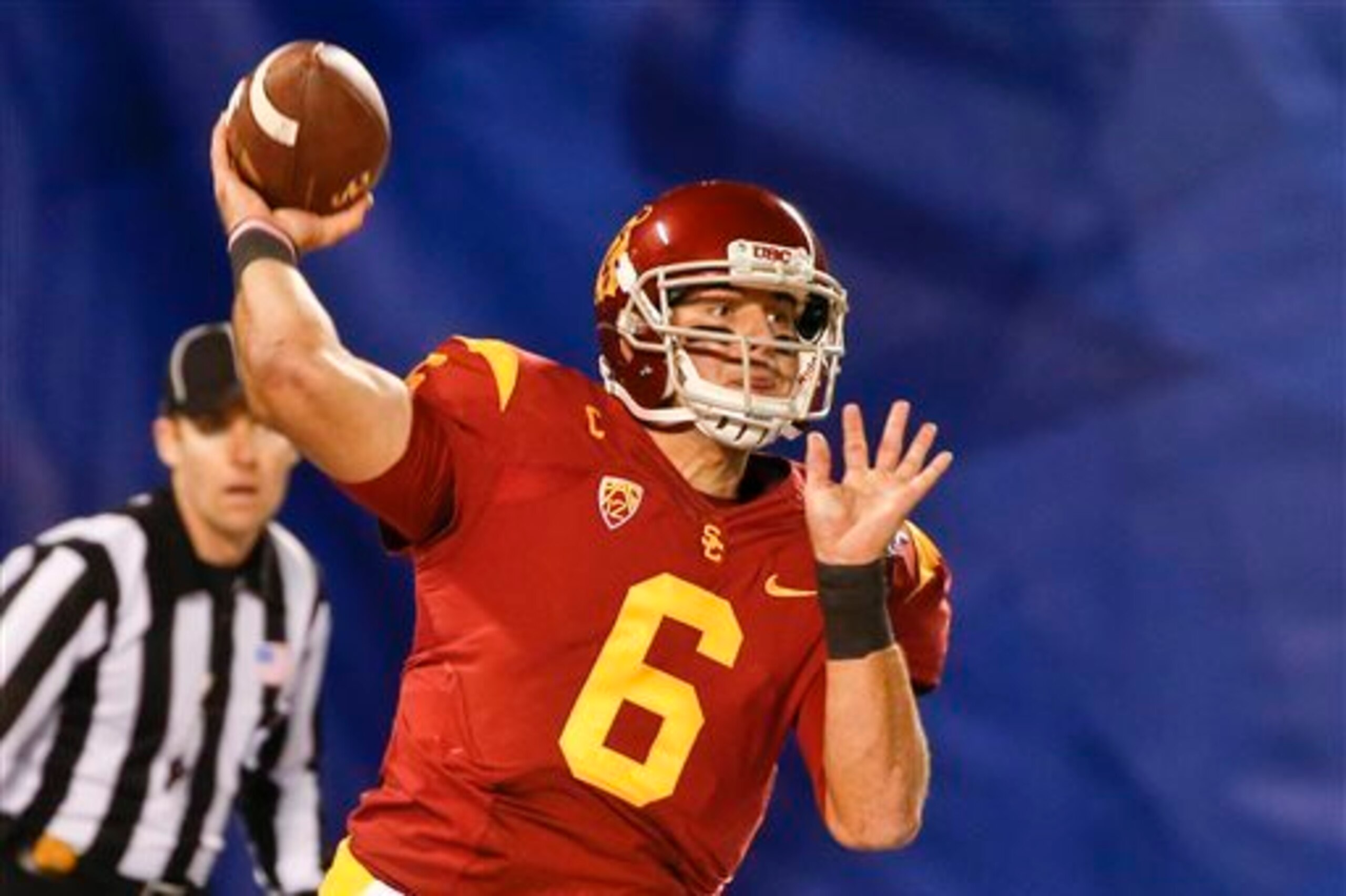
It's just that USC hasn't reached such glorious heights since the Pete Carroll days roughly a decade ago. That's been due in part to NCAA sanctions and in part to...um...Lane Kiffin.
That's why the Steve Sarkisian hire in late 2013 was so curious and met with such mixed reactions. It would seem, true or not, that the Trojans are hellbent on reliving the Carroll years by hiring his former assistants.
Sark led USC to nine wins a season ago, including the aforementioned bowl win. That's a sexy launching-off point for preseason hype. Nine wins isn't so high that the ceiling has been reached, but it's not so low that a turnaround seems insurmountable, either. However, the Trojans also lost four games in almost every imaginable way: Hail Marys, blowouts, last-second heartbreakers and total face plants.
If there's any year in which you can get away with working out the kinks of a transition, it's obviously the first year. But USC was erratic, hands down. Picking them as a playoff contender is based entirely on trust that the program has its act together, because the talent part of the equation has been solved.
Is USC back? As cliche as it is, it'll be a question that's asked throughout this season until it's undeniably clear one way or the other. There are opportunities, to be sure. Games against Stanford (Sept. 19), at Notre Dame (Oct. 17), at Oregon (Nov. 21) and UCLA (Nov. 28) will provide clarity.
Answering the question "yes" will not only be a boost to USC's quest for the return of its glory days, but to Sark's polarizing career as a still-growing head coach.
A "no" would be a monumental disappointment.
Will Baylor or TCU Finally Crack the Final Four? Both? Neither?
Nov. 27th. 7:30 p.m. on ESPN. It's already on the schedule. Mark it down.
That's when Baylor will travel to TCU in what many believe will be the de facto Big 12 championship game.
Or co-championship game, as the case may be.
It was that co-champion label that marked one of the myriad reasons the Big 12 was left out of last year's playoff. The exclusion was especially tough for TCU, which looked like a virtual lock at No. 3 in the College Football Playoff rankings heading into the final week of the season. (Baylor, which was criticized all season long for its soft nonconference schedule, never cracked the top four.)
But if the inaugural playoff year taught us anything, it's that there are no locks. After all, how can you lock something when you don't even know the secret code to open it? The truth is, there is no magic formula for playoff inclusion. What's important to the selection committee could, and probably will, change from year to year. A lack of a conference championship game hurt the Big 12 in 2014, but there's no guarantee it'll have the same effect this time around.
Still, being excluded from the playoff meant the Big 12 had to go into proactive mode—or at least the appearance of it. The league was in favor of adding a deregulated conference championship game...before it wasn't. The Big 12—or, at least, Oklahoma president David Boren—wanted to expand...then it didn't.
All that's left are more questions, which will inevitably be asked ad nauseam during Big 12 media days next week.
However the future of the Big 12 works out, nothing will be decided by that Nov. 27 game between the Bears and the Frogs. That seemingly all-important game comes at an intriguing time, too. Does it serve as a playoff quarterfinal of sorts? We won't know until December when the final rankings are revealed.
Will either Baylor or TCU finally get into the playoff? Both? Neither? Will it be dictated by the result of that Nov. 27 game or by other factors around the college football landscape? Or will both teams flop with a dark horse emerging as the conference champion? There are no answers at this time.
When it comes to the playoff, and to the future of the league, the Big 12 is in a holding pattern. It's not the most desirable place to be, but it's the only one that makes sense at the moment.
Examining the SEC's Reign of Dominance
Where does the SEC stand in college football in 2015? Look at it this way: Its most prominent voice, ESPN radio host Paul Finebaum, just said the conference "may be" overrated.
At SEC media days.
Say what now?
Look, we've all had low points in our lives, and right now we need to be there for the SEC as it copes with its own personal valley. If college football's most visible conference can't even get an attaboy from Finebaum at its own televised celebration party, where can it?
To be sure, some of the shine has come off of the SEC over the past two seasons. Not coincidentally, the SEC hasn't won a national championship since Alabama topped Notre Dame in 2012.
The streak was bound to end at some point. Seven straight national titles from 2006-07 to 2012-13 is a hell of a run but ultimately not one that can last forever. Furthermore, a two-year championship drought doesn't signal the end of times.
When you're as loved and as hated as the SEC is, a drought of any length of time becomes magnified and exposes other stats, like this about SEC blue blood Alabama from ESPN.com's Brett McMurphy:
What does all of this mean? It could mean the product isn't as effective as it used to be. It could mean other programs—Florida State, Oregon, Ohio State and the like—have caught up to the top of the SEC or, in some cases, surpassed it.
It could mean nothing if the SEC brings home another national championship in 2015, or it could mean everything if the SEC misses out on the playoff entirely.
Additionally, will recent results and Finebaum's comments reflect an overall viewpoint about the SEC in the weekly polls? It wasn't uncommon last season to see three or four SEC teams in the College Football Playoff Top 10. Will the league receive the same amount of love and respect under similar circumstances this year?
There's no unified answer (yet) on which SEC team has the best chance to represent the conference in the playoff, but the usual suspects—Alabama and Auburn—are near the top. Once again, the West Division is viewed as the stronger leg on which the SEC's championship hopes stand.
Whether it's strong enough to end the conference's brief title dry spell remains to be seen, but another championship-less year for the SEC would create some interesting reactions.
The Year of the Grad-Transfer Quarterback...or Is It?
The graduate-transfer quarterback has been a popular trend for the past few years. However, the volume of post-grad signal-callers finding new homes to finish out their eligibility really took off in 2015. Among the high-profile transfers were:
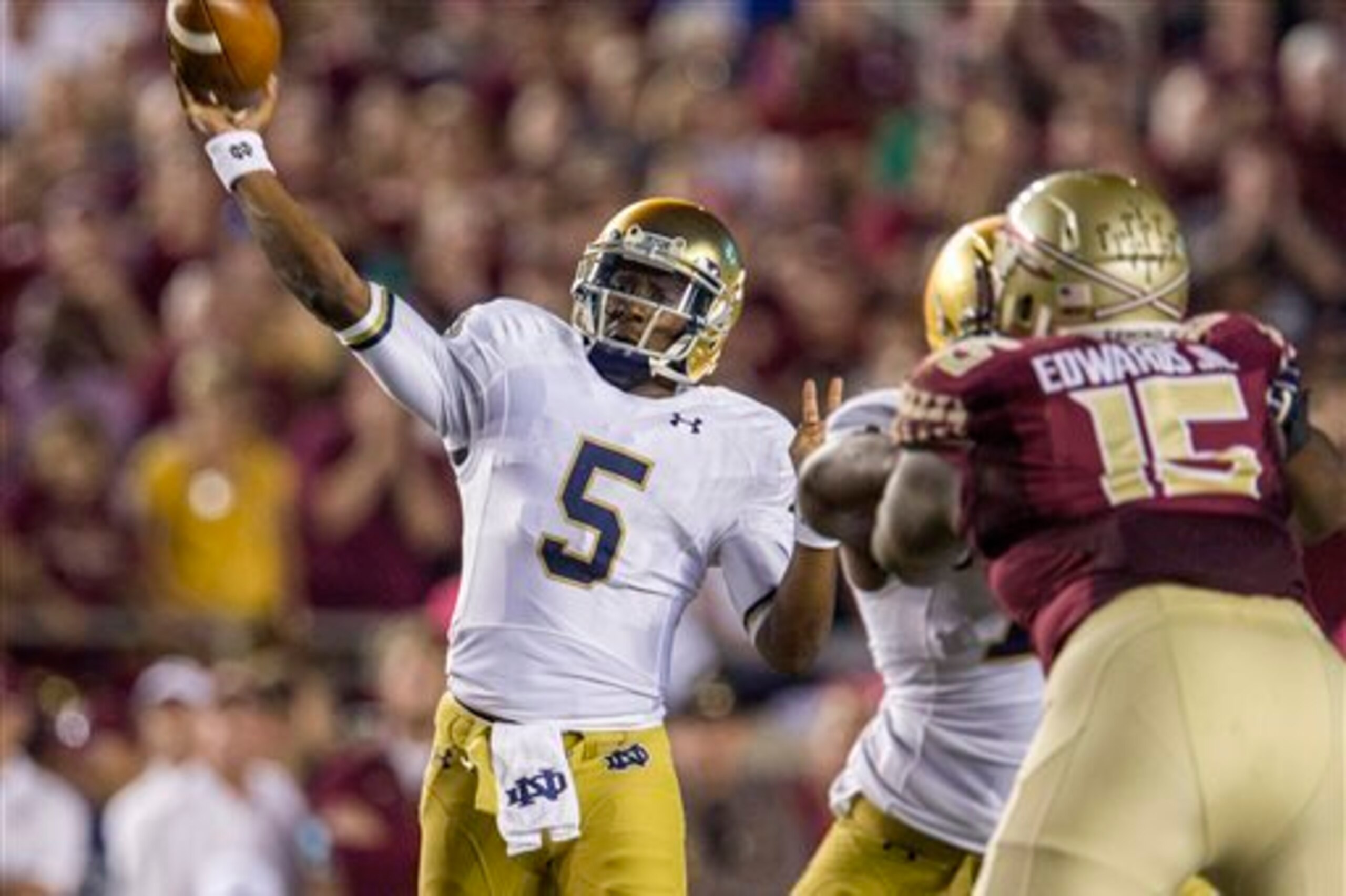
—Everett Golson, from Notre Dame to Florida State
—Vernon Adams Jr., from Eastern Washington to Oregon
—Jake Rudock, from Iowa to Michigan
—Jeff Driskel, from Florida to Louisiana Tech
—Daxx Garman, from Oklahoma State to Maryland
That doesn't count Braxton Miller, who was long speculated to be a transfer target before officially staying at Ohio State.
Still, there are some big names in this group. But here's the question: How many will actually start?
Or perhaps the more pertinent question is this: Will the assumed starters actually start?
After all, why bring in a grad transfer quarterback to upgrade the depth chart if he won't play?
However, the two biggest names on that list, Golson and Adams, have tough competitions ahead of them. Sean Maguire may not have had the best spring game at Florida State, but head coach Jimbo Fisher has praised Maguire throughout the offseason. Additionally, it's not like Golson comes to the Seminoles without his own set of problems. Though a natural (and improved) passer, Golson contributed to 22 turnovers last season.
Adams is an electrifying athlete who stood out at the Football Championship Subdivision. Considering the gap in interest level between FCS and FBS football, that's a big accomplishment. He also had big games against Oregon State and Washington in 2013 and '14, respectively. But longtime backup Jeff Lockie was impressive in Oregon's spring game and has shown no signs that he'll concede the starting job to Adams. Lockie may not possess Adams' physical gifts, but he's a natural leader and can move the offense.
We could be talking about a world in which Jeff Driskel is tearing it up at Louisiana Tech while Golson sits on the bench at Florida State. Or it could be the year of the grad-transfer quarterbacks across the landscape.
When Russell Wilson went from North Carolina State to Wisconsin in 2011, he unintentionally made a lot of people believe that every transition would be that seamless and successful. Wilson has rare leadership abilities, though, and the situation lined up well for him. In hindsight, he should be viewed as the exception to what a grad-transfer quarterback can do for a program.
What we get out of this crop of grad transfers is a mystery. Fresh starts could be beneficial across the board, or for one reason or another, it won't work out for anyone.
Then again, if college football was predictable, there'd be no reason to watch.
Ben Kercheval is a lead writer for college football. All quotes cited unless obtained firsthand.
.jpg?w=2560 "A.J. Exits Game with Injury")
.jpg?w=2560 "Report: Bowers to Miss Time")

.jpg?w=2560 "J.J. Named Vikings QB3")
.jpeg?w=2560 "Predicting Every Week 1 Game 🔮")