
B/R CFB 250: Top 9 Tight Ends
Bleacher Report's CFB 250 is an annual ranking of the best players in college football, regardless of NFL potential. Through interviews with B/R Experts Matt Miller, Michael Felder, Barrett Sallee and Adam Kramer, authors Brian Leigh and Brian Pedersen have studied, ranked and graded the top athletes in the country, narrowed that list to 250 and sorted by position. Today, Pedersen presents the top nine tight ends.
Other CFB 250 Positions
The tight end is the most misunderstood skill-position player in college football. Is he a blocker—someone slightly smaller than the rest of the offensive line but in effect just an extension of that wall? Is he in there to catch passes, and if so, is this only for short-yardage bursts, or can he stretch the field?
Every team in college football seems to use its tight ends differently, and as a result there aren't many stars at this position. When Bleacher Report ranked the top 250 players in the country before the 2015 season, only seven tight ends made the cut.
We're up to nine after the completion of the regular season, with some fresh faces coming on board while others have moved around in the rankings.
The following ranks are based primarily on players' skills at the college level rather than how they'd fare in the NFL. Though they may be using this time to develop their games in preparation for Sundays, their goals are centered on helping their college teams succeed.
The ratings are based on a tabulation of four different categories (hands, route running, speed and blocking) and based on evaluations made by our writers in conjunction with Bleacher Report football experts.
NOTE: Any ties in overall grade were broken based on which player would give a hypothetical college all-star team the best chance to win.
9. Dan Vitale, Northwestern
1 of 9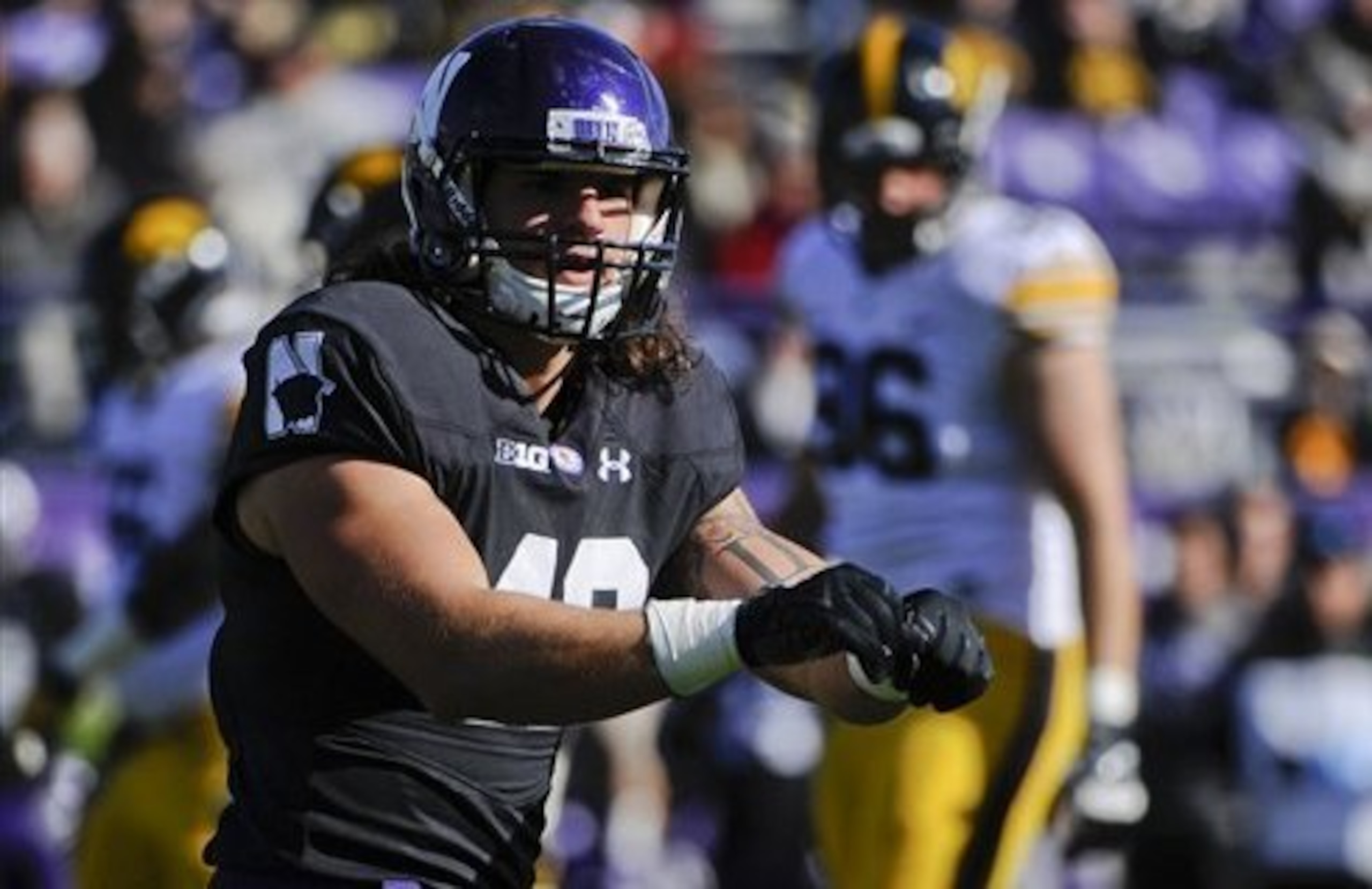
B/R Expert Scouting
"Their passing game this year has been an ongoing process, to put it kindly. For a team that lacks explosion on the outside, it's helped to have him. He's your ultimate Pat Fitzgerald guy."
—Adam Kramer
Hands
Northwestern threw for only 139.3 yards per game this season, completing 160 passes in 12 games. Dan Vitale had more than 20 percent of those receptions, with 20 of his 33 catches resulting in first downs.
Route Running
Filling the "superback" position that Pat Fitzgerald has used in his offense for nearly a decade, Vitale plays all over the field as Northwestern's primary receiving weapon. He can be found grabbing passes downfield, over the middle and even on bubble screens normally reserved for traditional wide receivers.
Speed
He looks like a linebacker at 6'2" and 235 pounds but can outrun most of those players who end up trying to guard him.
Blocking
Vitale is too valuable as a receiver to be kept on the line during pass plays. As a run-blocker, he can catch defenders off guard by going in motion and then hitting someone at the second level.
Overall
The Wildcats offense lacked any real flair in 2015; it employed more of a methodical attack instead of big plays. Yet on occasion, Northwestern would get frisky, which was when Vitale would end up making his biggest impact.
8. George Kittle, Iowa
2 of 9
B/R Expert Scouting
"He's surprisingly comfortable in open space. When they've asked him and called on him, some of their biggest plays have gone to the tight end. He's capable of some really explosive stuff."
—Adam Kramer
Hands
George Kittle only had 20 catches this season, but six of those went for touchdowns. And that's not including his stellar one-handed grab up the seam against Maryland on Halloween.
Route Running
There isn't anything flashy about the way Iowa uses its tight ends on passing routes. The coaching staff gave Kittle an area to head toward, and he always found his spot, often getting in position to catch while still in motion.
Speed
Kittle is great at getting to max speed right away, which is partly because he's not very fast. Once he gets going, though, most linebackers aren't able to keep up with him.
Blocking
Henry Krieger Coble is Iowa's most frequently used tight end in terms of total snaps as well as in the run game. When in there to block, though, Kittle tends to keep his seal long enough for a play to develop.
Overall
In a passing game that was mostly about efficiency and consistency, Kittle ended up being the big-play guy. Only a junior, he figures to play a more prominent role with the Hawkeyes in 2016.
7. Tyler Higbee, Western Kentucky
3 of 9
B/R Expert Scouting
"Not only can he use his speed to get open in man or zone against safeties and cornerbacks, but the kid can really punish the defense once the ball is in his hands."
—Michael Felder
Hands
Tyler Higbee seems to swallow the ball into his body on most receptions, letting his hands be a guide into the middle of his 6'6", 250-pound frame so he avoids bobbling the ball. When it's thrown ahead of him, though, he's able to reach out and collect like most wideouts do.
Route Running
There is no shortage of receiving weapons for Western Kentucky on every pass play, but Higbee doesn't just get the simple ones. He'll cross, cut, line up wide and throw in a double move here and there depending on who is guarding him.
Speed
Higbee won't outrun many defenders, but he is swift enough to make tacklers miss.
Blocking
The Hilltoppers run game benefited from the attention paid to their pass attack, and Higbee didn't spend that much time stuck to the line as an extra blocker.
Overall
Had it not been for a knee injury that knocked him out of four games in late October and early November, Higbee likely would have led the FBS in catches by a tight end. When he returned in the regular-season finale, he went right back to work with six receptions and two of his eight touchdown catches.

6. David Morgan, UTSA
4 of 9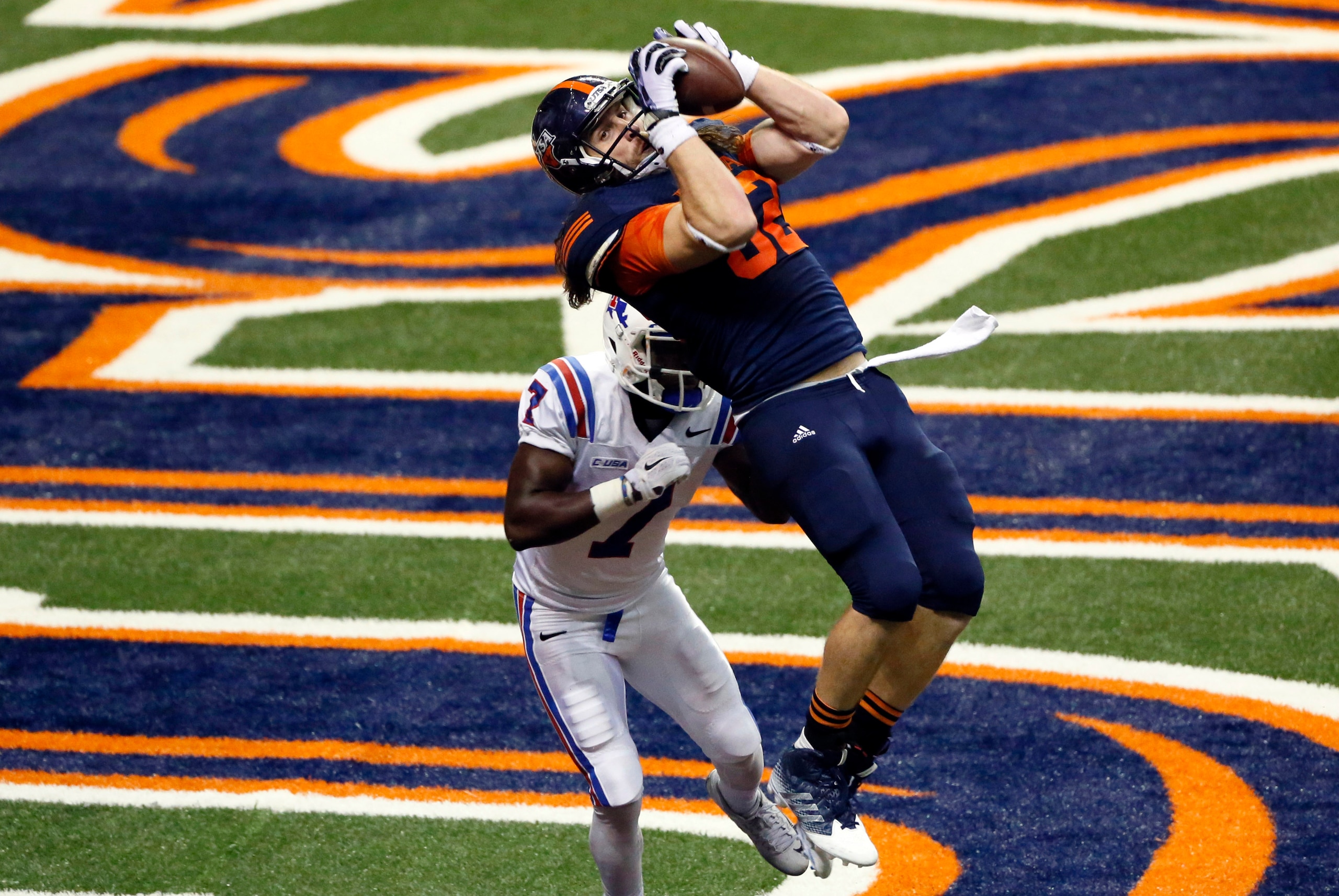
B/R Expert Scouting
"Reminded me of Maxx Williams from Minnesota last year in more ways than one. His skills are there from a get open, catch the ball with hands [standpoint], even in traffic, and making himself a target."
—Michael Felder
Hands
Very little went well for UTSA during the 2015 season, but one of the few bright spots was the emergence of David Morgan. Often injured in his career, he put it all together this fall and showed off a great catch radius that enabled him to grab at least three receptions in eight of 12 games while leading the team overall with 45 catches.
Route Running
The Roadrunners were young on the offensive line, which didn't give their quarterbacks much time to throw. Morgan served as a safety valve more than a target down the field, though in the red zone he was especially adept at finding an open spot, as he tallied five touchdowns on eight catches.
Speed
Morgan isn't particularly fast, but he has enough speed to get past a backpedaling defender as he runs upfield. It's his strength that stands out more, such as when he carried a Kansas State defender down the field after a reception.
Blocking
UTSA averaged fewer than four yards per carry in the run game this season, but 44 sacks taken had an impact on that average. When Morgan was in for run blocking, though, he often kept his edge sealed or helped work with tackles to build a solid outside running lane.
Overall
Named a second-team All-American by USA Today, Morgan is the first player in program history to earn such an honor. His contributions as a fifth-year senior prevented UTSA's rough season from being more dismal.
5. Austin Hooper, Stanford
5 of 9
B/R Expert Scouting
"He's a Stanford tight end—these guys are all cut from the same mold. But he's a little more agile than what we're used to seeing from those guys. A great catch radius."
—Matt Miller
Hands
Stanford has a knack for finding tight ends who have hands like vacuums, and Austin Hooper is the latest in that string that dates back to Coby Fleener and Zach Ertz. The difference, though, is that Hooper manages to do this all over the field and not just over the middle or on short routes.
Route Running
With a team-high six touchdown catches this season, Hooper has been targeted all over the field. He runs the seam well but can also handle the corner routes and is strong across the middle.
Speed
Hooper has average speed for a tight end who is as involved in the pass game as he is, though his ability to wiggle just enough to throw off a defender makes up for the lack of overall quickness.
Blocking
This is how Hooper got on the field in the first place two years ago, but his pass-catching ability has moved him away from the line on many plays. He can still handle the blocking assignments, but it's become less of a role for him.
Overall
Christian McCaffrey gets all of the headlines for his versatility as a rusher, receiver and return man, but Hooper is almost as versatile in his abilities. When Stanford needs a big play down the field, he tends to be the first person that quarterback Kevin Hogan turns to.
4. Jerell Adams, South Carolina
6 of 9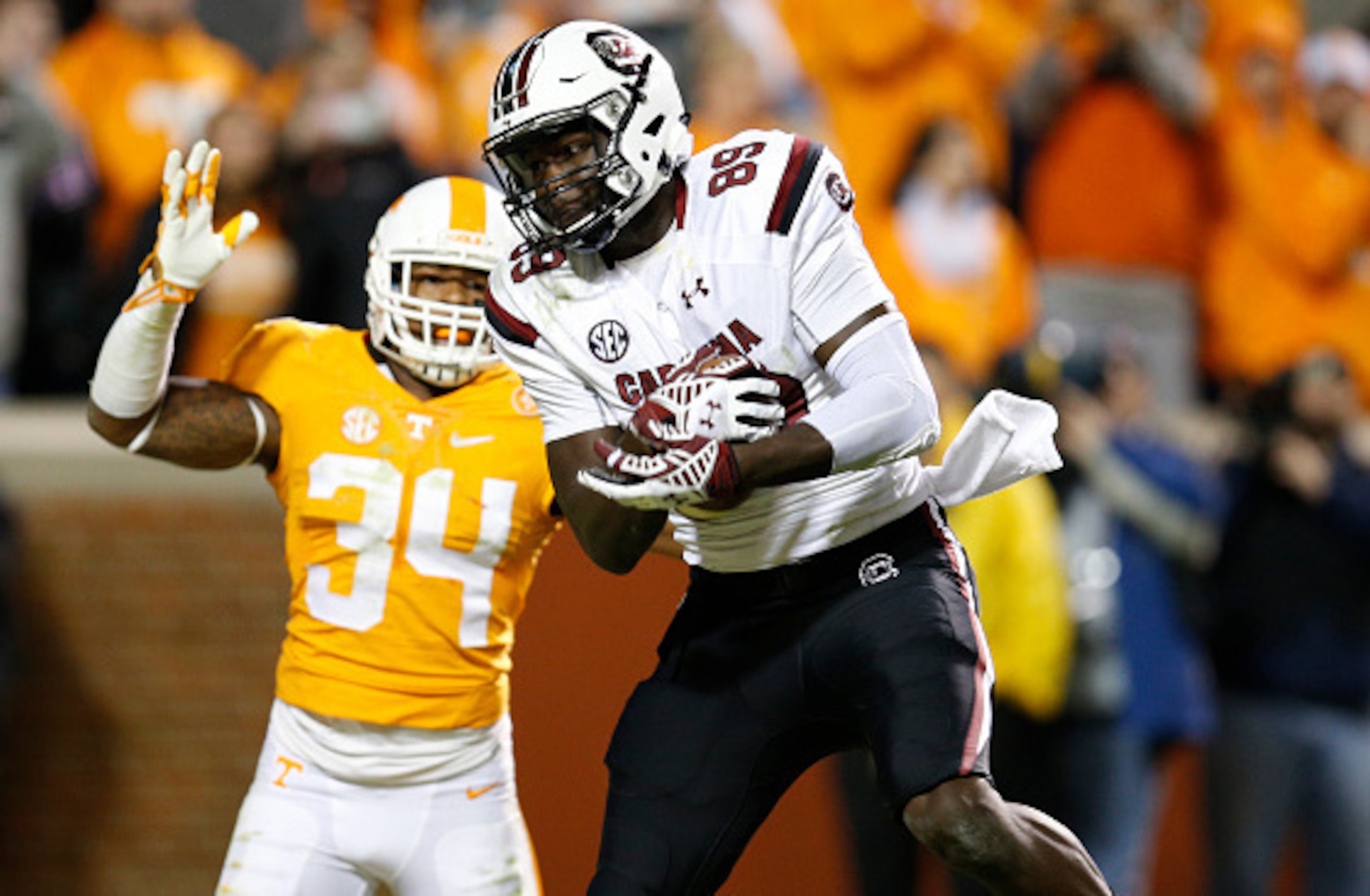
B/R Expert Scouting
"He's a matchup nightmare for a team that needed a safety valve. They needed a guy like that to be solid over the middle for young quarterbacks under pressure. He's been a difference-maker down the field at times."
—Barrett Sallee
Hands
Having a 6'6" target who can effectively catch the ball is a luxury that few teams have. Jerell Adams provided South Carolina with its only viable alternative to Pharoh Cooper and made some big catches this year, but he also had a huge fumble in the final seconds of the loss at Tennessee when he was careless with the ball in traffic.
Route Running
Adams isn't asked to make more than one move to either side after coming off the end of the line, but his size makes it possible for him to post up against defenders and not need to get much separation.
Speed
Surprisingly fast for a tight end, Adams gets on linebackers quicker than they expect, and then he's able to speed up even more as he moves down the field.
Blocking
Adams lacks the strength to take on the better defensive ends for more than a second or two. On run plays, if the back heads in his direction, he's just hoping not to get pushed back.
Overall
Bleacher Report NFL draft expert Matt Miller lists Adams as his "biggest riser" among draft-eligible tight ends, the product of the best season of his South Carolina career.
3. Jordan Leggett, Clemson
7 of 9
B/R Expert Scouting
"When [receiver] Mike Williams went down, that offense had to really evolve. He doesn't really look like a tight end, but he's a mismatch."
—Adam Kramer
Hands
Jordan Leggett's emergence this season as a reliable target all over the field has been one of the most underrated parts of Clemson's perfect record. He's the team leader in touchdown catches with seven and has been on the receiving end of four of Deshaun Watson's nine red-zone TD passes.
Route Running
Leggett measures up to other tight ends in terms of dimensions (6'5", 255 lbs), but he doesn't play the field like the prototypical guy at the position. He's used as much as a deep option as one who falls off the line and settles into a space, which makes him a matchup nightmare for defenders.
Speed
His ability to get behind defenders continues to catch teams off guard, leading to his being wide open on a lot of deep passes. Leggett also has the open-field quickness to find running lanes after making the catch.
Blocking
Because he spent most of his time in the slot or coming out of the backfield as an H-back, Leggett didn't get a lot of blocking assignments. On run plays he can hold his man adequately, but it's not a strength.
Overall
Before freshman Deon Cain and senior Charone Peake came alive during the second half of the season, Leggett was Clemson's second-best receiver behind Artavis Scott. He remains an underrated weapon who will only get better.
2. Jake Butt, Michigan
8 of 9
B/R Expert Scouting
"I know everybody just wants to make fun of his name, but he's such a good receiver. He just finds a way to get open. It's almost like Jason Witten—he's always open."
—Matt Miller
Hands
Even before he became a breakout star for Michigan this season, Jake Butt spent years honing his ability to catch anything that came his way. According to Mark Snyder of the Detroit Free Press, as far back as high school Butt would have his father throw tennis balls at him in rapid succession. That paid off right away in 2015, starting with a leaping grab over two defenders for a touchdown in the opener against Utah.
Route Running
The tight end isn't supposed to be a deep threat, but not all tight ends can stretch the field like Butt can. Small movements early on in his routes enable him to shake a defender and get wide open, and he's also able to cut one way or the other to create space.
Speed
He's no burner, but Butt also isn't a lumbering target. Eighteen of his 48 receptions went for 15 or more yards, including six that went for at least 25, and in many cases that was because he outran the slower defenders before making the catch.
Blocking
This is the area of Butt's game that needs the most work, especially as he progresses toward the next level. Mostly because Michigan didn't expect much of him when it came to helping with the run, his experience in this area was limited in 2015.
Overall
Only Amara Darboh caught more passes this season for Michigan than Butt, a weapon that head coach Jim Harbaugh and his staff pulled out of the heap of last year's team and turned into a top option. Butt is one of the top go-to players at his position in the country.
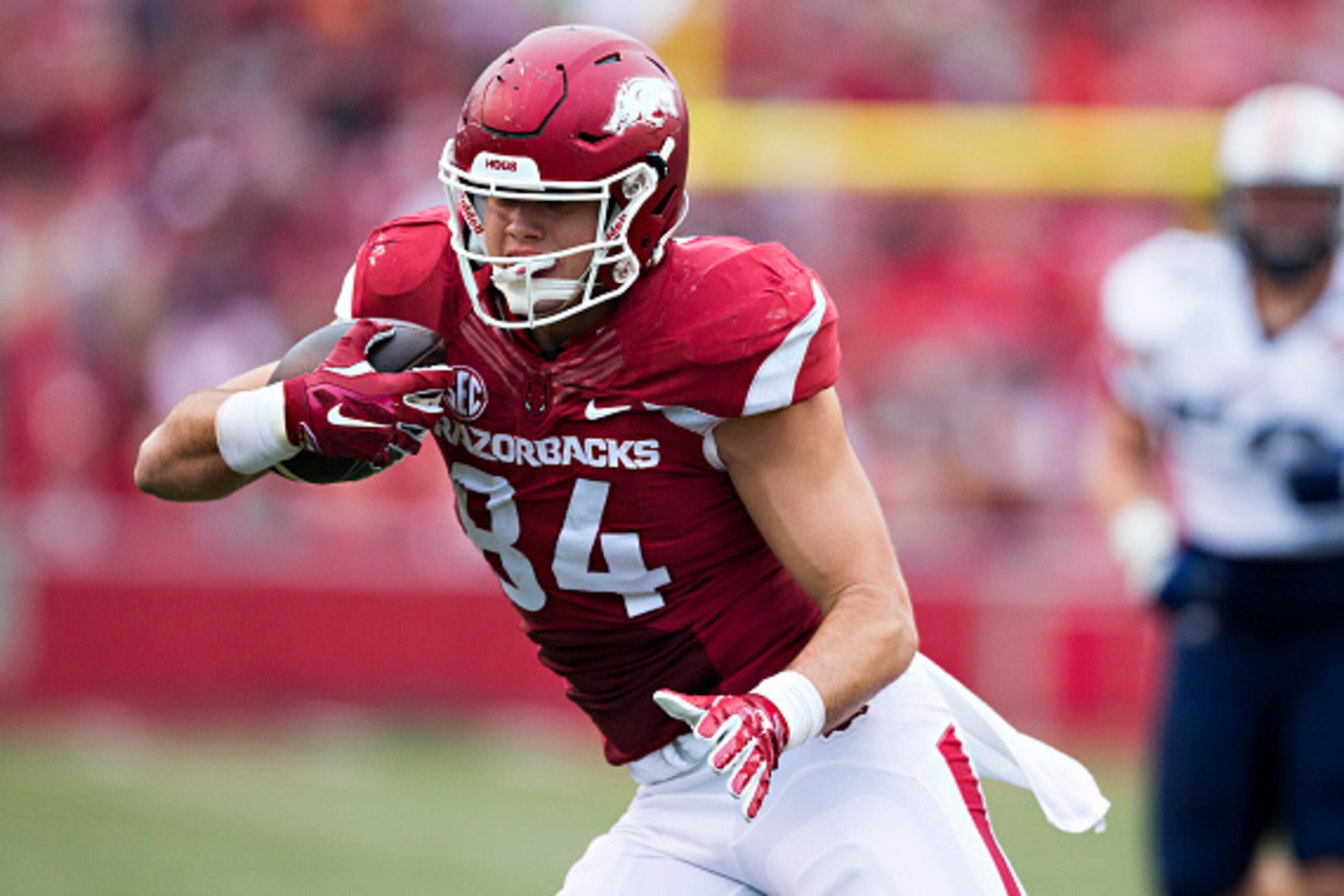
1. Hunter Henry, Arkansas
9 of 9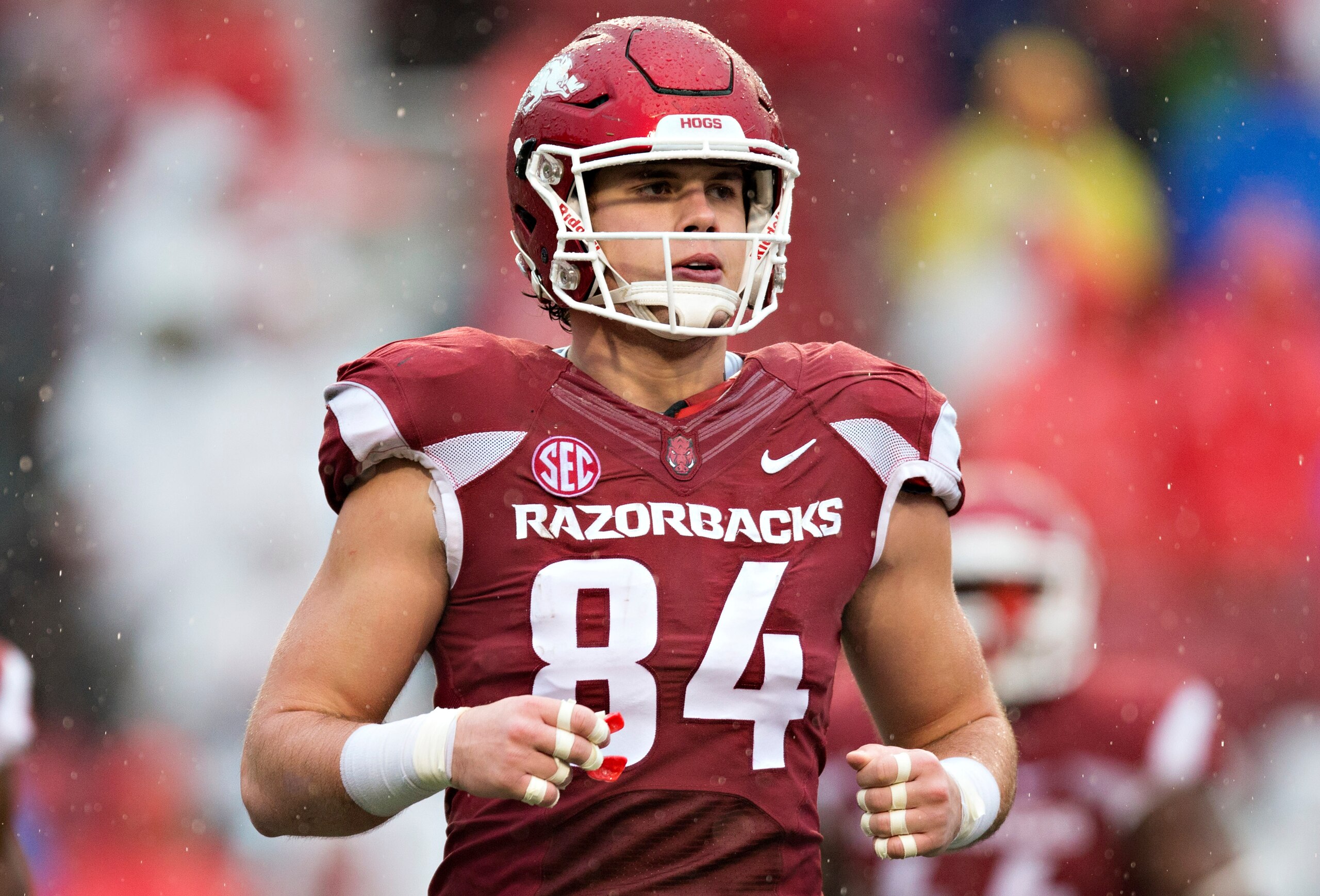
B/R Expert Scouting
"Hunter is a better blocker than people give him credit for. He's a mismatch up the seam for [quarterback] Brandon Allen. It's impossible to take into account everything they do with him because he does everything well."
—Barrett Sallee
Hands
Few teams use the tight end more in the receiving game than Arkansas, and a big reason for that is how adept Hunter Henry is at hauling in passes. He's great at pulling the ball quickly into his 6'5", 253-pound body and securing it well enough to keep moving down the field.
Route Running
Henry will spend as much time split out wide as he does on the edge of the line, but regardless of where he starts, he gets into position to make a catch. He's not the normal outlet you'd expect from a tight end, and he doesn't stick to just seam routes.
Speed
Because of his size, opponents tend to put a linebacker on him to try to body up to Henry. That's a mistake. Since he doesn't run like a 250-pounder, he gets up the field much quicker.
Blocking
The pass became a much bigger part of Arkansas' repertoire this season, but running the ball was still the bread-and-butter play. Despite being more of a receiving threat, Henry rarely left the field because he can handle edge-blocking assignments as well as any tight end in the country.
Overall
Henry has become more involved in Arkansas' game plan with each passing season in Fayetteville. He was the team's second-leading receiver for a third year in a row, and his reliability near the line of scrimmage and at the second level helped open up the deep routes for wide receivers.
.jpg?w=2560 "Auburn Trade Secrets Football")


_0.png?w=2560 "MLB Wild Card Game 1 Slate 🍿")