Academic Rankings and Conference Realignments
The first article I placed on Bleacher Report was to poke fun at my Texas Longhorn buddy: http://bleacherreport.com/articles/402794-wildcard-in-the-race-to-land-texas-and-texas-am.
I have been thinking about that article again as I hear more about how Texas agreed to move to the Pac-10 because of academics. In this rendering, Texas was merely looking to get into a neighborhood more appropriate for its academic stature.
US News & World Report has issued rankings of universities: http://colleges.usnews.rankingsandreviews.com/best-colleges/national-universities-rankings. It is a given that neither the SEC nor the Big 12 (in either its ten- or twelve-team configurations) can rank very high, and thus they are not tabled below. The ACC, Big Ten, and now Pac-11 are shown. Keep in mind that the list includes all the universities, not merely those that play major college football. Also, there are ties.
TOP NEWS
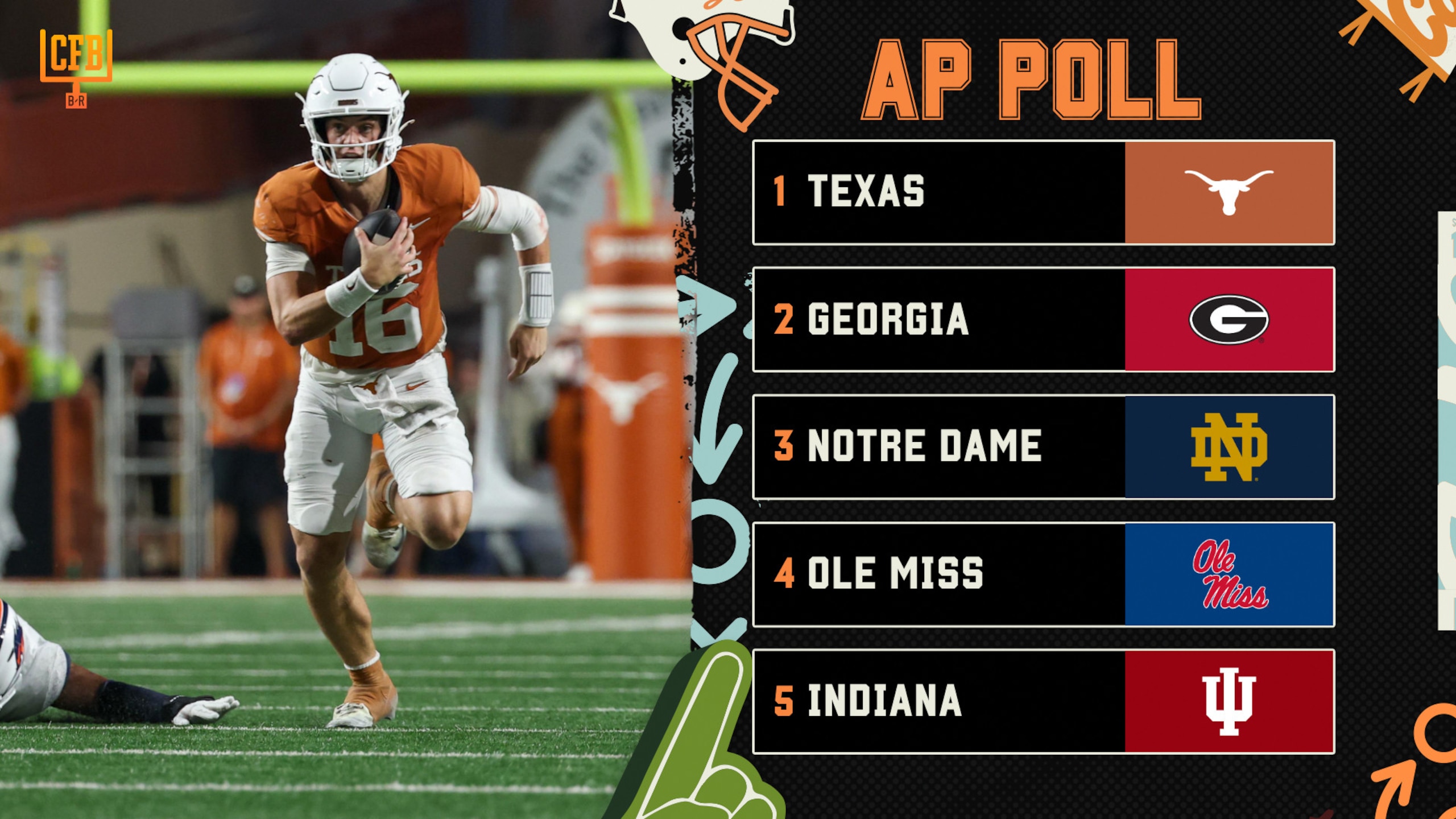
Week 3 CFB AP Top 25 Poll
Trinidad's Locker Room Pic 🥶

Top CFB winners and losers after dramatic slate
Big Ten Pac-11 ACC
12. Northwestern 4. Stanford 10. Duke
27. Michigan 21. Cal 24. Virginia
39. Illinois 24. UCLA 28. North Carolina
39. Wisconsin 26. Southern California 28. Wake Forest
47. Penn State 42. Washington 34. Boston College
53. Ohio State 77. Colorado 35. Georgia Tech
61. Purdue 102. Arizona 50. Miami
61. Minnesota 106. Washington State 53. Maryland
71. Indiana 115. Oregon 61. Clemson
71. Michigan State 121. Arizona State 71. Virginia Tech
71. Iowa Tier 3 unranked Oregon State 88. North Carolina State
96. Nebraska 102. Florida State
The first observation that must be made is that the Pac-11 has a Tier 3 school and four other schools ranked in triple digits. In other words, if Stanford were to leave the Pac and be replaced with Boise State, the conference, in terms of academics, would be almost the SEC of the West.
Are Texas administration officials so uninformed that they think that Texas going to the Pac, along with Tier 3 Big 12 schools Texas Tech and Oklahoma State and No. 102 Oklahoma, would be a major step up academically?
As in golf, low scores in these rankings win. If you add up the Big Ten scores and divide by 12, you get an average of 54. If you add up the ACC scores and divide by 12, you get an average of 49.
It is very much like in football: prejudices assume the Big Ten and even the Pac-11 are better than the ACC. But they do not hold up under close scrutiny.
The second observation that seems appropriate is that BYU, which Pac-11 fans bleat endlessly is too far beneath the conference academically to even be considered a possible member, is ranked No. 71. BYU is ranked ahead of six Pac-11 schools, including new member Colorado that most see as the academic shining light of the Rockies.
As an ACC fan, I conclude that the expansion of the ACC is on the horizon, to 14 or even 16 teams. Like most, I do not expect the Big Ten or the Pac to be finished. And it is a given that the SEC still would love to land Texas, A&M, and Oklahoma. So the ACC is prepared to expand to keep pace.
Texas is ranked No. 47, and A&M is ranked No. 61. Texas would be tied for fifth in Big Ten academic rankings, but only seventh in the ACC. I expect the Big 12 to be saved only temporarily, and then Texas and A&M to join the SEC. But if they want an academic step-up, the ACC is easily the best choice.
Notre Dame is No. 20 and would be the second highest-ranked school in both the ACC and the Big Ten. The difference, of course, is that the ACC has four private schools, with Wake Forest being the smallest school in a BCS AQ conference, and several smaller state universities, while the Big Ten has one larger private school and a string of huge state universities.
There are four Big East football schools that the ACC would be willing to add: Pitt (No. 56), Syracuse (No. 58), Connecticut (No. 66), and Rutgers (No. 66). All four would be near the bottom of the ACC, but above the new additions to the Pac and the Big Ten.
It indeed seems to be true that the conferences that excel at lacrosse are the best academically.

.jpg?w=2560 "Monken's NSFW Browns Quote 🤬")