

Q&A with Bill Hancock, Executive Director of College Football Playoff
ATLANTA — The third installment of the College Football Playoff will take place on New Year's Eve, with the Fiesta Bowl and the Chick-fil-A Peach Bowl acting as the national semifinals in 2016. The College Football Playoff National Championship will take place at Raymond James Stadium in Tampa, Florida on Mon., Jan. 9, 2017.
What lessons have been learned during the first two years of the playoff? How will tweaks to the semifinal dates change the way consumers view the matchups?
College Football Playoff executive director Bill Hancock and Chick-fil-A Peach Bowl CEO Gary Stokan sat down with Bleacher Report to discuss the CFP, where it's been, where it's at and where it's going.
TOP NEWS

Biggest CFB Surprises After Week 2 👀

New CFB Playoff Projections 🔮
-(1).png?w=2560)
CFB Week 2 Winners & Losers 📊
Bleacher Report: You've made the announcement that the national semifinals aren't always going to be on New Year's Eve after ratings issues last year, even though this year's will once again be played on Dec. 31 (on a Saturday). Do you regret trying to make New Year's Eve a college football celebration?
Bill Hancock: No, we don't regret it. We tried to do something on New Year's Eve and discovered that wasn't really the best thing to do. I'm so happy that our board was flexible enough to make a change. So the semifinals will either be on a Saturday or a national holiday for the next 10 years. We only had to change four years to make it happen.
We were charmed in the first year—not only because we had it on New Year's Day, but because we had two Heisman Trophy winners (Florida State's Jameis Winston and Oregon's Marcus Mariota)—and we had the curiosity of a new event. Some of that went away in the second year, including the New Year's Day games.
We tried to do something special, and upon further review, we're going to make a change.
Gary Stokan: In leadership, you have to have a vision. Bill and the committee had a vision of what they wanted to do with New Year's. We, as the Peach Bowl that has been a staple of New Year's Eve and had four of the top 10 rated non-BCS games in ESPN's history.
I credit Bill for his willingness to reach out to the six New Year's bowl games and talk about the good, bad and ugly of New Year's Eve in the future. I remember Bill specifically asking me, "You've played on New Year's Eve for 19 years; what works and what doesn't?" I credit Bill to think about best practices and ask people.
Bill likes to say that there's a family of college football, and that's part of leadership—to be willing to reach out—that Bill deserves credit for.
It's hard to say, "Hey, we were wrong and maybe our vision isn't the best way."
BH: Good grief. When you're wrong, you have to be willing to say it. It's like the lame apology of "I'm sorry if this offended anyone." Just say, "I'm sorry."
As we've all seen, ratings are going down. Viewership is going down. There are other ways to watch games. The NFL has that. We've seen it in the men's basketball tournament and the Olympics. We decided that we can give more people a chance to enjoy what we are doing in the semifinals if we stuck to Saturdays and holidays.
GS: Plus, Saturday is college football's day.
B/R: It seems like there were three drawbacks to last season's semifinals: the fact that it was on New Year's Eve, people being at work for one or both semifinals and games that got out of hand on the scoreboard. What was the biggest contributing factor to the ratings decline?
BH: Our research showed that those were the top three reasons. Most people felt like the top reason was the fact that it was a work day.
B/R: On semifinal Saturday this year, which is New Year's Eve, do you think that ratings will improve simply because it's a Saturday and not a work day?
BH: Yes, we do. Absolutely.
GS: Being in the bowl business for 19 years, it also helps attendance. Not that it's a big issue for the semifinals, but it makes it easier for people to come.
B/R: You've been doing this for two years now, and everybody was new at it when you started the playoff after the 2014 season. Were there any surprises, changes, disappointments or anything that stood out to you in the voting process—which includes a descending pool system of voting and discussion—once the playoff became a real thing?
BH: Good question. We've been through it two seasons, and we are not making any changes this year. We found that the protocol works and the whole philosophy that the committee operates under works.
First of all, integrity. And then the mechanics of how they vote—grouping small groups of teams that can be compared together, first in groups of three and then, in the last four steps, in groups of four down closer to the bottom of the rankings. That works. The concept of creating small groups of teams that can be evaluated against each other allows the committee members to dig deep and not overlook anything.
I'm pretty fond of saying, "It's not your father's college football rankings," where everybody drops their top 25 on a table, somebody averages it out and that's it. This is way, way, way different than anything that's ever been done in college football, and it works. We decided not to make any changes.
B/R: Because it is behind closed doors, there could be a perception that the process is flawed. Yet, the CFP does mock-selection exercises with media members and bowl representatives every year, including early this month when Gary participated. How important is it for you, personally, to hold those mock-voting meetings to ensure as much transparency as possible?
BH: One of our goals the first day that we created the playoff was to make it as transparent as we can. That's still a goal for us. The mocks are a big way that we do that.
GS: Big time.
BH: It's still a new event, so fans are still learning about how the process works. And the mocks are a great way for the public to know how the process works.
GS: Having gone through it, you really grow an appreciation with the process. When you do a top 25, you put one team at No. 9 and one team at No. 15. We didn't do it that way in the mock-selection process. Taking those six rounds of three and four teams per pool, you really do get it right because of the process and the data that the CFP provides. It really makes a difference, and Bill has done a great job of trying to make the process as transparent as possible.
It really works.
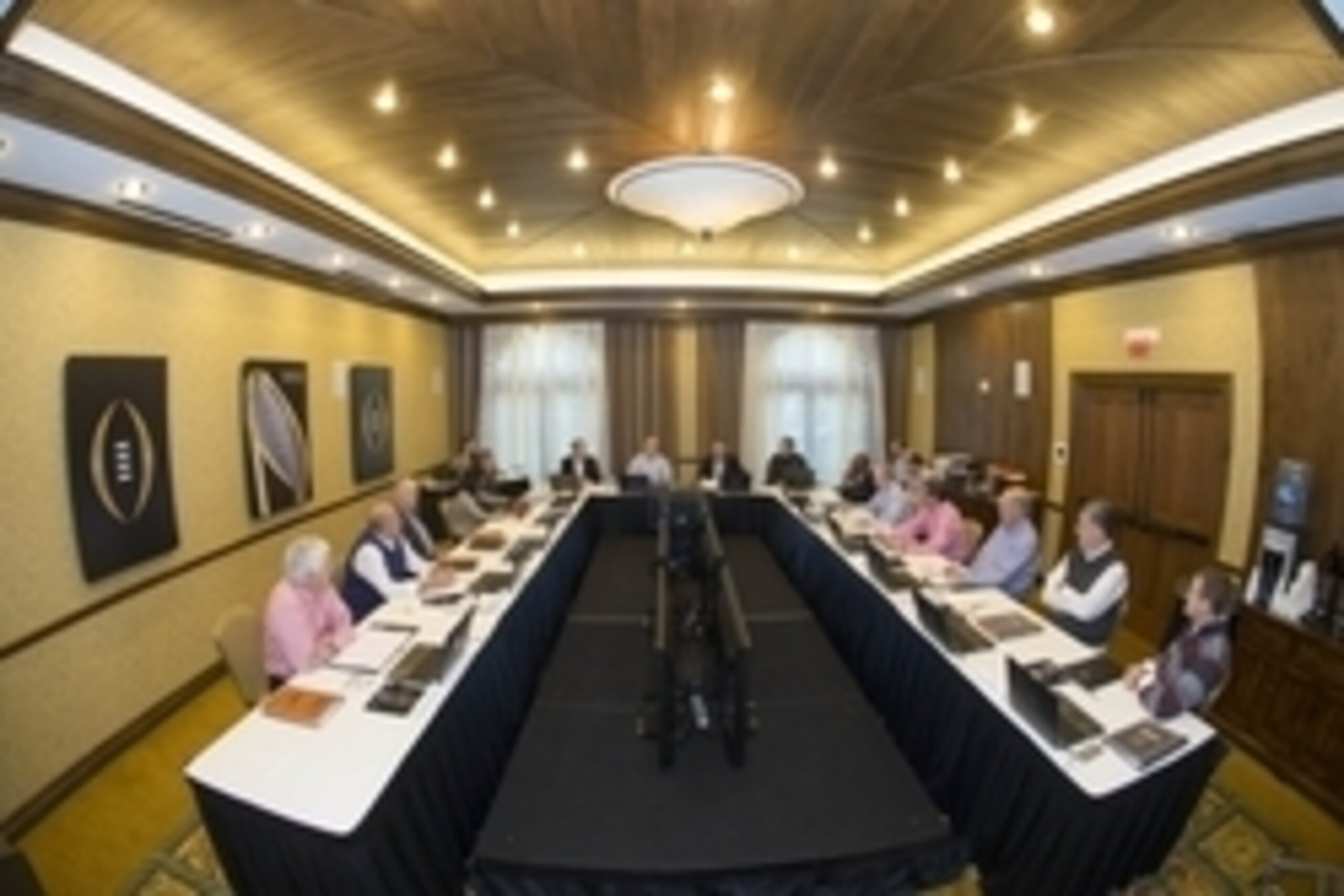
B/R: Gary, you went through the mock process this month. Even though you've been in this business for more than 20 years and know a lot about it, was there anything that surprised you?
GS: The process.
I didn't know how they got to the top four or the top 25. Those top three—you don't think about where you're ranking them. You just look at the teams, who's better, and put Team X ahead of Team Y. It takes the geography out of it and personal loyalties out of it due to recusals.
But on the other side, I also like the fact that if you feel like a team should be ranked somewhere else, you have to have three votes to go along with your desire to revote. That's a key point as well. You have to make a meaningful presentation to either sway or persuade three other people to go along with you, and then they have a revote.
BH: I think a cool thing, too is, when you get to the second round and are ranking teams four, five and six, you're not even thinking about teams 21 and 25. There are just six teams in that pool, and you're only focused on those six teams and rank those into a top three in that pool, which get slotted in spots four, five and six in the rankings.
B/R: These two national semifinals are in two completely different areas of the country, with the Peach being in Atlanta and the Fiesta being in Glendale, Arizona. How important is it to the selection committee to reward the higher-ranked teams with geographically attractive sites for their matchups?
BH: It's not critical to the success of the event; we found that out in the first two years. The semifinals are going to be off the charts in popularity, no matter who's in the game. On the other hand, we want to make it as easy as possible for the fans of the teams to go see their teams play. So that's why we have a clause in the protocol that guides the committee in how they rank the teams. So they rank highest two ranked teams based on convenience for the fans, home-crowd advantage or disadvantage and whether the folks are comfortable and have experience in the city.
As far as success for the event, it doesn't really matter. As far as the experience for the fans, that's certainly part of our goal.
Quotes obtained firsthand unless otherwise noted. Statistics courtesy of CFBStats.com unless otherwise noted. All recruiting information is courtesy of Scout.com. Odds provided by Odds Shark.
Barrett Sallee is the lead SEC college football writer and national college football video analyst for Bleacher Report as well as a host on Bleacher Report Radio on SiriusXM 83. Follow Barrett on Twitter @BarrettSallee.
.jpg?w=2560 "Grading WWE Raw 🔠")


.jpg?w=2560 "Nabers' Recent IG Post 👀")
.jpg?w=2560 "Landon Dickerson Placed on IR")