

How Money and Boosters Made Coaching College Football Such a Miserable Job
College football doesn't have a Mark Cuban or a Jerry Jones or a Jim Irsay, billionaires who own and control everything. This is an operation centered mostly around our higher education system, in many cases public institutions, owned and controlled by you, the taxpayer, and…
Ha! Not even close. At some point, it might have been something like that. But what we see now is an increasing number of billionaires taking charge of the third most popular sport in America and all but buying up school teams as their own little playthings.
"The world of intercollegiate athletics has grown indebted to what I call the pseudo-owner," said Rick Neuheisel, former coach at UCLA, Washington and Colorado and now a CBS analyst. "It's basically a sign of the times. When you are running on a very thin margin, you become in need of great support from boosters and alumni.
TOP NEWS
Mel Kiper's Brutal Arch Take 😬
🚨 Week 7 AP Top 25 Poll
8 Overreactions after Week 7 of CFB Season 😬
"The well-heeled of those, if they're the personality that likes to be in control—which is usually how they got their great fortunes—find themselves wanting to make decisions."
That's not just an observation. It is an explanation for the insane pressure and the decisions that are being made in the coaching profession.
| 2001 | 8-4 | Music City-L |
| 2002 | 13-1 | Sugar-W |
| 2003 | 11-3 | Capital One-W |
| 2004 | 10-2 | Outback-W |
| 2005 | 10-3 | Sugar-L |
| 2006 | 9-4 | Chick-fil-A-W |
| 2007 | 11-2 | Sugar-W |
| 2008 | 10-3 | Capital One-W |
| 2009 | 8-5 | Independence-W |
| 2010 | 6-7 | Liberty-L |
| 2011 | 10-4 | Outback-L |
| 2012 | 12-2 | Capital One-W |
| 2013 | 8-5 | Gator-L |
| 2014 | 10-3 | Belk-W |
| 2015 | 9-3 |
Take this as context for what Mark Richt, Georgia's longtime and highly successful coach, said in a press conference Monday about his firing:
"I think the expectations have been built to the point," Richt said, "where if you don't win a championship, it's kind of miserable around here."
Welcome to the new definition of the college coaching profession.
Meanwhile, Georgia athletic director Greg McGarity said he wouldn't discuss exactly why Richt had lost his job, saying only "there were a lot of things we talked about."
It's not fair to offer up some sort of subtle, uncertain reasoning like that. It makes you wonder if there's something deep and dirty going on. Well, there isn't. And there isn't in the case of Les Miles, either.
Miles won a national championship at LSU, played for another one and won two SEC titles, but reportedly he has been coaching for his job the past few weeks. And that is just so absurd. One week, LSU was ranked No. 2 in the country with the Heisman Trophy favorite playing running back—and two weeks later, Miles was on the hot seat.
Coach after coach has been fired this season. They've been going at an incredible rate, starting with Tim Beckman at Illinois, who didn't even make it to the season opener.
So what's going on? Well, this is a overgeneralization, but here goes: College football is fast becoming a sport run by sugar daddies using the game for their egos, much like you see in pro sports. When it comes to sports, these rich boosters tend to have, roughly, no idea what they're talking about. They want immediate results in a sport that's all about player development.
And the athletic directors who are supposedly hiring and firing coaches all over the place?
They do what they're told.
"It makes the entire coaching industry look precarious, no question about it," Neuheisel said.
As a prime example, Neuheisel pointed at the situation at Oklahoma State. That's where Mike Holder, a golf coach with relationships with big-money donors, was promoted to athletic director—and shortly after that, one of those donors, billionaire T. Boone Pickens, gifted an unprecedented $165 million to the school.
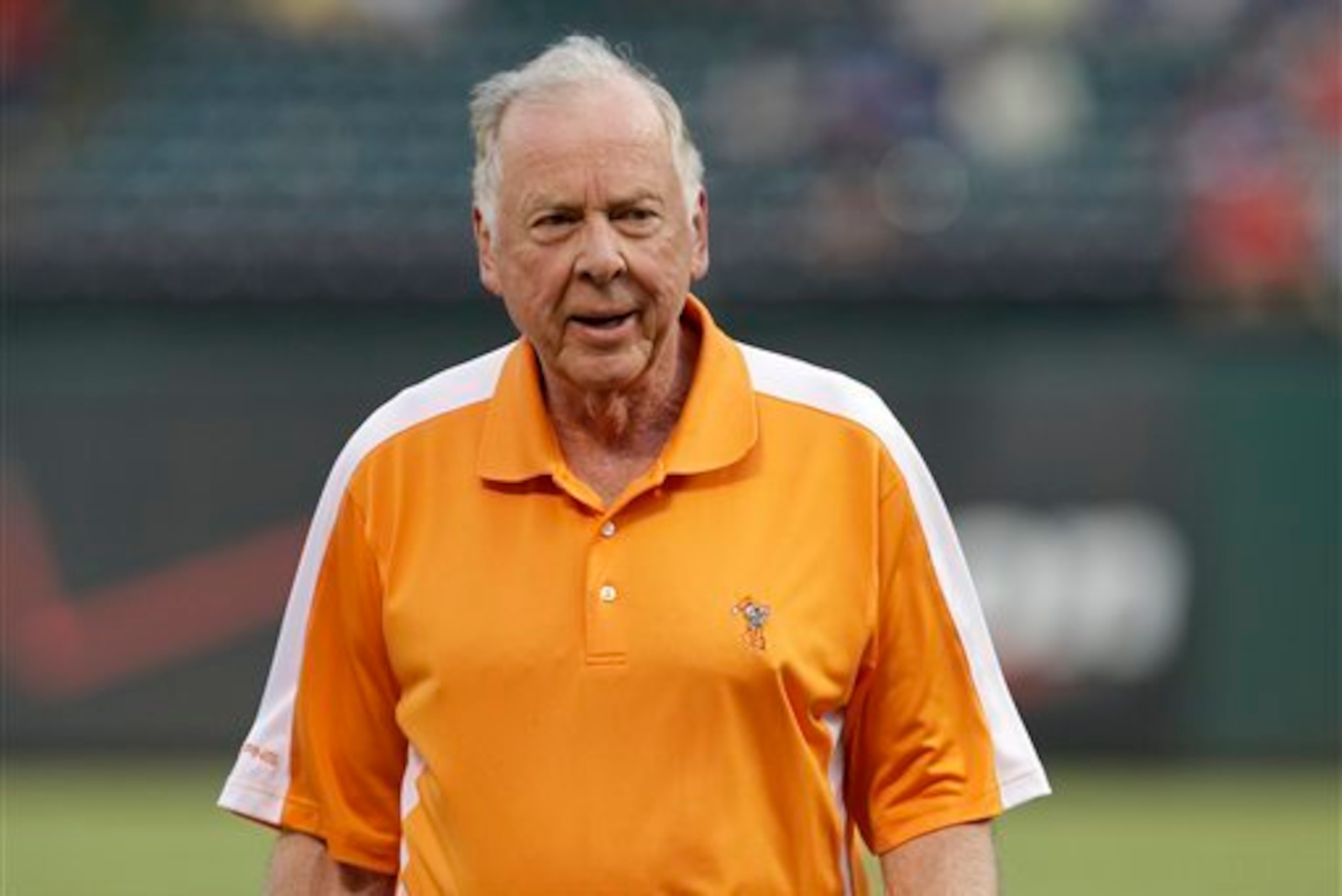
"He was the one who went out and tried to get T. Boone Pickens to help the program," Neuheisel said. "That's how he got to be the guy.
"Unfortunately, because of [the pseudo-owners'] businesses and their inability to really get close to the program, they don't go to practice, don't see how close things are."
That's not to pick on Pickens. It's just to show how college football works.
Two years ago, Phil Knight built Oregon football a palace of a football facility, complete with imported Brazilian wood floors in the weight room. Knight has his own locker, labeled "Uncle Phil." Texas A&M's pseudo-owners ponied up for a nearly half-billion-dollar renovation to make a statement out of a football stadium. And at Texas, reports are that the boosters are ready to come up with however much money it would take to get Alabama's Nick Saban to coach the Longhorns.
There are just so many dollars flying around with ESPN and the College Football Playoff, and everything is escalating. The sport is blowing up like a balloon with too much air in it. The money is there to be won, and the way to win it is to pay for a big-dollar coach, whom you get with big-dollar facilities, which can lure top recruits.
At some point, you wonder if this is a bubble that will pop. But for now, the economy of the sport just keeps growing.
That means a demand for instant and massive returns. And who's to blame when the returns aren't there right now?

Coaches. And it is changing the entire profession.
The game isn't built like the NFL, where if a player isn't good enough, he is replaced with a free agent. Despite the success of some freshman quarterbacks the past few years—such as Marcus Mariota, Johnny Manziel and Jameis Winston—the game is still a slow development.
"Oh man, I hate it," Clemson coach Dabo Swinney said. "I think it's really sad to be honest with you. And you've got a lot of people out there that may say, 'Well, yeah, these guys make a lot of money and this and that, blah, blah, blah.' You know, it's a great job but a bad business, and that's the world we live in now…
"Nobody is going to feel sorry for the coaches, but I know this: This is also a profession and there's real people involved with real feelings and real families."
Swinney wondered whether there would ever be another Frank Beamer, who quit Virginia Tech this year after 29 seasons.
North Carolina coach Larry Fedora called it a "microwave society."
"There's people out there who think it's easy to win," Fedora said. "It's not easy to win. It's very difficult to get 120 players to all pull in the same direction, to be selfless when that's not the way society teaches you to be.
"Society teaches you to get things now, right now, for yourself and not worry about anybody else. … That's not really the way you build a team or that you sustain success with a team. So for the people that are usually uneducated about what it takes to win, you know, they make rash decisions like that."
Neuheisel agreed and pointed to his own firing at UCLA. He said a coach has to identify his team's needs and fill them with a few years of recruiting classes that build a team with the coach's personality. And then, pseudo-owners shouldn't be swayed by a key injury. Neuheisel felt he had recruited the answer to UCLA's problems in quarterback Brett Hundley. But then he never got to coach him. He was fired after four years on the job, and coach Jim Mora immediately started to have success.
With Hundley at quarterback.
But that's just how it goes now. Across the country, from preseason to midseason to soon postseason, firing after firing.
The coaching profession has changed.
Greg Couch covers college football for Bleacher Report.

.jpg?w=2560 "🚨 Davante Out 6-10 Weeks")
.jpg?w=2560 "Tank Dell Playing Sunday 💯")
.jpg?w=2560 "Rams' New Kicker Placed on IR")