The New Woody and Bo? Urban Meyer and Jim Harbaugh Bring New Hype to 'The Game'
A native of Galena, Ohio, located just a half-hour drive from Ohio Stadium, Joshua Perry's relationship with the Ohio State-Michigan rivalry isn't unlike that of the other 20-somethings who grew up around "The Game."
In the '90s, he saw Wolverines head coach Lloyd Carr dominate and ultimately be one of the primary reasons for OSU's firing of John Cooper following the 2000 season. That was followed by an ongoing stretch that's seen the Buckeyes win 11 of their last 13 matchups against "That Team Up North," which now finds itself on its third head coach since Carr retired eight years ago.
So despite the unevenness—on one side or the other—that Perry's seen in the rivalry over the course of his life, you'll have to excuse him for not wanting to diminish the recent meaning of The Game as he prepares to play in his fourth edition of it. Which is why the Ohio State linebacker offered a unique analogy when asked about a potential "restoration" of the rivalry.
TOP NEWS

Deion Playbook Found at Hotel

Week 5 AP Top 25 Poll 🔢
Top Overreactions after Week 5 of CFB Season 😧
"'Restore,' to me, means that it went to crap and is dilapidated, and some hipsters went and bought it, not to live in but as an investment, and they're trying to flip it right now," Perry said at Big Ten media days in July. "That's not what this is."
Still, the Buckeyes' resident fashion expert conceded of the rivalry, "It hasn't been what it was."
But as Perry's final game against the Maize and Blue approaches, even he admitted that this year's game is unlike any other—and not just because both Ohio State and Michigan find their Big Ten title hopes on the line against one another for the first time since 2007, both needing help from Penn State against Michigan State later in the day.
With the addition of Wolverines head coach Jim Harbaugh, the stakes for both teams are now secondary in a rivalry that already includes one of college football's most prominent sideline stalkers, Urban Meyer.
And as the first showdown between Harbaugh and Meyer approaches, it's hard not to notice a palpable buzz building.
"It's always big to be a part of the first of something," Perry said Monday. "It's kind of the start of an era."
Saturday will mark the first official head-to-head battle between the two distinguished head coaches, with the eighth-ranked Buckeyes heading to Ann Arbor for a 12 p.m. ET kickoff with the No. 12 Wolverines. But it won't mark the first time the two coaches have simultaneously taken part in college football's most storied rivalry, as their collision course has been more than a quarter-century in the making.
The Guarantee
While Meyer wasn't able to leave his mark on The Game until the clock struck zero on Ohio State's 26-21 victory in 2012, Harbaugh first had his name etched in Michigan lore 29 years ago.
Needing a win against the Buckeyes to clinch a trip to Pasadena to play in the Rose Bowl, Harbaugh, then the senior quarterback for the sixth-ranked Wolverines, laid the groundwork for his confident reputation by issuing a guarantee that Michigan would beat Ohio State in the 1986 edition of The Game.
The eventual Heisman Trophy finalist made good on his promise, completing 19 of his 29 attempts for 261 yards in what was ultimately a 26-24 Wolverines win.
"It’s legendary in regards to historic tales of Michigan football," said Ken Magee, an Ann Arbor native
and author of The Game: The Michigan-Ohio State Football Rivalry.
And while Harbaugh has been reluctant to discuss his infamous guarantee—"That was a long time ago," he said following the Wolverines win over Penn State on Saturday, "in my youth"—Meyer remembers it well.
Then a graduate assistant working with the tight ends for the Buckeyes, Meyer was a member of former Ohio State coach Earle Bruce's staff when Harbaugh vowed victory. Asked about it Monday, the fourth-year Buckeyes head coach recalled the play that ultimately settled the score 29 years ago, a missed field goal by Ohio State kicker Matt Frantz.
"I do remember that," Meyer said of Harbaugh's guarantee. "And I remember us missing a wide-left right at the end as the clock ticked zero."
A year later, Harbaugh would begin what would prove to be a 14-year career in the NFL, while Meyer would begin his ascent up the coaching ranks, only after being fired from Ohio State as a part of Bruce's staff following the 1987 season.
But for both Harbaugh and Meyer, all roads would lead back to The Game.
The New Woody and Bo
In today's landscape of college football, you'd be hard-pressed to find two personalities more dynamic than the current head coaches at Ohio State and Michigan.
Meyer is more reserved but often intense. Success has followed him in head coaching stops at Bowling Green, Utah, Florida and OSU, resulting in three national titles in a 14-year head coaching career, including the Buckeyes run to last season's College Football Playoff championship.
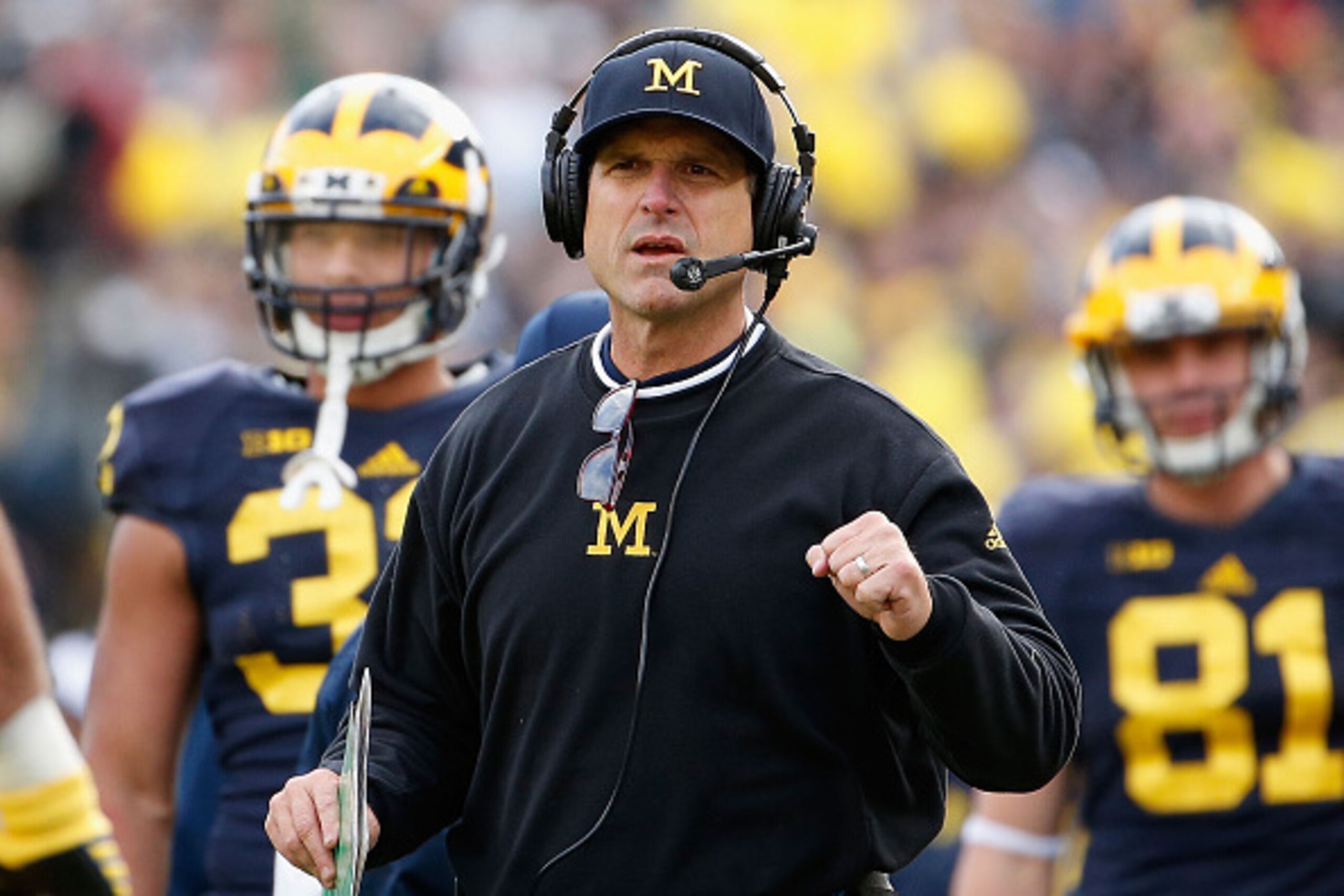
Harbaugh, meanwhile, hasn't quite seemed to make the full transition from player to coach, still wearing cleats and coming up with quirky sayings while completing turnaround jobs as the head coach at San Diego, Stanford, the NFL's San Francisco 49ers and now his alma mater.
The combination of the two hasn't proved to be a combustible mix just yet, save for a few thinly veiled run-ins on the recruiting trail.
Then again, the two have yet to coach a game against one another, which part of what makes Saturday's matchup so highly anticipated.
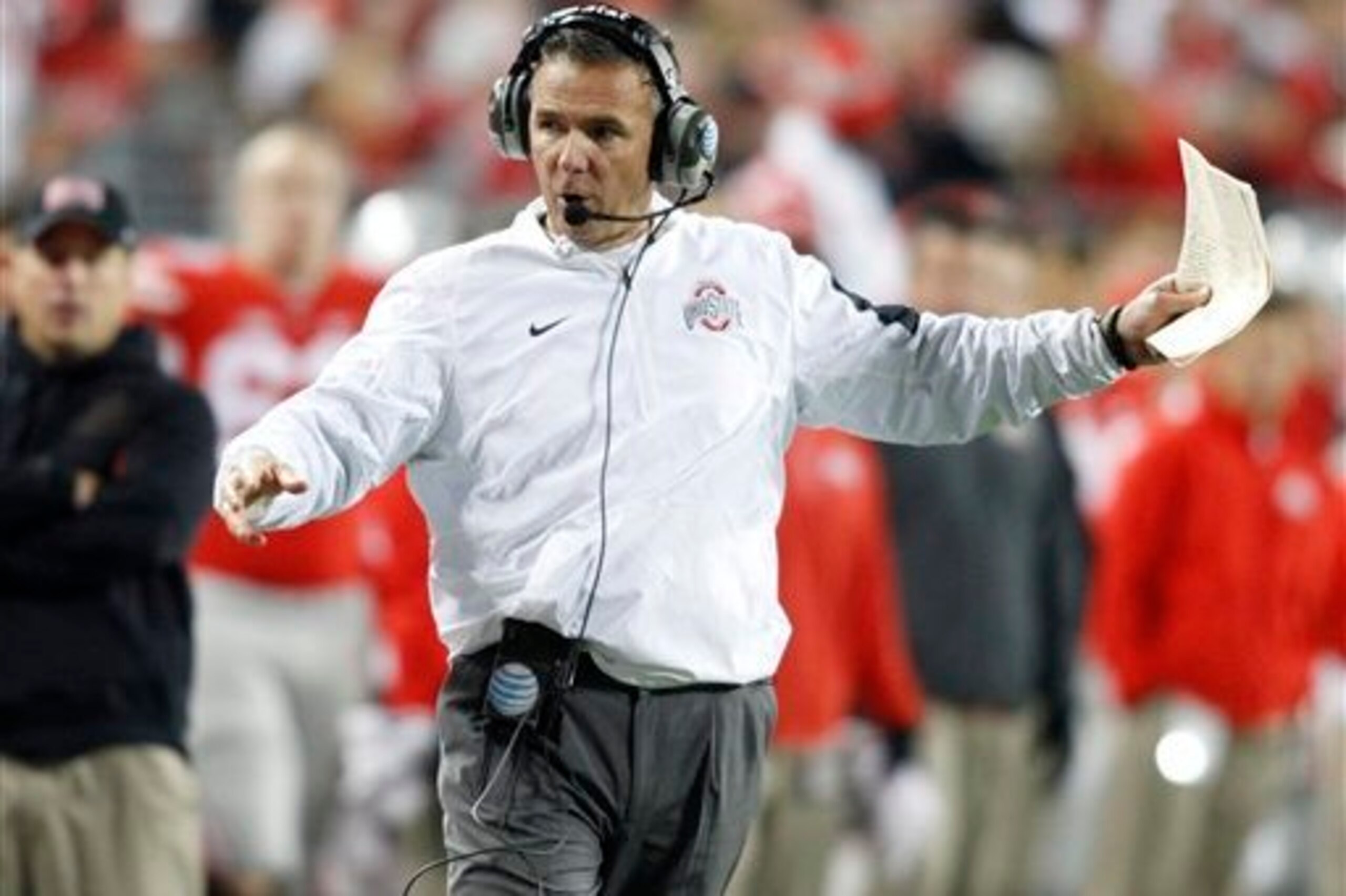
"Spice, intensity," ESPN College GameDay analyst and former Ohio State quarterback Kirk Herbstreit answered when asked by Bleacher Report what Harbaugh will add to the OSU-Michigan rivalry. "Even when Ohio State was winning [in the 2000s] with Jim Tressel, the fan in me liked Woody [Hayes] and Bo [Schembechler]. The fan in me liked the angst, the emotion—the 'I'm not going to cross midfield to shake his hand.' Just all the stories that you would hear.
"I don't know if we're going to get to that level with Urban and Jim, but it's going to be different."
Meyer idolized Hayes while growing up in Ashtabula, Ohio, before joining the staff of Bruce, whom the fiery former Buckeyes head coach mentored. Harbaugh played for and often references Schembechler, for whom his father, Jack Harbaugh, served as an assistant coach in the 1970s.
"They were legendary in their own way," Magee said of Hayes and Schembechler. "In essence, these were the Muhammad Alis and Joe Fraziers of the football world. Two legendary, epic coaches."
Given the success both Meyer and Harbaugh have already enjoyed in their coaching careers and their respective connections to the legendary head coaches associated with their respective programs, the comparisons are both obvious and fair.
They're also welcome, given the recent history of the Ohio State-Michigan rivalry.
Rivalry Restored
Pierre Woods grew up in Cleveland, a highly touted 4-star defensive end at then-emerging Northeast Ohio prep powerhouse Glenville High School. A fan of the Buckeyes throughout his childhood, Woods' recruitment coincided with the end of Cooper's time in Columbus, which saw the former Ohio State head coach accumulate a 2-10-1 record against the Wolverines from 1988 to 2000.
So when Cooper and the Buckeyes botched their recruitment of Woods—he said he went unrecognized by the former OSU head coach at an AAU basketball tournament before Cooper showed up at Glenville to recruit Woods days later—he had no qualms about going to play for the rival he grew up rooting against.
Given Michigan's dominance over Ohio State at the time, it seemed like the better option anyway.
"It was like, 'You know what? If you can't beat 'em, join 'em,'" Woods told B/R in a phone interview.
But Woods' arrival in Ann Arbor happened to be the same year the Buckeyes would replace Cooper with Tressel, who went 9-1 against the Wolverines, his lone loss to Carr coming in 2003. Just as it did the decade before, the lopsided nature of The Game continued, this time with Michigan on the losing end.
"When Rich Rodriguez was there, it was pretty bad," Woods said, referencing Carr's successor, who compiled a 0-3 record against Ohio State from 2008 to 2010.

More than the lack of intrigue surrounding The Game itself in recent years—Michigan hasn't had a shot at the Big Ten title in the final week of the regular season since 2007—there has been a void of personality on the sidelines for both schools.
Tressel was a senator who rarely strayed from being politically correct. Rodriguez wasn't a "Michigan Man" and never seemed to understand the rivalry. His successor, Brady Hoke, was no match for Meyer, tallying a 1-3 record against the Buckeyes, his lone victory coming against interim coach Luke Fickell in 2011.
All of this, added to Ohio State's recent dominance, has created an unspoken apathy toward the Buckeyes and Wolverines' annual Big Ten battle in recent years, as it became an indistinguishable game despite three recent close calls in the series.
But with Harbaugh now opposing Meyer on the sideline, lack of interest and personality should no longer be a problem.
"It's going to be very different than Brady Hoke just saying 'Ohio' and, 'Boy, that's gonna get them," Herbstreit said. "This is gonna be different just because of the personality of Jim."
The New "10-Year War?"
While their distinct personalities and resumes may be enough to do so, it's highly unlikely we'll see Meyer and Harbaugh create another "10-Year War," the period from 1969 to 1978 that saw Hayes and Schembechler go head-to-head. In that time, Schembechler went 5-4-1 against his mentor, with the two teams combining to nearly sweep the Big Ten titles and take one national title (Ohio State, 1970).
"Hollywood couldn’t have written a better script, where you pit the student against the teacher," Magee said. "It wasn’t just the two personalities that got into it. It was the media and the fans that really got into the whole 'Bo versus Woody.'"
With conference realignment and the addition of conference championship games and the College Football Playoff, it would be difficult for each Harbaugh-Meyer meeting to mean as much as the 10 between Schembechler and Hayes did. Quite frankly, given their respective track records, it'd be hard to imagine both coaches remaining at their current schools for the remainder of the next decade.
But while the stories may not be identical, interesting parallels do exist. While they aren't the same "student and teacher" Woody and Bo were, Harbaugh and Meyer were born in the same Toledo hospital six months apart, each living relatively short existences in Ohio's Glass City.
Then there's this season, which despite the Buckeyes' loss to Michigan State last weekend still possesses plenty of similarities to Schembechler's Ann Arbor debut in 1969.
Ohio State, the defending national champions, will be facing a rejuvenated two-loss Michigan team on the road, as was the case 46 years ago when a 24-12 Wolverines win jump-started the 10-Year War. Harbaugh will be in his signature pullover and khakis, just as Hayes wore his block "O" hat and short-sleeved button-up, adding color to a rivalry that was built in black and white.
"I’m sure we’ll talk about it as the week goes on," Harbaugh said of his coaching debut in The Game. "I’ll save some nuggets for later in the week."
And regardless of how this season—or the next nine play out—the comparisons to Woody and Bo will always be unavoidable. A part of that is due to their lineage, and a part of that has to do with a rivalry desperate to recapture relevance while still connecting to the glory days that made it what it was.
"The war in and of itself became one of mythic proportions because of how it was marketed," Magee said. "Imagine if it was today, with social media, with Twitter, with Facebook, with 24-hour sports channels. Imagine how much they would have built it up then."
Thanks to Meyer and Harbaugh, we no longer need to.
Ben Axelrod is Bleacher Report's Big Ten lead writer. You can follow him on Twitter @BenAxelrod. Unless noted otherwise, all quotes were obtained firsthand. All statistics courtesy of CFBStats.com. Recruiting rankings courtesy of 247Sports.

_0.png?w=2560)

.jpg?w=2560 "Love's Body Already 'Tired'")
.jpg?w=2560 "NFL investigating 2 referees for separate viral exchanges")
.jpg?w=2560 "Ward Nearly Walks Out of Presser ▶️")
.jpg?w=2560 "OBJ Calls Out Giants 😳")
.jpg?w=2560 "Tyreek Deal May Come Soon")