The Blueprint to Win 2015 College Football Playoff
Lost in the never-ending conversation about going undefeated or winning a national championship in college football are all the things it takes to get there.
It may sound like an obnoxiously simple statement, but going undefeated and/or winning a national title is hard—hard in the way developing a new mathematical proof is hard, because you're searching for an exact formula of universal truth. Programs like Florida State and Ohio State have made winning streaks so commonplace, the countless hours of work that made them happen in the first place can be taken for granted.

.jpg?w=2560 "NCAA Eligibility Football")
Even then, there's no guarantee a team will make it to a national title game, let alone win. "Four teams isn't enough," Steve Broussard, a longtime assistant coach at several Pac-12 schools, said in an interview with Bleacher Report. "The playoff should be eight or 16 teams to allow a lower-level team to participate and give them a chance to compete with the big boys."
The common complaint with Broussard's wish is it would dilute the regular season. But when you think about college football teams as a structure made of building blocks, you realize there are several of them—certainly more than four—that have the same blueprint.
What separates them?
Luck, for one, is the ultimate unpredictable metric. Be it a favorable officiating call or a fortuitous bounce of the football, luck is as necessary as turnover margin or offensive efficiency. Yet it cannot be fully measured on a stat sheet.
So if luck can't be measured, what can? What is the blueprint for winning the College Football Playoff? We compiled data from championship-winning teams over the last 10 years: Ohio State, Florida State, Alabama (x3), Auburn, Florida (x2), LSU and Texas. We examine common themes in the following categories:
- Recruiting rankings: What does it mean to recruit at a "championship level"?
- Preseason poll position: The USA Today coaches poll was tied to the BCS system, so this looks at whether preseason rankings either foreshadowed the national championship game or influenced it.
- Strength of schedule: Does it really matter?
- Margin of victory: How dominant are teams on a week-to-week basis?
- Yards per play (offense and defense): It's a more accurate measurement than total yardage, which can be influenced by the number plays.
- Explosive drives (offense and defense): How good is a team at picking up big yardage and preventing it?
- Turnover margin: How good are teams at holding on to the ball and taking it away?
Lastly, we'll look at the playoff contending teams in 2015 and see which ones fit the mold.
Before the Downs Are Played
A championship isn't won in a day. Or week. Or a month. Or even a year. The work to even be in a position to compete for a title begins years in advance and works its way forward.
Recruiting: What Championship-Level Classes Look Like
A common misconception fans tell themselves is recruiting rankings don't matter. Granted, it's true recruiting is an inexact science, but to say it "doesn't matter" also largely depends on the context. It may not matter when it comes to building a Super Bowl-caliber team, but it does matter when developing a championship-caliber team in college. To suggest anything else is a lie.
The past 10 national championship winners prove as much. Using 247Sports' composite* data, here are the national rankings for each title team from year one (four seasons before the championship run) to year five (the championship season). This allows for the possibility of redshirt seniors and true freshman to be contributors. Also, note that the percentage of blue-chip players—otherwise known as 4- and-5-star prospects—is noted in parentheses.
(*You can read more on the 247Sports Composite algorithm here.)
| Team (Year) | Year 1 | Year 2 | Year 3 | Year 4 | Year 5 | Average |
| Ohio State (2014) | No. 15 (.45) | No. 7 (.50) | No. 5 (.62) | No. 2 (.69) | No. 3 (.52) | 6.4 (.56) |
| Florida State (2013) | No. 13 (.40) | No. 7 (.30) | No. 2 (.52) | No. 3 (.74) | No. 11 (.45) | 7.2 (.48) |
| Alabama (2012) | No. 3 (.66) | No. 2 (.54) | No. 5 (.58) | No. 1 (.73) | No. 1 (.69) | 2.4 (.64) |
| Alabama (2011) | No. 13 (.16) | No. 3 (.66) | No. 2 (.54) | No. 5 (.58) | No. 1 (.73) | 4.8 (.53) |
| Auburn (2010) | No. 11 (.31) | No. 10 (.20) | No. 24 (.09) | No. 23 (.14) | No. 6 (.30) | 14.8 (.21) |
| Alabama (2009) | No. 22 (.11) | No. 15 (.12) | No. 13 (.16) | No. 3 (.66) | No. 2 (.54) | 11 (.32) |
| Florida (2008) | No. 5 (.42) | No. 12 (.35) | No. 2 (.75) | No. 1 (.62) | No. 6 (.64) | 5.2 (.56) |
| LSU (2007) | No. 3 (.61) | No. 3 (.48) | No. 13 (.38) | No. 9 (.41) | No. 5 (.63) | 6.6 (.41) |
| Florida (2006) | No. 10 (.41) | No. 1 (.54) | No. 5 (.42) | No. 12 (.35) | No. 2 (.75) | 6 (.49) |
| Texas (2005) | No. 11 (.19) | No. 1 (.65) | No. 8 (.50) | No. 9 (.42) | No. 14 (.50) | 8.6 (.45) |
There are natural errors within the timeline, of course. For instance: A player who signed five classes before a national championship may not have been on the team at the time it won it all. In fact, he may have declared for the NFL after three years.
Similarly, not every freshman who signed in the same season as a national championship started or even played. Some may have never made it on to campus. There's a natural attrition every year that needs to be anticipated.
But the numbers do provide an idea of what it means to recruit at a "championship level." In short, your favorite team better sign top-10 (maybe top-15) classes regularly with at least 40 percent of the prospects being of the blue-chip variety. It's no surprise to see Alabama's 2012 numbers rank the highest in both categories. That year, the Tide won their third national title in four years.
The two exceptions were Auburn in 2010 and Alabama in 2009. One had Heisman-winning quarterback Cam Newton. The other had head coach Nick Saban.
Do Preseason Polls Matter?
There are two polar opposite opinions on preseason polls. The first is they're irrelevant and the first poll shouldn't come out until, say, sometime in October. The other is preseason polls detrimentally influence perception throughout the season by forming false narratives and overrating (or underrating) certain teams.
The truth is probably somewhere in the middle, but it was nevertheless a more relative discussion when in the BCS era. With the playoff selection committee formulating its own Top 25, the coaches poll (and Associated Press poll) are of little use beyond entertainment purposes.
Still, did the coaches poll correctly anticipate which teams had a shot at the national championship? Yes and no. You could track down every preseason Top 10 team and where it finished the year, but the short answer is teams that went on to win a national title were typically given plenty of preseason love:
| Team | Preseason ranking |
| Ohio State (2014) | No. 6 |
| Florida State (2013) | No. 12 |
| Alabama (2012) | No. 2 |
| Alabama (2011) | No. 2 |
| Auburn (2010) | No. 23 |
| Alabama (2009) | No. 5 |
| Florida (2008) | No. 5 |
| LSU (2007) | No. 2 |
| Florida (2006) | No. 8 |
| Texas (2005) | No. 2 |
Other than Florida State in 2013 and Auburn in 2010, no eventual national champion charted began the season ranked outside the coaches poll Top 10. But the Seminoles and Tigers proved quickly they deserved more attention. Both landed in the Top Five by Week 8.
Winning by the Numbers
The recruiting classes have been signed and the offseason is over. Now it's time for the games to begin. What does a team have to do for 12 (or 13) weeks to make the final four?
Strength of Schedule: It Matters Just Enough
Strength of schedule isn't a direct correlation for how good a team is; it only measures how hard a team has been pushed. Presumably, however, a team that has successfully navigated its way through a tough schedule is better than one that has successfully gone through an easier one.
For much of the past 10 years in the BCS era, strength of schedule mattered. This was because Sagarin rankings were, like the coaches poll, hand in hand with the BCS. It was only natural, then, that teams with a higher strength of schedule generally ended up playing for the national championship. From 2005-12, the BCS national champion had a strength of schedule ranked in the top 20 of the Sagarin ratings.
| Team | Strength of Schedule |
| Ohio State (2014) | 29th |
| Florida State (2013) | 62nd |
| Alabama (2012) | 19th |
| Alabama (2011) | 15th |
| Auburn (2010) | 13th |
| Alabama (2009) | 2nd |
| Florida (2008) | 4th |
| LSU (2007) | 11th |
| Florida (2006) | 8th |
| Texas (2005) | 13th |
The exception in the BCS era was Florida State in 2013. The Seminoles' schedule was average in the national landscape and poor relative to past BCS champs. However, Florida State was so dominant week after week that it was impossible to ignore.
How strength of schedule impacts playoff selections can't be fully determined yet since the format is only in its second year. For what it's worth, though, last year's playoff field was considerably lighter on the strength-of-schedule emphasis. Only Alabama had a top-five SOS (No. 2), per Sagarin. Oregon (No. 20), Florida State (No. 21) and Ohio State (No. 29) all ranked lower by a sizable margin.
Baylor and TCU, the Big 12 teams left out of the field at No. 5 and No. 6 in the final regular-season playoff rankings, had Sagarin SOS ratings of 59th and 51st, respectively. (Recall, too, that TCU was No. 3 heading into the final week and dropped three spots after blowing out Iowa State.)

How the committee votes this year will help determine whether the high SOS trend will continue in the new format, or whether results will be more sporadic. If we're demanding an early answer, then yes, strength of schedule seems to matter some. However, the requirement appears to have been loosened in the playoff era.
"Strength of schedule will still have something to do with it," Broussard said. "And what about conference strength? Is there parity?"
What Dominating Looks Like
As mentioned above, the 2013 Florida State Seminoles were so dominant that leaving them out of the BCS championship game would have been an egregious omission. So just how good was Florida State?
The Seminoles broke the single-season FBS scoring record with 723 points, surpassing the previous high of 716 set by Oklahoma in 2008. As for margin of victory, no BCS champion from 2005-13 won by more every week. On average, FSU beat its opponents by 39.5 points.
For context, Baylor, which has the highest-scoring offense this year at 61.1 points per game, is beating opponents by 36 points per game. And the Bears' Sagarin SOS rating (102) is far worse than Florida State's was in 2013. (Of course, Baylor has yet to play the toughest part of its schedule. That 102 rating will improve.)
| Team | Margin of Victory (points per game) |
| Ohio State (2014) | 22.8 |
| Florida State (2013) | 39.5 |
| Alabama (2012) | 27.8 |
| Alabama (2011) | 26.6 |
| Auburn (2010) | 17.1 |
| Alabama (2009) | 20.4 |
| Florida (2008) | 30.7 |
| LSU (2007) | 18.7 |
| Florida (2006) | 16.2 |
| Texas (2005) | 33.8 |
Strength of schedule aside, the teams we charted were beating opponents comfortably. The lowest margin of victory for a BCS champion was 16.2 by Florida in 2006. Still, that means opponents would need make up three scores to win.
Elite Offenses vs. Elite Defenses: Excel in at Least One Area
The old saying goes "defense wins championships." But is that really true?
It can be, but the importance of offense can't be overlooked either. Six of the last 10 national champions finished in the top 10 nationally in yards per play on offense. The ones that didn't—2011 Alabama, 2009 Alabama, 2007 LSU and 2006 Florida—finished in the top 10 nationally in yards per play allowed on defense.
There were a few teams that were elite in both categories: 2005 Texas, 2008 Florida, 2012 Alabama and 2013 Florida State. Otherwise, it matters less which side of the ball is better; the important thing is for a team to truly excel in one area.
The numbers were similar in explosive drives*, as determined by FootballOutsiders.com (however, note the data only goes back to 2007). Five of the eight teams were explosive on offense. Two more were effective at stopping opposing offenses from being explosive. The outlier was LSU, which was neither explosive on offense nor especially stingy against big plays on defense.
(*Football Outsiders defines explosive drives as "the percentage of each offensive drive that average at least 10 yards per play.")
| Team | Off. Yards Per Play (Rank) | Def. Yards Per Play (Rank) | Off. Explosive Drives | Def. Explosive Drives |
| Ohio State | 6.98 (6th) | 4.98 (25th) | 6th | 31st |
| Florida State | 7.67 (1st) | 4.09 (2nd) | 4th | 2nd |
| Alabama | 6.95 (5th) | 4.18 (3rd) | 6th | 14th |
| Alabama | 6.46 (12th) | 3.32 (1st) | 41st | 1st |
| Auburn | 7.37 (3rd) | 5.36 (56th) | 6th | 57th |
| Alabama | 5.96 (32nd) | 4.08 (4th) | 20th | 8th |
| Florida | 7.13 (2nd) | 4.08 (10th) | 2nd | 14th |
| LSU | 5.8 (28th) | 4.4 (5th) | 57th | 70th |
| Florida | 6.3 (14th) | 4.3 (6th) | NA | NA |
| Texas | 7.1 (1st) | 4.4 (10th) | NA | NA |
Explosive plays and drives are most often associated with high-tempo offenses, but that doesn't have to be the case. The only thing that matters is finding matchups to exploit. On defense, making an opponent work for everything it gets goes a long way in potentially creating third-down situations or turnovers.
"As a coach, you're always looking at matchups between the regular season and the postseason," Broussard said. "Now it's a one-game series. So where's this team's weakest link and how can you exploit it for explosive plays?"
Alabama offensive coordinator Lane Kiffin is excellent at finding those advantageous matchups and exploiting them. Twice last year he was seen signaling "touchdown" during a play before the Tide even scored.
Winning the Turnover Battle
The term "forcing turnovers" can be misleading. There are turnovers that occur out of luck or being in the right place at the right time. Then there are turnovers that are actually forced by individual effort or good defense.
Broussard, like every other coach that has ever existed, harped on the importance of turnovers. A huge part of winning is taking care of the football while taking away scoring opportunities for opposing teams. Ultimately, football is a game of opportunities. How many or few a team has goes a long way in determining how successful it will be.
Turnover margin generally reflects this. All but one national champion (Florida, 2006) excelled in turnover margin. No team that had a positive turnover margin finished with anything less than a plus-five. Five were at least plus-14.
| Team | Turnover Margin |
| Ohio State (2014) | +7 |
| Florida State (2013) | +17 |
| Alabama (2012) | +14 |
| Alabama (2011) | +8 |
| Auburn (2010) | +5 |
| Alabama (2009) | +19 |
| Florida (2008) | +22 |
| LSU (2007) | +21 |
| Florida (2006) | -5 |
| Texas (2005) | +7 |
Want to make a national championship run? Win the turnover battle and do it big.
The Coach on the Sideline Matters (but so Can the Quarterback on the Field)
What's more important in winning, the coach or the players? The short answer is they're both critical in their own ways. "It goes hand in hand," Broussard said. "You have to have coaches capable of motivating players. But then players have to go out there and make plays."
However, consider that six of the past 10 national championships have been won by two coaches: Saban and Urban Meyer (at Florida and Ohio State). Florida State's Jimbo Fisher and LSU's Les Miles are the only other active head coaches to have won a title in that span.
The other two are Gene Chizik, the former Auburn coach who is currently the defensive coordinator for North Carolina, and former Texas coach Mack Brown.
And Chizik and Brown had once-in-a-generation type of players at quarterback.
In Texas' two national championship appearances, '05 and '09, Brown had the two best quarterbacks in program history: Vince Young and Colt McCoy, respectively. One accounted for 467 yards and three touchdowns in a national championship game. The other hurt his shoulder early in the game and did not return.
You already know what happened, but you could guess the outcomes of each game based on those sentences.
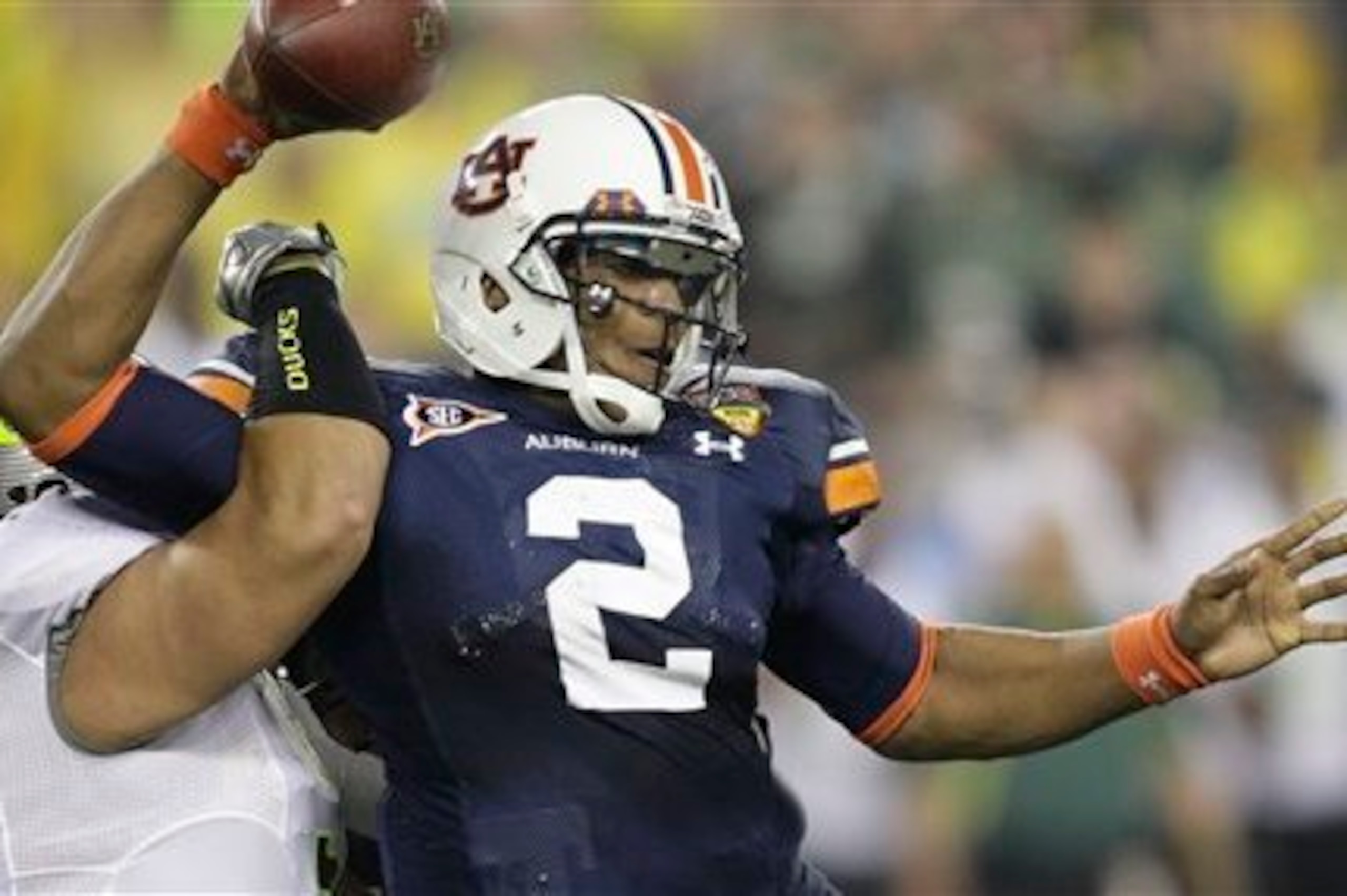
As for Chizik, Auburn's '10 national championship was led by Newton, a rare quarterback—a specimen, really—if there ever was one. Newton would go on to be the No. 1 overall pick in the 2011 NFL draft.
An experienced quarterback isn't needed to win a national championship. Newton and Florida State's Jameis Winston were first-year players when they led their teams to the top of college football. In fact, a prolific quarterback isn't necessary either. Alabama's Greg McElroy and LSU's Matt Flynn have a national championship while Oregon's Marcus Mariota, last year's Heisman winner, does not. Life in college football is perplexing that way sometimes.
But if a team doesn't have a top-tier quarterback, it better have a top-tier coach on the sideline.
The Outliers
Sometimes, there are things you simply can't account for in a championship run, for better or worse.
The LSU Factor
In 2007, college football didn't know what it was or what it wanted to be when it grew up, leaving the BCS, a series of computer formulas, to try to sift through the madness. What resulted was one big shoulder shrug when it came to determining the two best teams: LSU and Ohio State.
When charting the numbers for this blueprint, LSU was often the anomaly. The Tigers were the only two-loss national champion. They didn't routinely blow opponents out, at least not to the level of other national champions. They weren't particularly lethal on offense and didn't have a game-changing quarterback.
But LSU thrived in a year that was anything but normal. Michigan's Week 1 loss to Appalachian State in the Big House was a statement that things were about to get batty. Sure enough, '07 was a year of upsets while teams like South Florida and Kansas took their turns being ranked No. 2 in the AP poll.
LSU again played in the national championship in 2011, a year when the BCS was marred by more controversy than usual because the title game featured two SEC West teams.
As Andy Hutchins of SB Nation points out, LSU has played for a national title on a four-year cycle. 2015 falls in line with that. And, like '07 and '11, this season might just be crazy enough to match Tigers coach Les Miles.
Staying Healthy and Overcoming Injuries
The irony of addressing injuries now is that it was literally the first thing Broussard mentioned.
"How healthy you are and what kind of depth you have is crucial," Broussard said. "It's about finding other guys to step up and putting them in positions to make plays."
When coaches talk about depth, it's not just in the number of players on the charts. It's about the experience and/or capabilities of the No. 2s and No. 3s. That's what made Ohio State's championship run so memorable. Cardale Jones was the third-string quarterback not five months before confetti rained down on him in AT&T Stadium in Arlington, Texas. In that span, the Buckeyes coaching staff essentially had to adjust the offense not once, but twice on the fly.
If there's a team Ohio State can empathize with, it's Baylor. Bears quarterback Seth Russell is done for the year with a fracture in his neck, leaving true freshman Jarrett Stidham to run the offense. As it so happens, Baylor is about to embark on its toughest stretch of the season. In November, Baylor plays Oklahoma, at Oklahoma State and at TCU in consecutive weeks.
Baylor isn't alone, though. 2015 has felt like the "year of the injury" in many ways. The list of injured stars is too long to count, but when players like Russell, Pitt running back James Conner, UCLA linebacker Myles Jack and West Virginia safety Karl Joseph are out for the year, you know it's bad.
Perhaps no two teams understand this more than Notre Dame and TCU, both of which have been hit hard by injuries and attrition. The Frogs have been particularly banged up on defense while the Irish have felt the impact all over. Yet they are a combined 14-1 with the only loss—Notre Dame's—coming on the road by two points to Clemson.
Injuries are awful because they show no prejudice. They can strike anywhere, anytime to any player. If playoff hopes are going to be realized, though, teams have to be prepared to successfully play the next man up—and not just say so in theory.
Who Fits the Mold?
For this exercise, 14 playoff-caliber teams were put under the exact same lens as the previous 10 national championship winners to see if any programs stood out. Those teams are: Ohio State, Baylor, TCU, LSU, Michigan State, Clemson, Alabama, Stanford, Notre Dame, Oklahoma State, Iowa, Florida, Utah and Memphis.
These are teams ranked in the coaches poll Top 15. However, Florida State and Oklahoma were substituted for Memphis (No. 16) since 1) the Tigers are a legitimate playoff crasher and 2) Florida State and Oklahoma lost to sub-.500 teams.
Since the 2015 season has only recently crossed the halfway point, the comparisons are only a guide. For example: Baylor has one of the worst strength of schedules in major college football, but things get a lot more challenging over the next month. Conversely, Iowa's schedule gets easier. Offensive and defensive numbers can improve or dissolve. About the only thing that will stay the same are recruiting rankings because they've already been established.
However, enough football has been played that trends should at least be forming. The requirements for aligning this year's teams with past champions under the same categories are as follows based on past numbers:
- Recruiting: Must have averaged a top-15 class with at least 40 percent blue-chip recruits.
- Preseason coaches poll rankings: Must be ranked in the Top 15.
- Sagarin SOS: Must be ranked in the top 30.
- Margin of victory: Must be at least 16 points.
- Offensive yards per play: Must be at least 6.00 YPP.
- Defensive yards allowed per play: Must be no greater than 5.00 YPP.
- Explosive drives (offense vs. defense): Must rank in the top 15 of at least one category.
- Turnover margin: Must be at least plus-five.
Seven teams align with at least two-thirds of the nine categories: Ohio State, Baylor, TCU, LSU, Clemson, Alabama and Notre Dame. Stanford and Memphis weren't far behind with five categories.
Some of the teams make sense. The Buckeyes haven't played their best football yet—though their Week 8 win over Rutgers indicates they're getting close—but they've received the benefit of the doubt. Others are a surprise. Despite losing to Northwestern in Week 1, Stanford has quickly turned things around and is playing as well as anyone. In a few weeks, the Cardinal could be considered one of college football's top four teams.
Memphis is the ultimate wild card. The Tigers aren't some low-level football team getting by without a signature win. If Ole Miss continues to win out, Memphis is going to look even better after beating the Rebels in Week 7.
The great thing about college football's regular season is it still matters even though the postseason format has doubled. Baylor and TCU still have to play one another, as do Notre Dame and Stanford, and Alabama and LSU. Things will naturally figure themselves out, and the playoff field will continue to narrow.
A lot can and will change between now and early December, but if you're looking for teams to follow that fit a certain mold, the Buckeyes, Bears, Frogs, Tide, Irish, Cardinal and Tigers (x3) should be the ones at the top of the list.
Not that they weren't already, that is.
Ben Kercheval is a lead writer for college football. All quotes obtained firsthand unless noted otherwise. All stats courtesy of cfbstats.com (2008-15) and sports-reference.com (2005-07) unless specified otherwise.


.jpg?w=2560 "Top Trade Targets Entering Week 6")


.png?w=2560 "Muncy Sums Up NLCS Offense 💩")