

The Year of the Running Back in College Football
Like some sort of genetically engineered freak created in a laboratory two miles below the Earth's surface, Leonard Fournette made the sport of football look frustratingly easy last Saturday.
He made the large men with the unfortunate and impossible task of tackling him look like toddlers as he tossed them to the sky and to the ground. He juked others out of their bodies on national television, prompting equal silence and applause. When he didn’t have to run directly through or sidestep those in his path, he simply ran past everyone with casual, violent grace.
As he did, names like Herschel Walker and Bo Jackson were summoned for comparison. Along the way, a Heisman campaign was launched and given enough fuel to travel the world. And, perhaps more significant than any individual or team award, the 230-pound running back carried the torch for an entire position.
The best part? He is not alone.
The running back is not just back. With the great quarterback drought upon us, the running backs—a position left for dead not long ago—might just be the key ingredient over the next few months. Take a look at how some of the nation's top running backs are picking up the slack for their struggling quarterbacks:
| LSU RB Leonard Fournette | Rushing: 387 | 12 |
| LSU QB Brandon Harris | Passing: 145 | 122 |
| Georgia RB Nick Chubb | Rushing: 468 | 3 |
| Georgia QB Greyson Lambert | Passing: 587 | 65 |
| Notre Dame RB C.J. Prosise | Rushing: 451 | 5 |
| Notre Dame QB Deshone Kizer | Passing: 334 | 107 |
“He fits in very comfortably with some of the elite running backs that we’ve had here,” LSU head coach Les Miles said this week. “Considering we’ve played two games in this season, I will let Leonard Fournette define who he is.”
The definition is still a work in progress. It’s also not something that will ever be circumscribed by touches or stats. The stories that will be passed on for generations are already being told—the way that a young athlete just two games into his sophomore season, something that is still hard to process, tore through the entire Auburn defense by his lonesome.
Perhaps most impressive in his 228-yard, three-touchdown night was the fact that Fournette did not log a single carry in the fourth quarter. There was no need. At that point, this game was decided. His night was done. It was time to harness the experiment for another week.
“He seems to get warmed up the more reps he gets,” Miles added on Fournette. “Yet, we wouldn’t want to wear him out before we get to some of our key contests in our season. In the same vein, it’s awfully important that we win. And the most important criterion is the guy who should touch the ball the most in that opportunity to win the game.”
Consider how unusual this sounds in this day and age where offenses are driven by the throwers of footballs. Quarterbacks are not only the most important cog in the machine; it’s also the most recognized. The last five Heisman winners have all been quarterbacks. The award has also gone to the position in 13 of the last 14 years.
And yet, LSU has managed to look dominant through two games with just 145 total passing yards. It has gone from a team that looked considerably overrated in preseason polls to a potential College Football Playoff contender. Fournette, early on, is a runaway favorite for the Heisman.
There is a long way to go until this potential is realized. Of course there is work to be done, so please don’t stay fixated on the giant carrots dangling off the stick for long. Instead, marvel at the brave new reality that one gifted running back is poised to carry a program on his shoulders. That might be all it takes this season.
This formula is not limited to LSU. Look around the Top 10 of the always-evolving AP poll, and one will find a similar blueprint.
The team nestled near LSU at No. 7 in the current poll, Georgia, is operating under a similar philosophy. While graduate transfer Greyson Lambert has played well since coming over from Virginia, running back Nick Chubb—averaging more than eight yards per carry in the young season—has picked up right where he left off last season.

Also a sophomore, Georgia’s 220-pound back has rushed for at least 100 yards in 11 consecutive games. That’s only two shy of Herschel Walker’s school record. There goes that name again.
If Chubb hits the 100-yard mark against Southern University this weekend, he’ll have an opportunity to tie Walker’s mark for consecutive 100-yard games against Alabama in Week 5.
“I care about it, but it’s not something I get up every day thinking about,” Chubb told Chip Towers of Dawg Nation this week. “If I don’t get 100 yards it wouldn’t really bother me, as long as we won the game. … If I don’t need to be in the game, that’s fine.”
Sound familiar? The usage of one of the nation’s truly elite weapons certainly parallels Miles’ mentality at LSU. As it should. Use every bullet in the chamber only when you have to. Right now, Chubb is Georgia’s first and last resort. He will be a significant portion of its playoff run if such a run is realized.
Notre Dame, in the unlikeliest of ways, knows the feeling. When running back Tarean Folston suffered a season-ending injury in Week 1, it looked like the Irish would lean on quarterback Malik Zaire and perhaps adjust the offense moving forward.
When Zaire was lost for the year the next week, however, head coach Brian Kelly found his boost from a former safety recruit who made the switch to wide receiver and now to running back.
C.J. Prosise, currently the team’s No. 1 back, has become one of the nation's most dynamic weapons seemingly overnight. In three games, Prosise has rushed for 451 yards and scored four touchdowns, averaging 7.6 yards per carry.
His 91-yard touchdown run against Georgia Tech—playing alongside a quarterback that is still adapting to in-game snaps—was the longest in Notre Dame Stadium history. As good as wide receiver Will Fuller and linebacker Jaylon Smith have been, Prosise has been the difference. He’s the edge they didn’t know they had.
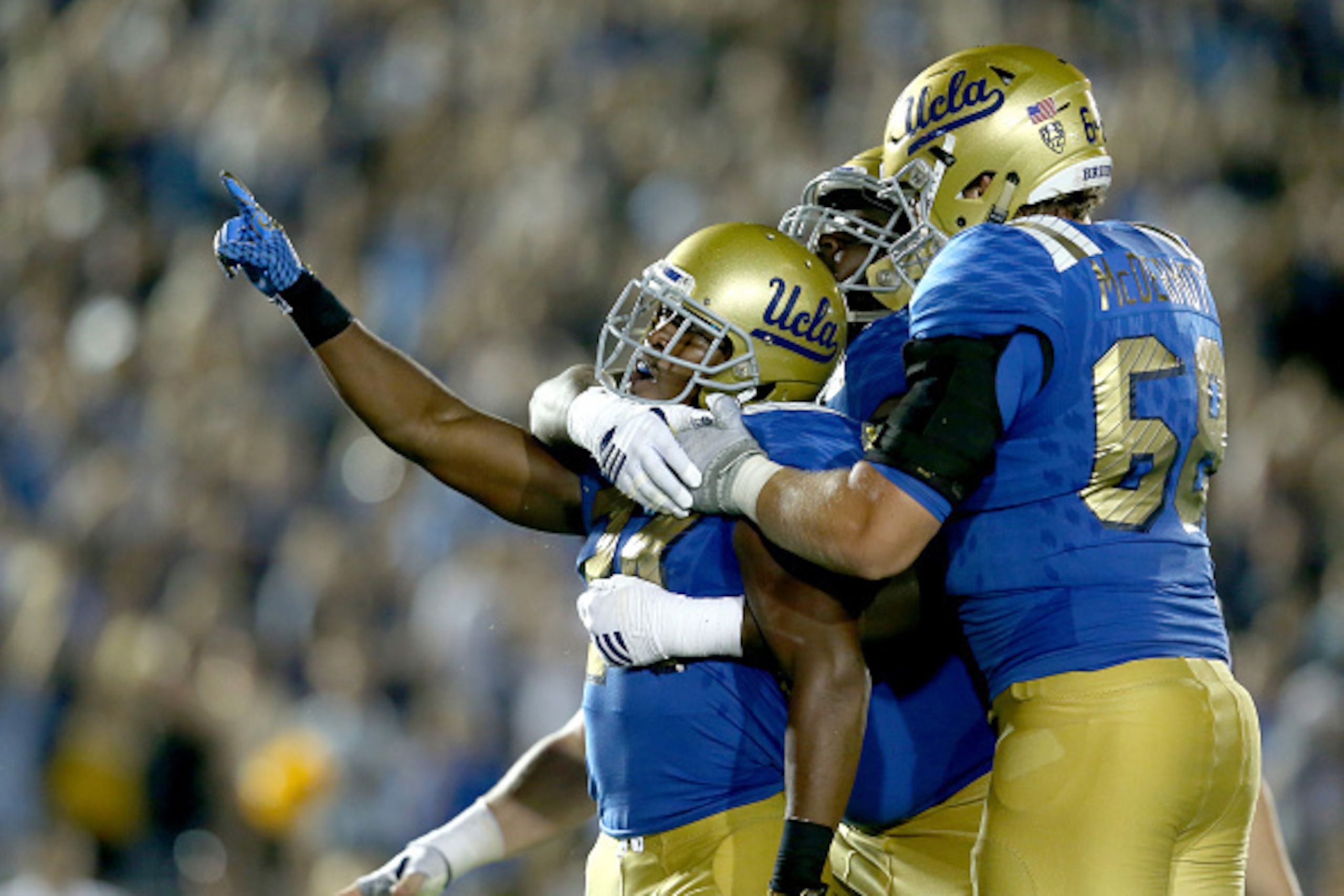
Let's keep looking in search of more. As true freshman quarterback Josh Rosen has suddenly looked like a true freshman for UCLA, junior running back Paul Perkins has put the team on his back. Against BYU on Saturday, Perkins ran for 219 yards on 26 carries in a 24-23 victory. It should come as no surprise for those who watched the Pac-12’s leading rusher last season.
“I feel like I have enough respect throughout the team that people will take what I say to heart,” Perkins told Bleacher Report this past offseason. “Whatever my role has to be in this offense to win a national championship, I’ll do that.”
With linebacker Myles Jack out for the season following a knee injury sustained in practice—the third defensive starter lost for the Bruins on the year—Perkins will have to be even better for UCLA to have that breakthrough season. It starts this week against Arizona.
Elsewhere around the country, the running back is doing much of the heavy lifting—more so than usual. Florida State’s Dalvin Cook has 476 yards through three games, sparking an offense that has undergone significant renovations.
Oregon running back Royce Freeman has 373 yards and five touchdowns through three games, and he will be expected to do much of the heavy lifting against Oregon this week. As much as the Ducks like to throw the football through giant windows, Freeman’s bulldozing presence will be integral to another playoff push.
And the man who started it all, Ohio State’s Ezekiel Elliott, did so before anyone even knew what was happening. In many ways, the Year of the Running Back began back in January when Elliott ran for 696 yards in the team’s final three games.
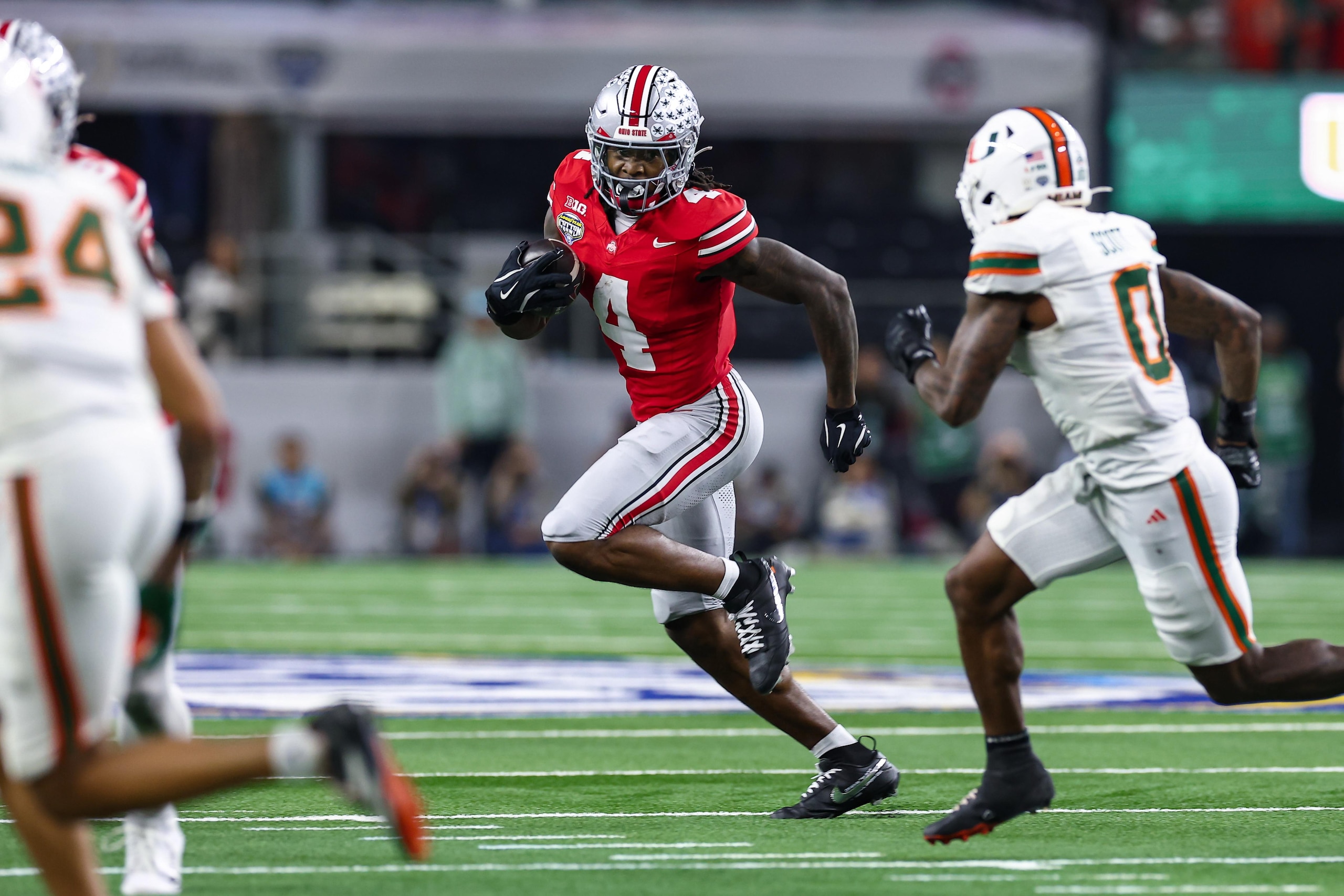
While the quarterback has gotten so much attention in Columbus, Elliott was the catalyst of that national championship run. With Cardale Jones and J.T. Barrett shuffling in and out of games early on, it might be up to Elliott to carry the team once more. Don’t be surprised if he does.
The significance of the running back movement is by no means limited to a handful of teams. For whatever reason, there is a now a surplus of large ball-carriers capable of moving at tremendous speeds.
Not all of these backs will operate with the speed and power of LSU’s battering ram with a V-12 engine. Perhaps he’s a different challenge entirely. But with quarterbacks across the nation struggling to seize control of games—and with power programs leaning on power backs because they have to, 2015 could be a running back renaissance.
This might be the year the position takes back the spotlight that it once rightfully owned, one spectacular broken tackle or long touchdown run at a time.
Unless noted otherwise, all quotes obtained firsthand.
.jpg?w=2560 "Buzz: Donald Eyeing Media Future")



.jpg?w=2560 "🔴 Live: WWE NXT 👊")