Urban Meyer and the Resurrection of the Big Ten
The Big Ten died on September 6, 2014. We watched it die together.
With the inspiration of my boss and enough negative fuel to power a visit to the moon, I wrote a eulogy for a conference while assessing the damage. After all, I wanted to pay my respects.


Although I left open the possibility of a College Football Playoff run—it was Week 2, after all—it was hard to quantify losses from Ohio State, Michigan State and a shutout trouncing for Michigan as anything but an autumn funeral.
These high-profile losses had company, too. Nebraska nearly fell to McNeese State, Iowa almost lost to Ball State, Purdue was dismantled by Central Michigan, and Northwestern lost to Northern Illinois.
This felt like the end of something, a 24-hour stretch that told a story that would impact more than just one day.
The reality, however, is this was to be expected. The Big Ten’s 2-5 bowl record from the prior year—much like its six-year absence from the national title game—painted this dreadful Saturday as the norm. This, for many, was the kind of disappointment you could forecast; recent history told you so.
It was thought to be the end, the lowest of lows for a conference tired of being a punchline.

As it turns out, however, September 6 wasn’t the death of the Big Ten. It was a new beginning.
Fast forward to January 1. Michigan State stages one of the best comebacks ever to beat No. 5 Baylor, Wisconsin takes out Auburn, and Ohio State slays mighty Alabama. The Big Ten is officially back.
“There shouldn't be a narrative each year,” Big Ten commissioner Jim Delany said following Ohio State’s Sugar Bowl victory. “It should be its own year...it's a new cycle for all of us. We feel good to have been included. We're a long way from September. Our teams have gotten better. The season has played out. We didn't have any predictions. We just wanted to see the season play out.”
Ohio State, the catalyst of the Big Ten turnaround, had the honor of being pronounced dead twice in one season. The first came when starting quarterback Braxton Miller—a Heisman favorite to many—was ruled out for the year before the season after shoulder surgery. With backup quarterback J.T. Barrett leading the way, the Buckeyes were once again left for dead after losing to Virginia Tech at home early on, a loss no one envisioned regardless of the signal-caller under center.
But then, everything changed. The offensive line came together. The defense returned to form. Backup quarterback 1.0 became a Heisman contender. These developments led to a Big Ten Championship, a shocking inclusion in the first College Football Playoff and then an upset that no one (outside the state of Ohio) saw coming.
Months after looking utterly helpless and hopeless, Ohio State topped Alabama—the sport’s most terrifying and unconquerable monster—and gained access to the first championship game of the College Football Playoff era.
To do so, it needed a third-string quarterback who has looked like anything but a third-string quarterback. Cardale Jones, still yet to start his first regular-season game, has responded to his opportunity—yet another injury at quarterback—in a way we could never have expected.

Without him, a Sugar Bowl victory doesn’t happen. The comeback never happens.
Ohio State never makes it to the championship game, let alone the playoff. But to arrive at this point, Urban Meyer followed a blueprint that he publicly preached not long after he arrived in Columbus.
Only one day after securing a program-changing recruiting class back in February 2013—a class that included Joey Bosa, Ezekiel Elliott, J.T. Barrett, Vonn Bell, Dontre Wilson and Jalin Marshall, among others—Meyer told the rest of the Big Ten what he thought of its outdated and ghastly carpeting while appearing on 97.1 The Fan in Ohio.
“I don't know enough about what goes on in the other programs. I know I have a lot of respect for the tradition and their historical success they've had,” Meyer said. “But we do need, as a conference, to keep pushing that envelope to be better.”
He wasn’t wrong. His talking points were critical of the other teams in the conference; they were also undeniable. And yes, this particular serving of honesty was delivered with an industrial-sized serving of C-4.
Considering that some of his peers were already unhappy with his alleged recruiting tactics, his most recent words didn’t earn him any conference acquaintances. It also become national news.
“It's not only important, it's essential,” Meyer added, on improved recruiting within the conference. “It has to happen.”
The football gospel Meyer preached on Columbus airwaves nearly two years ago paved the way for this year’s success. His 2013 class, a testament to this plan, is how the Buckeyes crashed the playoff and disassembled Alabama.
These promising prospects with incredible athletic gifts developed into stars. And, most terrifying of all, there’s still room to grow.
| Player | Position | 2014 Performance |
| Joey Bosa | Defensive End | 13.5 sacks, 20 TFL, four forced fumbles |
| J.T. Barrett | Quarterback | 45 total TDs, 2,834 passing yards, 938 rushing yards |
| Ezekiel Elliott | Running Back | 1,632 rushing yards, 221 receiving yards, 14 TDs |
| Darron Lee | Linebacker | 73 tackles, 16.5 TFL, 7.5 sacks, two INTs, two TDs |
| Vonn Bell | Safety | 86 tackles, six interceptions, six pass breakups |
| Jalin Marshall | H-Back | Eight total TDs, 142 rushing yards, 447 receiving yards |
| Eli Apple | Cornerback | 46 tackles, 5.5 TFL, two INTs, one TD |
| Dontre Wilson | H-Back | 300 receiving yards, 100 rushing yards, three TDs (nine games) |
“We don’t redshirt,” Meyer said at his press conference this week while speaking of the 2013 class. “It’s not like we are going to say, ‘Hey, let’s save them for the ‘17 year, and let’s have a heck of a year.’ You can’t do that now because they are all gone, anyways, after three. If you’re a great player, you’re gone, so play them. If they are not good enough, don’t play them.
“So that’s the mentality we have when we go out and recruit. When they are here, we don’t say, we are going to save you and let you mature a little bit.”
On January 1, the maturation took place right before our eyes. The process—to steal a familiar line from Alabama head coach Nick Saban—took yet another step forward. Before Ohio State came back from a 21-6 deficit and statically dominated a team that no one envisioned it would dominate, however, it received its motivation from the most unlikely of places.
While this 60-minute movement was years in the making, the motivation to pull such upsets came from unlikely sources only hours earlier.
As Ohio State readied for the semifinal, two of the Big Ten’s most powerful brands went up against programs perceived to be far more powerful. Michigan State’s historic comeback against Baylor in the Cotton Bowl and Wisconsin’s unlikely upset over Auburn in the Outback Bowl served as an appetizer for the conference.
Before the Buckeyes ever took the field, the conference had gained credibility. Writers began pouring out positive headlines. The negativity that had been so prevalent less than four months prior was, to a degree, nullified.
For Ohio State, these results provided far more than a reputation boost. They were reassurance.
“I'll tell you when I think the tide turned a little bit, when Wisconsin beat Auburn,” Meyer said. “Everybody on our team knew that. I made sure they knew that. When Michigan State came back and beat an excellent Baylor team. And maybe the Big Ten’s not that bad.”
As the Spartans mounted an enormous fourth-quarter comeback, Meyer watched and rooted on the same program that dismantled his team’s national championship hopes in spectacular, gut-punching, silent-pizza-eating fashion a little over a calendar year ago.

“And then our players—you should have seen their face, man, they knew,” Meyer said on Michigan State’s win. “They knew.”
Of course, a perceived emotional edge will only take you so far. There is still the matter of taking down a team loaded with superb talent. Ohio State, with its third-string quarterback, did just that.
In doing so, Ohio State didn’t just come a step closer to an authentic championship run unlike any other in the history of the sport; it also capped off a perception-shifting day for a conference that had been buried months before.
“The SEC has had a terrific run. Narratives are based on facts. But sometimes narratives overcome the facts,” Delany said on January 1. “Winning games on big stages, it certainly reset that. Until you actually win the game, you can’t expect anybody to change the momentum of the narrative. We had a great day today. We’ve always tipped our hats to the guys who won. I tip my hat to us.”
Regardless of what happens on January 12 against Oregon, the Big Ten’s massive renovation has begun.
“Maybe the Big Ten is pretty damned good,” Meyer said after the Sugar Bowl. “And it’s certainly getting better.”
Competing schools in the conference have taken Meyer’s 2013 radio rant to heart. It’s why Penn State hired James Franklin; it’s also why Michigan brought on Jim Harbaugh, a coaching addition that captured the full attention of the entire sport.
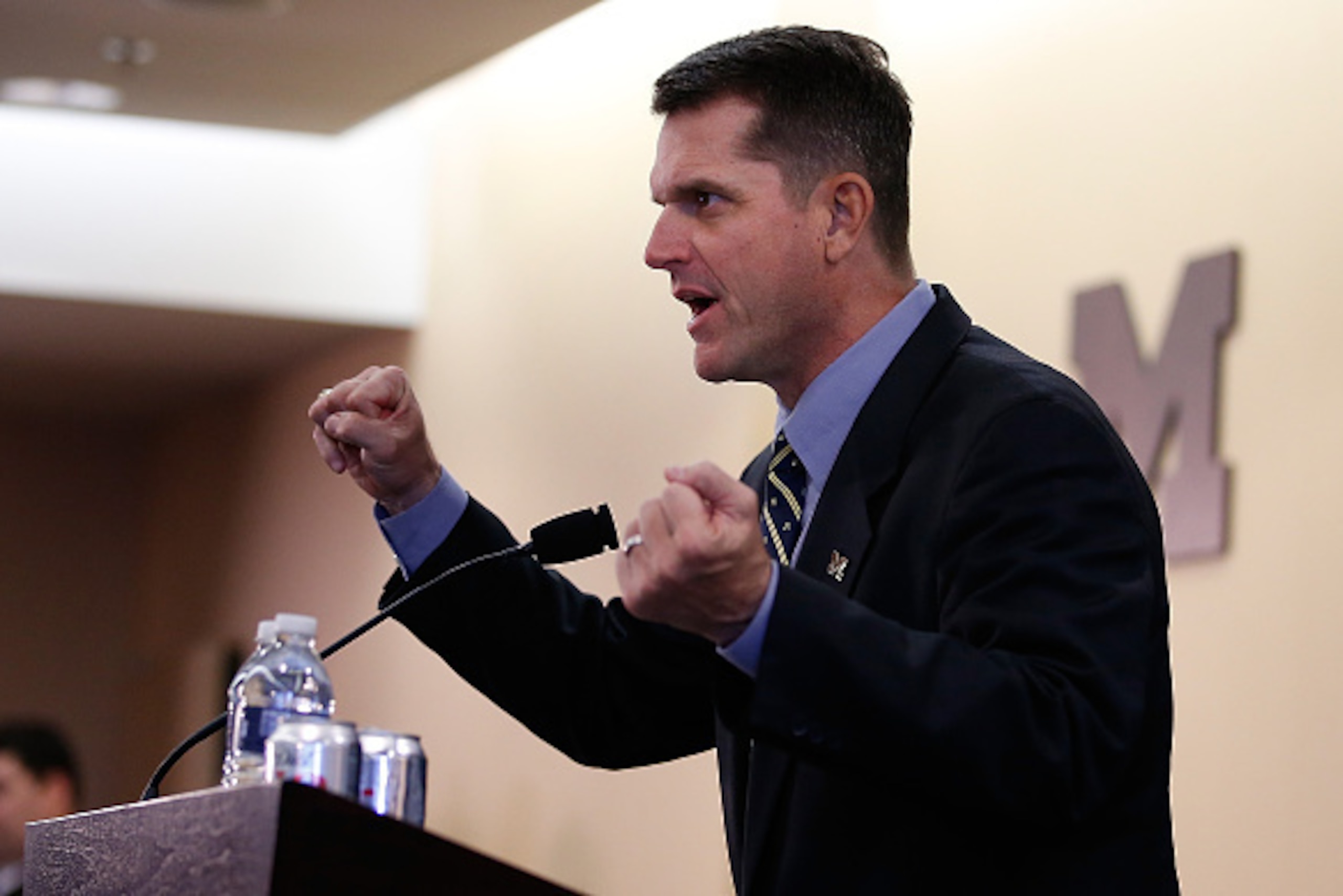
To recruit, you first need a recruiter.
It’s what Ohio State found in Meyer not long ago, and it’s what others in the conference are hoping they have discovered with recent hires. There's far more to it than simply acquiring talent, although it's a tremendous place to start and the only way to establish a foundation.
Luring the nation’s premier talent away from the Southeast will never be natural for some Big Ten schools. But with larger-than-life personalities on the sideline and in family rooms, an unfamiliar ritual will become more familiar in time.
There is still much work to be done to repair the reputation of the Big Ten, a process that will take years and multiple successes to complete. One day does not make a conference, just like one day doesn't break it.
As Ohio State readies for its national showcase—a chance to lift the reputation of the conference even higher—one thing has become clear before the national champion is determined.
We can put down our shovels.
Adam Kramer is the lead national college football writer and video analyst for Bleacher Report, as well as a co-host of the CFB Hangover on Bleacher Report Radio (Sundays, 9-11 a.m. ET) on Sirius 93, XM 208. Unless noted otherwise, all quotes obtained firsthand. All stats via CFBstats.com.

.jpg?w=2560 "Report: NFL to End Pro Bowl 🚨")

.jpg?w=2560 "Consensus Mock Draft 📋")

.jpg?w=2560 "NFL's New Disciplinary Rules")