

How Top-Rated Pac-12 Recruiting Classes Have Fared
College football programs can win without heralded signing classes, but recent precedent in the Pac-12 suggests that winning on the recruiting trail leads to winning on the field.
Since expanding to 12 members in 2011, the conference's three champions and five of its six divisional winners featured junior and/or senior classes scoring in the Top 20 of 247Sports.com composite rankings.
As the Pac-12's collective recruiting improved, so too did the conference's overall level of play, reaching a crescendo in 2013 with five double-digit-win teams and a record nine bowl participants.


There is something of a chicken-and-the-egg principle at work when examining the correlation between recruiting classes and collegiate success. Take Stanford, which was just three years removed from finishing in the cellar and was among the worst BCS conference teams when it signed a top-flight class in 2009.
Similarly, USC had to elevate from the doldrums of the worst stretch in program to become the recruiting giant that sustained a seven-year run of conference championships.
Winning begets recruiting success, but recruiting success begets winning. Starting the cycle is the challenge new coaches face, but as the last five years in the Pac-12 prove, it's a cycle that works with some perpetuity once it's begun.
| USC (3) | 2 | 12 | Matt Barkley, Jarvis Jones, Devon Kennard, T.J. McDonald |
| UCLA (14) | - | 9 | Keenan Graham, Xavier Su'a-Filo |
| Stanford (18) | - | 9 | Zach Ertz, Tyler Gaffney, Ben Gardner, Trent Murphy, Shayne Skov, Stepfan Taylor, Levine Toilolo |
The 2009 signing class made a huge impact on the last two Pac-12 championship races and helped shape the conference's power structure into what it is today.
Jim Harbaugh had Stanford headed in the right direction when he signed the nation's No. 18-ranked recruiting class, but the Cardinal hadn't bowled since 2001.
Shayne Skov, Tyler Gaffney, Trent Murphy, Ben Gardner and Josh Mauro signed on to a vision of competing for conference championships. They made the vision a reality.
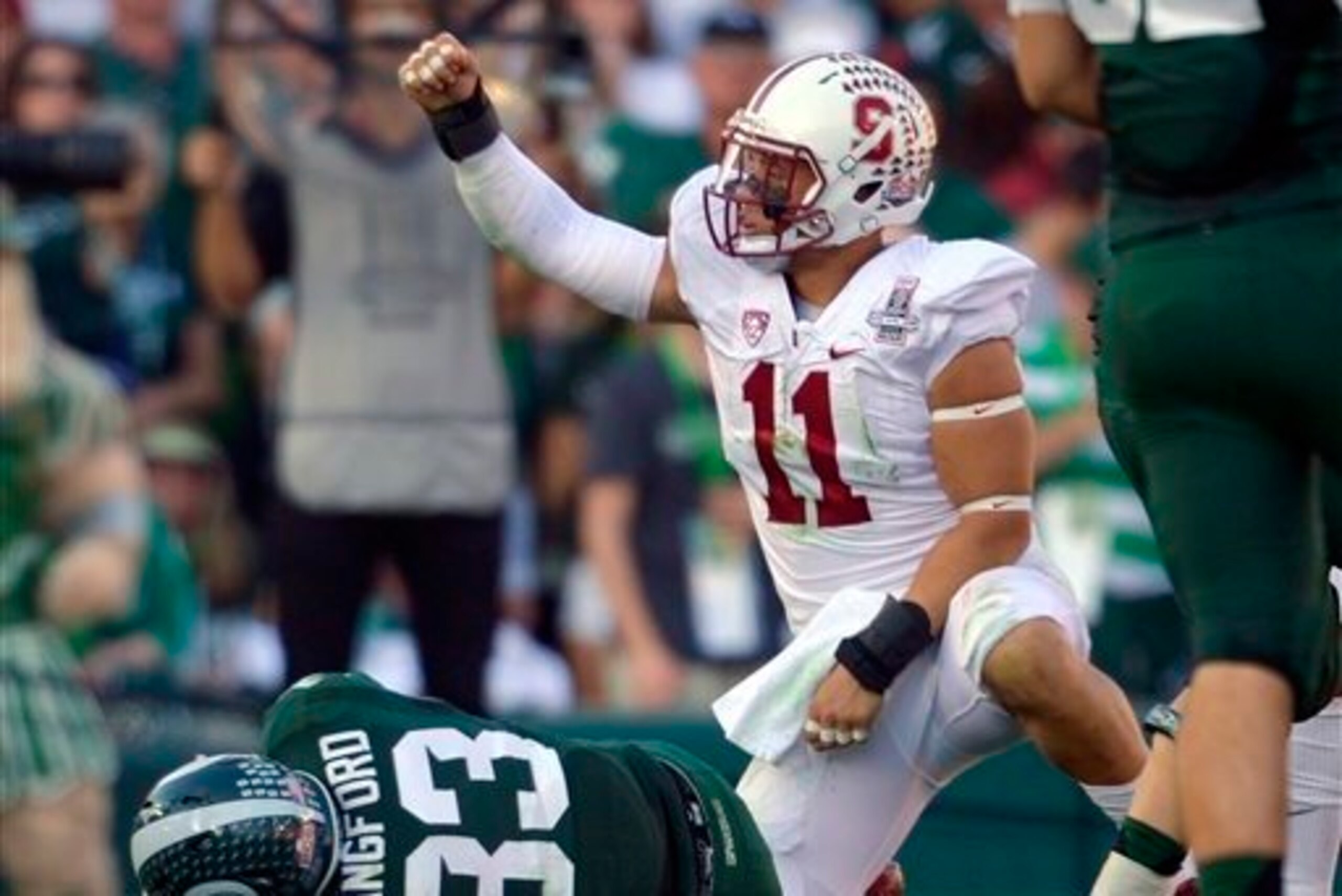
"I think we've probably got more fifth-year seniors than any other team in the country," Skov said following the Cardinal's Pac-12 Championship game defeat of Arizona State in December.
Stanford's 2009 class was also integral to the program's 2012 championship. Along with the many standout defenders signed then, the Cardinal welcomed aboard tight ends Zach Ertz and Levine Toilolo, both of whom were central to the offensive scheme, and three-time team leading rusher Stepfan Taylor.
USC was still riding the high tide of its dominance in the 2000s, and the 2009 recruiting class followed the last and one of the best USC teams to reach seven straight BCS bowls. Quarterback Matt Barkley, the jewel of this class, rewrote Trojans record books as a four-year starter, and linebacker Devon Kennard was a cornerstone of the Trojans' stellar 2013 defense.
But the 2009 class also offers a reminder that a lot can happen in four years. Linebacker Jarvis Jones proved to be the other star of USC's class along with Barkley, but he did so at Georgia after failing to gain medical clearance to become a Trojan.
| USC (3) | 4 | 12 | Dion Bailey, Xavier Grimble, Hayes Pullard, George Uko, Robert Woods |
| UCLA (10) | 1 | 9 | Anthony Barr, Cassius Marsh, Jordan Zumwalt |
| Oregon (13) | 1 | 8 | Hroniss Grasu, Josh Huff, Terrance Mitchell, Lache Seastrunk, Tony Washington |
| Washington (14) | - | 8 | Sean Parker, Kevin Smith, John Timu |
| Cal (19) | 1 | 6 | Keenan Allen |
Carroll's departure from USC to the NFL didn't put a damper on the Trojans' recruiting efforts. Lane Kiffin came aboard and showed the same recruiting prowess at USC he demonstrated in his one season at Tennessee—and having Ed Orgeron on staff certainly didn't hurt, either.
But the most telling takeaway from the conference's 2010 recruiting is that four seasons later, a record five Pac-12 teams finished with at least 10 wins and four signed Top-20 ranked classes comprised of this year's seniors and redshirt juniors.
The lone exception—and it sticks out like a sore thumb, given the program made just one bowl appearance in the subsequent four seasons—is Cal. Wide receiver Keenan Allen lived up to his 5-star billing in his three seasons with the Golden Bears and is a contender for the NFL's Offensive Rookie of the Year.
Aside from Allen, the 2010 Cal signing class is an exception to the rule. Yes, great recruiting classes make victories more attainable, but they are only pieces of a larger puzzle. The rest of the Top-20 2010 group succeeded in turning its potential into tangible results.
| USC (3) | 1 | 14 | Buck Allen, Marqise Lee, Cody Kessler, Tre Madden, Marcus Martin, J.R. Tavai |
| Oregon (12) | 1 | 8 | Ifo Ekpre-Olomu, Tyler Johnstone, Marcus Mariota, De'Anthony Thomas |
| Cal (15) | - | 10 | Brendon Bigelow, Kameron Jackson, Viliami Moala |
USC's last conference-leading class in a run of 10 years dominating the recruiting trail played a key role in the Trojans' 10-win 2013 season, and that same crop will be integral in the Trojans' pursuit of their first Pac-12 title since 2008—even without its marquee signee, wide receiver Marquis Lee.
Running backs Tre Madden and Buck Allen each operated as the centerpiece of the running game at different times and quarterback Cody Kessler developed into a capable playmaker.

As well as USC's 2011 recruiting class has performed, Oregon assembled a group that will headline the Pac-12's 2014 front-runners. Head coach Mark Helfrich scored a major coup when center Hroniss Grasu, cornerback Ifo Ekpre-Olomu and quarterback Marcus Mariota all opted to return for another season. Conversely, USC lost standouts Lee and center Marcus Martin from its 2011 recruiting class.
Cal again fell victim to unmet potential, a second consecutive Top 20 class achieving little. The Golden Bears reached the Holiday Bowl in 2011, this group's true freshman season, but has won just four games in the two years since.
| Stanford (7) | 2 | 9 | Kyle Murphy, Andrus Peat, Michael Rector, Barry Sanders Jr. |
| USC (9) | 1 | 10 | Nelson Agholor, Morgan Breslin, Max Tuerk, Leonard Williams |
| Oregon (13) | 1 | 10 | Bralon Addison, DeForest Buckner, Kyle Long, Byron Marshall |
| UCLA (17) | 1 | 6 | Ish Adams, Devin Fuller, Randall Goforth, Simon Goines |
The transition of Pac-12 power from USC to Stanford and Oregon becomes somewhat more evident in the 2012 signing class. Make no mistake, the Trojans still recruited well; wide receiver Nelson Agholor and defensive lineman Leonard Williams are two of the conference's most exciting players on their respective sides of the ball.
However, in the first year of NCAA-mandated scholarship limitations, USC ceded the Pac-12's No. 1 for the first time in a decade to Stanford. National signing day 2012 promises to keep the two-time defending conference champion Cardinal stocked for more success, despite losing so much from its previous recruiting classes.
| UCLA (7) | 1 | 18 | Caleb Benenoch, Myles Jack, Alex Redmond, Eddie Vanderdoes |
| USC (12) | 4 | 8 | Su'a Cravens, Justin Davis, Ty Isaac, Khaliel Rogers |
| Washington (18) | - | 7 | John Ross, Damore'ea Stringfellow |
| Oregon (19) | 1 | 7 | Johnny Mundt, Torrodney Prevot, Thomas Tyner |
UCLA's conference-best No. 7 signing class paid immediate dividends. Head coach Jim Mora pointed out UCLA played 18 true freshmen in 2013, including linebacker Myles Jack, winner of the Pac-12's Defensive and Offensive Freshmen of the Year awards.
Jack was also an Football Writers Association of America Freshman All-American, along with teammates Alex Redmond, one of three first-year players to start on the Bruins offensive line, and defensive lineman Eddie Vanderdoes.
UCLA accounted for three of the Pac-12's five nominations to the Freshman All-America team, the other two coming from much more lowly rated recruiting classes at Arizona (wide receiver Nate Phillips) and Colorado (linebacker Addison Gillam).
The Bruins were unique in that teams reliant on immediate contributions from freshmen are typically also-rans. Arizona and Colorado both finished with sub-.500 conference records, for example. Conversely, UCLA was in the hunt for the Pac-12 South's best mark for a second straight season and a third consecutive title-game appearance on Nov. 23.
As this class continues to develop, UCLA is positioned to improve upon its already impressive on-field results under Mora. And with another Top 20 class likely signing on this year's national signing day, the Pac-12 has yet another example of the cyclical connection between victories on the recruiting trail and victories on the field.
Kyle Kensing is the Pac-12 Lead Writer. Quotes obtained firsthand unless otherwise noted. Recruiting information obtained via 247Sports.com.
.jpg?w=2560 "Rams troll Jameis, Giants on social media")


.jpg?w=2560 "WWE Raw Live Grades 🔠")
.png?w=2560 "Davante's MONSTER MNF 🤯")