

2010 College Football Predictions: Notre Dame's Seven X-Factors
The anticipation of college football kickoff week is reaching a fever pitch as predictions, prophecies, and projections swarm the Internet and sports talk radio.
Like a scene from Planet Earth, it's time to join the instinctual lemming herd and inexplicably hurtle head first over the cliff of conjecture.
Notre Dame and new coach Brian Kelly are favorite subjects for oracles both outside and within the team's fanbase. Opinions of coach and team run the spectrum from savior hero-worship to cautious optimism to resigned failure.
A jumpy fanbase is to be expected. Many are still in therapy dealing with a decade of bipolar results, a star-in-waiting quarterback with an Achilles knee, and a defense that only stopped one thing in 2009: trying.
So before kickoff renders these predictions completely meaningless, here are seven X-factors that, depending on their outcomes, will swing Notre Dame's season.
7. Wide Receivers Not Named "Michael Floyd"
1 of 7
Golden Tate's departure for the NFL leaves Michael Floyd as the prime target for both Irish quarterback Dayne Crist and opponents' double teams.
For Kelly's spread offense to be effective, others from Floyd's unit will need to emerge as legitimate weapons, but who will it be?
Converted running back Theo Riddick has drawn the most attention from Kelly during fall camp as a small guy who is quick and elusive.
Unfortunately, this description is eerily similar to the fall camp when Charlie Weis declared that Munir Prince would be an impact player with "whoosh." As it turned out, the response of "Munir who?" is still accurate.
Behind Riddick is a cadre of receivers who have yet to emerge as dangerous offensive threats.
- John Goodman is sure-handed but slow.
- Duval Kamara has never lived up to his physical tools (6'4" and 225 pounds).
- Robby Toma looks like he could still play in Pee-Wee leagues.
- Shaq Evans didn't crack the two-deep.
- TJ Jones (named the third starter for Purdue) is a freshman with average size and speed.
If Kelly wants to continue his track record for turning no-names into stars, this wide receiving corps would be a good place to start.
What to watch: With Floyd's injury history, don't expect many more jump balls for him in the end zone. For Notre Dame to be successful in the red zone, they will need others who can catch the ball in traffic.
6. Manti Te'o and the Hype
2 of 7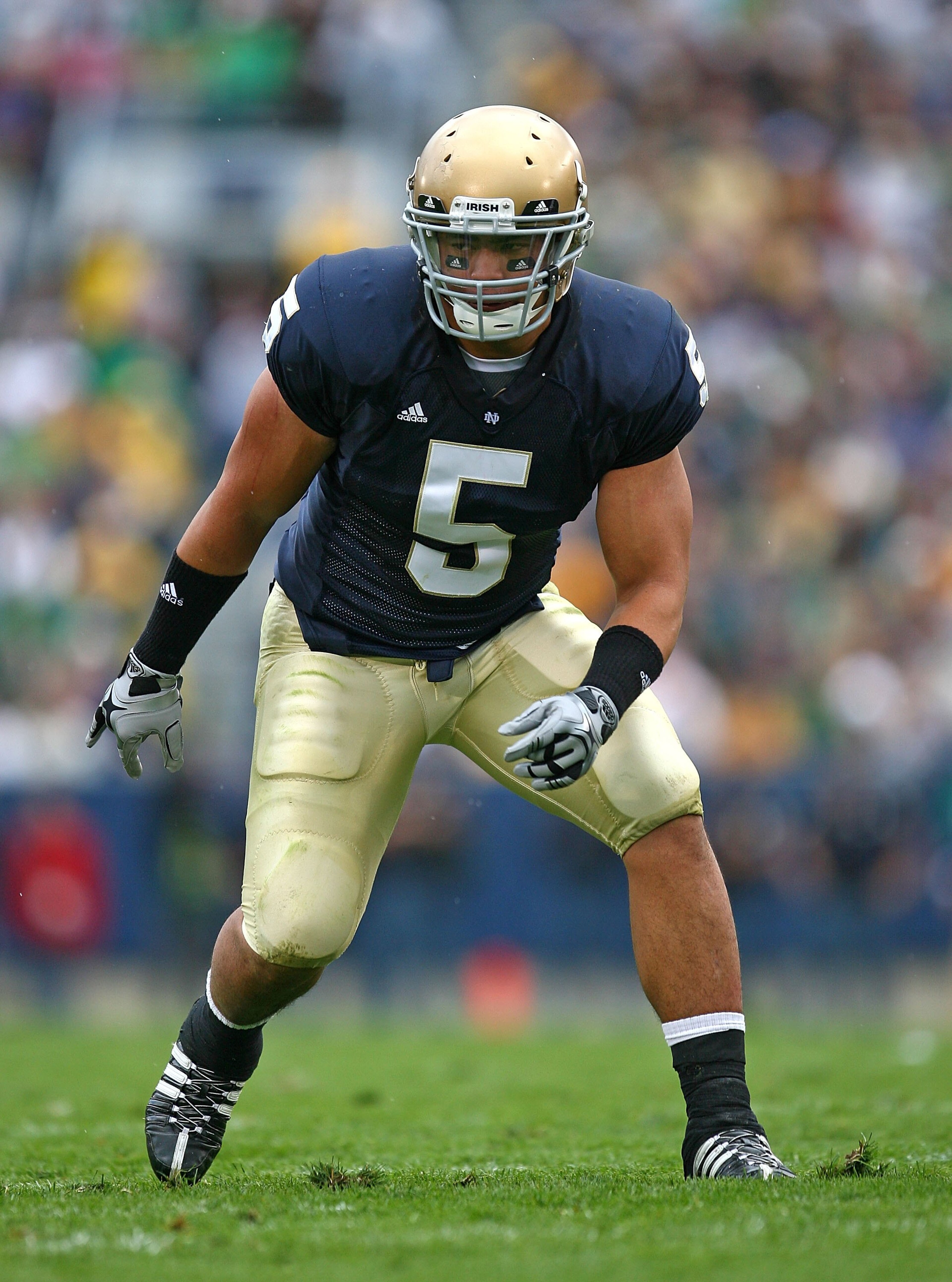
When Manti Te'o selected Notre Dame on National Signing Day in February of 2009, it felt like a bad teen movie when the stud good guy inexplicably picks the homely nerdy girl to take to prom.
Te'o must have seen something beyond skin-deep because, as the tragic 2009 season progressed, it became evident that he was very close to embattled Coach Weis.
Now Te'o must put Weis' departure behind him and work to live up to the tremendous hype on his shoulders. Even as a freshman, Te'o hit harder and tackled better than the rest of the Irish defense. Even for a bad defense like the 2009 Irish, such a feat is impressive for a freshman.
A powerful middle linebacker with smarts, strength, and instinct can be a truly disruptive weapon on defense. Kelly said that Te'o played last year entirely on instinct. If the other two pieces fall into place this year, the Irish defense could have a legitimate game-changer.
What to watch: If he is still blowing up plays late in the season after defenses start keying on him, he is on his way to future stardom.
5. Offensive Line Cohesion
3 of 7
The offensive line seems like it is always a concern for most teams, primarily because the unit is only as good as its weakest link. And if the unit isn't good, quarterbacks get hurt (see X-factor No. 2).
The 2010 Irish return the pair of guards but replace everyone else in the trenches. This is one of the team's deepest groups, but the many upperclassmen are largely inexperienced.
Two positions to watch will be left tackle and center. At left tackle, sophomore Zack Martin emerged in camp as the clear starter over senior Matt Romine. Martin will be critical to the protection of quarterback Dayne Crist's surgically repaired right knee.
The fall camp battle at center ended with brawn trumping brain. Junior Braxston Cave, who should have changed his name to Magnus Magnusson after a 520-pound bench press, won the starting job over seasoned senior Dan Wenger.
What to watch: Cave struggled with shotgun snaps early in the fall but improved enough to win the starting spot. With the liberal use of the shotgun in Kelly's offense, Cave will be on a short leash if there's any hint of the shotgun debacle that started (and effectively ended) the 2007 season.
4. Defensive Line Depth
4 of 7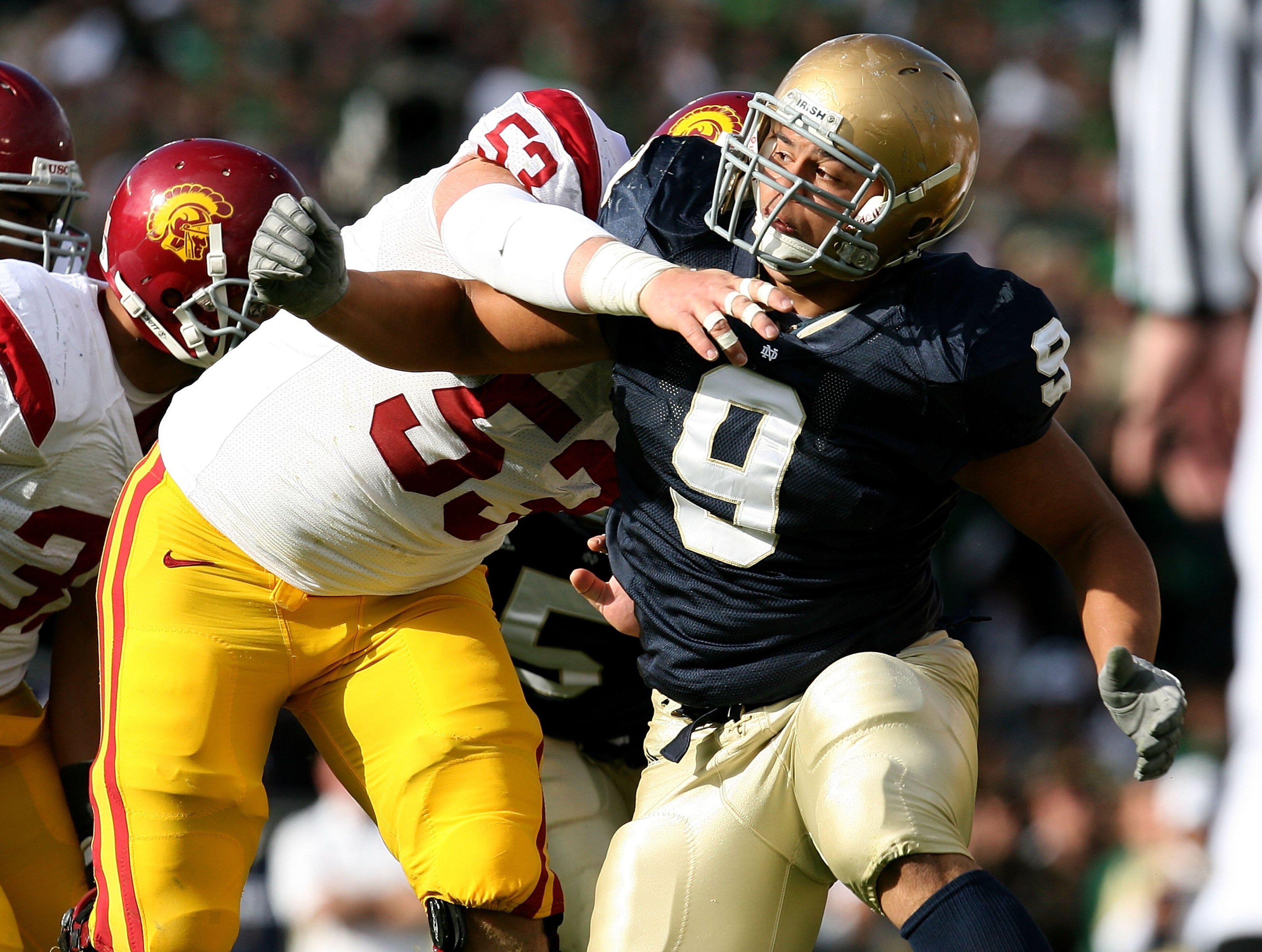
The good news for the Notre Dame defensive line is that the starters are finally playing in their proper positions.
Irish defensive coordinator Bob Diaco brings with him a 3-4 defensive alignment that fits the talents of defensive ends Ethan Johnson and Kapron Lewis-Moore much better.
Veteran nose guard Ian Williams anchors the middle of what should be an effective group.
The bad news is that the rest of them are a mixed bag of the other guys. If any of the starting three go down, the Irish could be in trouble. Notre Dame will need these three to create havoc on the interior to prevent the exposure of a weak secondary. That will require creating much more pass pressure than last year, when the team managed a only meager 20 sacks.
As bad as Notre Dame was against the pass last year, they didn't get in the way of many running backs either.
What to watch: Last year's leading tackler was graduated safety Kyle McCarthy, so the defensive line can no longer count on him to bail them out of missed tackles. If the Irish can't stop the run, pass defense will be the least of their worries.
3. The Secondary
5 of 7
It's difficult to remember who plays in Notre Dame's secondary, mostly due to the lack of plays that would involve "pass broken up by..." or "interception by..." or "touchdown not given up by..."
Expectations for the secondary are relatively low this year, but if they can manage to contain the big play, the Irish defense may still be respectable in 2010. Unfortunately, the unit suffers from a chronic case of underperformance, which leaves even that likelihood in doubt.
The best play the Notre Dame secondary made in 2009 was watch the Michigan State quarterback overthrow his wide receiver standing all alone in the end zone for what would have been a winning touchdown. It's a difficult play to rely on consistently, so for the Notre Dame secondary, the goal is basic competence or bust.
What to watch: Notre Dame must improve performance on third down, especially 3rd-and-long. Too many times in 2009 the Irish sat on the cusp of a momentum shift, only to be completely demoralized by a converted 3rd-and-10.
To take advantage of Kelly's no-huddle spread, Notre Dame needs to keep the opposing defense from getting breathers on the sideline.
2. Dayne Crist's Right Knee
6 of 7
Sportswriters around the country watched with hope during fall practice that a guy named Crist playing for Notre Dame would be healthy enough to deliver them the abundant wealth of headlines previously provided by Golden Tate.
Last season, Dayne Crist, the heir apparent to Jimmy Clausen, underwent surgery to repair a torn ACL following a garbage time injury against Washington State.
His recovery moved relatively quickly, and he has been going at full speed as the No. 1 quarterback throughout fall practice.
But Crist's knee isn't the only thing that is rebuilt. Notre Dame's offensive line has three new starters, including a sophomore at left tackle. Crist will have to show a pocket presence beyond his experience in order to avoid big hits and stay healthy all season.
If he does go down, the backup situation is tenuous. True freshman Tommy Rees beat out an inconsistent Nate Montana (yes, that Montana) to win the understudy role. For a position as important as quarterback in Kelly's system, the loss of Crist will put a lot more pressure on a patched-up defense.
At each of his coaching stops, Kelly has had to pull a rabbit out of his hat at the quarterback position. But the last time a true freshman started at quarterback for Notre Dame, Jimmy Clausen was removing the turf from his helmet far more often than celebrating a touchdown.
What to watch: How often Crist is running quarterback draws and other similar plays will be a strong indicator of how much confidence both player and coach have in the knee.
1. The First Loss
7 of 7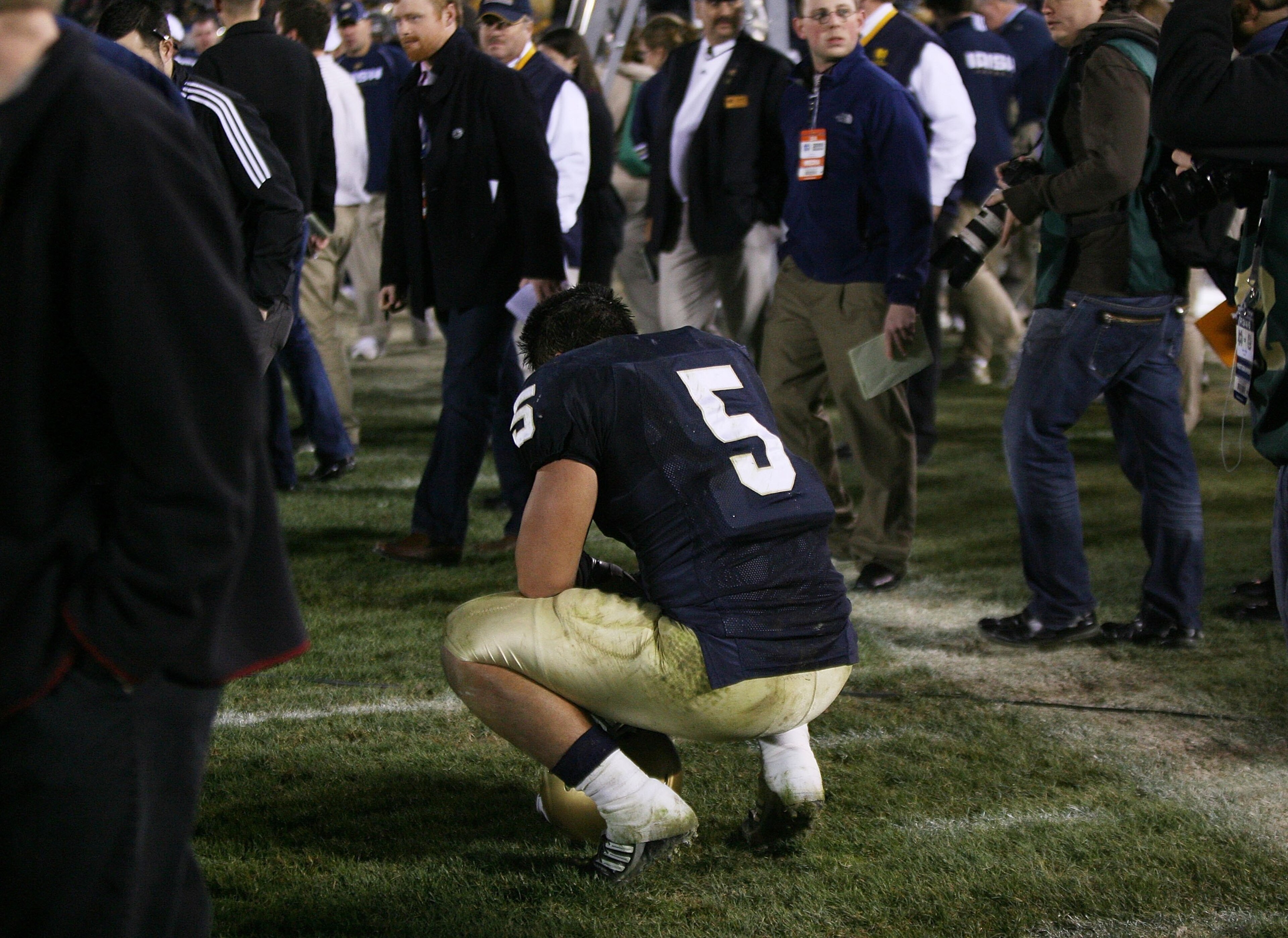
The two most important keys of this factor:
- How they play in defeat
- How they play in the next game
These two factors will be more important than the score or the opponent.
Last year, Jimmy Clausen was one of the few players to make a play when the breaks were beating the boys. If this does not become a team effort, the Irish will continue to roll over to teams with less talent.
The mental mistakes such as broken coverages or missed blocks are the habits of losing that drove Charlie Weis out of South Bend. For Kelly to return the Irish to a winning team, he first needs to stop Notre Dame from beating itself. The elimination of bad habits from game to game will be a good indicator of Kelly's progress.
Toughness, both physical and mental, is a vague quality to define, but people know it when they see it. Kelly has talked about the need for Notre Dame to reconnect with the identity of "The Fighting Irish," to play anyone, anywhere, anytime.
Now he and the team need to back up the talk.
What to watch: Leadership starts at the top, so Kelly's reaction in his first loss will be important to send a hard message to his team that losing is not acceptable. This will be Kelly's first exposure to fan and media dissection of every facet of the game, and he will need to be calm in the face of that scrutiny.
.jpg?w=3840 "AEW Dynamite Live Grades 🔠")