The 50 Greatest Players in Nebraska Cornhuskers Football History

By (Correspondent) on May 18, 2010

72,231 reads

49Icon_comment

Previous
1 of 52
Next
95734827

In the relatively brief time that I've been a writer here at Bleacher Report, I've written several articles that were outside my comfort zone.

After all, Nebraska football has been my bread and butter.

That's where research comes into play.

In the handful of articles I've written, ones in which I'm not fully versed in the subject, I do a lot of research.

Perhaps that's putting it mildly.

When faced with an unfamiliar subject, this writer completely engrosses himself in a mountain of data: statistics, bios, blogs, game recaps, newswire reports, etc.

If it's out there, I'll do my best to find it in order to give the reader a different perspective or perhaps a nugget or two of knowledge that they didn't have prior to reading the article.

And in the interest of thoroughness and professionalism, sometimes I go a bit overboard in my research. Just ask the college football article coordinator.

So when I was offered the opportunity to write an article about the 50 Greatest Huskers of All-Time, I jumped at the chance.

After all, Nebraska football is what I know best.

But once I started my research, I quickly learned how much I didn't know.

What started as a dream assignment quickly became the most challenging article I've written to date.

Besides wading through an ocean of information, I had to decide who to include, who to leave out, and how much I wanted to write about the players that made the cut.

In addition, there was the daunting task of ranking the players.

Which counts for more, individual achievements or national championships? How do the Husker greats from the Devaney era and earlier stack up to the Husker greats from the Osborne era to the present? How much does their pro career (if any) factor into the debate?

So while I enjoyed the process and am extremely happy to have been given the chance to write such a mammoth article about my beloved Huskers, one that encompasses over 100 years of football, it was no easy task.

Therefore, this is the result of countless hours spent scouring the Internet and other sources for information and then condensing it into one comprehensive article.

It's my hope that you enjoy reading it as much as I enjoyed writing it, that I did my all-time favorite team justice, and finally, that you might learn a thing or two along the way.

I know that I did.

50. Michael Booker - CB

81398912_display_image

Michael Booker, an Oceanside, California native, was a two-year starter for the Huskers at cornerback who, in his three year career (1994-96) helped Nebraska win two consecutive national titles.

As a senior, Booker earned All-Big 12 honors with his solid play, but is probably best remembered for his performance in the 1996 Fiesta Bowl, as he and his Huskers not only took the fun out of Steve Spurrier's "Fun 'n Gun" offense, but completely dominated the Gators, 62-24.

Booker did more than his part, turning in a career day in which he made four tackles, broke up three passes, and returned an interception 42 yards for a touchdown.

His efforts that night made Booker the game's Defensive MVP.

After his career at Nebraska, Booker was drafted in the first round of the 1997 NFL Draft with the eleventh overall pick by the Atlanta Falcons.

In five years, split between the Falcons and the Tennessee Titans, Booker registered 87 tackles and eight interceptions, while also starting for Atlanta in Super Bowl XXXIII.

However, Booker publicly stated that he didn't enjoy playing in the NFL as much as he did at Nebraska, which spawned criticism among fans.

In 2002, Booker, then a free-agent, worked out for the Green Bay Packers, but retired from professional football altogether shortly thereafter.

Dion Booker, Michael's younger brother, later played free safety for Nebraska from 1997-2001.

Booker now resides in the Charlotte, North Carolina area.

(Photo: Sports Illustrated)

49. Bobby Reynolds - HB

50063_1_display_image

Bobby Reynolds, a native of Grand Island, became a Husker during one of the darkest eras of Nebraska football.

Prior to his arrival, the Huskers hadn't finished with a winning record in ten years.

Reynolds proceeded to rewrite the school's offensive record books and most of his records lived well into the Osborne era.

Among those records were marks for career scoring (which lasted 22 years), and career rushing (which lasted 21 years). His single-season rushing record and his single-season touchdown record lasted for 32 years and 33 years respectively.

Reynolds was a first-team All-America selection in 1950, though injuries hampered him for the rest of his Husker career and would eventually bring a premature end to his college playing days.

His final touchdown run came against Missouri and, though it was recorded as having covered only 33 yards, witnesses claim that it was much like the 95-yard record-breaking scoring run by Eric Crouch in 2001 (also against Missouri). On his way to the end zone, Reynolds reversed his direction three times and ran through practically the entire Mizzou D.

In 1953, Reynolds was drafted as a seventh-round pick by the Los Angeles Rams.

Inducted into the College Football Hall of Fame in 1984, Reynolds died at the age of 54 in 1985.

(Photo: College Football Hall of Fame)

48. Brook Berringer - QB

Brook-berringer_display_image

Any Husker fan worth his salt is familiar with the inspiring, yet tragic story of Husker quarterback, Brook Berringer.

After all, a life-sized bronze statue of Tom Osborne instructing a helmeted Berringer, football in hand, has graced the exterior of Memorial Stadium since 2006.

No, Berringer was never a "superstar" as a player, but his selfless contribution to the team helped bring Tom Osborne's first (and long overdue) national championship.

Though it's one of the most well-known legends in the rich history of Husker lore and this author could never do it justice in just a slide's worth of information, the story and its message of grace, humility, and destiny deserves to be told, long after the last roar of the crowd echoes through the grandstands of Memorial Stadium.

In 1994, Nebraska, having ended their prior season with a heartbreaking loss to Florida State in the Orange Bowl, had unfinished business and were determined to make it to the grand stage again, but this time with a different outcome.

For the first four games, the Huskers, led by the dynamic Tommie Frazier appeared unstoppable, crushing their opposition (which included West Virginia, Texas Tech, and UCLA) by a combined score of 192-58. Frazier was making an early case for the Heisman and the Blackshirts were smothering their opponents until, late in each game, Osborne took his foot off the accelerator and exhausted his team's depth chart.

Then, after a seven-touchdown victory against Pacific, what appeared to be the worst thing possible occurred; Frazier was sidelined, diagnosed with blood clots in his leg.

Berringer, despite completing only 17 passes in his first two seasons, had to step up and replace the irreplaceable Frazier.

In the seven games that Berringer started, he had a 62 percent completion rate (94 of 151) and threw for 1,295 yards with ten touchdowns.

More importantly, the Huskers remained undefeated.

Ron Brown, Berringer's lead recruiter, recently revisited the '94 game against Colorado in an interview. He believes that game solidified Berringer's role as not just a back-up but a spirited leader who convinced his team that they could beat anyone, that their greatness that season was also their destiny.

Even with the wealth of talent the Buffaloes possessed in Kordell Stewart, Michael Westbrook, and eventual Heisman Trophy winner Rashaan Salaam, Berringer played a nearly flawless game and led the Huskers to a 24-7 victory.

In the national championship game against Miami, Frazier, who had missed more than half of the season, shared time with Berringer. Berringer rose to the occasion once more, throwing a touchdown pass in the second quarter.

The next year, Berringer played sparingly, but fittingly enough scored the Huskers' final touchdown to put the exclamation point on their rout of Florida in the Fiesta Bowl, giving Nebraska back-to-back national titles.

In 1996, Berringer's life was cut short, just two days before the NFL Draft in which he was expected to be chosen.

While flying a Piper Cub over Raymond, Nebraska, Berringer crashed into an alfalfa field and was killed.

Since then, the Huskers have chosen to remember their soft-spoken leader in a variety of ways.

Besides the beautiful sculpture outside Memorial Stadium, the university founded the Brook Berringer Citizenship Team which honors Nebraska football players who have consistently gone above and beyond the call of duty, providing excellent leadership, involvement and service.

Perhaps the inscription behind the now famous statue of Osborne and Berringer sums it up the best:

"Destiny is not a matter of chance, it is a matter of choice."

(Photo: Sports Illustrated)

47. George Sauer - FB

George-sauer-sr_display_image

George Sauer was one of the Huskers' preeminent players in the 1930's.

The famed college coach, Dana X. Bible, once said this of his fullback:

"He was probably my best all-around athlete. He was great at carrying the ball and he was one of the best on defense. He simply rolled up his sleeves and met the ball carrier head on."

High praise from a coaching legend, but considering Sauer's career, it was well-deserved.

"Everybody wanted to be George Sauer," commented Ed Schwartzkopf, who later became a Husker player. According to Schwartzkopf, boys in Nebraska constantly cajoled their mothers into sewing Sauer's jersey number onto their sweaters during his heyday.

In three seasons, the Lincoln, Nebraska product rushed for 1,570 yards, passed for 701, and was also the team's punter. During those years, Sauer helped guide the Huskers to a 23-4-1 record, including an 8-1 season in 1932 in which the Huskers' only loss came at the hands of an undefeated Pittsburgh squad.

A great two-way player, Sauer led the voting for the 1933 New Year's Day All-Star game as a senior. Sauer excelled on the field that day as he snagged interceptions and scored the only touchdowns of the contest.

At the conclusion of the game, sports writer Lawrence Perry wrote that Sauer, "stands clearly as the premier ball carrier in the nation."

In 1933, Sauer was also named as an All-America selection.

After Nebraska, Sauer played for the Green Bay Packers for three seasons and retired after they won the 1936 league championship.

Sauer then embarked on a coaching career that spanned from 1937-59 (only broken by three years of service in the Navy) and included stints at New Hampshire, Kansas, Navy, and Baylor.

In 1961, Sauer became the general manager of the New York Titans (now the New York Jets) and was instrumental in not only signing Joe Namath, but also one of Namath's favorite receivers, George Sauer, Jr.

Sauer was inducted into the College Football Hall of Fame in 1954, then into the Nebraska Football Hall of Fame in 1971.

He died in 1994 at the age of 83.

46. Matt Herian - TE

2763477

Had this list been compiled just a few short years ago, Tracey Wistrom might have occupied this spot.

After all, Wistrom did make the Athlon Sports Nebraska All-Time Team and broke Junior Miller's career yardage mark for tight ends.

Or, if this list was to be compiled this time next year, once could certainly make a case for Mike McNeill.

However, the fact that Matt Herian recovered from a gruesome leg fracture and still managed to break Wistrom's tight end career yardage record earns him a spot on this list.

Like a couple of other players on this list, you could dismiss Herian as simply a product of the system. But numbers tell just part of the story.

It was the grit and determination Herian displayed to get back into the line-up and become one of Nebraska's best tight ends that speaks more about the type of hard-nosed, workmanlike player he was more than any stat sheet ever could.

Besides, considering all the promise that Herian showed prior to his injury, it's worth noting what he might have accomplished had he not suffered that broken leg.

A native of Pierce, Nebraska, Herian helped his high school make the Class C-1 state playoffs in all four years he played, racking up 24 touchdowns and 2,386 yards in the process.

Then, as a Husker freshman in 2002, Herian started his Nebraska career with a bang by scoring a 33-yard touchdown on his first career reception. Before the season was over, Herian set a then-Husker freshman receiving record of 301 yards.

Herian immediately proved that he had big-play capability, as he averaged 43 yards per catch and scored an 80-yard receiving touchdown against Colorado. The catch tied a school record for the longest reception by a tight end.

By season's end, Herian was named as a first-team Freshman All-Big 12 selection.

Herian started his sophomore 2003 season with at least one reception in the first six games which, when added to the final three games of his freshman campaign, gave him a streak of nine straight games with a catch. Herian racked up 484 receiving yards, which tied him for the team lead in receptions. He also led the team in receiving touchdowns.

That year against Troy State, Herian had 110 receiving yards, including a 77-yard reception; the single-game total was the most by a Husker tight end since 1999. Against Colorado, he burned the Buffaloes again with a 58-yard touchdown catch.

His superb play landed Herian on two first-team All-Big 12 lists and resulted in him being chosen as a John Mackey Award semifinalist.

In 2004, Herian was having another productive season in which he surpassed 1,000 career receiving yards. However, Herian then suffered a horrible leg fracture which sidelined him for not only the rest of the season, but the entire 2005 season as well. The NCAA granted Herian a medical redshirt.

Herian finally returned to the field in 2006 after many believed that his playing days were over.

In his first game back, against Louisiana Tech, Herian caught the Huskers' opening touchdown of the season and broke Tracey Wistrom's career yardage record for Husker tight ends.

He then tied the school's tight end career receptions mark against USC and, after a couple of catches versus Iowa State and Texas, finally became Nebraska's all-time tight end reception leader.

Sadly, Herian didn't fare as well in the pros.

In 2007, Herian was signed as an undrafted free-agent by the Tampa Bay Buccaneers (along with ex-Husker teammate Zac Taylor), put on injured reserve and then released later that same year.

45. Nate Swift - WR

76776910

With perhaps one of the best names ever for a wide receiver, Nate Swift, the Hutchinson, Minnesota native, firmly entrenched himself in the Husker record books during his four-year career.

Having snared 166 catches in 51 games between 2005-08, Swift is Nebraska's all-time leader in career receptions and finished only three yards behind the legendary Johnny Rodgers to place second on the Husker's all-time receiving yardage list (2,476).

Though he placed second in several statistical categories, including season receiving yards (931) and season receptions (68), Swift holds Nebraska's freshman receiving records for receptions (45), yards (641), and touchdowns (seven).

In addition to those honors, Swift added his name to a very select list of Huskers when, as a freshman, he became only the third receiver with three 100-yard receiving games in a season, joining Irving Fryar and Johnny Rodgers.

Swift started all 13 games in his senior season with at least one reception in each, had a reception in 45 of the 51 games he played, and finished his career with one or more catches in his final 18 games.

Since Swift was one of Nebraska's more prolific receivers, many overlook his contributions as a punt returner. During his senior season, he ranked second in the Big 12 and eighth nationally with a 14.8-yard average and also scored on an 88-yard return against Virginia Tech.

In 2009, Swift signed a rookie free-agent contract with the Denver Broncos, but was waived and ended up on the Jacksonville Jaguars practice squad.

44. Joel Makovicka - FB

393045

During the Osborne years, the Huskers were very successful at developing walk-on talent.

Joel Makovicka is a shining example of that success.

The Brainard, Nebraska native is one of four brothers to play for the Scarlet and Cream.

His older brother, Jeff, was also a walk-on fullback who started for the 1995 National Championship team and his younger brothers, Justin and Jordan, continued the family tradition at Nebraska over a decade later.

The fact that the four brothers starred at Nebraska should come as no surprise; their father was inducted into the Nebraska Football Hall of Fame in 1996. The eldest Makovicka lettered for four years at Kearney State College (1967-70) as a halfback.

After redshirting his freshman year in 1995 and backing up his brother the following year, Joel stood poised as the Huskers' next starting fullback.

In 1997, he did just that; stepping up into the void and turning in the fourth-best rushing season by a fullback in school history, 685 yards and nine touchdowns, en route to helping Nebraska win its third national title in four years.

After a solid senior season in 1998, Makovicka ended his career with 1,447 yards and 13 touchdowns (a school record for career touchdowns by a fullback), along with a 5.9 yards per carry average, and enjoyed many accolades both on and off the field.

A three-time Academic All-Big 12 selection and two-time First Team CoSIDA Academic All-America honoree, Makovicka was a Doak Walker Award nominee and the recipient of the Guy Chamberlin Trophy in his final season.

Makovicka was also named to the All-Century Nebraska football team.

In the 1999 NFL Draft, Makovicka was selected in the fourth round by the Arizona Cardinals and started ten games at fullback as a rookie.

After his professional football career ended in 2002, Makovicka tried his hand at coaching for the University of Virginia, but has since earned a Doctorate in Physical Therapy at Creighton University and now operates a pair of clinics in Omaha.

43. Dana Stephenson - RCB/S

Shadow_display_image

Don't let the fact that this author couldn't find a photograph of Dana Stephenson make you skip to the next slide.

A member of the Athlon Sports' Nebraska All-Time Team, Dana Stephenson's name is scattered throughout the Husker record books.

Nebraska's career leader in interceptions with 14, Stephenson played from 1967-69 and also holds the school record for interceptions in a game (three, tied with three other players, the latest being Matt O'Hanlon in 2009) and also had two season interception totals (seven in 1969 and five in 1968) that tie him for second and seventh among all former Huskers.

Most famously, his three-interception performance against favored and 18th-ranked Colorado in 1969 almost single-handedly gave the Huskers a 20-7 upset win.

A team captain in 1970, Stephenson was a two-time All-Big 8 selection in 1968-69 and was the third recipient of Guy Chamberlain Trophy in 1969.

42. Joe Ganz - QB

84154839

After contemplating this spot on the list, it came down to Zac Taylor and Joe Ganz.

Taylor holds the Nebraska records for most career passing yards, attempts, completions, and touchdowns. He also did all of that in just two seasons.

However, after a trip through the Nebraska record books, it became clear that Ganz still holds nearly twice as many records as Taylor.

That, combined with Ganz' plucky play, feel-good underdog story, and the fact that he only played one full season and change, gave Joe the nod although Taylor should receive a most honorable mention.

One could argue that Joe Ganz (or Taylor, for that matter) was a product of the system, that he put up his gaudy numbers in a wide-open, pass-happy Big 12 Conference, but that would be selling Ganz a bit short.

Especially since Ganz kept such a positive attitude after being passed over for the 2007 starting spot in favor of Sam Keller and still became one of Nebraska's best all-time passers.

Hailing from the suburbs of Chicago, Ganz redshirted his first year and was named the Offensive MVP of the scout team.

In 2005, Ganz backed-up Zac Taylor, but still never saw the field.

After backing-up Taylor again, Ganz played in five games during the 2006 season, but (as referenced above) was relegated to a back-up role once again in 2007.

However, after Keller suffered a shoulder injury late in the season against Texas, Ganz came off the bench, performed admirably against the Longhorns, and then exploded into Nebraska stardom.

The week after the Texas game, Ganz threw for 405 yards and four touchdowns against Kansas, adding a rushing score in the process, then shelled Kansas State the following week with a 510-yard, seven touchdown performance, both Nebraska game records.

In the team's final game, versus Colorado, Ganz once again lit up the scoreboard with 484 passing yards, four passing touchdowns and two rushing touchdowns, good enough for second on the school's all-time single-game passing and single-game total offense lists.

At season's end, Ganz had connected on 58.6 percent of his passes for 1,435 yards and 16 touchdowns. In November alone, Ganz laid claim to three of the five 400-yard passing games and three of the top five games of total offense in Husker history.

Ganz' penchant for throwing touchdowns resulted in a receiver tying the school's single-game touchdown mark in every one of his three starts.

In 2008, Ganz's offensive parade continued.

Adding five more 300-yard passing games to his resume, Ganz proceeded to lay claim to 23 school records, including the mark for single-season passing yards (3,568) and total offense (3,826 yards). Additionally, the 25 touchdowns he threw in '08 were second best all-time as were his 45 career passing touchdowns.

An extremely accurate thrower, Ganz also broke the the Huskers' career mark for completion percentage, as well as the single-season records for total completions and passing accuracy. At season's end, only three other quarterbacks had a higher completion percentage than Ganz in '08; Sam Bradford, Tim Tebow and Colt McCoy, all Heisman finalists.

Not just a drop-back passer, Ganz rushed for 258 yards and five touchdowns, while also becoming only the third player in Nebraska history to pass, run and catch a touchdown in a single game.

The other two? Heisman winners Johnny Rodgers and Eric Crouch.

Ganz put an exclamation point on his 2008 Husker MVP season by setting a new Husker bowl record for passing yardage and becoming the game's MVP in Nebraska's 26-21 win over Clemson in the 2009 Gator Bowl.

Other accolades for Ganz included being named to the Johnny Unitas Golden Arm Award watch list, winning the Tom Novak Trophy and being named to the Brook Berringer Citizenship Team.

Ganz finished his career with 5,125 passing yards and 44 passing touchdowns, both good for second on the Huskers' all-time list, behind Taylor.

However, when one considers that Ganz had only 725 fewer yards and one touchdown less than Taylor and that his career completion percentage was eight points higher, Ganz was arguably the better quarterback. Even more so when one also considers that Ganz had only 16 career starts to Taylor's 26.

After life at Nebraska, where he became a cult hero of sorts, Ganz was again the underdog as he tried to make it in the NFL.

Ganz signed a undrafted free-agent contract with the Washington Redskins, where he competed against former Big 12 rival, Chase Daniel. However, the Redskins decided not to retain Ganz and, in June 2009, he tried out with the Buffalo Bills.

This January, a report from a Lincoln newspaper stated that Ganz will now serve as an offensive intern for the Nebraska coaching staff. Having passed on becoming a graduate assistant, his duties will be limited to work with the strength and conditioning staff as well as the video department.

Said Husker offensive coordinator Shawn Watson about Ganz and his new role, "He’s my living example of what I want in a quarterback. He’s performed at a really high level...I think he can bring the preparation aspect of it. And he can be a real mentor to all these young quarterbacks we have. They just need to listen.”

41. Josh Bullocks - FS

Nebraska3_display_image

Either Josh or his twin brother Daniel could have conceivably made this list, as their careers were strikingly similar; they were both excellent Nebraska secondary players who were on the Lott Trophy and Jim Thorpe Award watch lists and they were both drafted in the second round by their respective NFL teams.

However, Josh was the only one of the two to be a first-team All-America selection and he also holds the NU single-season interception record with ten in 2003.

After playing running back and cornerback alongside his brother (who was the quarterback) at Hixson High in Chattanooga, Tennessee, Josh redshirted during his first year at Nebraska.

As a redshirt freshman in 2002, he was listed third on the free safety depth chart, but made his first start against Oklahoma State and was named the official starter prior to the Texas game.

In 2003, Bullocks had five interceptions five games into the season, and set a school record with four consecutive games with an interception. In the ninth game of the season, versus Texas, Bullocks broke a 33-year old record for interceptions in a season with his eighth pick. Bullocks hit double digits with his 10th interception in the 11th game of the season against Kansas State and almost added an 11th pick with fifth pass break-up of the year.

Bullocks' effort placed him second nationally in interceptions per game (0.77 ints/gm) and helped the Nebraska defense rank first in the nation in interceptions (32) and second in takeaways (47). His ten interceptions were more than the total interceptions of four of the Big 12's teams and tied him with a fifth.

In 2003, Bullocks was named as a first-team All-Big 12 and first-team All-America selection as well as a Jim Thorpe Award semifinalist.

Headed into 2004, Bullocks' impressive '03 season continued to garner national notice. Among the honors he received were a preseason All-Big 12 selection, inclusion on the Lott and Jim Thorpe Award watch lists and recognition as the number-one safety in the country by two separate national publications.

Though Bullocks, as a team captain in 2004, only managed to add two more interceptions to his career total of 13 (which ranks second all-time at Nebraska, behind only Dana Stephenson), he did manage to lead all defensive backs with a career-high 63 tackles.

After his senior season, Bullocks was named to the Coaches' All-Big 12 second-team.

Bullocks was drafted in 2005 by the New Orleans Saints in the second round with the 40th overall pick. In four years as a Saint, he had six interceptions and then signed a one-year free-agent contract with the Chicago Bears in 2009.

In 2007, the Bullocks brothers set up a $5,000 scholarship at their high school to be awarded to a senior athlete.

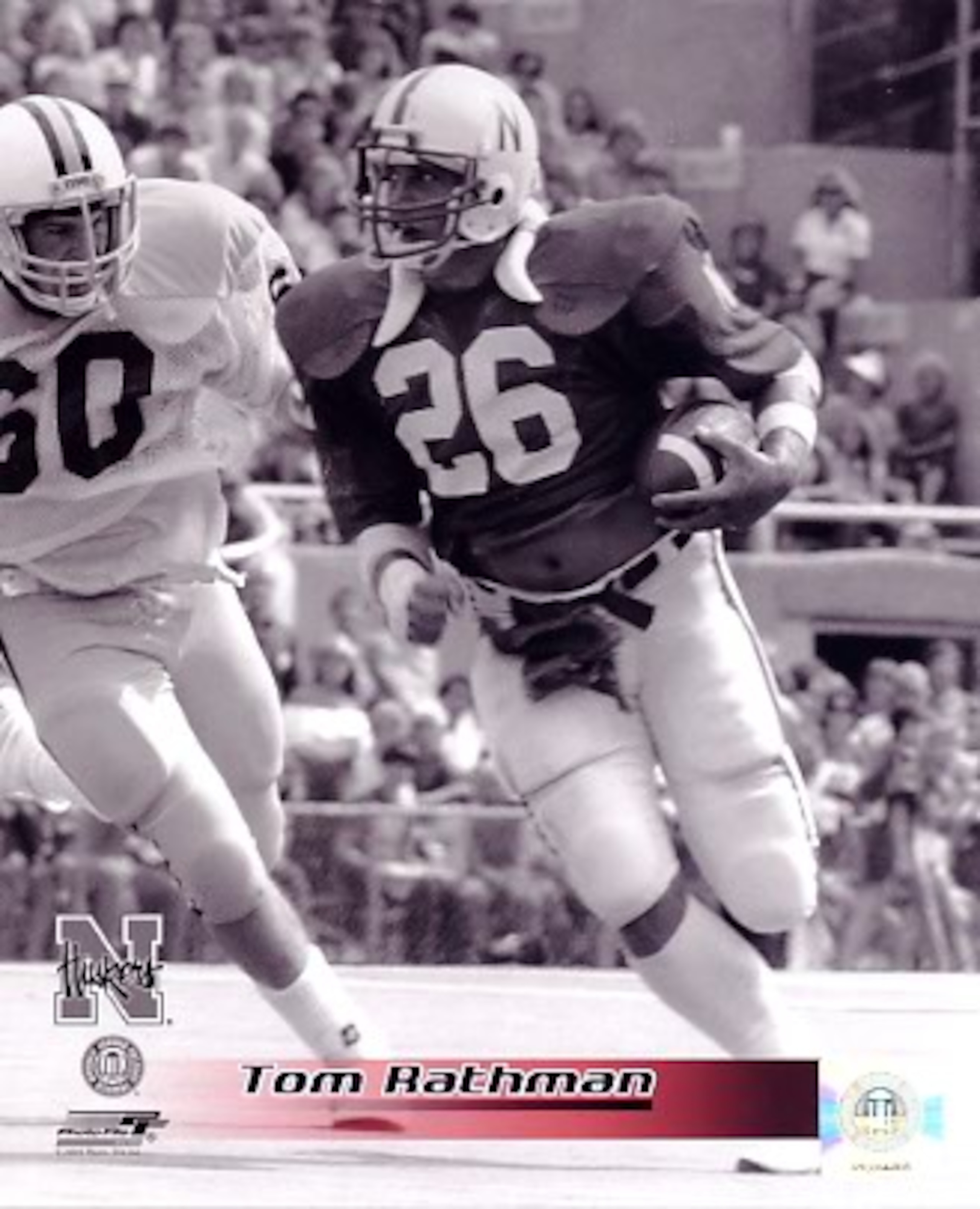
40. Tom Rathman - FB

Image

Before Bill Callahan (unsuccessfully) brought his finesse-style of football to Lincoln, when college football fans thought of Nebraska, they envisioned giant offensive linemen and hard-nosed fullbacks opening gaping holes for powerful I-backs.

Tom Rathman embodied that style of football.

The Grand Island native, better known by some for his professional career with the San Francisco 49ers (where he won two Super Bowl rings), was an excellent blocker as well as an explosive runner.

In fact, his 881 yards in 1985 is still the highest single-season rushing total for fullbacks in Nebraska football history. That season he averaged 7.5 yards per carry.

With a nose for the endzone (Rathman scored 12 times in his career, a Nebraska record at the time), he also showed big-play ability, ripping off large chunks of real estate (32 or more yards) on six of his scoring runs in his senior season. The longest was an 84-yarder against Colorado; he also gashed Florida State for a 60-yard touchdown and Kansas for a 44-yard score.

In 1985, he was an All-Big 8 selection and a third-team All-America honoree and was later inducted into the Nebraska Football Hall of Fame in 1992.

In 2000, Husker fans voted the tough-as-nails Rathman to their All-Century team.

As a pro, he blocked for his former Husker teammate Roger Craig in San Francisco. Rathman gained over 2,000 rushing yards, 2,600 receiving yards and scored 34 touchdowns in his career.

Two of those touchdowns came in Super Bowl XXIV; in 1989, he also led all NFL running backs in receiving with 73 grabs for 616 yards.

Following his nine-year professional career which included a stint with the Raiders, Rathman went in to coaching. He has been a running backs coach for three NFL teams including the 49ers; in 2009 he joined the 49ers coaching staff for a second time.

39. Kenny Walker - DT

Lmnztxoctormpqv

Considering all the great Blackshirt defenses that Nebraska has had throughout the years, a story about a player earning All-America and Big 8 Defensive Player-of-the-Year honors wouldn't be all that surprising.

Nor would it be surprising if that same player went on to play several seasons in the NFL and CFL, at one point working his way into a starting role for the Denver Broncos.

What might come as a surprise to some fans is the fact that the player in question, Kenny Walker, is deaf.

Deprived of his ability to hear at age two after a bout with spinal meningitis, Walker was a natural athlete who, as a youngster, excelled at a variety of sports.

By the tenth-grade, he had become a starter on his Texas high school football team, where he eventually earned all-state honors. His athletic prowess didn't end at the gridiron either; in addition to being a track and field star, Walker also garnered accolades as an all-state center in basketball.

Despite his disability, his success in the sports world and his accomplishments in the classroom eventually commanded the notice of Tom Osborne and the University of Nebraska.

After accepting the Huskers' scholarship offer, Walker became the first deaf player to don the Scarlet and Cream and began his steady rise in the ranks of college football.

By his senior season, Osborne referred to Walker as "the greatest pass rusher in college football today."

An inspiration to all who witnessed his play, his heroic example became the stuff of legends.

A former team psychologist, Jack Stark, credits Walker with the Huskers' rise to dominance in the nineties.

Prior to a Citrus Bowl appearance in 1991, doctors had told coach Osborne that his declining health might force him from coaching. After a dismal first half against Georgia Tech, Osborne gave a heartfelt speech in which he mentioned his possible retirement.

Walker, an adept lip-reader, enveloped Osborne in a fierce hug following his remarks.

The team went wild.

Though the Huskers failed to win the game, Stark believes that moment was the emotional turnaround of the Nebraska program that eventually led to the Cornhuskers' near-invincibility and three national titles from 1994 to 1997.

In Walker's final home game, the entire stadium rose as one and gave him a silent ovation in sign language. It remains one of the most inspiring and unforgettable moments in Nebraska football history.

After becoming only the second deaf player in the NFL, Walker then played for the Calgary Stampeders, making him the CFL's first deaf athlete.

Between the two leagues, Walker played five years of professional football.

Walker later coached football for the Iowa School for the Deaf, and remains a heroic example for all persons, regardless of their physical limitations.

(Photo: Huskers.com)

38. Mike Minter - ROV

346002

A member of the vaunted Blackshirts defense during the Huskers' championship runs in 1994 and 1995, Minter, an Oklahoma native, was named to the Nebraska fans' All-Century Team in 2000 and was inducted into the Nebraska Football Hall of Fame in 2006.

A first-team AP All-Big 12 selection in 1996, Minter collected numerous other Big 8 and Big 12 honors during his career, including the Tom Novak Award as a redshirt senior.

in 1994, he tore his ACL and missed the final ten games of the season.

However, his determination allowed him to start his final two seasons in the Nebraska secondary and compile one of the greatest single seasons in his senior year.

While also spending playing time as a WILL linebacker, Minter recorded 51 tackles (15 solo and four for losses) along with five interceptions and six pass break-ups.

In 1997, Minter was selected in the second round with the 56th overall pick by the Carolina Panthers.

In the sixth game of his NFL rookie season, Minter won the starting spot at safety and, with the exception of a couple of injuries, held the job until his retirement in 2007.

Minter is near or at the top of a slew of Panthers' team statistical rankings including career tackles, interceptions, forced fumbles, fumble recoveries, and interceptions returned for touchdowns.

Since his retirement, Minter has been very active with several charitable organizations and even considered a career in politics.

According to his very slick website, mikeminter.com, he has recently focused his philanthropy on helping the YMCA of Greater Charlotte with their relief efforts in Africa.

37. Bob Newton - OT

Buwnrvhjskqqxns

A transfer from Cerritos Junior College in Norwalk, California in 1969, Bob Newton set a Big 8 conference record by being nominated for Lineman-of-the-Week four times (against Wake Forest, Minnesota, Kansas, and Oklahoma State).

Described by the great Bob Devaney as a lineman “who defiantly should be considered as an All-American," Newton lived up to the hype and was named a consensus All-America selection, as well as a unanimous All-Big 8 honoree, while helping lead Nebraska to their first national title.

Chosen by the Chicago Bears in the third round of the 1971 NFL Draft, Newton also played for the Seattle Seahawks in a professional career that lasted twelve years until his retirement in 1982.

In 2000, Husker fans voted Newton to the Nebraska All-Century Football Team.

(Photo: huskers.com)

36. Marc Munford - LB

Oumarcmunfordint_display_image

A three-time All-Big 8 award winner, Marc Munford led the Huskers in tackles for three straight years (1984-86).

In 1984, as a sophomore, Munford racked up 99 tackles (61 solo and seven for losses). Against Missouri, Munford had two interceptions (one for a touchdown) and a season-high 16 tackles. He matched those 16 stops with another 16 versus Oklahoma and finished the year nicely with nine tackles (seven solo) and another interception against LSU in the Sugar Bowl.

The next year, a knee injury cost him the final two games of the season but, as mentioned above, Munford still led the team in tackles with 67; 11 of those came in the Huskers' game versus Illinois.

In 1986, he came back from his knee injury with a vengeance, registering another 90 tackles (49 unassisted) and added a pair of interceptions as he earned honorable mention All-America honors.

His 153 solo stops is still third-best in Husker history, while his total tackles tally of 256 places him at the eighth spot on the all-time Husker list.

Munford was drafted in the fourth round in 1987 by the Denver Broncos and he spent four years in the NFL, dividing his time with the Broncos and the Kansas City Chiefs.

In 1997, Munford was inducted into the Nebraska Football Hall of Fame.

Three years later he was voted by the fans onto the Huskers' All-Century team.

35. Ed Stewart - WLB

Zctikytjluplgam

Filling the footsteps of fellow linebacker Trev Alberts in 1994, Ed Stewart did more than just occupy space.

As a fixture of a dominant Blackshirts defense that helped secure Tom Osborne's first national title, Stewart actually surpassed Alberts' 248 career tackles with 257 of his own and now ranks seventh on Nebraska's all-time career tackle list.

A consensus All-America selection in 1994, Stewart was also the Big 8 Defensive Player-of-the-Year as well as a Football Writers Defensive Player-of-the-Year and Butkus Award finalist.

Elected to the Nebraska All-Century Team by a fan vote, Stewart signed a free agent contract with the Carolina Panthers only to be waived, spend time in Europe playing for Amsterdam in the WLAF, and ultimately ended up on the St Louis Rams' practice squad, before leaving football entirely.

Since then, Stewart has been inducted into the Nebraska Football Hall of Fame and has continued his motivational speaking career, begun in 1994.

His charitable work has included a successful fundraising effort which netted almost $500,000 for the United Way. Stewart has also served on the boards of the Special Olympics and Big Brothers Big Sisters.

Stewart was also an athletic administrator for nine years at the University of Missouri and is now serving as Assistant Commissioner of Football and Student Services for the Big 12 Conference.

(Photo: huskers.com)

34. Jerry Murtaugh - LB

Hcxyhtvfrraabxb

Jerry Murtaugh is not a name that springs to mind when talking about the great Huskers of the past.

But it should.

Murtaugh was not only one of the more proficient tacklers of his era (1968-70), but was the Huskers' career leader in total tackles (342) until Barrett Ruud eclipsed his record in the early 2000's.

In 1968, the Omaha native led the team in tackles as a sophomore (99), and then followed up that effort in 1969 by breaking the single-season record for tackles as a junior (126).

However, in 1970, Murtaugh's star shone the brightest as he helped Bob Devaney and his fellow Cornhuskers win their first national title, a title that team co-captain Murtaugh boldly predicted the Huskers would win before the season ever began.

It all started the previous year after the Huskers shellacked the Georgia Bulldogs in the Sun Bowl, 45-6.

It was a game that Murtaugh almost didn't play.

While in El Paso, he and some teammates had gotten into some minor trouble in Juarez, Mexico, which prompted coach Devaney to threaten to send him back to Lincoln.

However, Devaney wanted to win as much as anyone and ended up allowing Murtaugh to play.

After the game, Georgia coach Vince Dooley said that Nebraska didn't belong in the Sun Bowl...but not for reasons you might expect.

Dooley meant that Nebraska deserved better competition than his Bulldogs could muster. He went on to say that the Cornhuskers had been the best team he had ever seen in all his years of coaching.

Murtaugh was recognized as the Outstanding Lineman-of-the-Game.

Afterwards, he took Dooley's comments to heart, thinking to himself, "Look out for us next year." His belief in his fellow teammates grew stronger and stronger until, in 1970, he made his boastful comment to the newspapers.

According to Murtaugh, the remark enraged Devaney, who promptly told his confident, young linebacker to "keep your damn mouth shut". As a punishment, Murtaugh ran countless steps, something that the mischievous defender did often.

In fact, Murtaugh attributes his troublemaking streak for helping him get into great physical shape.

With an angry coach and a bold prediction both looming over his head at the start of the 1970 campaign, Murtaugh certainly did his part to make sure he didn't have to eat his words.

His mark of 132 total tackles and 71 unassisted tackles that season still ranks fourth all-time on both lists.

In the Orange Bowl against LSU, Murtaugh led the team with nine tackles as a smothering Nebraska defense held the Tigers to only 51 yards rushing in a 17-12 win.

Murtaugh was rewarded for his efforts by being named the 1970 Big Eight Player of the Year and a first-team All-America selection.

With his playing days as a Husker behind him, Murtaugh signed a free-agent contact with the New England Patriots, but blew out his knee twice, effectively ending his professional career.

Named to the Athlon Sports Nebraska All-Time Team, Murtaugh co-hosts the Legends Radio Show on 590 AM in Omaha.

33. Scott Frost - QB

249397

One of only three quarterbacks to win a national championship at Nebraska, Scott Frost, though he played only two seasons with the Huskers, managed to distinguish himself in a variety of ways.

Frost, a native of Wood River, Nebraska, played for Stanford University for two years before transferring to the Huskers and sitting out the 1995 national championship season.

In 1996, Frost was a first-year starter for Nebraska, replacing the great Tommie Frazier. That year, he was named the Big 12 Newcomer-of-the-Year and set two school records.

An efficient passer, Frost had a 13-3 touchdown-to-interception ratio. His three interceptions (on 200 attempts) provided one of those records. Additionally, Frost ranked third nationally in fewest interceptions thrown and 32nd in passing efficiency (103.9).

Meanwhile, his 1,878 yards of total offense was a Husker single-season record for a junior.

As a senior in 1997, Frost led Nebraska to its fifth national title and became only the 10th quarterback in NCAA history to rush for over 1,000 yards in a season (fourth in conference history) and the first quarterback in school history to rush for 1,000 yards while passing for 1,000 yards in the same season.

For his efforts, Frost was named an AP second-team All-Big 12 selection, a Johnny Unitas Award finalist, a Davey O'Brien Award semifinalist, and the winner of the Tom Novak Award.

Though he holds the a school record for 155 pass attempts with no interceptions, Frost will probably be remembered most for helping keep the Huskers' national title hopes alive by throwing a single pass.

In the 1997 game at Missouri, Frost threw a last-second pass which was kicked into the air by wingback Shevin Wiggins and then caught by receiver Matt Davison for a touchdown.

The score sent the contest into overtime, where Frost won the game for the Huskers with a rushing touchdown, thereby preserving Nebraska's perfect season.

Frost then played five seasons in the NFL as a defensive back and a special teams player for the New York Jets, Cleveland Browns, and Green Bay Packers before trying his hand at coaching.

In 2002, Frost returned to Nebraska as a graduate assistant coach, then tried to return to the NFL with the Tampa Bay Buccaneers.

Four years later, Frost took the same position at Kansas State, then in 2007, became the linebackers coach at the University of Northern Iowa before being promoted to co-defensive coordinator.

In January of 2009, Frost was hired by the University of Oregon as their wide receivers coach.

That September, Frost was again involved in a bizarre incident when, following a loss to Boise State, running back LeGarrette Blount lost his cool. Frost can be seen in the video trying to restrain an enraged Blount.

32. Ed Weir - T

220px-ed_weir_display_image

Ed Weir owned the distinction of being Nebraska's first two-time All-America selection as well as being the university's first player inducted into the College Football Hall of Fame in 1951.

Weir was an influential part of Nebraska athletics, not only during his playing days in the 1920's, but also in other capacities for almost 50 years.

As a player, the two-time captain helped the Huskers open Memorial Stadium in style, with a 24-0 win over Oklahoma in 1923, plus they blanked Illinois, 14-0 on the road, marking the only time that the famed Red Grange failed to find the end zone during his illustrious career.

Perhaps more impressively, Weir and the Huskers defeated Notre Dame's famous "Four Horsemen", making the Huskers the only team to do so during Notre Dame's golden era between 1922 and 1924.

Notre Dame's coach, the legendary Knute Rockne, called Weir "the greatest tackle I ever saw."

After his college career, Weir played three seasons in the NFL for the Frankford Yellow Jackets, then in 1928 returned to Nebraska as an assistant football coach and an assistant track and field coach.

Weir coached for Dana X. Bible from 1929-36 and helped the Huskers win seven Big Six titles during his tenure. He also was instrumental in the success of Nebraska's track and field program; as head coach, the Huskers won ten conference titles between 1939 to 1955.

In 1974, the Huskers dedicated their track and field stadium in Weir's honor.

Weir has also been honored by the Football Writers Association of America with his inclusion in their 1920's All-Star team and by his induction into the Nebraska Football Hall of Fame in 1971.

Weir passed away in 1991.

31. Junior Miller - TE

Vviqvhwralywwmb

One of the best tight ends in Husker history, Junior Miller was a force to be reckoned with during his senior season in 1979.

Named to every major All-America team and an All-Big 8 honoree, Miller broke the mold of the traditional Nebraska blocking-first tight end.

After seeing limited playing time as a sophomore, Miller exploded in 1978. He led the Huskers in several receiving categories; receptions (33), yardage (609) and touchdowns (6).

Against Kansas State, Miller had a career day; five catches for 124 yards, and was honored as the Big 8 Offensive Player-of-the-Week.

At season's end, Miller was named a first-team All-Big 8 and third-team All-America selection.

Though he didn't better his totals as a senior, Miller caught touchdowns in five different games, including a pair of two-touchdown performances against Penn State and Iowa State. Second on the team in receptions and receiving yardage, Miller also established himself as a running threat, gaining 80 yards on eight carries.

By the time he left Lincoln, Miller held every tight end receiving record at Nebraska. To this day, he holds the Husker tight-end records for yards gained and touchdowns scored in a single season.

In the 1980 NFL Draft, Miller was chosen by the Atlanta Falcons in the first round with the seventh overall pick.

As a Falcon, Miller was a two-time Pro Bowl selection; as a rookie in 1980 and again in 1981.

His career lasted five years, the final year of which Miller played for the New Orleans Saints.

Voted to the Husker fans' All-Century team, Miller founded Lincoln-based Miller Mailing in 1987, a company that still operates to this day.

(Photo: huskers.com)

30. Jerry Tagge - QB

81341285_display_image

Selling concessions as a teenager at Lambeau Field in the 1960's, Jerry Tagge might have imagined himself slinging the pigskin out on the "frozen tundra". He would get there eventually, but not before leading the Nebraska Cornhuskers to their first two national championships.

Born at Offutt Air Force Base near Omaha, Nebraska, Tagge played his high school football at Green Bay West High School in Wisconsin. A standout athlete, he earned All-State and All-America prep honors in both football and basketball.

In 1969, as a sophomore for the Huskers, Tagge split time at quarterback with Van Brownson, yet still managed to set school records for total offense (1,544 yards) and passing accuracy (57 percent). In his first start of the season, against Minnesota, Tagge set a new Nebraska record with 301 yards of total offense; at the time, he was only the sixth player in Big 8 history to do so.

The following season, Tagge broke his own mark for total offense in a season, while also breaking the Huskers' records for career passing and total offense.

One of his highlights that season was directing the Huskers, who were two-touchdown underdogs, to a 21-21 tie against USC at the Los Angeles Coliseum.

However, his most memorable moment came during his MVP effort against LSU in the Orange Bowl. In the fourth quarter, Tagge stretched across the goal line from the one to score the go-ahead touchdown, giving Bob Devaney and the Huskers their first national championship.

His completion percentage of 63.03 percent in 1970 would survive until 2008.

Led once again by Tagge in 1971, the Cornhuskers would repeat as national champions. Along the way, Tagge rewrote all the passing and total offense records in the Nebraska record book and repeated as the Orange Bowl MVP, as the Huskers cruised against the Alabama Crimson Tide, 38-6.

As a result of his outstanding 1971 season, Tagge received both All-Big 8 and All-America honors.

Following his Husker career, Tagge was atop Nebraska's career passing list and still ranks fourth among all Nebraska passers, behind only Zac Taylor, Joe Ganz and Dave Humm.

Though he was taken with the 11th pick of the first round by the Green Bay Packers in 1972, Tagge was unable to duplicate his success as a pro. He played for three seasons in Green Bay before being released after the 1974 season by the Packers' new head coach, Bart Starr.

Tagge then saw action in the World Football League and the CFL, where he won the Jeff Nicklin Memorial Trophy (awarded to the CFL's Most Outstanding Player in the West Division) in his first season. However, a knee injury in 1979 ended Tagge's professional career.

Life after football for Tagge included stints selling apartments in St. Louis, then life insurance in Omaha after moving there in 1986. Eventually, he founded Tagge-Rutherford Financial Services where he serves as an executive vice-president to this day.

(Photo: Sports Illustrated/Getty Images)

29. Barrett Ruud - LB

2710640

For the Ruud family, playing football at Nebraska is not just a family tradition, but perhaps a birthright.

Judging by Barrett Ruud's career, in which he became Nebraska's all-time leading tackler, it's not hard to see why.

Besides having his brother, Bo, follow in the family's footsteps as a Husker from 2003-07, Barrett had four other family members precede him at Nebraska.

The Ruud Husker family history started with Barrett's grandfather, Clarence Swanson (1918-21), two uncles (Bob Martin and John Ruud, who played in the seventies) and his father, Tom Ruud, who played for the Huskers from 1972-74 and then became a first-round pick for the Buffalo Bills and a five-year NFL veteran.

As a true freshman in 2001, Ruud played in every game and made 49 tackles, the most among non-starters. For his effort, he was named a second-team Freshman All-America selection.

In 2002, Ruud started all 14 games at Mike linebacker and finished the season one tackle shy of the team lead. Despite having to contend with a broken hand and a leg injury, Ruud had six games of eight or more tackles and was awarded a Coaches' All-Big 12 Honorable-Mention.

The next season, as a junior, Ruud set a school record for tackles in a season with 149 and racked up double-digit tackle totals in nine games. In the last four games of the season, Ruud had 14 tackles or more, including a career-high 17 stops at Texas and 16 more against Colorado.

Ruud also finished second on the team in tackles for loss and seventh nationally in total tackles.

As a result, Ruud made multiple All-Big 12 teams as a second-teamer and one as a third teamer.

In his final season, Ruud, a 2004 team captain, led the team in tackles for a second straight year and broke the school record for total tackles with 432, which shattered Jerry Murtaugh's previous mark of 342. Along the way, Ruud also broke the record for solo tackles in a game with 16 against Kansas State, set a personal mark of 19 tackles in a game, and led the Huskers in tackles for loss with 18.

Besides owning the school record for total career tackles, Ruud, upon the completion of his Nebraska career, also laid claim to the the top two spots on the NU single-season tackle leaders list as well as the record for unassisted tackles in one season.

Ruud also enjoyed several accolades in his senior year; besides being named Nebraska's Defensive MVP, he was a consensus first-team All-Big 12 selection and a third-team All-America honoree.

In the 2005 NFL Draft, Ruud was taken in the second round with the 36th overall pick by the Tampa Bay Buccaneers.

As a Buccaneer, Ruud won the NFC Defensive Player of the Month Award in September of 2007 and has 467 tackles, five interceptions and three sacks in five seasons played.

A solid player who has also become a fan favorite in Tampa Bay, he still enjoys the chants of "RUUUUD" after making a play, not unlike the Saturdays he spent playing in Lincoln.

28. Lawrence Phillips - IB

72281873

During his playing time as a Husker, Lawrence Phillips brought enough bad publicity to his team and to coach Tom Osborne, who tried to stand by his troubled player, that he doesn't even have a bio on the Huskers' official website.

An amazingly gifted athlete, Phillips became the poster child for college players who had run afoul of the law and subsequently became one of the more notable busts in NFL history.

Though any honest account of Phillips' career at Nebraska must also include his legal problems, a story that Husker fans have heard all too often, let us for a moment try to focus on his on-the-field accomplishments as a premiere college athlete.

Clearly a troubled youth, Phillips was living in a foster home when he was recruited by Osborne.

During his freshman season in 1993, Phillips worked his way up the depth chart and, after his solid performance in the 1994 Orange Bowl, established himself as Nebraska's number-one running back.

In 1994, Phillips saw plenty of playing time as quarterbacks Tommie Frazier and Brook Berringer suffered from injury problems. Phillips took full advantage of the opportunity and tied a school record by compiling 11-straight 100-yard rushing games, despite battling a thumb injury and having to contend with opposing defense stacking the box against him.

In all, Phillips turned in 1,722 yards in 1994 (good enough for second on NU's season rushing yardage list) on a school record 286 attempts. His '94 rushing total still ranks as the best sophomore season in school history.

In the 1995 Orange Bowl, Phillips racked up 96 yards on 19 carries (which included a 25-yarder that was the longest run the stingy Hurricane defense had allowed all season) while helping Osborne win his first national championship.

In 1996, Phillips' ugly story of criminal mischief began.

A pre-season favorite for the Heisman Trophy, Phillips had an 11-yard per carry average and six touchdowns in just two games. After coming off a 206-yard performance against Michigan State, he was arrested for assaulting his ex-girlfriend, who played for the Huskers' women's basketball team.

Osborne suspended Phillips from the team, but reinstated him before the Iowa State game. Osborne, a devout Christian, took a lot of flak in the media for his decision, which he believed to be in the best interest of Phillips.

While freshman phenom running back Ahman Green started, Phillips was allowed to play in several games, which only made the media blitz more intense. Osborne was unfairly labeled as a "win at all costs" coach, especially when he allowed Phillips to start in the Fiesta Bowl.

During a 62-24 drubbing of Florida, Phillips turned in another dominating performance (165 rushing yards and two touchdowns with an additional touchdown scored on a 25-yard reception).

With the condemnation of Osborne and Phillips at its highest, Osborne encouraged Phillips to leave Nebraska a year early for the NFL.

When Phillips left the Huskers, he was the fifth-leading rusher in Nebraska history.

Although Osborne was highly criticized by a rabid media for his handling of Phillips' situation, many Husker fans still believe that he did the right thing by not giving up on a clearly troubled young man.

In the 1996 NFL Draft, the St. Louis Rams selected Phillips in the first round with the sixth overall pick. It was a decision that the Rams would later regret when, after drafting Phillips, they traded their star running back, Jerome Bettis, to the Pittsburgh Steelers.

At the time, however, St. Louis had high hopes for Phillips and ESPN's Joe Theismann called Phillips "the best player in the draft."

Phillips played for one and a half seasons with the Rams, before an argument over playing time with the Rams' coach, Dick Vermeil, caused Vermeil to cut him. Known for openly showing his emotions, Vermeil tearfully stated that Phillips had the potential to be the best running back he had ever coached.

Phillips continued his career with the Miami Dolphins, though reports surfaced that Phillips had pleaded no contest for assaulting a woman at a nightclub.

After missing the 1998 season, Phillips tried to resurrect his career with the Barcelona Dragons of NFL Europe. Eventually he made it back to the NFL and played for the San Francisco 49ers.

On a Monday Night game against the Arizona Cardinals, Phillips managed to score a 68-yard rushing touchdown, but missed a block of a blitzing Aeneas Williams, which knocked the Niners' quarterback Steve Young out of the game. The injury Young sustained would eventually lead to his retirement.

After a brief one-year stint in the Arena Football League in 2001, Phillips spent two years in the CFL and helped the Montreal Alouettes win the 2002 Grey Cup.

By 2003, Phillips was out of professional football entirely.

Unfortunately, the story doesn't end there.

In 2005, Phillips was arrested in Los Angeles for allegedly striking three teenagers with his car following an altercation after a pick-up football game. Upon his arrest, Phillips had outstanding warrants with both the LAPD and the San Diego Police Department for two separate domestic abuse allegations.

After being found guilty on seven counts of assault with a deadly weapon in 2006, Phillips was later sentenced to ten years imprisonment.

Phillips was also found guilty in 2009 for charges ranging from assaulting his then-girlfriend to auto theft.

All told, Phillips was sentenced to over 31 years in a California State Prison.

27. Guy Chamberlain - HB

Krowgwssyzfptce

Guy Chamberlin's football career (both college and pro) provided the University of Nebraska with many firsts and earned "The Champ" (as he was later known) many honors and distinctions.

The first Nebraska football player to play in what eventually became the NFL and the second to earn All-America honors (the first being his teammate, VIc Halligan), Chamberlin was the first of only two former Huskers to be inducted into both the College and Pro Football Halls of Fame.

Chamberlin started his collegiate career at Nebraska Wesleyan, then transferred to Lincoln, where in 1914, he was an All-Missouri Valley Conference halfback, then in 1915, an All-America end.

So dominant were the Ewald O. Stiehm-coached Nebraska teams for which Chamberlin played, they were a perfect 8-0 in 1915, a mark that earned the Huskers an MVC Championship, and with a 52-7 homecoming win over Iowa (a game in which Chamberlin scored five touchdowns), they enjoyed a 29-game unbeaten streak.

Highlights of Chamberlin's career at Nebraska also included a 95-yard kickoff return for a touchdown against Michigan State, a 70-yard touchdown run against Kansas (both in 1914) and two touchdown runs along with a game-winning touchdown pass to defeat Notre Dame 20-19 in 1915.

After lettering at Nebraska for two years, Chamberlin taught science to high school students in Lexington, Nebraska and then served in the Army for two years during World War I.

Having completed his service, Chamberlin played for the 1919 Canton Bulldogs at the request of the great Jim Thorpe and was then heavily recruited by the famed George Halas to play for the Decatur Staleys in 1920.

Chamberlin played alongside Halas for the Staleys for two years, then returned to Canton as a player-coach. From 1922-24, "The Champ" led the Bulldogs to a 21-game unbeaten streak and three consecutive NFL championships.

At one point in Chamberlin's illustrious career, Halas called him the "greatest two-way end in the history of the game."

In 1926, Chamberlin, then a player-coach for the Frankford Yellowjackets, won a fourth NFL championship in five years.

After a couple of unsuccessful years with the Chicago Cardinals, Chamberlin then retired to his birthplace of Blue Springs, Nebraska, where he became a farmer, state livestock inspector and, eventually, a radio broadcaster.

In 1962, Chamberlin was inducted into the College Football Hall of Fame and was then voted into the Pro Football Hall of Fame in 1965.

Chamberlin passed away in 1967.

In an effort to memorialize Chamberlin, the Huskers created the Guy Chamberlin Trophy, given annually at the Outland Trophy Award banquet, to the senior Nebraska football player who "has shown by the play and contributions to the betterment of the University of Nebraska football squad that he has the qualities and dedication of Guy Chamberlin to the Cornhusker tradition."

(Photo: huskers.com)

26. Irving Fryar - WB

Irvingfryar_display_image

Remembered more for his 17-year NFL career, Irving Fryar was still known as a speedy, all-purpose threat for the Nebraska Cornhuskers.

Though the Huskers featured a prolific, run-first offensive attack led by a dangerous, option quarterback, Turner Gill, and a Heisman Trophy winner, Mike Rozier, Fryar earned first-team All-America honors in 1983.

Not impressed?

It was only the second time in the era of two-platoon football that a receiver had accomplished that feat while playing for a team that led the nation in rushing.

In fact, during Fryar's career, the Huskers led the nation in rushing twice and finished second once, yet Fryar still managed to finish his career at Nebraska with the second-most receiving yardage in school history.

Fryar's versatility was most apparent during his senior year; he was second in the Big 8 in all-purpose yards, fifth in punt returns, sixth in receiving and eighth in scoring.

That versatility and his speed convinced the New England Patriots to draft him as the top-overall pick in 1984.

In the NFL, Fryar played for four different teams, was named to five Pro Bowls and set or broke seven NFL records. During his career, he caught 851 passes for 12,785 yards and 84 touchdowns. Including rushing and special teams duties, Fryar wound up with 15,594 all-purpose yards.

In a side note many years later, Fryar's son, Londen, wanted to play for Nebraska, but former coach Bill Callahan wasn't interested.

Londen ended up playing cornerback for Western Michigan and, as fate would have it, WMU played Nebraska in the 2008 season opener.

As a result, Husker fans got to see the elder Fryar pace the sidelines at Memorial Stadium in a Western Michigan jersey as he understandably supported his son.

To add insult to injury, it appears that Londen was a good player, as he briefly played cornerback for the New York Giants.

As a fan here on Bleacher Report remarked, it added "Even more wood to the fire of hate I have for bill callahan. And no, his name doesn't deserve to be capitalized."

25. Roger Craig - IB

Rogercraig6_display_image

Though he would eventually be eclipsed by Mike Rozier, Roger Craig finished his career in the number-four spot on the NU career rushing list, just three yards short of third.

Craig scored 15 touchdowns in his sophomore year, despite being the third-string I-back, which placed him sixth nationally in scoring.

As a junior, he was the third-leading rusher in the Big 8 and combined with Mike Rozier for 2,003 yards from the I-back position. That season, Craig had a 94-yard rushing touchdown; at the time it was the longest in Husker history and kept that distinction for twenty years.

In Craig's 1982 senior season, he was slowed by injuries which limited the effectiveness of coach Tom Osborne's plan to have Craig lead the way for Rozier as fullback.

Nevertheless, Craig was voted to the Nebraska All-Century Team nearly two decades after his career at Nebraska.

However, after being drafted in the second round of the 1983 NFL Draft by the San Francisco 49ers, Craig's full talent truly emerged.

A three-time Super Bowl champion and four-time Pro Bowl selection with the 49ers, Craig became the first NFL player to rack up both 1,000 yards rushing and receiving in the same season (1985), the first player to score three touchdowns in a Super Bowl (SB XIX), and also the the first NFL player to be named to the Pro Bowl as both a running back and a fullback.

Known for his distinctive high-knee running style, Craig was also rumored to carry his teammate and fellow ex-Husker, Tom Rathman, on his back during practices. Craig explained that Rathman carried the load for Craig during games and it was the least he could do for his fullback.

During his eleven-year professional career, in which he reached the playoffs every season, the last three with the Raiders and Vikings, Craig managed to distinguish himself multiple times.

In 1988, Craig was named the AP NFL Offensive Player of the Year; it was also the second time he broke the 2,000 combined yardage mark.

Craig is also the only running back to lead the NFL in season receptions as well as the only running back in NFL history to gain over 100 receiving yards in a Super Bowl.

A 1989 inductee into the Nebraska Football Hall of Fame, Craig is also a member of the NFL's 1980's All-Decade Team and the Bay Area Sports Hall of Fame. He was also named as one of 25 semifinalists in 2009 and 15 modern-era finalists in 2010 for the Pro Football Hall of Fame.

Currently employed as a marketer for a software company in California, Craig has studied Tae Kwan Do and has become an accomplished long distance runner with numerous marathons to his credit.

24. Mike Brown - ROV

335024

A hard-hitter with a nose for the football, Mike Brown was a three-year starter in the Husker secondary, from 1997-99, where he became only the first defensive back to lead the team in tackles for three straight years and the third Husker to do so, the others being linebackers Jerry Murtaugh and Mike Munford.

He also finished his career second on the school's all-time tackle list (now third) and is currently tied for seventh in career interceptions.

Besides that, Brown owns a slew of other school records for defensive backs including: total tackles in one season (102), unassisted tackles in one season (56), career tackles (287), career unassisted tackles (137), and career tackles for a loss (17).

After consecutive seasons as a second-team All-Big 12 coaches' selection in 1997 & 1998, Brown upped the ante in his senior year when he became a first-team All-Big 12 and All-America selection, as well as a 1999 Bronko Nagurski candidate, a Jim Thorpe Award candidate and the recipient of the Guy Chamberlain Trophy.

No slacker off the field either, Brown became only the third Husker to capture first-team CoSida All-America honors the same year he was named as a first-team All-America selection, joining Grant Wistrom (1997) and Dave Rimington (1981-82).

Brown finished his much-decorated career, arguably the best for a Husker defensive back, with one more award, the 2000 Fiesta Bowl Defensive MVP.

Voted by the fans to Nebraska's All-Century team, Brown was selected in the second round (39th pick overall) by the Chicago Bears in the 2000 NFL Draft.

Brown then put together a remarkable rookie season, starting for the Bears at free safety for the entire sixteen games. Though his performance that year was much lauded by the press, he ended up losing the NFL Defensive Rookie of the Year Award to his teammate, Brian Urlacher.

In his second professional season, Brown wowed the Chicago fans with a pair of consecutive overtime game-winning interception returns for touchdowns.

His confident play on the field caused Urlacher to repeatedly state that Brown was the true defensive leader of the Bears.

Since then, a series of injuries have limited Brown's playing time and effectiveness.

In 2009, the Bears decided not to offer another contract to Brown and he signed instead with the Kansas City Chiefs.

23. Neil Smith - DT

Jamughjboiljgbh

Before he terrorized quarterbacks as a Kansas City Chief or won two Super Bowl rings with the Denver Broncos, Neil Smith was a disruptive, defensive force for the Nebraska Cornhuskers.

Though Smith fulfilled his true potential as a pro and became a legend in Kansas City with his "baseball swing" sack celebration (in honor of another legendary KC athlete, George Brett) he certainly wasn't a slouch in college.

Even after he got off on the wrong foot with the legendary Tom Osborne.

As a freshman, Smith woke up one morning to a blanket of snow on the Nebraska campus. Mistakenly believing that there would be no team meetings that day, Smith went back to bed.

A few hours later, an angry Osborne showed up at his door and said, "Neil, if you're not going to class and if you're not going to meetings, you're at the wrong university."

The event left the freshman shaken and, according to Smith, caused him to grow up in a hurry.

To this day, Smith credits Osborne for teaching him about life and accountability.

After his first two seasons in Lincoln, neither of which being particularly noteworthy, Smith showed a glimpse of things to come in his junior year, as the New Orleans native had a pair of 10-tackle games, recorded five sacks and had a solid game in front of his home crowd against LSU in the 1987 Sugar Bowl.

As a senior, Smith blossomed and recorded 65 total tackles (12 for loss), 7.5 sacks, two forced fumbles, one fumble recovery, three pass break-ups, a blocked field goal and an interception.

Twelve of those tackles came against Colorado as did one of his sacks, his fumble recovery and his blocked kick.

The co-captain's efforts in 1987 earned him first-team All Big-8 honors from the Associated Press and UPI as well as a first-team All-America selection by the Sporting News.

In the 1988 NFL Draft, the Chiefs, fearful that the Detroit Lions would draft Smith, traded up one spot and drafted Smith with the second-overall pick of the first round.

After 13 seasons in the NFL, Smith amassed 105 sacks, 12 fumble recoveries, four interceptions and a return for a touchdown.

Oh, and he added to his jewelry collection with those two Super Bowl rings.

A six-time Pro Bowler, Smith was inducted into the Chiefs Hall of Fame and had his jersey number retired by Kansas City in 2006. Smith was also voted by the fans onto Nebraska's All-Century Team.

Even with all his accomplishments, one of the more interesting facts about Smith is that he had a rule created bearing his namesake, which prevented defensive linemen from flinching in an attempt to induce a false start against opposing offensive linemen.

After his retirement, Smith became a co-owner of the Kansas City Brigade, an arena football team created after the New Orleans VooDoo were forced to leave Smith's hometown in the wake of Hurricane Katrina. The team, now defunct, was forced to cease operations when the AFL became a casualty of the poor economy.

The retired Smith is also an active charity worker.

This May, Smith took part in a celebrity golf tournament to benefit the Bo Pelini Foundation; contributions from that organization have benefited juvenile and adult diabetes patients, breast cancer research and treatment, as well underprivileged children.

(Photo: huskers.com)

22. Broderick Thomas - OLB

Yhst-11986183190822_2091_21979701_display_image

A nephew of Mike Singletary, Broderick Thomas enjoyed a successful career as a linebacker at Nebraska and then went on to play for four different NFL teams from 1989-98.

Obviously, playing linebacker must run in that family's blood.

As a Blackshirt, Thomas totaled 242 tackles (39 for loss) and 22.5 quarterback sacks on his way to being named a two-time All-America selection and a three-time All-Big 8 honoree. Thomas was also a Butkus and Lombardi Award finalist.

His outstanding career convinced Husker fans to vote him onto the Nebraska All-Century team.

Following his days as a Husker, he was drafted with the sixth-overall pick in the 1989 NFL Draft by the Tampa Bay Buccaneers.

He played five seasons for Tampa Bay and, in 2003, was ranked as the 36th best Buccaneer in franchise history.

After a single season with both the Detroit Lions and Minnesota Vikings, he ended his career, in which he recorded 47.5 sacks, with four more years as a Dallas Cowboy.

Perhaps more like his uncle than originally thought, he made a controversial statement about the Missouri Tigers on a sports radio show, in which he referred to the Tigers as "the bottom of the barrel."

Once a Husker, always a Husker.

21. Ralph Brown - CB

Brownhit_display_image

Ralph Brown not only demonstrated excellence on the field, he demonstrated longevity as well; in his final game as a Husker, he had started in 52 consecutive games, tops in Nebraska history and second on the NCAA all-time list.

Brown certainly didn't squander those 52 opportunities to make an impact (pardon the pun) as he racked up a truckload of awards and school records.

Along with his consecutive games started record, Brown also owns the Huskers' records for pass break-ups in a game (7) and a career (50). Brown also ranks second in pass break-ups in a season (15) and fourth in career interceptions (11).

Brown was also the first Husker to lead the team in pass break-ups for four consecutive years.

One of the most decorated defensive backs in school history, he started his career at Nebraska as the 1996 Big 12 Defensive Newcomer of the Year and also earned honorable-mention All-Big 12 and first-team All-America freshman honors.

Each of the next three years, Brown would be named to the All-Big 12 first-team, be recognized as a Jim Thorpe Award candidate and finally, in his senior season, a first team All-America selection.

As a first-team All-America honoree, along with fellow teammate and first-teamer Mike Brown (no relation), it would mark the first time that Nebraska had two defensive backs so honored in the same season. With their first-team honors, it became the 26th time that Nebraska had multiple All-Americans in the same season.

Brown was also the first Nebraska defensive back and 20th Husker overall to be a first-team All-Conference selection for three consecutive years and the first since Grant Wistrom and Aaron Taylor in 1997.

In the 2000 NFL Draft, Brown was picked in the fifth round by the New York Giants.

The same year, he was voted onto the Nebraska All-Century Team. Brown was also chosen by Athlon Sports for their All-Nebraska Team.

During his ten-year NFL career, Brown has also played for the Minnesota Vikings and Cleveland Browns. He has been a member of the Arizona Cardinals since 2007.

20. Ahman Green - IB

72529735

Perhaps better known nationally for his NFL career (especially with the Green Bay Packers, as their all-time leading rusher), Green ranks second behind Heisman Trophy winner, Mike Rozier on Nebraska's career rushing list.

One of only two players to compile 20 or more 100-yard rushing games (the other also being Rozier), Green racked up 3,880 yards in just three seasons.

In his freshman year, behind a pair of higher-profile players, Tommie Frazier and Lawrence Phillips, and on a National Championship squad, Green managed to set a single-season school rushing record for freshmen which still stands today. He also earned a freshman All-America selection and was named the Big Eight Freshman of the Year.

As a junior, he was named a second-team All-America honoree and a finalist for the Doak Walker Award, in addition to his Big 12 honors.

That season, Tom Osborne's final year as head coach, Green set an Orange Bowl record of 206 yards and also scored twice as the Huskers dismantled a Tennessee Volunteer team led by Peyton Manning.

The dominant win, coupled with Michigan's close game against Washington State earned the Huskers a share of the national title and allowed Tom Osborne to retire on top of the college football world.

In the NFL, Green has been named to four Pro Bowls, all with the Packers, though he also played for the Seahawks and the Texans.

Currently, Green is a free agent, however, he has already begun the transition of life after football by teaching at a high school in De Pere, Wisconsin. He works with at-risk and special needs students on a part-time basis.

19. Jason Peter - DT

72379475

Jason Peter has experienced a lot in 35 years; he has known the jubilation of being a champion and the despair of being an addict.

In his recent memoir, Peter discusses both. His cautionary tale demonstrates how the excesses of success can nearly destroy a man.

There is no question that Peter enjoyed much success during his time as a Cornhusker. From 1994-97, he saw the Huskers compile a 49-2 record, win three national championships and four bowl games.

Peter played a large part in his team's success during that span. He started every game during his final three seasons, some of it alongside his brother, Christian.

And while the Huskers added to their legacy, Peter built one of his own.

In his college career, his resume consisted of 124 total tackles, 20 tackles for loss and nine sacks. He was a first-team All Big 12 selection in both 1996 and 1997, as well as a first-team All-America selection, a Football News Defensive Player-of-the-Year semifinalist, a Bronko Nagurski Trophy finalist, and an Outland Trophy finalist in 1997.

He rode that high into the 1998 NFL Draft, where he was selected in the first round by the Carolina Panthers with the 14th overall pick.

Then the downward spiral began.

Although his troubles started with the use of prescription painkillers while at Nebraska, it worsened as he struggled with a persistent stinger in his neck while in the pros.

In his rookie year, Peter got a DWI and entered the league's substance-abuse program. However, Peter was still savvy enough of a user to know that the Vicodin he was popping wouldn't show in his drug tests.

His drug use increased.

Peter had little difficulty obtaining higher amounts of Vicodin; he had more than enough money and no shortage of doctors to unwittingly support his growing habit.

His chronic injury eventually led to a premature end to his professional career in 2001. Peter's drug use escalated even further; eventually he was taking nearly 80 Vicodin a day.

At that point in his life, with his money earned from football and an abundance of time, Peter slipped even deeper into the dark world of illicit drugs and sex.

Without having to worry about drug tests, Peter found it easier to buy illegal drugs rather than find doctors to write him prescriptions. He expanded his repertoire of drugs to include Ambien, GHB, cocaine, crack cocaine and finally, heroin.

During that time, Peter also developed a voracious appetite for prostitutes; at one point, the brothel he frequented could no longer keep up with his demand.

Eventually, he and his live-in stripper girlfriend (an addict as well) hid away in a New York City apartment and began burning through the $6.5 million dollars he had been paid by the Panthers to support both their habits.

As his addictions spun wildly out of control, paranoia crept into Peter's mind. His low point came when his drug-addled brain convinced him to attempt suicide. An unannounced visit from his aunt saved his life.

Peter's aunt, realizing that her nephew was a serious danger to himself, helped convince him to enter rehab. After several failed stints at various clinics, Peter eventually succumbed to treatment and started the process of recovery.

Peter outlined all of this in his recent book.

"I hope it helps someone," Peter told SI's Peter King.

Since then he has managed to stay clean and often speaks publicly about his demons.

In addition, he co-hosted a sports radio talk show in Lincoln until November of 2009, when the radio station changed formats.

18. Bob Brown - RG

64

Bob Brown is one of only two Huskers to have their jersey number permanently retired (the other being Tom Novak) and also one of only two Huskers to have been inducted into both the College and Pro Football Halls of Fame (the other being Guy Chamberlain).

That in itself is impressive enough to warrant inclusion on this list, but his awards and distinctions don't end there.

Though he wasn't the "Jackie Robinson" of Cornhusker football (that honor belongs to George Flippin way back in 1891) he was the first African-American at Nebraska to earn All-America honors.

A fearsome player on the field, he not only helped Bob Devaney win his first Big 8 title, but was also voted as the lineman of the year in 1963 by the Washington D.C. Touchdown Club.

A two-way player, Brown also played linebacker for the Huskers and compiled 49 tackles, an interception and two fumble recoveries.

Chosen by the Philadelphia Eagles in 1964 with the second overall pick, his fearsomeness spread throughout the NFL.

A six-time Pro Bowl selection and five time AP first-team All-Pro, Brown was named the NFL/NFC Lineman of the Year three times.

By virtue of his stellar ten-year professional career, in which he also played for the Los Angeles Rams and Oakland Raiders, Brown was named to the NFL's 1960's All-Decade Team.

In 1993, Brown was enshrined into the College Football Hall of Fame.

2004 was also a good year for Brown, as he was inducted into the Pro Football Hall of Fame in Canton and also had his jersey number permanently retired by the Huskers during halftime of Nebraska's game against Colorado.

In an interview by the university in 2004, Brown fondly reminisced about his career at Nebraska:

"As a senior, I was noticed by Warren Schmakel, who was the freshman coach at the University of Nebraska."

"I was offered and accepted an athletic scholarship, and this exposed me to an academic and athletic college program that I think is best in the country, along with the special caveat to play for, in my opinion, the greatest teacher (and) football college coach ever–Bob Devaney."

17. Tom Novak - C/LB

Tjxhypbdhonfcxg

On the north wall of Memorial Stadium, among the 15 other players' names who've had their jersey numbers retired by the Huskers, sits Tom Novak's #60.

Though it's emblazoned in red (denoting that it has been permanently retired), it would be easy to miss, considering it's the furthest west among the names in that select group and the fact that most fans, when looking at that wall, are most likely watching the jumbotron.

The placement of Novak's name and number among the other Husker greats, serves as a metaphor of sorts in regards to his place in Nebraska football history.

In other words, it wouldn't be difficult to overlook Novak, especially since, in the opinions of many Husker fans, Nebraska's glorious football history didn't really begin until the Bob Devaney era.

Nevertheless, Novak, the only pre-Devaney Husker to make the fan's All-Century team, is the Huskers' only four-time all-conference selection.

The Omaha native, who passed away in 1997, truly embodied the hearty midwestern spirit and was regarded as one of the toughest players ever to play the game, earning the nickname "Train Wreck" as a result of his exploits on the field.

After playing the number-one ranked Fighting Irish in 1947, Novak truly was a one-man wrecking crew; at one point, Novak had 17 tackles on 21 plays and a 47-yard interception return.

Though the Huskers lost 31-0, Novak received a standing ovation by the South Bend crowd and the Irish placed him on their all-opponent team.

Upon his return to Lincoln, Novak was met with a hero's welcome. After being paraded around the town in a convertible, Novak said of the Irish, "They weren't as tough as I thought they'd be."

Lyle Bremser, the longtime voice of the Nebraska Cornhuskers said of Novak, "My eyes have never seen Tom Novak's equal at any position."

Speaking of positions, Novak won his All-Conference honors at multiple spots; at fullback in 1946, at center in 1947-48, and at center & linebacker in 1949.

Novak was also a baseball letterwinner at Nebraska for three years, playing on two Big Seven championship teams in 1948 and 1950.

Though Novak demonstrated the talent to play football professionally, especially after his College All-Stars team beat the Philadelphia Eagles in an exhibition game, he went into business instead.

The first Nebraska player to have his jersey number retired, Novak is recognized each year by an award bearing his name given out at the Outland Trophy dinner to the player who "best exemplifies courage and determination despite all odds in the manner of Nebraska All-America center Tom Novak."

(Photo: UNL Photographic Services)

16. Turner Gill - QB

Turnergill1984_display_image

Now the head coach of the Kansas Jayhawks, Turner Gill once thrilled Husker fans on crisp autumn afternoons and came within one failed two-point conversion of helping Tom Osborne win his first national championship.

By now, even the youngest Nebraska fans are familiar with the 1984 Orange Bowl; that game will live in perpetuity on networks such as ESPN Classic. For many, it represents just how close Gill came to leading the Huskers to the promised land for the first time since back-to-back titles under coach Bob Devaney.

However, after looking back at Gill's career, it was actually one of three instances when the Cornhuskers came tantalizingly close to a national title with the talented quarterback under center.

Gill chose Nebraska after a hotly-contested recruiting battle which also included the Texas Longhorns and the Oklahoma Sooners.

In Gill's freshman year, he saw limited duty at the helm of the Husker offense, which was a rarity since the NCAA had only recently allowed freshmen to compete at the varsity level.

The following year, 1981, Gill came off the bench to lead a rally against Auburn and ended up winning the starting role. Gill helped the Huskers cruise through an unbeaten Big 8 schedule and win the conference title outright for the first time since 1971.

His highlight of the season came against a 59-0 demolition of Colorado, a game which earned Gill Big 8 Offensive Player-of-the-Week honors.

However, a seemingly minor leg injury suffered against Iowa State developed into a more serious one and kept him from competing against Clemson in the Orange Bowl.

The Huskers fell to the Tigers, but had they won, it could have resulted in a national championship for Nebraska.

Missed opportunity number one.

In Gill's junior season, Nebraska suffered a controversial loss to the eventual national champions, Penn State. Though the Huskers completed another undefeated run through the Big 8, the Penn State loss kept them from competing for a national title.

Missed opportunity number two.

Then came the 1983 season, in which Gill and the Huskers cruised through their conference with yet another unblemished record. The top-ranked Cornhuskers played upstart Miami in the 1984 Orange Bowl and, as we all know, fell agonizingly short when Osborne bravely decided to go for two after a late touchdown.

Missed opportunity number three.

Despite these three heartbreaking seasons, Gill managed to put up some impressive numbers.

As a junior, he broke the school record for single-game completion percentage against Kansas State.

In his senior season, Gill had the highest completion percentage in the Big 8 and would have been third-best in the nation, had he thrown just ten more passes. He also set school and conference records for lowest interception percentage and came within a hair's breadth of the NCAA record.

Just how close was Gill to breaking the national record? One hundredth of one percent. One less interception or two more completions would have secured the record.

During Gill's storied career, he finished third in school history, behind Jerry Tagge and Dave Humm, for completions, completion percentage, and yards. With 34 career touchdowns, Gill finished second to Humm and he wound up fourth on the Huskers' all-time total offense list.

A three time All-Big 8 pick and a second-team All-America selection as a senior, Gill finished fourth in the voting for the Heisman Trophy, which ended up going to his teammate, Mike Rozier.

Nebraska enjoyed a 28-2 record with Gill at the helm, including a 20-0 conference record which resulted in three straight Big 8 titles.

After his playing days in Lincoln, Gill spent two seasons in the CFL, but a series of concussions ended his career. It was then that Gill, a two-sport athlete for Nebraska, decided to pursue a baseball career.

Having been drafted twice by MLB teams (the White Sox at age 17 and the Yankees at age 21), Gill was signed by the Cleveland Indians and spent three years playing in the minor leagues.

In 1989, Gill became an assistant coach for the Huskers. All told, he spent 13 seasons as a Nebraska coach and was the lone holdover from Frank Solich's staff following his termination. During Gill's tenure he coached Husker greats Eric Crouch and Tommie Frazier while helping the Huskers win three national championships in the '90's.

After a brief stint as the Director of Player Development for the Green Bay Packers, Gill was hired by the University of Buffalo and orchestrated a dramatic turnaround of the perennially inept Bulls.

When Bill Callahan was fired as the Huskers' head coach, many Nebraska fans hoped that Gill would be hired as his replacement.

However, it was not to be.

Gill continued his coaching career at Buffalo and was also interviewed by the Auburn Tigers, who ended up hiring Gene Chizik.

In 2009, Gill was hired by Kansas to replace Mark Mangino. At the time of his hiring, Gill was only one of 11 black coaches in the FBS.

Considering his long-time ties with the Nebraska program, it's likely that watching him coach the Jayhawks will be bittersweet for many Husker fans.

It wouldn't be surprising if Husker nation finds a new team to root for in the Jayhawks, that is, when they're not playing Nebraska.

(Photo: eric-rasmussen.com)

15. Dominic Raiola - C

Art_display_image

When Ndamukong Suh joins the Detroit Lions, he will have company in a former Husker who also excelled at his position in award-winning fashion.

Considering how that former Husker has parlayed his collegiate career into a lucrative professional one, a steak dinner or two, to welcome Suh, is certainly not out of the question.

Dominic Raiola, the Lions' current center, has toiled away for a woeful franchise for nine seasons. Nevertheless, he signed a four-year contract extension in 2009 worth $20 million, nine million of it guaranteed.

With Suh looming on the horizon, ready to make an impact on the Lions' defense, Raiola might finally get to laugh all the way to the bank instead of gritting his teeth through another embarrassing season in Detroit.

But before we get too far ahead of ourselves, let's look back at Raiola's meteoric career as a Nebraska Cornhusker and how he parlayed his collegiate experience into an NFL fortune.

Born in Honolulu, Raiola must have been in for quite a shock during his first Nebraska winter. Nevertheless, the bitter midwestern weather didn't seem to affect the fiery Raiola, as evidenced by his play.

In 1998, Raiola earned the distinction of being the first Husker freshman to start a game on the offensive line since Rob Zatechka in 1991.

Following his freshman year, Raiola became a two-year starter and earned numerous accolades, including back-to-back first-team All-Big 12 honors.

In 1999, he became just the fifth Husker offensive lineman and third center to earn first-team all-conference honors as a sophomore. The last center to achieve that feat was Dave Rimington in 1980.

Raiola also set a single-season school record for pancake blocks (140) as well as a record for pancake blocks per game (11.67).

Raiola then broke his own record in his junior year.

Just call him Mr. IHOP.

That same season, Raiola was an Outland and Lombardi finalist and a second-team All-America honoree, in addition to becoming the very first Rimington Trophy recipient.

Barring injury, it's likely that Raiola would have had a more prolific year in 2001, but he chose to forego his senior season and instead was drafted by the Detroit Lions in the second round of the '01 NFL Draft with the 50th overall pick.

In 2001, as a rookie with the Lions, Raiola saw his initial playing time as a mid-season replacement. By the end of the season, he was named to Pro Football Weekly's All-Rookie team.

His jersey number was then retired by Huskers in 2002.

Raiola's stellar play ensured that he started all 16 games in the 2002, 2003, and 2004 seasons.

While most aspects of the Lions' play has been pitiful, the offensive line has been one of the few bright spots.

In 2002, they allowed the fewest sacks in league (20) and set a new franchise record, then in 2003, they bettered their own mark by allowing only 11 sacks.

In the past couple of years, it appears that Raiola has grown somewhat impatient with his team's performance. In both 2008 and 2009, Raiola has gotten into verbal altercations with disgruntled Lions fans. The most recent incident occurred when his then-rookie quarterback, Matthew Stafford, was being heckled.

Apparently Suh and the rest of the Lions' rookie class can't get there soon enough for Mr Raiola.

14. Larry Jacobson - DT

Nacaopaabsbsbbd

The first in a long line of Huskers to win the Outland Trophy (in fact, the first Husker to win any major award), Larry Jacobson almost became an Iowa Hawkeye instead.

According to a 2004 interview granted to David Max, the South Dakotan initially signed a Big Ten letter of intent with Iowa, only to reconsider and sign a national letter of intent with Nebraska.

A member of two national championship teams (1970 & '71), Jacobson also played in the famed "Game of the Century" against Oklahoma.

In 1971, after racking up 73 tackles (including 28 solo stops and 12 tackles for loss), Jacobson recalls being a bit puzzled about his Outland Trophy win.

"I didn't even know what it was. He (then defensive line coach, Monte Kiffin) had to spell it. I found that out before I found out I made All Big 8 or anything else so that was a big deal at the time. I really didn't know what it was. There wasn't any tradition on it."

After his award-winning career at Nebraska, Jacobson was one of three Huskers selected in the first round of the 1972 NFL Draft; the other two were QB Jerry Tagge and RB Jeff Kinney.

Though he started for the New York Giants in his rookie season, Jacobson's promising career was cut short by a broken leg during the Giants' 1975 training camp.

During the 1994 Spring Game, Jacobson had his jersey number (75) retired along with Trev Alberts and Will Shields. It was the first time that three ex-Cornhuskers had their numbers retired simultaneously.

While researching this article, this author came upon a Jacobson quote from the above-mentioned interview that now ranks among his all-time favorite Husker quotes.

After remarking on the mutual respect between the Huskers and the Oklahoma Sooners, Jacobson made the following comment about Colorado:

"Colorado was a team that you had to watch what was going on or they would knock the hell out of you, and they're still that way. They never learned how to win."

They still haven't, Mr. Jacobson. They still haven't.

(Photo: UNL Photographic Services)

13. Aaron Taylor - C/OG

72457349

Aaron Taylor is one of eight Nebraska Cornhuskers to win the Outland Trophy (for a total of nine times) and the only Husker to receive All-America honors at two positions, as a center in 1996 and as an offensive guard in 1997.

He also won the Jim Parker Award, awarded to the nation's best collegiate offensive lineman.

In 37 games as a Nebraska starter, he was credited with 377 pancake blocks.

One of the Huskers from the legendary Nebraska teams of the mid-nineties, Taylor enjoyed a 49-2 record as a collegiate player in addition to three national championships.

A member of several All-Nebraska and All-Century teams, ranging from a Nebraska fan poll to SI's "NCAA Football All-Century Team," Taylor had his jersey number retired by the Huskers in 1998.

Unfortunately, Taylor's story peaked during his years at Nebraska. His life after Husker football is not of the "happily ever after" variety.

In 1998, Taylor was drafted in the seventh round of the NFL Draft by the Indianapolis Colts, but ended up on the Chicago Bears' practice squad.

He retired from football shortly thereafter.

That in itself is not tragic; plenty of players fail to live up to the expectations they create for themselves in college.

What's sad is what happened next in Taylor's life.

During a stint in which he decided to coach high school football, he and several other players opened a Husker-themed restaurant in Omaha. According to reports, the restaurant failed due to mismanagement and a $70,000 tax debt resulted.

Since Taylor was an officer of the restaurant, he was liable for the back taxes and, in 2009, under Chapter 7 bankruptcy law, was required to sell off his championship rings and Outland Trophy.

The sale upset many Nebraska fans who then tried to raise the necessary funds so that Taylor could reacquire his hardware.

As of this writing, the author has been unable to find any reports indicating the effort was successful, meaning that one of the greatest players in Nebraska history has nothing tangible to show for his success as a collegian.

12. Zach Weigert - OT

Amkonline_2090_167385614_display_image

In 46 games as a Nebraska Cornhusker, Zach Weigert gave up just one sack.

Not surprisingly, he became one of Nebraska's most-decorated offensive linemen in a long line of highly-decorated Husker O-linemen.

During his dominating career at Nebraska, a career in which he recorded 113 pancake blocks in 1994 alone, Weigert was named to the All-Big 8 team three years in a row from 1992-94 (becoming the 17th Husker and sixth Husker lineman to do so), became an All-America selection twice (as a first-teamer during his senior year), and also brought home the UPI Lineman of the Year Award, the Jim Parker Trophy and the Outland Trophy, in addition to being a Lombardi Award finalist in 1994.

With his Outland Trophy award, he became Nebraska's seventh offensive lineman to be so honored.

For Weigert's individual efforts and for helping lead the Huskers to their 11th NCAA rushing title and first national championship since 1971, he had his Nebraska jersey number retired in 1995 and was voted by Husker fans onto the Nebraska All-Century Football Team.

After leaving Lincoln, Weigert was selected in the second round of the NFL Draft with the 38th overall pick by the St. Louis Rams.

During his 12-year NFL career, the Fremont, Nebraska native also played for the Jacksonville Jaguars and the Houston Texans.

11. Trev Alberts - LB

234394

Recently named the athletic director for the University of Nebraska at Omaha, Alberts is arguably the best linebacker in Nebraska history as he is the school's lone Butkus Award winner.

Although named the Big Eight Newcomer-of-the-Year in 1990 and a first-team All-Big Eight selection in 1992, his most notable season was his senior campaign in 1993.

That year, he broke the school's single-season record for sacks against Iowa State, but dislocated his elbow on the ninth play of the Oklahoma game.

Nevertheless, Alberts returned to the 11-0 Huskers team in time to face Florida State in the '94 Orange Bowl. Despite being hampered by a cast on his arm, Alberts had six tackles, three sacks, and three quarterback hurries. Prior to that game, the Seminoles' quarterbacks had only been sacked five times all season.

Though the Huskers lost the game, 18-16, and, with it, a national championship, Alberts was named the defensive MVP.

Alberts finished the season with 96 tackles (47 unassisted), 21 tackles for loss, and a school record-tying 15 sacks. He also added three forced fumbles, 38 quarterback hurries and a pass break-up.

For his efforts, Alberts was named a first-team All-America selection, the Big Eight Defensive Player of the Year, and the Big Eight Male Athlete of the Year, in addition to being the Butkus Award honoree.

During his career, Alberts set school career records for tackles for loss (45) and sacks (29.5).

In the 1994 NFL Draft, he was the fifth-overall pick by the Indianapolis Colts, but injuries forced him to retire prior to the 1997 season.

His jersey was also retired in 1994.

After having bounced around for several years as a college football broadcaster, Alberts will now serve as the athletic director at UNO.

Upon his hiring Alberts remarked, "I believe the potential for UNO’s athletic programs is unlimited. This new chapter in my life will be exciting for me and for my family. I had an amazing experience as a college athlete. For several years now, I’ve wanted to return to college athletics and give something back. This position at UNO is a privilege."

10. Will Shields - OG

Umvagspiizpyibf

Nebraska's first scholarship player from the state of Oklahoma, Will Shields became the fifth Husker to win the coveted Outland Trophy in 1992.

As a sophomore, Shields also became the first player since Dave Rimington to be named to the Big Eight first-team offense.

In addition to winning the Outland Trophy in his senior season, Shields was a consensus All-America pick and a Lombardi Award semi-finalist.

During his career at Nebraska, which spanned from 1989-92, Shields helped anchor an offensive line which led the Big Red to three national rushing titles (1989, 1991, and 1992).

Shields is also one of only 16 ex-Cornhuskers to have his jersey number retired.

In 1999, Shields was voted to the Nebraska All-Century Football Team by both the fans and the Gannett News Service while, in 2002, Athlon Sports honored Shields by including him in the All-Time Nebraska Team.

More impressively, Shields was elected to the Walter Camp Football Foundation College Football All-Century Team along with fellow Nebraska guards, Aaron Taylor and Dean Steinkuhler.

Only three other Huskers were given that prestigious honor (WB Johnny Rodgers, C Dave Rimington and QB Tommie Frazier).

Following his stellar career at Nebraska, Shields played 14 seasons for the Kansas City Chiefs, where the awards kept coming.

Shields was a 12-time Pro Bowl selection (a Kansas City record), a nine-time All-Pro, the 2005 Ed Block Courage Award recipient and a member of the NFL 2000's All-Decade Team.

Known also for his longevity, Shields started in 230 straight games (including the playoffs) which ranks him second all-time, behind only Brett Favre.

In 2003, Shields was recognized as the Walter Payton Man of the Year for his work with the "Will to Succeed" Foundation which he created in 1993 to assist neglected and abused women and children.

(Photo: Huskers.com)

9. Grant Wistrom - DE

72442237

In December 2009, Grant Wistrom, became the 14th Nebraska Cornhusker inducted into the College Football Hall of Fame.

The honor added yet another chapter to his very successful career as a football player; Wistrom is one of the lucky few to have won a championship at every level of football.

A three-sport high school athlete in Joplin, Missouri, Wistrom helped lead the Webb City Cardinals to two class 4A championships.

After being heavily recruited, Wistrom enjoyed both individual and team success while at Nebraska.

From 1994-97, Wistrom collected 206 tackles, 58.5 tackles for loss (a Husker record) and 26.5 sacks, which is second-best in school history.

Meanwhile, as Wistrom racked up the stats, the Huskers racked up a 49-2 record and three national titles.

The Big 12 Newcomer-of-the-Year in 1994, Wistrom played in all 13 games and was one of only two true freshmen to play among a very talented and deep National Championship squad.

A first-team All-Conference selection in 1995, Wistrom earned an amazing amount of accolades the following two seasons; in both 1996 and 1997, he was consensus Academic All-Big 12, consensus Academic All-America, first-team All-Big 12, Big 12 Defensive Player of the Year and a consensus All-America selection.

To clarify, he earned each of those awards BOTH years, in 1996 and in 1997.

However, 1997 was his greatest year as he was a finalist for the Bronko Nagurski Award, the recipient of the Bill Willis Award and the fourth Husker to win the Lombardi Award.

In addition, he was named the Big 12 Male Athlete of the Year and became the 13th Husker to win the NCAA's highest honor, the NCAA Top Eight Award.

Oh, and the Huskers shared the national title with Michigan.

The sixth-overall pick in the 1998 NFL Draft, Wistrom signed with the St. Louis Rams.

His jersey number at Nebraska was retired that same year.

In 2000, Wistrom's Rams defeated the Tennessee Titans in Super Bowl XXXIV and he made a second Super Bowl appearance with the Seattle Seahawks six years later.

Wistrom, who retired after the 2006 NFL season, formed his own foundation to assist pediatric cancer patients and became an assistant football coach at Parkview High School in Springfield, Missouri where his brother, Chance, is the principal.

8. Eric Crouch - QB

Crouch2_display_image

Eric Crouch remains one of the most polarizing figures in Nebraska football history.

Some fans love him, some fans, not so much.

But that's to be expected.

After all, Crouch did become Nebraska's third Heisman Trophy winner and gained 3,000 yards rushing and 4,000 yards passing in his career.

On the other hand, he presided over one of the most embarrassing losses in Husker history and, as a result of his reluctance to play other positions in the NFL, became one of the bigger Heisman busts in recent history.

But at a football program that prizes excellence, perhaps that's the price one pays for failing to lead the Huskers to a national championship.

Crouch, an Omaha native, was forced to redshirt in 1997, the result of an ankle injury that required surgery.

In 1998, Crouch took over for an injured Bobby Newcombe and made a couple of starts before Newcombe's return. Newcombe played for five games before another injury sidelined him. Senior walk-on Monte Christo took Newcombe's place, but was pulled during the Texas game in favor of Crouch.

The season ended in a 23-20 Holiday Bowl loss to Arizona with Crouch at the helm.

The following season, Newcombe was the starter again and it was rumored that Crouch might leave the team. However, Crouch started the third game of the year as Newcombe moved to wingback.

Crouch led the Huskers to a 12-1 season in which they successfully avenged their loss to the Longhorns in the Big 12 Championship and prevailed over a number-three ranked Tennessee team in the Fiesta Bowl.

Crouch was named the MVP of the game.

In 2000, Crouch started every game of the season, but the Huskers fell to both Kansas State and Oklahoma (the eventual national champions). The season ended with Nebraska shelling Northwestern in the Alamo Bowl, 66-17, which set the stage for Crouch's best season.

In his final year, Crouch was a early Heisman Trophy favorite as he set or broke various records with regularity.

In the first game of the season, Crouch supplanted Tommie Frazier as Nebraska's all-time total-offense leader, then three games later, he became the Big 12's number-one all-time rushing quarterback.

The next week, Crouch ripped off the longest touchdown run in NU history at Missouri, a 95-yarder which still stands today.

Against Iowa State, the following week, he became the career leader for rushing touchdowns by a quarterback. Crouch followed that accomplishment by becoming only the fourth player in FBS history to both pass and rush for 3000 yards in a career.

But perhaps his most memorable moment as a Husker came the next week, when the Huskers ran the Black 41 Flash Reverse Pass against the number-two ranked and defending national champion Oklahoma Sooners.

Crouch pitched the ball to Thunder Collins who, in turn, pitched the ball to Mike Stuntz. Meanwhile, Crouch streaked down the sideline and caught a strike from Stuntz which resulted in a 63-yard touchdown. Nebraska went on to win the game, 20-10.

The Huskers posted two more victories and Crouch became the school leader for most career wins by a starting quarterback.

Then, when the 11-0 Huskers cruised into Boulder, they were demolished by the Colorado Buffaloes, 62-36, despite a Herculean effort by Crouch (360 total yards), which was, at the time, a school record.

The loss, while devastating to the psyche of the Huskers, didn't knock Crouch out of the Heisman race. He ended up winning the coveted award anyway, though it was the closest Heisman ballot since 1985.

Controversy ensued when the Huskers, who failed to win their conference, were tabbed by the BCS computers by a five-hundredths of a point to face Miami in the Rose Bowl for the national title. However, it hardly mattered as the Hurricanes trounced the Huskers, 31-14.

It was a humiliating end for the Huskers in a season that had shown so much promise. Nevertheless, Crouch added several awards to go with his Heisman, including the Davey O'Brien, the Walter Camp, and the Big 12 Offensive Player of the Year Awards. He also shared the Guy Chamberlin Trophy with Tracey Wistrom.

Upon Crouch's departure at Nebraska, he owned 32 school records. In addition he became only the third quarterback in NCAA history to rush for 3,000 yards and pass for 4,000 yards in a career and just the 13th quarterback in NCAA history to rush and pass for 1,000 yards in the same season.

His jersey number was retired by Nebraska in 2002.

In the 2002 NFL Draft, Crouch was picked as a wide receiver in the third round by the St. Louis Rams, however his stubbornness over playing quarterback hampered him.

After sustaining an injury as the result of a hard hit, Crouch had to have 150cc of blood drained from his leg. He never played a single game for the Rams.

In January 2005, Crouch signed with the Kansas City Chiefs and spent time playing in NFL Europe as a safety, then moved to the CFL.

By 2006, Crouch was listed as the fourth-string quarterback for the Toronto Argonauts. He was released following an injury in 2007.

Crouch was then drafted by Team Texas in the All-American Football League, but never had the opportunity to play after the league postponed its inaugural season.

The former Heisman Trophy winner now runs a company which sells recreational equipment.

This month, he publicly backed a Nebraska state amendment which would help non-profit organizations save money.

(Photo: Sports Illustrated)

7. Dean Steinkuhler - OG

81430694_display_image

One might think that, after Dave Rimington swept the awards in 1982, he'd be a tough act to follow.

Enter Dean Steinkuhler.

In 1983 he won both the Outland Trophy and the Lombardi Award making it the third consecutive time that a Husker had received the Outland and the second consectutive time that a Husker had won the Lombardi.

Steinkuhler's feat, remarkable in itself, was significant in another way as Nebraska became the only school to have consecutive winners of both awards.

Steinkuhler was an integral part of the Huskers' 1983 offensive line that helped Mike Rozier become only the second running back to gain over 2,000 yards in a single season.

Named to nearly every All-America list that season (what could the others have been thinking?), Steinkuhler put his tiny hometown of Burr, Nebraska on the map. Burr became the smallest town in history, with a 2000 census population of 66, to produce an All-America selection.

No ordinary lineman, Steinkuhler is often remembered for his touchdown run in the 1984 Orange Bowl. An intentional fumble by then-QB Turner Gill, Steinkuhler scooped it up and rumbled 19 yards for a score.

Steinkuhler has since been named to several All-Century teams and had his jersey number retired in 1983, joining a very select group of Husker players.

In the 1984 NFL Draft, Steinkuhler became the highest drafted Nebraska offensive lineman when he was chosen second overall by the Houston Oilers. Only his teammate, Irving Fryar, was drafted earlier.

At the time, it was only the second instance that the two highest drafted players originated from the same school.

His pro career lasted eight years. In his first season, he was the Oilers co-rookie of the year. Several years later, he was reunited with Rozier in Houston and blocked for him once again.

In recent years, playing Nebraska football has become a Steinkuhler family tradition. His sons, Baker and Ty, have both played for the Huskers; Ty had a moderately successful career for Nebraska from 2004-08 and now plays for the New York Jets while Baker is currently a promising defensive tackle for the Huskers.

(Photo: Sports Illustrated/Getty Images)

6. Rich Glover - MG

Richglover_display_image

"The greatest defensive player I ever saw."

That's how former Nebraska coach, Bob Devaney, described Rich Glover.

In 1972, Glover became Nebraska's first Lombardi Award winner and second Outland Trophy winner (Glover's college and pro teammate, Larry Jacobson, won the Outland the year before).

Glover was also the first of four Huskers to win both awards (the other three being Dave Rimington, Dean Steinkuhler and Ndamukong Suh). Only 13 players have won both awards, 12 of those having done so in the same season.

A two-time consensus All-America selection, Glover helped Nebraska win back-to-back national titles as an underclassman, leading the team with 92 tackles in 1971, 22 of them coming in the "Game of the Century," as the top-ranked, defending national champion Cornhuskers clashed with the second-ranked, undefeated Oklahoma Sooners.

In 1972, Glover won Big 8 Defensive Player of the Year honors and finished third in the Heisman balloting, making him the only defensive player in the top ten that year. His teammate, Johnny Rodgers, was that season's recipient of the prestigious trophy.

Glover's superb play also put put him on several other prestigious short-lists.

He is one of only 16 Huskers to have their jersey number retired; he was so honored after the 1972 season. Glover was also inducted into the College Football Hall of Fame in 1995; only 14 Huskers have been inducted thus far.

Glover was also one of six Cornhuskers to make SI's All-Century team, and among the six, was the lone defensive player.

After his career at Nebraska, Glover rejoined his teammate, Jacobson, after he was drafted in the third round of the NFL draft, with the 69th overall selection, by the New York Giants.

Glover played one season with the Giants, then in 1974, joined the Shreveport Steamers of the World Football League. He returned to the NFL for two seasons with the Philadelphia Eagles, but injuries forced him to leave the game after only four years of professional football.

With his football career behind him, Glover became a teacher and coach in San Jose, California.

In 2004, he was an assistant coach for the New Mexico State football program, but ultimately returned to his birthplace in Jersey City, New Jersey to resume teaching.

Currently, Glover is the head football coach for Dickinson High School in Jersey City.

5. Johnny Rodgers - WB

70060_1_display_image

Johnny Rodgers was one of the most electrifying players ever to emerge from a Nebraska backfield and holds the distinction of being the first Husker to win the Heisman Trophy.

An All-Big Eight honoree in 1970, as both a slot back and a wide receiver as a sophomore, Rodgers helped the Huskers win their first national title under the great Bob Devaney.

However, Rodgers is best remembered for his 72-yard yard punt return for a touchdown in 1971's "Game of the Century" against Oklahoma.

Rodgers' sensational return against OU is just one example of his ability to rise to the occasion in big games; quite simply, Rodgers was the true definition of a playmaker.

In the 1972 Orange Bowl, Rodgers helped the Huskers win their second-consecutive national championship with a 77-yard punt return for a touchdown in a 38-6 dismantling of Alabama.

His eight career touchdowns scored on kickoff/punt returns is still a NCAA record today.

The following season, in the 1973 Orange Bowl, Rodgers, who had switched to I-back, ran over the Notre Dame Fighting Irish with four rushing touchdowns. In the same game, he threw a 52-yard touchdown pass, which set an Orange Bowl record for points scored and capped off a remarkable career.

In addition to also being the 1972 Walter Camp Award winner, Rodgers at one point held 41 school records, seven conference records and four NCAA records.

Over the course of his three-year career, Nebraska boasted a 32-2-2 record, and Rodgers gained a then-NCAA record 5,487 all-purpose yards (6,059 including bowl games). Rodgers also posted an NCAA record of 13.8 yards per touch.

Rodgers' jersey number was retired in 1972.

Rodgers was drafted in the first round of the 1973 NFL Draft by the San Diego Chargers with the 25th overall pick, but for financial reasons, opted to play for the Montreal Alouettes of the CFL instead.

Rodgers, known in the CFL as the "ordinary superstar" had a moderate level of success. In four years, he was named as the CFL's Most Outstanding Rookie, won the Jeff Russel Memorial Trophy twice (for the Eastern Division MVP) and helped his team win the 1974 Grey Cup.

In 1977, Rodgers did indeed play for the Chargers, but a series of hamstring injuries and a freak accident that severely injured his knee, limited his NFL career to just 17 games.

Since then, Rodgers was inducted into the College Football Hall of Fame in 2000 and has been named to a host of All-Century and All-Nebraska football teams.

The Omaha native, whose business ventures have ranged from real estate to a college sports themed bedding and apparel company, now works with the university to encourage athletes who have dropped out to complete their education and is involved in a children's mentoring program.

4. Dave Rimington - C

Qrzsxftxfamqdqk

When there is a prestigious annual trophy presented in your name and you're often considered to be the best player to ever play a certain position, then you're pretty much a lock to make any list that casts you in a favorable light.

And, chances are, your name is Dave Rimington.

Just the fact that Rimington is the only two-time Outland Trophy winner in history would be enough of a bio, but as impressive as that sounds, it only scratches the surface of Rimington's accomplishments.

Before this writer is accused of outright bias, let's dig a little deeper, shall we?

A two-time consensus, first-team All-America selection, Rimington was named the UPI Big Eight Player-of-the-Year and the AP Big Eight Offensive Player of the Year in 1981. It was the greatest recognition of a lineman in conference history.

In 1982, Rimington was the UPI National Lineman of the Year, the Big EIght Athlete of the Year (an award that encompassed all sports) and placed fifth in the Heisman Trophy race.

Rimington also won the Lombardi Award in '82 and is only one of 13 players to win both the Outland Trophy and the Lombardi Award.

Rimington's other honors include:

1980-82: First-team Academic All-Big Eight selection

1981-82: First-team Academic All-America selection

1982: National Football Foundation and College Football Hall of Fame
Scholar-Athlete

1982: Jersey number retired by Nebraska

1983: NCAA Top Five Student-Athlete

1994: FWAA 1969-1994 All-America Team

1997: College Football Hall of Fame inductee

1999: Sports Illustrated "NCAA Football All-Century Team" (starting center)*

1999: Walter Camp All-Century Team (starting center)*

1999: Nebraska All-Century Football Team (fan poll)

1999: Gannett News Service All-Century Nebraska Football Team

2002: Athlon Sports Nebraska All-Time Team

2004: CoSIDA Academic All-America Hall of Fame (first Husker inducted)

2008: Orange Bowl's 75th Anniversary All-Time Team

*Only center to be named to both All-Century teams

The 25th pick in the first round of the 1983 NFL draft, Rimington played seven years professionally, five for the Cincinnati Bengals and two for the Philadelphia Eagles.

Since 1995, Rimington has been the president of the Boomer Esiason Foundation. The organization's goal is to find a cure for cystic fibrosis.

(Photo: UNL Photographic Services)

3. Ndamukong Suh - DT

94026982

What can be said about Ndamukong Suh that hasn't already been said before?

After all, when it comes to the college football awards handed out in 2009, it would be easier to name the ones he DIDN'T win, rather than the ones he did.

Nevertheless, in the order of fairness and, in an attempt to provide a thorough account of the Huskers' "50 Greatest Players", let's recap Suh's amazing career and his virtually incomparable senior season.

Easily the most dominant defensive player in recent memory, the man wearing #93 for the Blackshirts had announcers across the country scrambling to correctly pronounce his first name, only to give up and call him simply Mr. Suh.

In the end, it was fitting as Ndamukong Suh was clearly a man among boys.

As a youngster, Suh played soccer, but quickly grew to dislike the lack of contact in the game. He then turned to football.

At Grant High School in Portland, Oregon, Suh was an excellent all-around athlete, but quickly demonstrated his prowess on the football field. Among the many accolades Suh earned, he was named the state Class 4A Defensive Player of the Year and was listed as the top prospect in the state of Oregon. Also a fixture on his team's offensive line, he received first-team offensive honors as well.

As a true freshman at Nebraska, he was injured after just two games and received a medical redshirt.

In his redshirt freshman year, Suh played as a back-up defensive tackle, but still managed to garner freshman all-conference honors from a major national publication.

After a solid, yet unremarkable sophomore season in which he started 11 of 12 games, the legend of Ndamukong Suh began to grow in earnest.

After the firing of Bill Callahan, Suh publicly stated that had Callahan retained his job, Suh would have most likely ended up transferring to Oregon State. Had that happened, Husker Nation would have sorely missed the final two seasons of the best defensive player in Nebraska history.

As a junior, Suh became the first defensive tackle to lead the team in tackles since 1973 with 76, the most by a Husker defensive lineman since 1992.

While also leading the team in sacks and tackles for a loss, Suh quickly earned a reputation as a game changer with two blocked kicks, a forced fumble and two interceptions returned for touchdowns. His second touchdown return came in a thrilling win at home against Colorado and effectively sealed the win for the Huskers.

The video of Suh smashing Cody Hawkins into the Memorial Stadium Turf on his way to the end zone became an instant YouTube sensation among Husker fans. Not only because it capped off a win versus a hated rival, but because it also served as a notice to the rest of the college football world that Suh would be an even more dominant force for the Blackshirts if he chose to return for his senior year.

Following the 2008 season, Suh was recognized as the Nebraska Defensive MVP and a first-team All-Big 12 selection.

Meanwhile, Suh pondered a leap to the NFL.

Nebraska's coach, Bo Pelini, didn't pressure Suh. Instead, he advised his defensive star to do what was best for him and his family. Sure, the Huskers would have loved to have Suh back for one more year, but Pelini wisely told Suh to make the decision that would be most beneficial to Suh.

From this point on, anyone who is even a passing college football fan knows what happened next.

Fortunately, Suh decided to remain with the Huskers and put together one of the most impressively dominating seasons in college football history.

Suh led Nebraska in tackles for the second straight year with 85, the most by a Husker defensive lineman since 1974 and the first time that a defensive lineman led the team in tackles in consecutive seasons. He also led the team in tackles for loss (24), sacks (12), quarterback hurries (26) and blocked kicks (three).

In the process, Suh re-wrote the Husker record book. His numbers are all the more remarkable considering that he posted them from the defensive tackle spot.

Here are just a few of the school records that Suh posted:

His career tackles for loss mark of 57 ranks second in Nebraska history, just 1.5 tackles shy of Grant Wistrom.

His 24 career sacks total (24) was fourth best all-time, his career pass break-ups (15) shattered the school record for defensive tackles and the two blocked kicks he had against Iowa State was a school single-game record.

Additionally, Suh's three blocked kicks in 2009 was a record for his position as was his six career blocks, the best ever by a defensive lineman, and just one shy of the school record for all positions.

With a true nose for the ball, Suh had at least one tackle for loss in 21 of his last 25 games and he registered five total tackles or better in 15 of his final 20 games.

Suh also had a penchant for showing up in big games.

In the Big 12 Championship against Texas, a game in which hardly anyone thought the Huskers would be competitive, Suh had a monster game.

With a national audience watching, Suh stepped up and recorded a game-high 12 tackles, seven tackles for loss, and 4.5 sacks as he tossed Colt McCoy around like a rag doll and begrudgingly won the respect of the Longhorns' fans.

After almost single-handedly winning the game for Nebraska, the awards poured in. Along with winning several defensive player of the week honors, Suh swept almost every major defensive award.

In all, Suh won the Outland Trophy, the Lombardi Award, the Bronko Nagurski Trophy, the Chuck Bednarik Award, the Bill Willis Award, and the AP College Player of the Year Award.

In addition, Suh was named as a finalist for the Walter Camp National Player of the Year Award and the Lott Trophy.

But the accolades didn't end there.

Suh was also named a unanimous first-team All-America selection, the 2009 CBSSports.com National Defensive Player of the Year, the 2009 Big 12 Defensive Player of the Year, the 2009 Big 12 Defensive Lineman of the Year, the 2009 Guy Chamberlin Award Winner, and the 2009 Nebraska Team MVP.

Also a finalist for the Heisman Trophy, Suh placed fourth, receiving the most votes ever for a fourth place finisher and making him the best Nebraska player to not win the coveted award, with the possible exception of Tommie Frazier.

As a result of all of the hardware that he collected, Suh distinguished himself in various other ways.

He became the first defensive player to become the AP College Player of the Year since its inception in 1998, the first defensive tackle to become a Heisman finalist since Warren Sapp in 1994, and only the fourth Husker and 12th player overall to win both the Outland Trophy and the Lombardi Award.

Additionally, he became the first Husker and fifth player in NCAA history to win both the Bronko Nagurski Trophy and the Chuck Bednarik Award, and the first Husker to be named the Big 12 Defensive Player of the Year since Grant Wistrom in 1996 & 1997.

Considering all those awards and accolades, expect to see Suh's #93 retired along with the 16 other Huskers who have been so honored.

Suh was then drafted by the Detroit Lions with the second overall pick. Considered by most experts to be the best player in the draft, Suh probably would have gone first, had the St. Louis Rams not needed a quarterback.

This year, Suh also pledged $2.6 million dollars to the University of Nebraska, just moments before the annual Red-White Spring Game; two million dollars to the athletic department and $600,000 to the Nebraska College of Engineering to be used to endow scholarships.

Upon making such an unprecedented gesture, Suh said, "I didn’t feel like I had to, but I definitely wanted to give back to the university that gave me so much."

Considering how much he gave to the football program as a player, it's not surprising that Suh would feel so compelled to keep giving, long after he hung up his cleats as the best defensive player in Nebraska football history.

2. Tommie Frazier - QB

72495116

Compiling this list, it quickly became apparent that Nebraska has had a lot of good quarterbacks, not necessarily of the passing variety, at least until recently, but among those quarterbacks, the best of the best was Tommie Frazier.

Frazier never won the Heisman, like Eric Crouch, but whatever he might might have lacked award-wise, he more than made up for by winning games, and meaningful ones at that.

With a 33-3 record as the Huskers' starting quarterback, Frazier presided over one of the most lethal offenses in college football history, winning back-to-back national titles, and almost a third had Nebraska managed to convert a last second field goal in the 1994 Orange Bowl (a game in which Frazier was voted the MVP).

While he did receive numerous accolades during his career, it would have been interesting to see how much hardware he would have won had he remained healthy.

Frazier's 1994 season was cut in half due to blood clots in his leg, but the seemingly invulnerable Huskers, with their high-powered offense and suffocating defense, fought their way back into the national title game once more, this time against Miami in the Orange Bowl.

Though he shared playing time in the title game with Brook Berringer, Frazier helped orchestrate a 24-17 comeback win and was named the game's MVP again.

The following season, a healthy Frazier and probably the best college football team in history, steamrolled their opponents en route to a clash with the Florida Gators in the Fiesta Bowl.

While most predicted that Steve Spurrier's Gators and their "Fun 'n Gun" offense would make short work of the Huskers, Nebraska ended up destroying the much vaunted Florida squad, 62-24.

Frazier dazzled the entire nation with his sublime play. He turned in a 199-yard/ two touchdown rushing performance while adding another 105 yards and a touchdown through the air.

On on of his runs, a 75-yard touchdown, Frazier ran through virtually the entire Gator defense, breaking seven tackles on his way to the end zone.

Frazier took home MVP honors once again, making him the only player in NCAA history to win three MVP awards in national championship games.

Frazier also led the Huskers' high-octane offense with 1,996 total yards.

Though he finished second in the Heisman voting in 1995, Frazier won the Johnny Unitas Golden Arm Award and was recognized by eight different organizations as a first-team All-America selection.

In addition, Frazier was awarded two separate Player of the Year awards in 1995 as well as being named as a finalist for the Davey O'Brien, Maxwell and the Walter Camp Player-of-the-Year awards.

His jersey number was retired by the Huskers in 1996.

Though he never played in the NFL as his problem with blood clots scared every team away, he did play in the CFL for the Montreal Alouettes.

After his playing days were over, Frazier became an assistant coach at Baylor University and assistant director of athletic development at Nebraska.

Eventually he became the head coach at Doane College in Crete, Nebraska, though he resigned shortly thereafter.

Though Frazier has been named to a number of All-Century and All-Time teams, his legacy at Nebraska might actually be continued in the flesh as Frazier's second cousin, Brion Carnes, ended up signing with Nebraska this year.

1. Mike Rozier - IB

30

The 1983 Heisman Trophy winner, Mike Rozier, became Nebraska's all-time leading rusher in just three seasons.

Let that fact sink in for a moment.

Three seasons.

What's even more remarkable is that Rozier wasn't even on the Huskers' recruiting radar; his discovery was a completely fortuitous accident.

At Woodrow Wilson High in Camden, New Jersey, Rozier had gone unnoticed by virtually every major college program, including Nebraska.

However, as then Husker assistant, Frank Solich, was busy watching game film and scouting a receiver from a rival high school as they played Woodrow Wilson High, one player stood out above all the others.

That player was Mike Rozier.

Due to poor grades, Rozier spent his freshman season playing for a junior college in Kansas.

Rozier then burst upon the Nebraska scene in his sophomore year, eventually supplanting the talented Roger Craig and forcing the Husker coaching staff to move Craig to fullback.

In his junior year, Rozier broke Bobby Reynolds' single-season school rushing record, ending up with 1,689 yards and was a consensus selection for the All-America team.

The following year, Rozier's senior season, he rocked the college football world.

His 2,486 total yards (2,148 rushing) were the most in the nation (in addition to eclipsing Johnny Rodgers' 1972 school record for single-season all-purpose yards) and his 29 rushing touchdowns were an NCAA record.

To put his 1983 season into perspective, let's examine some of Rozier's other achievements that year:

He became only the second NCAA player to rush for more than 2,000 yards.

His 7.8 yards-per-carry average is still an NCAA record for all players with more than 214 carries.

In the Huskers' game against Kansas, he ran for a then-school record 285 yards, 230 of them coming in the first half alone.

In his last four regular season games, he rushed for more than 200 yards per game and compiled 929 yards, a Big 8 record, and his eleven 100-yard rushing games tied yet another NCAA record.

Rozier became Nebraska's first ever NCAA rushing champion with 179 yards per game and its second NCAA scoring champion with 14.5 points per game.

By season's end, along with all of his conference awards and records (and another All-America selection) he ran away with the Maxwell Award, the Walter Camp Award and the Heisman Trophy.

Sadly, his collegiate career ended with an ankle injury in the 1984 Orange Bowl. Though he had plowed through a stingy Miami defense for 138 yards in the first half, he was forced to leave the game in the third quarter with 147 yards.

His departure left more than a few Husker fans to wonder if the game's outcome might have been different had he remained in the backfield.

To this day, Rozier stands alone among Nebraska rushers.

His 4,780 career rushing yards is 900 yards better than second-place Ahman Green. Meanwhile, his 52 career touchdowns and 312 total points rank second behind only Eric Crouch 61 touchdowns and 368 points among position players, though Crouch had four seasons to Rozier's three.

Imagine if Rozier had played for four years.

Although Rozier was the first pick overall in the USFL draft and the second pick in the NFL's supplemental draft, his professional career never reached the potential he had shown in college. Some claim that Rozier never fully recovered from his '84 Orange Bowl injury.

He spent two seasons in the USFL (1984-85) and then played in the NFL until 1991, where he was a two-time Pro Bowl selection.

In 2006, Rozier was inducted into the College Football Hall of Fame.

So, if you need any more reasons to hate former Nebraska athletic director Steve Pederson, just remember that he fired the man who discovered the greatest running back in Nebraska football history.

Even if it was by accident.

Begin Slideshow
Keep Reading
Flag
Props (11)
This article is

What is the duplicate article?

Why is this article offensive?

Where is this article plagiarized from?

Why is this article poorly edited?

Flag This Article
Nebraska Huskers Football Nebraska Huskers Football: Like this team?
Default-user-icon-comment
or to post a comment

49 Comments

There are no comments yet. Get the conversation started by leaving the first comment
Big
Loading comments...
just now posted just now
  • Loading...
  • Nobody has liked this comment yet
Cancel

This comment and all replies have been deleted This comment has been deleted Undo delete

Follow Nebraska Huskers Football from B/R on Facebook

Follow Nebraska Huskers Football from B/R on Facebook and get the latest updates straight to your newsfeed!

Fans of

Icon_subscribe
Icon_youtube
Icon_google
Nebraska Huskers Football

Subscribe Now

We will never share your email address

Thanks for signing up.

We're Scouting Top Writers

Projecting Final Records for Every BCS Team Hint: you can use arrow keys to navigate through this channel.