Is the Death of the Big 12 Inevitable?
Is conference realignment really over?
Though Maryland and Rutgers’ shift to the Big Ten in 2014 signals the last move in the seismic shift, is it safe to issue an “all-clear?”
The question comes down to one major conference which, on the surface, seems settled in for the long haul. In reality, it's sitting on what could be a major fault line in college football.
TOP NEWS

Ole Miss' LSU Gear Warning 🫣

Belichick Shuts Down 'Ridiculous' GF Rumors

Todd McShay Drops New Mock
That conference is the Big 12—and what does or doesn’t happen to the league over the next several years could decide whether the current calm is permanent, or just a pause in the action.
Size Matters
Despite having Texas and Oklahoma, the Big 12 remains in a precarious position because it is too small to sustain itself.
Coming into 2014, it's the only power-five conference with fewer than 12 members.
Here’s the membership tally:
| ACC | 14 |
| Big 12 | 10 |
| Big Ten | 14 |
| Pac-12 | 12 |
| SEC | 14 |
While this is significant for a number of reasons, it could be catastrophic if the FBS splits into two divisions, separating the haves from the have-nots.
If this happens, an even number of super-conferences makes the most sense, since it would most logically fill a four-team College Football Playoff. In other words, the four slots would be filled by four conference champions.
This puts the Big 12 in the weakest position, because wouldn’t it be easier to bump up the 12- and 14-team conferences’ memberships than try to find four to six teams to add to the Big 12?
College Football Playoff Implications
Even if the Big 12 were to linger on in its shrunken form, its size will cost it in the new College Football Playoff scheme.
The issue is that the Big 12—too small to split into divisions—has no conference championship game.
This means that the top two members will play one fewer game than do the title teams from the other power-five leagues.
Though on the one hand this is an advantage, given that it’s one less chance to take a loss heading into the playoff selection process, on the other hand it’s a huge minus.

Think about it this way: Would a committee of humans, not a BCS computer, pick a 11-1 Baylor team—which won the Big 12 but didn’t play in a title game—over an 12-1 Michigan State team which won the Big Ten title by beating No. 2 Ohio State in the conference championship game?
You’ve got to think that the Spartans would have the edge in every way, even if the committee deemed Baylor’s regular-season schedule more difficult.
So, if there are four spots—which there are—why in the world wouldn’t those go to the champions of the ACC, SEC, Big Ten and Pac-12, all of which have to play an extra quality game to win a championship?
What if an Anchor Store Leaves the Mall?
The demise of the Big 12 could come in an instant if one of its remaining members flew the coop.
Though it’s hard to believe that programs tied to bigger schools in their respective states would leave—say Oklahoma State, Texas Tech or Baylor—what’s easier to believe is other scenarios.
Kansas and Kansas State could defect—in tandem—for any of the other power-five conferences—and West Virginia could jump from yet another sinking ship it has boarded.
What would spell immediate disaster, and ring the death toll, is if another conference lured either Texas or Oklahoma away.

Before everyone declares “Never!” because of the inequitable power structure which favors the big schools, remember that Nebraska and Texas A&M seemed as solid as a rock just five years ago.
If the money is right, it’s easy to see the Sooners jumping away from what is still a Longhorn-dominated conference, and it’s easy to see them taking Oklahoma State with them.
And though Texas seems like the least likely candidate to leave the league it created, don’t be surprised if it flees from the mess some hold it responsible for.
Remember what Nebraska athletic director Tom Osborne had to say back in June 2010, according to The Associated Press (via ColoradoDaily.com): "We like the Big 12. We’re not looking to leave. We’re not mad at anybody. We’re not upset about anything..."
The Cornhuskers’ officially fled to the Big Ten just 10 days later.
What Can Save It
There are two scenarios which can save the Big 12: Win a national championship or add at least two more members.
If Oklahoma—the Big 12’s most realistic title team for 2014—could break through and win it all, now, the league becomes more viable.

This works the same if any other member wins the College Football Playoff, but it works best if it’s a headliner like the Sooners or Longhorns.
Call it the “Florida State effect.” In other words, it’s more difficult and less credible to discuss how a league won’t make it when it owns the crystal football.
For the Big 12, a national championship would only be a short-term solution to its problem. In the long-term, the league can only be saved by expansion.
Who Can Save It
Though the Big 12 added TCU and West Virginia in 2012, this was a reaction to the loss of Nebraska, Colorado, Texas A&M and Missouri, not an expansion plan.
Sitting back and watching while other leagues multiplied means that the Big 12 missed out on potential suitors like Louisville, which would have been a quality addition.
Though you could make a solid argument that programs like Cincinnati, Central Florida or Houston would be viable targets (each is stuck in the American Athletic), adding two such programs won’t get it done. The same could be said for BYU; it’s a quality partner, but not a major player.
The Big 12 must add at least one “big boy” to ensure its long term viability. It must grab a team which is already a member of a power-five conference.
Here are three options which would achieve this goal:
Miami (Fla.)
The Hurricanes haven’t won a title—of any kind—since defecting from the Big East to the ACC in 2004.
This compromises their conference allegiance only because they’ve never gained any traction or put down any real roots. Think about it: Who is Miami’s rival in the ACC?

Miami is the only one of the three major football schools in a huge football state that isn’t dominant in a conference. Florida is the SEC school in the state, Florida State is the ACC school in the state, but the Hurricanes are just “another” ACC team.
A move to the Big 12 creates a slot for Miami as the Florida team in the Big 12, plus it guarantees a yearly meeting with Oklahoma, Texas, West Virginia (an old Big East chum), Baylor, TCU, etc.
It saves the Big 12 and means a new lease on life—and momentum—for Miami.
Arizona and Arizona State
Though the Big 12 luring the entire state of Arizona away from the Pac-12 might seem unrealistic, stranger things have happened.
And the Big 12 still has big, deep pockets.
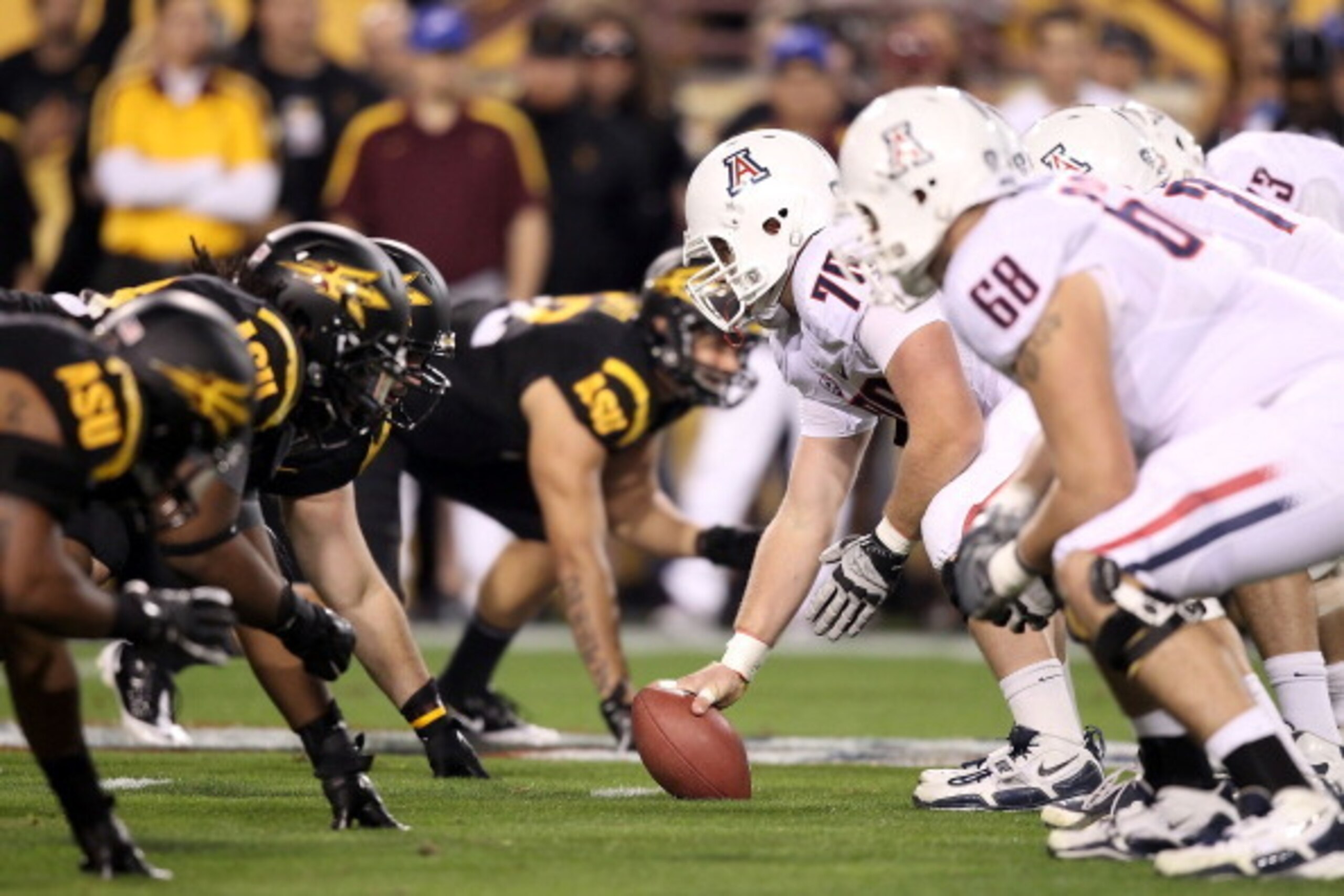
The Arizona teams have always been a bit of a satellite to the Pac-12 geographically: You’ve got the California teams, the Oregon teams, the Washington teams and then way down south, there are the teams from Arizona.
Though the addition of Colorado and Utah solidified the region, it’s hard to argue that these are rivalries that will ever make a real difference to the conference power structure.
The addition of an entire state of quality football, with regional ties, would ensure the Big 12 survived for years.
Clemson
Though Clemson would be a better fit for the SEC, it is another program which could be enticed to leave the ACC, which still is not a football destination.
Clemson, like Miami, is a football school in a basketball conference, and could potentially be lured out from under the ACC’s regime.

The addition of Louisville to the ACC Atlantic may actually make a move more tempting for the Tigers.
Think about it this way: If Bobby Petrino can put together a run, why in the world would Clemson want to become the third wheel in the Atlantic when it could be the celebrated savior of the Big 12?
Nabbing Clemson would be a major win—and lifeline—for the Big 12.
What’s Next?
Though it’s impossible to predict what’s next for the Big 12, the options are clear cut: It loses Texas or Oklahoma and dies. It gets whacked by poaching to fill a new super-conference division. Or, it expands by at least two programs—with at least one being a current power-five member—and survives.
All options signal the beginning of another wave of conference expansion. It’s inevitable.
Historical data courtesy of College Football Data Warehouse.
.jpg?w=2560)

.jpg?w=2560 "DJ Moore Suffers Shoulder Injury")



_0.jpg?w=2560 "2017 NBA Re-Draft Gives Teams the Ultimate Do-Overs 🏀")