Stay Away! One NBA Team Each Top-10 Free Agent Should Avoid This Offseason
Who are we to tell esteemed NBA free agents what they should and should not do?
Genuinely concerned, totally responsible, always self-effacing good hoop samaritans, that's who.
Free agency will be tricky for its participants to navigate this year. Fewer than 10 teams will have significant room above the mid-level exception without deep-sixing some incumbent contracts. Younger unproven studs will have a tougher time brokering lucrative dice rolls, and buyers figure to be wary of overcompensating veterans just to say they did something.
Scrimpy spenders won't seriously impact the general market for the league's biggest, bestest, most awesomest free agents. Some of them may be subject to signing cheaper-than-usual contracts, while others could find their list of suitors innately curtailed by the stunted cash flow. But the overall interest from teams won't be going anywhere. This summer's A- (and B-plus) listers will have plenty of options.
Picking the right landing spot can be difficult. More than one destination typically makes sense. Avoiding potentially bad situations is more important. Awkward, overhyped and flat-out terrible fits can set back development, damage individual value and derail title pursuits.
Many of these names aren't conventional flight risks. To remove them, though, would be to provide an incomplete look at the best available talent. To-be-explained caveats and disclaimers will be included wherever necessary.
No-go destinations are selected based on cap space, team need and loose inclinations. We are not plucking out one hypothetical workplace from a catalogue of 30.
Multitasking is fun, so this will double as a ranking of the summer's top 10 free agents. Age, health bills and previous performances factor into the equation, but players are ordered based upon the value they'll return in their next contract to account for upward, downward and steady trajectories.
10. Aaron Gordon: Chicago Bulls
1 of 10
Age (as of July 1): 22
Free-Agency Status: Restricted
2017-18 Per-Game Stats: 17.6 points, 7.9 rebounds, 2.3 assists, 1.0 steals, 0.8 blocks, 43.4 percent shooting
Advanced Stats: 16.5 player efficiency rating (PER), 0.00 total points added (TPA), 0.73 real plus-minus (RPM)
Aaron Gordon is among the scant few restricted free agents in position to command cornerstone money.
His improved three-point shooting is more folklore than scientific—he hit 30 percent of his treys following the Orlando Magic's 8-4 start—and doesn't yet have the pull-up chops to be the central focus for an entire offense. But he remains a tantalizing physical prospect, someone who should, in time, serve as that middle ground between wings and bigs.
Certain teams may talk themselves into an over-the-top offer that forces the Magic to think twice about matching it. And the Bulls have a clear path to more than $23 million in room even if they carry Zach LaVine's free-agent hold ($9.6 million). They just haven't been clear on how, or if, they'll use it.
As Mark Schanowski of NBC Sports Chicago wrote:
"The assumption in league circles is the Bulls will wait until 2019 to make their big move when players like Klay Thompson, Kawhi Leonard and Kyrie Irving could be on the market, and might consider signing with the Bulls after watching another year of development from LaVine, Lauri Markkanen and Kris Dunn. But [vice president of basketball operations John] Paxson couldn't have been more transparent in describing the mental pain he endured watching his team play for the best possible draft position during a 27-55 season, so he's not going to pass up on a chance to add a franchise player if one suddenly becomes available this summer."
Gordon doesn't qualify as a franchise player. Not yet, anyway. That's the risk teams run and embrace in restricted free agency. They're paying for what might happen later. And Chicago, a squad in the infant stages of its reset, has the timeline to bankroll that gamble for a sub-25-year-old who fits within said window.
Whether the Bulls should eat into their slush fund this summer is an entirely different matter. They shouldn't, but if Paxson and general manager Gar Forman feel an urgency to avoid a protracted project, Gordon has the cross-position shine to catch their attention. He is interchangeable with Lauri Markkanen and Bobby Portis up front when the Bulls want to run five-out lineups and familiar enough working on the perimeter to be slotted alongside traditional bigs like Cristiano Felicio and Robin Lopez.
Soaking up time at the 3 spot would also be a necessity. Chicago has too many bigs and is short on wings—kind of like this summer's free-agent class. But after enduring a small forward experiment gone terribly awry in Orlando, Gordon should distance himself from any team counting on him for true-wing minutes. He can set his take-it-or-leave-it price for the Magic elsewhere.
Honorable Mentions: 11. Tyreke Evans; 12. Will Barton; 13. Jabari Parker; 14. Kentavious Caldwell-Pope; 15. Derrick Favors
9. Julius Randle: Atlanta Hawks
2 of 10
Age: 23
Free-Agency Status: Restricted
2017-18 Per-Game Stats: 16.1 points, 8.0 rebounds, 2.6 assists, 0.5 steals, 0.5 blocks, 55.8 percent shooting
Julius Randle is in a weird spot. He's working off a breakout campaign with the Los Angeles Lakers that included sturdier one-on-one defense and extensive time at the 5. His market should be abuzz with suitors.
Except, Randle's appeal is inherently dragged down by the Lakers' longstanding interest in authoring a superstar coup. They might not need to renounce him as part of the process, but they also may have no choice. It depends on how many, if any, upper-crust names they land, in addition to whether they're willing to waive Luol Deng or able to effectively pot-sweeten a salary dump.
Los Angeles' wandering eyes render Randle uniquely accessible for a restricted free agent. Signing him to an offer sheet early could culminate in a successful poaching job if Paul George (player option) and LeBron James (player option) slow-play their own decisions.
Then again, Randle's undetermined place in the Lakers' big picture minimizes the cause for desperate overpays. A market-value deal, or something slightly over it, could wind up doing the trick.
The Atlanta Hawks, for their part, don't sound like a team itching to part with cap space. As general manager Travis Schlenk said during an appearance on 92.9 The Game in Atlanta (via Hawks.com's KL Chouinard):
"We're going to continue to develop our young core. We're going to continue to look to gather assets and use our cap flexibility. As you guys are probably aware, this summer is going to be really tight summer financially in the NBA. We're projecting as many as 16 teams could be looking at the luxury tax. We're going to be one of those seven teams that has any real significant cap space. We're going to look to use that cap space to relieve some of the financial troubles that other teams might be having to continue to gather assets."
Burning through their clear path to $20-plus million in room doesn't jibe with this approach from the Hawks. But again: They're in the minority of the salary-cap spectrum. They have the juice to stage aggressive overtures and the timeline to spin the wheel on developing studs. And Randle comes with the added bonus of not compromising all their flexibility. A non-shooter like himself won't fetch Aaron Gordon money.
Still, Randle would be wise to keep looking if the Hawks come knocking on his door. Playing him in the frontcourt with John Collins has a high entertainment ceiling, but only in measured doses. Neither is a prime-time defender, and Collins' best long-term fit overlaps with Randle's ideal position: center.
8. DeAndre Jordan: Los Angeles Lakers
3 of 10
Age: 29
Free-Agency Status: Player option
2017-18 Per-Game Stats: 12.0 points, 15.2 rebounds, 1.5 assists, 0.5 steals, 0.9 blocks, 64.5 percent shooting
DeAndre Jordan may not belong on any list of free agents when all's said and done.
Turning down next season's $24.1 million salary to enter a center-crammed market when everyone's predicting financial Armageddon feels like a potentially misguided move. Jordan turns 30 in late July and is past his athletic peak. Screen-setting is his only means of floor-spacing. His offensive value is otherwise rooted in the pick-and-roll pizzazz of his team's primary ball-handler.
Functioning as a defensive anchor won't get any easier either. Jordan has always been a tick overrated on the less glamorous end—a strong rebounder and shot-swatter who excels as a stationary deterrent. Head coach Doc Rivers' "Please love my player!" campaign is at least partially responsible for his reputation.
How much is that player supposed to net in free agency? Matching the annual average from his current contract is out of the question. It will take him at least two full years to recoup that $24.1 million take-home—or, as Bleacher Report's Grant Hughes mused on a recent episode of the Hardwood Knocks podcast, maybe even three.
Getting a one-part legacy deal from the Los Angeles Clippers is similarly off the table. They're in no position to saddle themselves with long-term money unless they can trade it later. They enjoy an unimpeded route to $60 million in cap space next summer and haven't yet decided between an overhaul or more of the same.
Bringing back Jordan at anything above market value compromises that flexibility. He'll have to suss out sumptuous placeholder offers spanning one or two years to come anywhere close to the $20 million-a-year benchmark.
Enter the Lakers. They'll be on the hunt for contingencies if they strike out on Paul George and LeBron James. They might even have interest in making a short-term splash should they sign one of them. Jordan fills a need at center—especially if Julius Randle gets shown the door—and would be right in his wheelhouse patrolling the paint behind Los Angeles' collection of rangy wings.
And yet, pushing 30, Jordan cannot be playing the Kentavious Caldwell-Pope game. He's better off opting in and exploring what should be a friendlier landscape in 2019 or securing himself one final three- or four-year payday worth more in totality than the $24.1 million he's owed next season.
7. DeMarcus Cousins: Phoenix Suns
4 of 10
Age: 27
Free-Agency Status: Unrestricted
2017-18 Per-Game Stats: 25.2 points, 12.9 rebounds, 5.4 assists, 1.6 steals, 1.6 blocks, 47.0 percent shooting
DeMarcus Cousins finds himself in a precarious situation.
His Achilles injury torpedoes what already figured to be a limited sweepstakes relative to the usual All-Star fuss. The New Orleans Pelicans could even be prepared to move on. Nikola Mirotic's play alongside Anthony Davis has armed them with leverage they didn't own before. As ESPN.com's Zach Lowe explained:
"As uncomfortable as it is to say, New Orleans' raging success in these playoffs has to change that calculus. The Pelicans look better, faster, stingier, more versatile with Davis at center, Jrue Holiday in an elevated role, and Nikola Mirotic spacing the floor for Davis' borderline pornographic rim runs. A long-term, near-max deal for Cousins is simply too risky given the Pelicans know this current roster—when healthy, an important caveat—can win at this level."
Sub-max and short-term overtures from the Pelicans, coupled with the uncertainty surrounding his recovery, could coax Cousins into testing the field and window-shopping for more annual money over a longer span. And the Phoenix Suns have cash to blow.
General manager Ryan McDonough can chisel out more than $25 million in wiggle room if he ditches Alex Len, Elfrid Payton (restricted) and Alan Williams (non-guaranteed). Both McDonough and franchise cornerstone Devin Booker have also emphasized the need to leave a mark in free agency now—which tracks with Booker's salary set to explode in 2019-20.
Phoenix has a handful of bigs on the docket but showed interest in trading for Cousins before New Orleans grabbed him, per The Ringer's Kevin O'Connor. Dragan Bender and Marquese Chriss haven't morphed into sure things since then. Nor has Tyson Chandler started aging in reverse. If the Suns miss out or pass on Deandre Ayton in the draft—Luka Doncic speculation is gaining steam following the hire of Igor Kokoskov, who coached him on the Slovenian national team—they'll have room for star power in the middle.
Cousins should practice his "Thanks, but no thanks" face in case they give him a call. He accelerates their timeline without guaranteeing a return to the playoffs and will inevitably be blamed for their pitfalls. It could be his play, his pay grade, his attitude or a combination of all three. It doesn't matter.
Someway, somehow, the absence of absolute perfection would turn into vilification. Cousin needs to be on a team with another safety net. It doesn't have to be a megahuman like Davis, but tethering his future to a franchise headlined by Booker won't do him any favors when his own stardom is now in question.
6. Clint Capela: Dallas Mavericks
5 of 10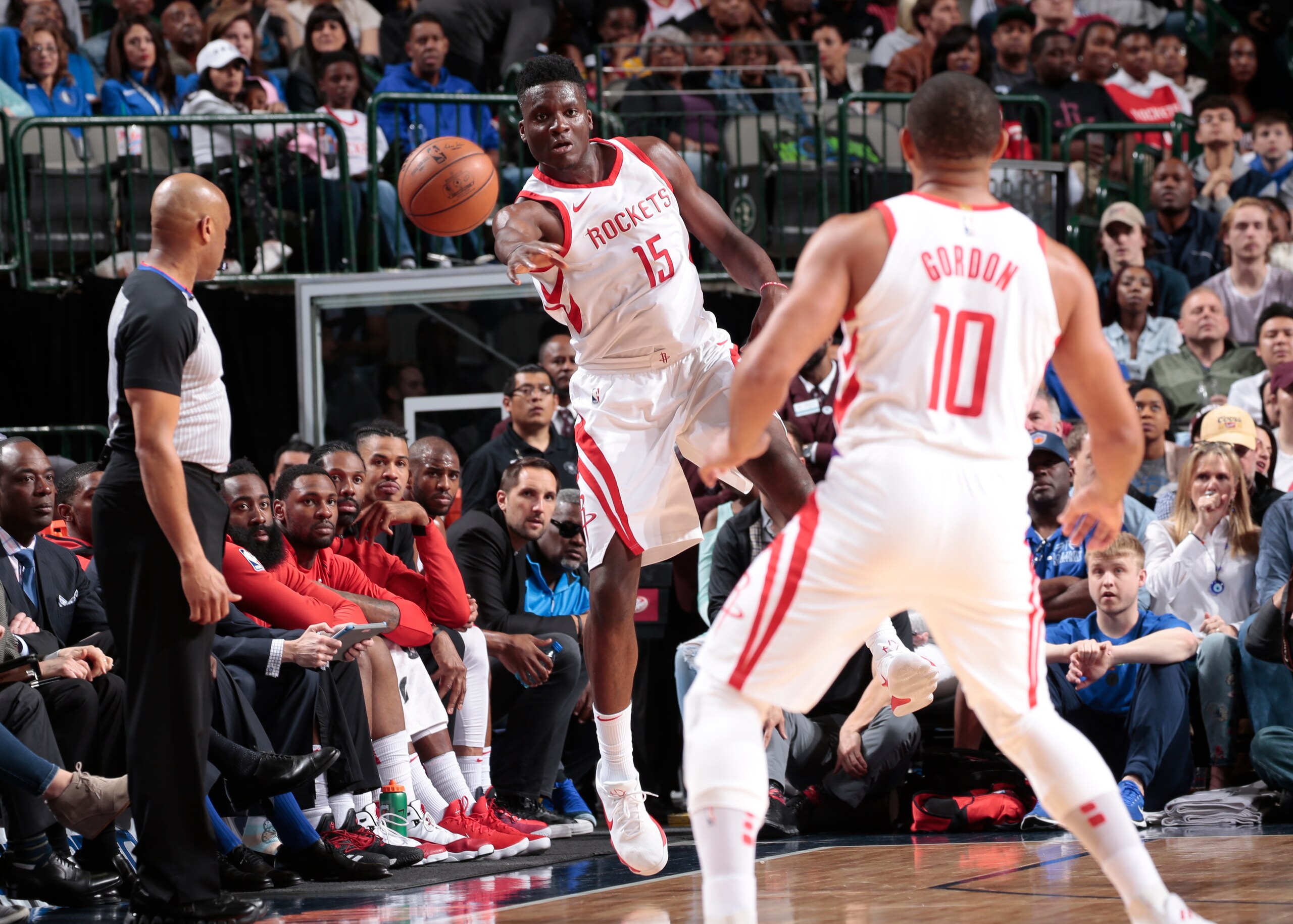
Age: 24
Free-Agency Status: Restricted
2017-18 Per-Game Stats: 13.9 points, 10.8 rebounds, 0.9 assists, 0.8 steals, 1.9 blocks, 65.2 percent shooting
Restricted free agents are no strangers to surfing the summertime waters. Incumbent teams often prefer to let the market set their price tag even when they're max-contract candidates.
Clint Capela might not need to do any legwork before signing his next deal. He's not a max player, but the Houston Rockets have consistently erred on the side of "Money is no object!"
"This is what you're going to do for us," Mike D'Antoni explained to Capela in their first training camp together, per Sports Illustrated's Lee Jenkins. "Protect the rim, run the floor, set a pick, roll to the basket—oh, it didn't work—go back, set another pick and do it over again. I'm going to yell at you, but if we win a championship, you'll be the reason, and if we lose, it's not your fault. We'll still probably give you $80 million."
"We'll have him here as long as he'll have us," general manager Daryl Morey told ESPN.com's Tim MacMahon for a piece that dropped in November. "He couldn't price himself out."
Maybe Capela and Houston strike a deal without ever including a third party. That could happen. But the Rockets have to start thinking about the luxury tax. They'll have more than $105 million alone committed to Ryan Anderson, Eric Gordon, James Harden, P.J. Tucker and Chris Paul if the latter commands a max deal over the offseason. And they still have to consider new contracts for Trevor Ariza and Luc Mbah a Moute.
Letting Capela bring back his best offer in a generally stingy market could allow the Rockets to save money compared to negotiating against themselves. At worst, he'll broker a massive salary that affirms his importance.
For relationship's sake, though, Capela would be smart to use a team other than the Dallas Mavericks as leverage. They'll have plenty of cap space if they don't sponge up unwanted salaries via trade, and their center rotation is hardly set in stone. But why risk creating any bad juju between he and the Rockets by getting into bed with a state rival?
Houston cannot realistically be bitter about losing Chandler Parsons to Dallas in 2014. Morey and friends dodged a cap bullet there. But the Rockets did have the gall to phone the Mavericks about Dirk Nowitzki's availability a few months prior, and owner Mark Cuban predictably didn't react well.
Are he and the Mavericks over it? Probably. Would they pass on the chance to gum up the Rockets' long-haul ledger or, worse, whisk away a James Harden favorite? Probably not. And maybe Houston won't care. Either way, if Capela wants to remain the Rockets' golden boy, he should play it safe and look for offer sheets from, well, literally any other team.
5. Paul George: Oklahoma City Thunder
6 of 10
Age: 28
Free-Agency Status: Player option
2017-18 Per-Game Stats: 21.9 points, 5.7 rebounds, 3.3 assists, 2.0 steals, 0.5 blocks, 43.0 percent shooting
More than a few people already have Paul George scoping out his preferred locker in Staples Center. Others simply have him leaving the Oklahoma City Thunder, period. Sources told ESPN's Ryen Russillo that George is "gone" this summer (h/t Slam Online's Ryne Nelson).
To his credit, George has never once sounded like someone with one, let alone both feet out of the door. His exit interview following Oklahoma City's first-round loss to the Utah Jazz was more encouraging than alarming, and general manager Sam Presti is inclined to take him at his word.
"I talked to PG," he said, per the Norman Transcript's Fred Katz. "I would say, why don't we listen to Paul? He has had a lot of comments also. I'm not trying to dissuade anybody or say that what someone says someone told them is inaccurate. I'd rather listen to the man, himself."
Push the Purple and Gold boogeyman aside for a second. George will have other options. Perhaps the Philadelphia 76ers catch his attention. Maybe, just maybe, a sign-and-trade with the Cleveland Cavaliers would be in play. (Note: probably not.)
Regardless, no matter how you break up his free agency, the Thunder pose one of the more inferior fits.
Yes, they can offer him more years (five) and larger raises (eight percent) than any other team. And sure, worst case scenario, Carmelo Anthony and his $27.9 million salary (early termination option) will come off the books after next season. But, like, where does Oklahoma City go from there?
Fast forward to 2019-20, and the Thunder will have $64 million committed to just Steven Adams and Russell Westbrook. Tacking on George's max salary—around $32.7 million in his second year—puts them at $96.7 million. Bake in Andre Roberson's $10.7 million hit and poof! They'll have over $107 million funneled into four players, against a projected salary cap of $108 million.
Re-signing George locks the Thunder into this base. And, by extension, it ropes George to this same core. That roster rigidity doesn't portend good times after what happened this year. Oklahoma City won't have the cash resources to reel in impactful talent and will instead have to bank on development from Alex Abrines and Terrence Ferguson, a resurgence from Patrick Patterson, an ice-cold free-agent market for Jerami Grant and successful future draft picks.
This says nothing of Roberson's recovery from a ruptured left patellar tendon. If he doesn't return to form, the Thunder will be deprived of the NBA's best perimeter defensive duo.
Ignore everything else, and George is still tasked with solving the Westbrook problem. They were effective this season in the time they spent without Anthony, but Westbrook's offensive monopoly grates on superstars accustomed to operating on-ball. Unless George sees a stylistic shift in the point guard's future and has the utmost faith in Presti to flesh out the roster with one hand tied behind his back, joining younger slates in Los Angeles or Philly or somewhere else should take priority.
4. Chris Paul: San Antonio Spurs
7 of 10
Age: 33
Free-Agency Status: Unrestricted
2017-18 Per-Game Stats: 18.6 points, 5.4 rebounds, 7.9 assists, 1.7 steals, 0.2 blocks, 46.0 percent shooting
Chris Paul shouldn't be looking for a home outside Houston. Never mind if the Rockets get trounced by the Golden State Warriors in the Western Conference Finals. He's about to turn 33. He doesn't have time to start over, with a fourth team, if he's hoping to sneak in a title before his twilight.
Plus, he delayed his foray into free agency by one year specifically to play for the Rockets (and with Harden). They own his Bird rights and can promise him more money over a longer term—a huge deal if he's considering (or forced to accept) anything below the max.
In the event he's driven to shop around, he should steer clear of the San Antonio Spurs. They won't have the cap space to sign him unless Rudy Gay and Danny Green opt out and they offload salary on the trade block, but they're far more flexible than most cash-strapped squads.
And remember: The Spurs were treated as a genuine threat to sign Paul last summer before he orchestrated his move to Houston. Pau Gasol's decision to opt out was even seen by some—cough, resident idiot yours truly, cough—as evidence that something was brewing.
That pipe dream elicited natural, justifiable support in 2017. It holds zero clout now. The Spurs remain the Spurs, yet their way of life is no longer a given.
Kawhi Leonard is still working his way back from a right quad injury and, per ESPN.com's Ramona Shelburne and Michael C. Wright, barely on speaking terms with the organization. Head coach Gregg Popovich is 69 and just lost his wife, Erin, to a decades-long health battle. He's signed up to guide Team USA in 2020, but no one can be sure how much longer he wants or is able to be on the sidelines.
San Antonio's books are hardly clean to boot. Gasol is owed $36.8 million over the next two season ($6.7 million guaranteed in 2019-20), and LaMarcus Aldridge's three-year, $72.3 million will kick in for 2018-19 ($7 million guaranteed in 2020-21).
Factor in everyone the Spurs would likely have to renounce or trade—namely Green, Kyle Anderson, Patty Mills—to make the money work, and the Paul-to-San Antonio bandwagon swiftly devolves into a bygone paradise.
3. Nikola Jokic: Sacramento Kings
8 of 10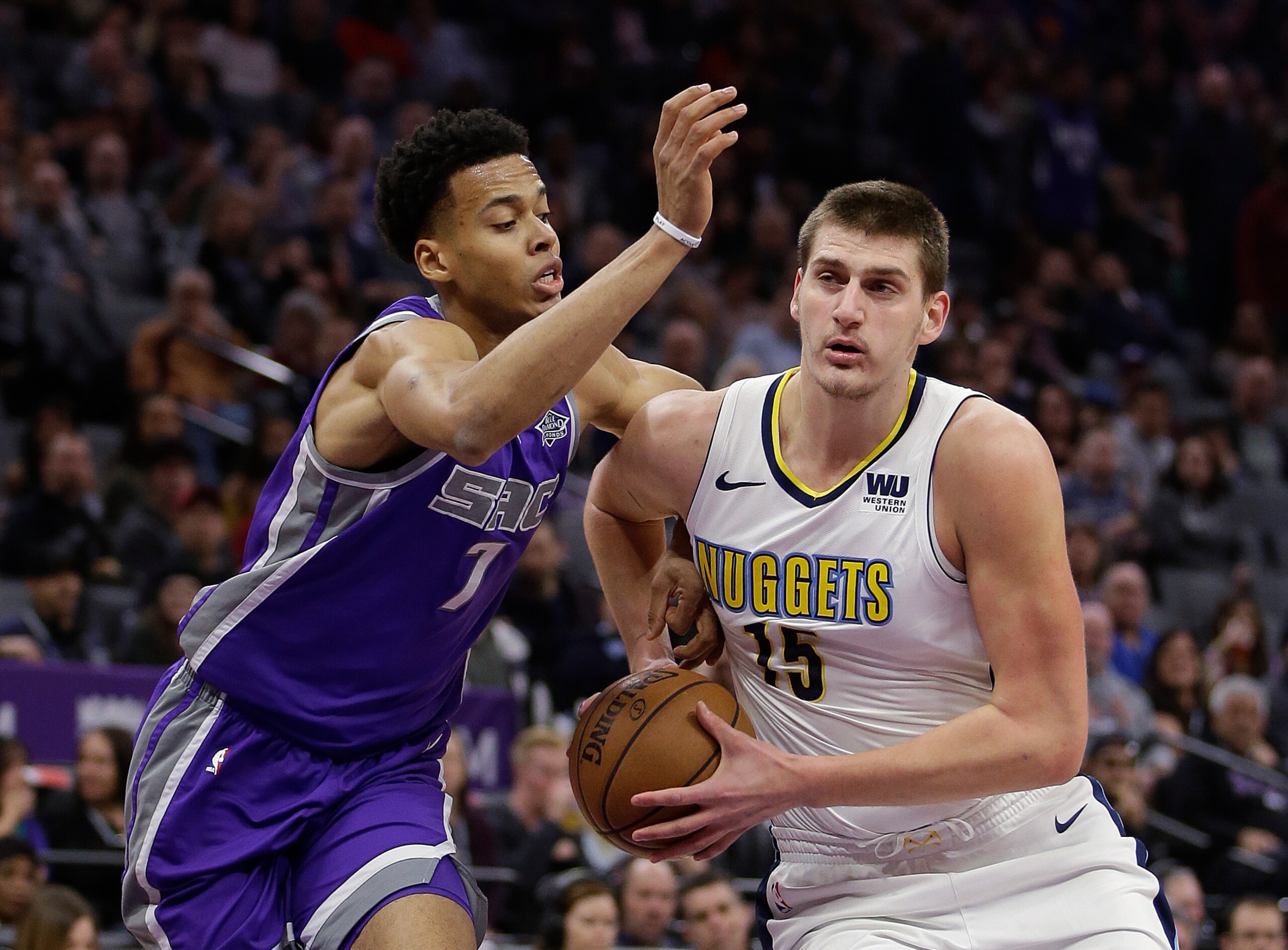
Age: 23
Free-Agency Status: Team option
2017-18 Per-Game Stats: 18.5 points, 10.7 rebounds, 6.1 assists, 1.2 steals, 0.8 blocks, 49.9 percent shooting
Sing it loud for everyone in the back, and for those intimidated by numbers: Players are ordered based upon the value they'll return in their next contract.
Plenty of smart people will argue Paul George and Chris Paul are better than Nikola Jokic right now. That's OK! But he won't turn 24 until next February and has made cameos in the upper echelon of pretty much every available catch-all metric.
Jokic is fifth in Basketball-Reference's Value Over Replacement Player since 2016-17, has led all centers in ESPN's RPM for three years running and has finished ninth and fifth, respectively, in NBA Math's leaguewide TPA rankings over the past two seasons. To say he'll provide more value on his next contract than a soon-to-be 33-year-old point guard and a 28-year-old wing who doesn't shoulder as much offensive responsibility is not some grand, unwarranted gesture.
Anyway, Jokic's inclusion is fraught with caveats. The Denver Nuggets have the power to keep him at $1.6 million by picking up his club option. But doing so tickets him for unrestricted free agency in 2019.
Declining the team option now sends him to the restricted market, where they'll have both the right to match any offer he receives and built-in goodwill after setting him up for a raise one year early. Most expect the Nuggets to go that route following general manager Tim Connelly's year-end presser.
"The sooner we can get his signature on a long-term contract, the better," he said, per the Denver Post's Gina Mizell. "Whatever keeps him here the longest is best for us and best for the team."
Finding max money to bring back to Denver's brass won't be a problem for Jokic if they don't dangle it from the jump. His offense alone puts him on the fast track to being a top-10 player. And though the Nuggets will assuredly match any offer sheet he signs, he shouldn't be entertaining pitches from teams he doesn't actually want to join.
Put the Sacramento Kings atop his no-fly list. They'll fall around $5 million short of his $25.3 million starting salary without touching the roster, but they can make up the difference if one of Kosta Koufos, Iman Shumpert and Garrett Temple opt out, or if they auction off their other younger bigs.
Not that the Kings should be looking to spend big in free agency. They did that last summer, and it didn't work out so well. But they don't control the rights to their draft pick next year and will soon need to start contemplating raises for Willie Cauley-Stein (restricted free agent in 2019), Buddy Hield (extension eligible in 2019) and Skal Labissiere (extension eligible in 2019).
Jokic is young enough to fit their indistinct timeline, and unlike Cauley-Stein, Labissiere or Harry Giles, he's a proven frontcourt commodity. If he needs to scour the market for max money, even as an obligatory measure, the Kings would be wise to join the fray. And Jokic would be even wiser to use another suitor with a better track record—you know, just in case something goes wrong with Denver.
2. Kevin Durant: Team Not-the-Warriors
9 of 10
Age: 29
Free-Agency Status: Player option
2017-18 Per-Game Stats: 26.4 points, 6.8 rebounds, 5.4 assists, 0.7 steals, 1.8 blocks, 51.6 percent shooting
So, yeah, we're not going to really bother with this one.
Kevin Durant plans on opting out of his contract this summer, but only so he can re-sign with the Warriors, according to ESPN.com's Chris Haynes. He accepted about $10 million less than his max last year to facilitate the returns of Andre Iguodala and Shaun Livingston and is likely looking to bridge this gap for next year now that Golden State owns his Early Bird rights.
Try thinking of a scenario in which Durant even takes a meeting with another team. It doesn't exist.
The Warriors could get blitzed in the Western Conference Finals or NBA Finals. Rumors could surface that they're looking to break up the Fab Four to avoid unfathomable luxury-tax penalties. Nick Young could decide to take his chucking elsewhere.
None of it would matter. Durant isn't going anywhere. Things could take a turn for the worse—which, by the Warriors' standards, consists of Jordan Bell stubbing his toe—and it wouldn't change a thing. They'd still offer him the best shot at a title and dynasty.
Besides, could you imagine if Durant tried to leave in the aftermath of a postseason exit? He was, and continues to be, destroyed for abandoning Oklahoma City. Jumping ship on Golden State would consign him to permanent meme duty.
1. LeBron James: Philadelphia 76ers
10 of 10
Age: 33
Free-Agency Status: Player option
2017-18 Per-Game Stats: 27.5 points, 8.6 rebounds, 9.1 assists, 1.4 steals, 0.9 blocks, 54.2 percent shooting
Would you believe this isn't purposely inflammatory?
Philly is among the four teams—along with the Cavaliers, Lakers and Rockets—that have LeBron James' eye, according to O'Connor. Building a substantive case against his purported interest is difficult, verging on stupid.
The Sixers could make the Eastern Conference Finals...this year...without him. They can dredge up his $35.4 million max salary without sacrificing Robert Covington, Markelle Fultz, Joel Embiid, Dario Saric or Ben Simmons. (Dumping Jerryd Bayless' $8.5 million expiring deal is basically their only hurdle, and that shouldn't require much of a sweetener.) The Sixers even have the inside track on retaining Marco Belinelli, Ersan Ilyasova and JJ Redick at a discount.
Why shouldn't James look at this team? Heck, why shouldn't he just sign with them?
Covington is the eldest member of the core, and he's just 27. Embiid is the second oldest, and he won't turn 25 until next March. The Sixers, more so than any other team, are built to maximize what's left of LeBron's heyday while allowing him to age out of his prime on a powerhouse contender talented enough to exist without him.
Prospective fits don't get any better than that...in theory. Practically speaking, however, the Sixers don't offer a seamless transition.
Simmons doesn't have range outside the paint. Embiid is used to working with the ball in his hands. Fultz will need on-rock reps to follow his No. 1 pick trajectory. James has developed into a solid spot-up shooter; he drained more than 40 percent of his catch-and-fire treys during the regular season. And using him as a screen-setting roller amounts to a real-life cheat code.
But the stylistic shift he'd have to undergo in Philly is far too stark. It might work over time. Immediately, though, joining the Sixers puts pressure on him to retreat into off-ball work while straining the incumbent youngsters—Fultz and Simmons in particular—to adapt and evolve at an untenable, if unfair, rate.
Starting off with a slightly more malleable supporting cast in Los Angeles would work better. Ditto for an opt-in-and-trade to Houston, where James Harden and Chris Paul have already mastered this balancing act. Even staying in Cleveland, with the hope that the Brooklyn Nets pick can anchor a blockbuster acquisition, stands to make James' life a lot easier.
Unless otherwise noted, stats courtesy of NBA.com or Basketball Reference and accurate leading into games on Thursday. Salary and cap hold information via Basketball Insiders and RealGM.
Dan Favale covers the NBA for Bleacher Report. Follow him on Twitter (@danfavale) and listen to his Hardwood Knocks podcast, co-hosted by B/R's Andrew Bailey.

.jpg?w=2560 "Mike Evans Carted Off")

.jpg?w=2560 "Browns Come Back to Stun Panthers")
.jpg?w=2560 "Dolphins HC on Achane Injury")