

New NBA Superteams That Could Happen Before Next Season
Superteam pursuits used to be all the rage in the NBA, with successful formations by the Los Angeles Clippers and since-torn-down Miami Heat acting as primary inspiration. They weren't the first superteams. The 2007-08 Boston Celtics weren't, either. But the more recent powerhouses triggered league-wide copycat attempts.
That period of rampant miming has since subsided. Teams aren't avoiding star-stacked visions, but the number of flagrantly pipe-dreaming franchises has dwindled in number.
Flat-out failures by the Brooklyn Nets, Los Angeles Lakers and New York Knicks serve as cautionary tales. Salary-cap spikes have made it harder to rebuild through free agency. The new collective bargaining agreement hammered out in December makes it harder still.
Plus, when the Golden State Warriors and whatever team LeBron James calls his own are the standard for superpowers, the prospect of building up a worthy peer is daunting. There isn't a rush to rival what, for the past few years, couldn't be rivaled. The Clippers are good, borderline great, but diving into the luxury tax for a top-heavy squad that may never reach or get past the Conference Finals isn't ideal.
Still, some teams might be ready to reinvigorate the superteam trend in the near future—as in next season. Every possibility is a long shot, because that's the nature of multistar models, but a select few squads have a clearer path to completion than most.
Cap space, trade assets and incumbent talent will all determine how this search shakes out. We're looking for teams with the best shot at employing three top-25 talents by next season while maintaining adequate depth.
Top-25 determinations will rest on a player's value outside a Big Three or Big Four. Kyrie Irving and Kevin Love aren't always recognized as such with the Cleveland Cavaliers, but playing beside each other and James dilutes their standing.
Again: Next season is the timeline. Budding juggernauts won't make the cut. The Minnesota Timberwolves have a case down the line, but the odds of their signing an All-NBA talent and then having another one of their own kiddies join Karl-Anthony Towns on Superstar Mountain by 2017-18 are too steep even for this exercise.
Not Quite Super and Probably Won't Get Super by 2017-18
1 of 6
Utah Jazz
If the Utah Jazz re-sign Gordon Hayward (player option), George Hill and Joe Ingles (restricted), they'll be one good season's worth of health away from vying for top-three positioning in the Western Conference. And they'll have legitimate star power.
Rudy Gobert and Hayward give them two All-NBA-level talents. They'll just struggle to find a third.
Hill is underrated and about to get paid like a star, but he'll forever have to scrap and claw to even place in the top 10 at his position. One of Dante Exum, Rodney Hood or Trey Lyles could explode in higher-usage roles, but that opportunity won't be there by next season if the band sticks together. Utah's rotation will extend too deep.
Signing another star, meanwhile, is out of the question. The Jazz have no shot at skirting the luxury tax if they hold onto even two of Hayward, Hill and Ingles. Pawning off Alec Burks and/or Derrick Favors would go a long way, but it won't give them actual cap space.
Failing an atypical attempt to consolidate assets into an A-1 player on the trade market, Utah is fated to mirror a middle-class version of the San Antonio Spurs—dominant without overwhelming name power.
Washington Wizards
Bradley Beal, Otto Porter and John Wall make for a fringe Big Three. One day, they might qualify as a Clippers-caliber triumvirate.
But next season is pushing it. Though Wall is comfortably one of the NBA's 20 best players, his two running mates may never come close to replicating his success.
Porter can be the second-in-command on a championship team, but he'll never get the touches to be much more than an ancillary scorer while playing next Beal and Wall. Beal is already a top-20 offensive player, but his defense isn't up to snuff relative to other stud wings.
Even if we count on all three to play under the star designation next season, the Wizards are about as top-heavy as the Clippers and won't have the money to adequately flesh out the rest of the roster after re-signing Porter (restricted).
That'd be fine if, like the Clippers, their two best players were top-10, or even top-15, talents. But they're not. They employ only one of those and, at best, will spend next season toiling away in the gray area between superteam and dark-horse contender.
Honorable Mention: Miami Heat
2 of 6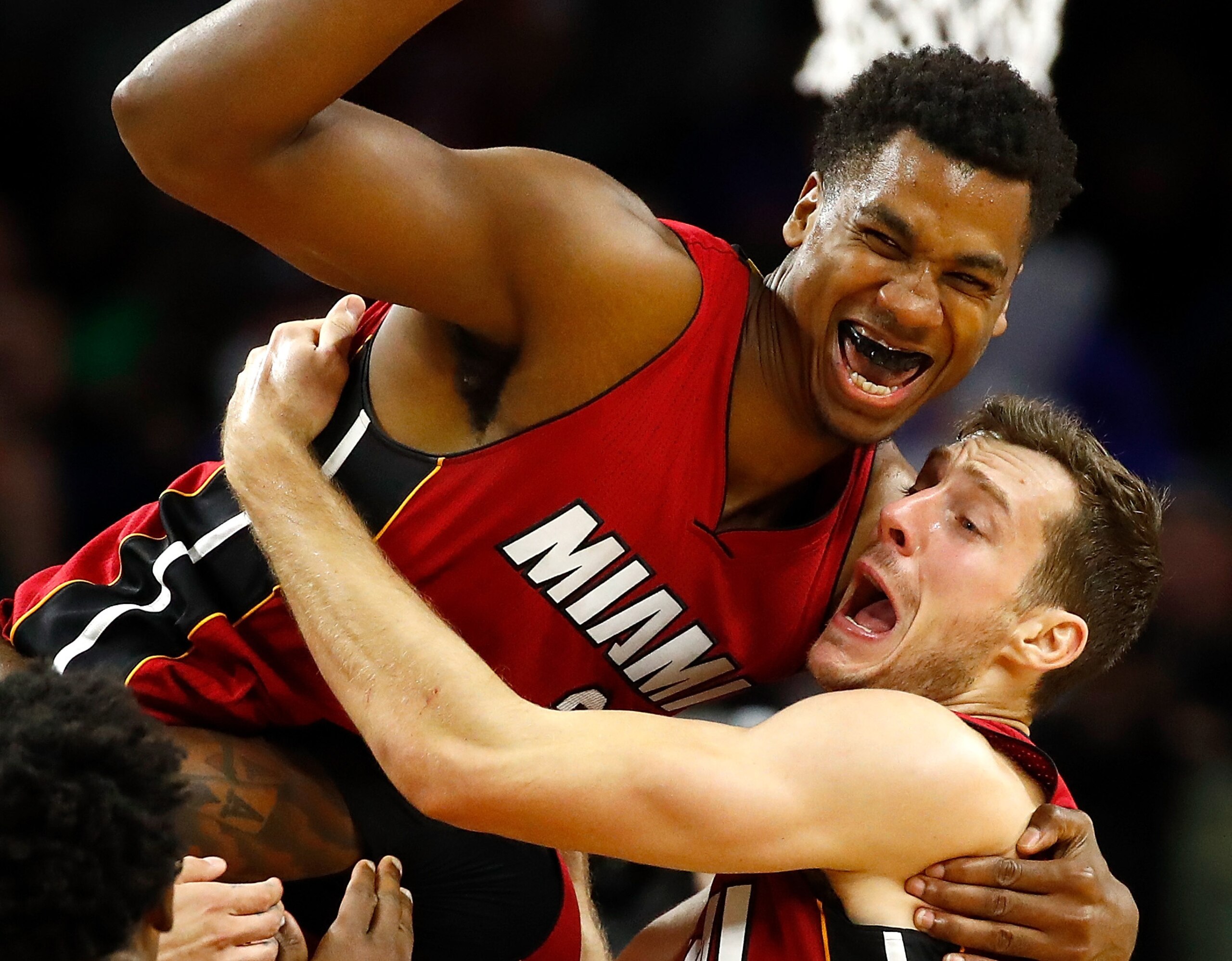
The Miami Heat won't have any trouble making room for another star. They don't have the trade assets to enter the Jimmy Butler and Paul George sweepstakes, but they have the next best thing: lots and lots of cap space.
Chris Bosh's deal is still expected to be expunged from the ledger, per the Miami Herald's Barry Jackson. That alone gives the Heat more than $30 million to burn through after renouncing non-Bird holds on James Johnson and Dion Waiters (player options)—enough money to pursue an All-Star like Hayward, who has emerged as a primary target, according to the New York Daily News' Frank Isola.
Two things are already raining on this hypothetical parade. First up: Team president Pat Riley is done chasing "whales," per Jackson. He's instead devoting attention to who Miami has in place:
"We are going to focus on our guys, really focus on this group of guys. We have found something about three of these guys, I felt they had something but never really had the platform. We will always observe what’s going on in free agency. We have that flexibility. When you have a draft pick and a lot of players on your team you like, you are in good position to move forward.
"
For the sake of having more to discuss, let's say Riley is bluffing. And then let's say the Heat successfully whisk Hayward, Blake Griffin, Serge Ibaka, Paul Millsap or another star off his feet.
Does adding one of them to Goran Dragic and Hassan Whiteside give you enough star power or depth to join the superteam ranks? Debatable.
Get a leap from Tyler Johnson, Josh Richardson and/or Justise Winslow, and you're there. Waive Wayne Ellington and find a taker for the final year of Josh McRoberts' contract, and you surpass $40 million in space—enough, maybe, to about-face into a Danilo Gallinari (player option) and Ibaka combination.
Whatever the intended scenario, the Heat, as Riley alluded to by focusing on Miami's own, would be too dependent on free agency to soup up their foundation to superteam levels.
Honorable Mention: San Antonio Spurs
3 of 6
Obligatory explanation for the too-long, won't-read crowd prepared to argue the Spurs are already a superteam: I hear you. The whole world hears you. The Spurs are great. But, by design, they are more tacit terrors than smack-you-in-the-face juggernauts.
Can they reinvent themselves over the offseason, much like they did in 2015 with the LaMarcus Aldridge addition? Maybe, but probably not.
Replace all their free-agent and non-guaranteed holds with the necessary empty roster chargers, and the Spurs are looking at under $7 million in cap space—less than the projected mid-level exception. They'd be better off operating as a capped-out team.
Things only get interesting if Pau Gasol and David Lee opt out of their contracts. That gives the Spurs more than $20 million to play around with. This opens the door for a reunion with George Hill, but it won't be enough to convert Kyle Lowry or Chris Paul. (Upgrading at point guard needs to be the focus.)
Spreading the final year of Tony Parker's contract over the next three via the stretch provision opens up a little more than $10 million in additional spending power. Or the Spurs could break character even more and use their first-round pick to grease the wheels of a salary dump, thus creating more than $35 million in room.
All of a sudden, they can sling the full max for any free agent. Stephen Curry and Kevin Durant (player option) aren't walking through the door, but if you're Lowry and Paul, don't you have to at least contemplate switching digs to play with Aldridge, Danny Green and Kawhi Leonard?
Spurs fans needn't stress about this, though. It's technically possible, so it makes sense to rap about, but there are too many hurdles that must first be cleared to even entertain it. Cutting bait with Parker's legacy status is unthinkable, and San Antonio will have a tough enough time keeping Patty Mills and Dewayne Dedmon (player option). Trying to sign another top player is the least of its worries.



No. 3 Best Possibility: Denver Nuggets
4 of 6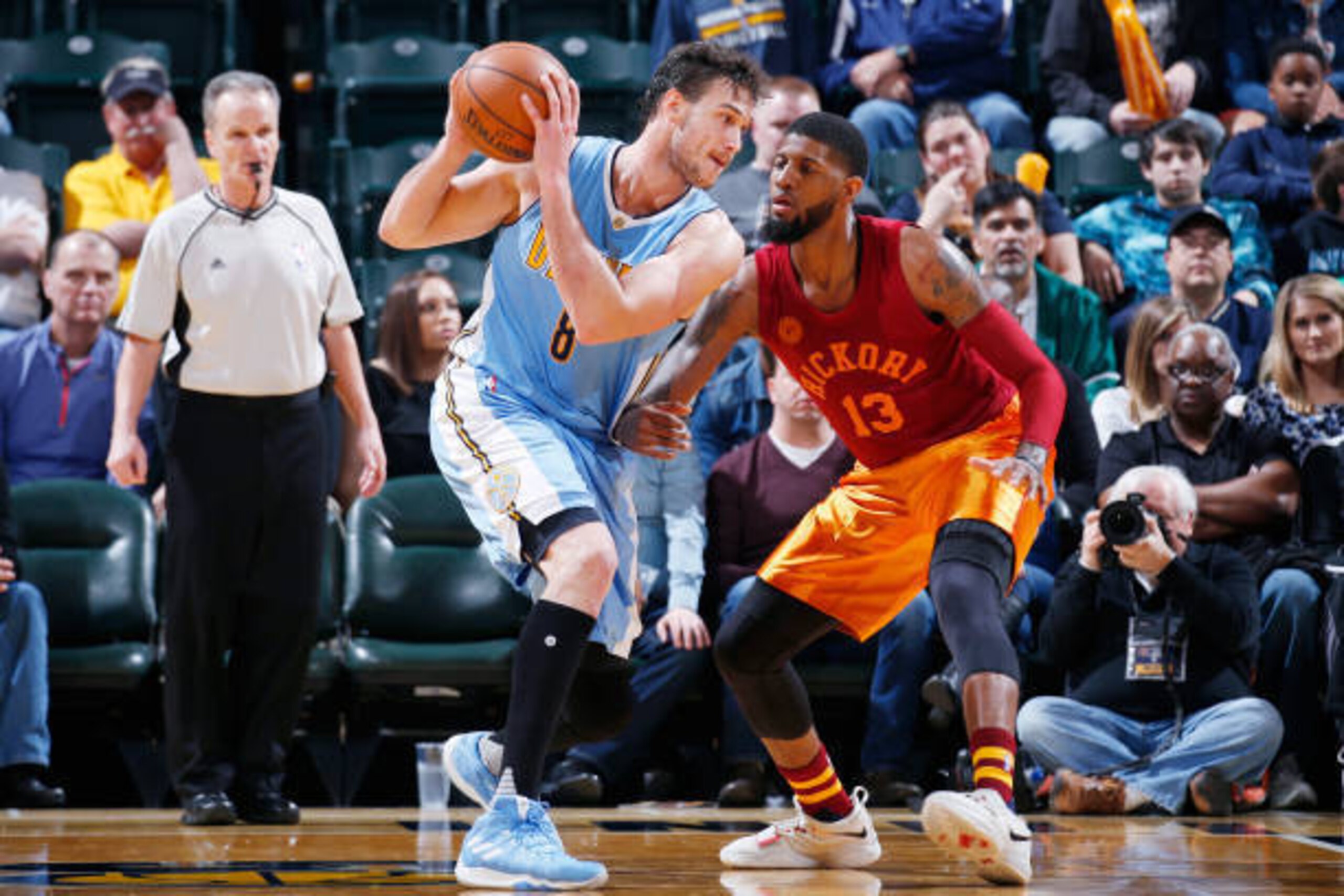
Cap space and an enviable number of trade assets help build the Denver Nuggets' argument, but Nikola Jokic takes it home. He gives them an incumbent superstar-in-training—someone who serves as a draw to free agents and inbound acquisitions.
Jokic hasn't expedited the Nuggets' timeline. He's given them one. They know it, too. They made a "monster" play for George at the trade deadline, according to ESPN.com's Chris Haynes and Marc Stein. Nothing happened, obviously, and their case is muddied by George's apparent disinterest in suiting up for them.
That's why cap space is so important. The Nuggets have the flexibility to make pitches to All-NBA talent this summer. If Danilo Gallinari opts out as expected and they renounce his $22.6 million hold, they carve out more than $34 million in breathing room. Dump or stash their first-round pick, renounce Mason Plumlee's $5.8 million hold or waive Mike Miller, and they'll blow past $35 million in space.
Reach that benchmark, and the Nuggets are working with almost unrivaled means. They can sign any max free agents—even ones such as Kyle Lowry, Paul Millsap and Chris Paul, who'll be eligible for deals that pay them more than 35 percent of next season's cap in Year 1 ($35.4 million).
Denver isn't a choice free-agent destination, but that won't matter. Only a handful of teams will be able to afford the highest-priced flight risks. The Nuggets, if nothing else, become a legitimate option due to the absence of other ones.
And after inking a Millsap or Paul, they'll still have all the trimmings for a blockbuster trade: Prospects galore in Malik Beasley, Juan Hernangomez, Emmanuel Mudiay and Jamal Murray; a first-round pick and future selections; cheaper impact players in Will Barton (expiring) and Gary Harris (extension-eligible); and serviceable salary-matching material in Wilson Chandler and Kenneth Faried.
Some combination of these assets gets the Nuggets in the conversation for Butler, George or any other All-NBA name that becomes available. By then, in this scenario, they'll have paired Jokic with an Ibaka, Millsap, Paul, Blake Griffin, etc. Good luck derailing a chance to play with that type of duo and not regretting it later.
No. 2 Best Possibility: Toronto Raptors
5 of 6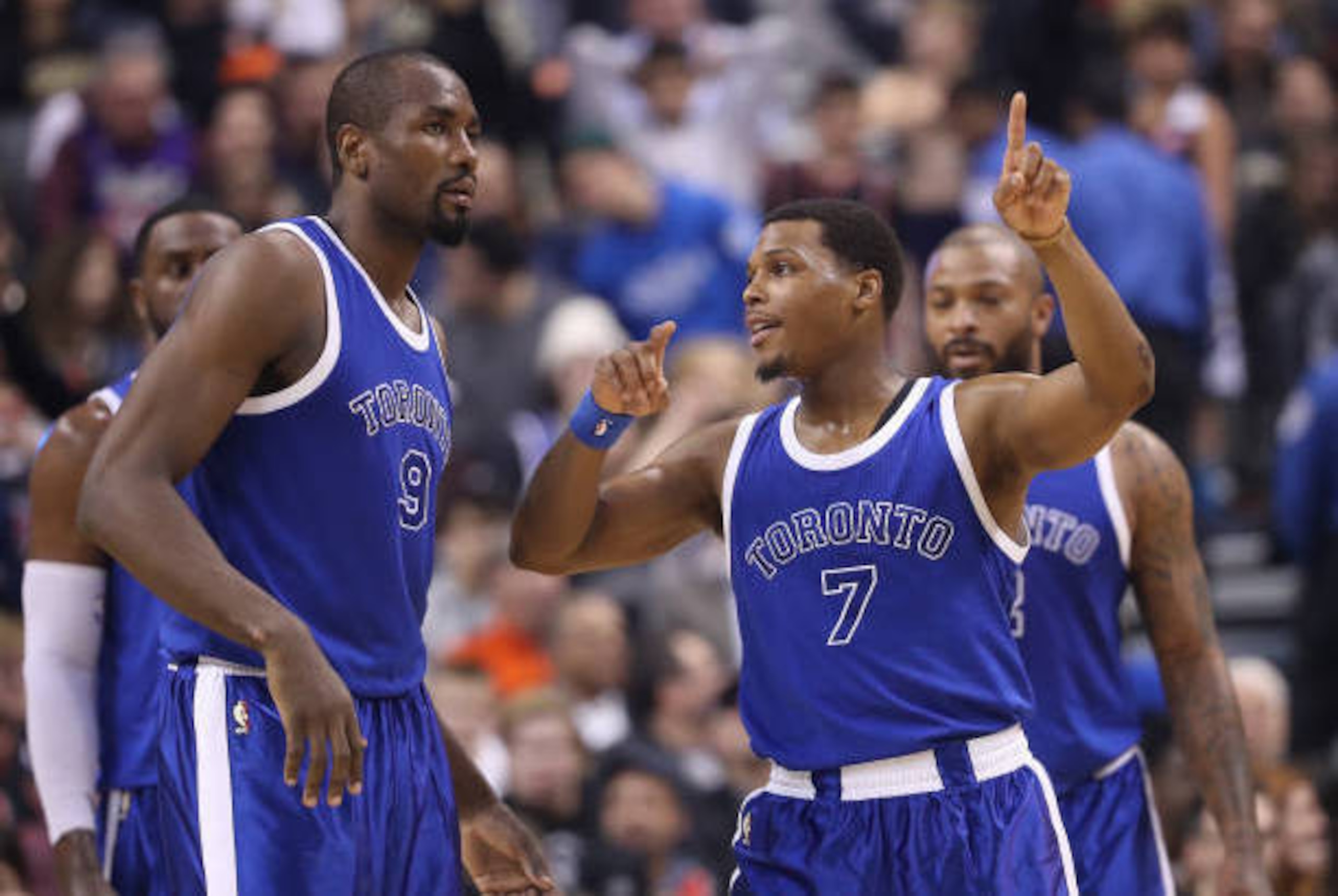
The Toronto Raptors are the only team in the NBA that can morph into a superteam by next season without touching the roster. They have the star power to enter the discussion after trading for Serge Ibaka, but the resulting Big Three featuring him, DeMar DeRozan and Kyle Lowry hasn't seen enough court time to prove anything.
A broken wrist sidelined Lowry for all but four games after the All-Star break. Including the regular season and playoffs, Toronto's Big Three has made four appearances and logged 98 minutes, through which it's a combined plus-one.
This setup needs more time. And barring the unimaginable, the Raptors will get it. General manager Masai Ujiri plans to re-sign both Ibaka and Lowry (player option), which keeps the Big Three intact.
Bring everyone else back, and Toronto would be a uniquely deep superteam. But that's where things get iffy. Retaining free agents Patrick Patterson and P.J. Tucker, in addition to Ibaka and Lowry, vaults the payroll past $153 million before taxes. And it'll travel higher still if Ibaka ($18.5 million), Patterson ($9.1 million) and Tucker ($10.1 million) combine to command more than their cap holds—a distinctly possible, if inevitable, outcome.
Shedding some salary won't revoke the Raptors' superpower appeal. Keep two or more of Patterson, Tucker, DeMarre Carroll and Jonas Valanciunas, and they maintain the depth necessary to prop up their star troika.
Remember: Lucas Nogueira and Norman Powell should reach another level. Nogueira's rim-running and defensive function suits Toronto better than Valanciunas at their peak, and Powell, in short order, could come close to being an upgrade over Carroll or Tucker.
The window for this juggernaut is uncertain. Lowry is 31, Ibaka has basically been the same player since 2012-13 and DeRozan isn't transforming into a lockdown defender. There's not much room for growth with this nucleus. But that doesn't make it any less of a threat in the short term.
No. 1 Best Possibility: Boston Celtics
6 of 6
No matter what anyone thinks the Celtics should have done at the trade deadline, they remain in a comfy spot. They control ownership of the Brooklyn Nets' next two picks, have a wide arrangement of appealing trade pieces, don't have any big-time free agents and have two All-Star talents in Al Horford and Isaiah Thomas.
Oh: They have a clear path toward $30-plus million in cap space, too.
Renouncing the rights to free agents Jonas Jerebko, Amir Johnson and Kelly Olynyk (restricted) gets the Celtics around $22.4 million in wiggle room. Waiving Tyler Zeller's non-guaranteed salary ($8 million) and one of Demetrius Jackson or Jordan Mickey forges a hair under $30.3 million in space—without accounting for draft-and-stash prospects Guerschon Yabusele and Ante Zizic.
This, as luck would have it, is just enough for Boston to max out a star with up to nine years experience. So, Gordon Hayward. He has a good thing going with the Jazz, but as The Ringer's Kevin O'Connor explained back in March, the Celtics connection is real:
"The only realistic team with max cap space and a less treacherous road to the NBA Finals than the Jazz is the Celtics. Brad Stevens coached Gordon Hayward for two years at Butler, and the two have a bond that extends back to Hayward’s high school days. There have been rumblings about the duo reuniting ever since Stevens took the Celtics job in 2013; if there’s one looming threat to Utah for Hayward, it’s Boston.
"
Adding Hayward to Bradley, Crowder, Horford, Smart, Thomas, a top-three pick and the sophomore version of Jaylen Brown either creates a superteam or something close to it. But the Celtics wouldn't stop there. They'll still have the assets to nab another star via trade.
George becomes the better option with this new look. He's more used to playing off the ball than Butler, which pairs nicely with Hayward, Horford and Thomas. Either way, the Celtics can make it work. And with Hayward, they might get that chance.
After all, assuming Butler and George are up for grabs, neither Chicago nor Indiana can offhandedly dismiss overtures built around some mix of Bradley, Brown, Crowder, a top-three pick and Brooklyn's 2018 selection.
Dan Favale covers the NBA for Bleacher Report. Follow him on Twitter (@danfavale) and listen to his Hardwood Knocks podcast co-hosted by B/R's Andrew Bailey.
Stats courtesy of Basketball Reference or NBA.com. Team salary and player contract information via Basketball Insiders. Draft-pick projections from RealGM.

.jpg?w=2560 "NFL investigating 2 referees for separate viral exchanges")

.jpg?w=2560 "Report: Chiefs Contact Hill's Agent")
.jpg?w=2560 "OBJ Calls Out Giants 😳")
.jpg?w=2560 "Tyreek makes another cryptic post amid Chiefs rumors")

