The 1 Player at Every Position Who Will Be Overhyped in 2018 NBA Free Agency
The buildup to this summer's NBA free-agency class lacks the usual amount of ballyhoo.
Everyone's waiting on pins and needles for LeBron James' latest decision. Beyond that...crickets. Mostly.
A relative dearth of star power has given way to an absence of drama. Big names are peppered throughout the list of available players, but many of them, like Kevin Durant and Chris Paul, aren't going anywhere.
The market's ongoing correction from 2016's spending binge takes care of the rest. Free agents were dealt reality checks last summer (unless they were paid by the New York Knicks) and will be in for more of the same this year.
At least half the league will begin the offseason up against or over the cap. Most of the teams with clear paths to serious room are in the early stages of rebuilds and won't burn through it with reckless abandon.
Add it all together, and you have a perfect storm of wet blankets harshing free agency's typical buzz. Hype and hyperbole are harder to come by because the landscape won't allow for expensive and aggressive overreactions.
Consider this look at overpraised names with that in mind. We're evaluating players in the context of their positions and what could happen if outside suitors make it their mission to steal them from incumbents.
Some of these players are straight-up overrated. Others, though, are merely in line to be overpaid or overhyped—or both—because the league at large has little else to overvalue.
Point Guard: Fred VanVleet, Toronto Raptors
1 of 5
Age: 24
Free-Agency Status: Restricted
2017-18 Per-Game Stats: 8.8 points, 2.5 rebounds, 3.2 assists, 0.9 steals, 0.3 blocks, 43.1 percent shooting
Advanced Metrics: 16.1 player efficiency rating (PER), 61.09 total points added (TPA), 3.74 Real Plus-Minus (RPM)
Deep breaths, because this one cuts to the core.
Fred VanVleet is legitimately good. He qualifies as an under-the-radar target in many ways. Not enough people outside the Toronto Raptors bubble understand just how important he is to the team's identity.
Head coach Dwane Casey entrusts VanVleet with regular crunch-time duties. Delon Wright, at 6'5", seems like the more obvious choice to play beside DeMar DeRozan and Kyle Lowry in three-guard lineups. But the 6'0" VanVleet has logged close to 150 possessions more as the star duo's third wheel, during which time the Raptors are posting a net rating of 10.5, according to Cleaning the Glass.
His ability to play on or off the ball is tough to overstate. Ditto for his bulldog defensive approach. He blitzes through rival screens and is hell on earth to challenge out of the pick-and-roll. But a wildly thin point guard market works against him in this exact discussion.
No floor general jumps off the page after Chris Paul. Isaiah Thomas, who recently had season-ending surgery, isn't receiving much love these days. Derrick Rose's name no longer carries that cachet. Elfrid Payton hasn't done much to help his stock since being traded to the Phoenix Suns in February and is now coping with a left knee injury.
Starting gigs around the league also range from scarce to nonexistent. And the hype train doesn't typically stop at "Backup Point Guard" station.
Still, VanVleet is the closest potential exception. He's young, scrappy on defense—knocking down more than 41 percent of his threes—and, most critically, a flight risk. The Raptors will be up against the tax this summer before reinvesting in their roster. They can move around some money to make room for him, but a Gilbert Arenas free agent like himself might incite a backloaded offer sheet.
Players entering the restricted market after just one or two years of experience cannot get a starting salary worth more than the non-taxpayer's mid-level exception ($8.6 million in 2018-19). Their second-season earnings are then limited to a 5 percent increase. That stipulation doesn't exist thereafter. VanVleet's salary can skyrocket in the third year. Think along the lines of what the Houston Rockets did with Jeremy Lin in 2012.
This isn't an overwhelmingly likely outcome. Suitors must have the space this summer to afford the average annual salary of the poison-pill pact they offer. This year's point guard pool shouldn't engender that degree of desperation when the market itself is so stingy.
If someone's going to inspire such recklessness, though, it'll be VanVleet.
Runner-Up: Marcus Smart, Boston Celtics (restricted)
Shooting Guard: Rodney Hood, Cleveland Cavaliers
2 of 5
Age: 25
Free-Agency Status: Restricted
2017-18 Per-Game Stats: 14.9 points, 2.8 rebounds, 1.6 assists, 0.7 steals, 0.2 blocks, 42.7 percent shooting
Rodney Hood's reputation still fails to reconcile his potential with what he's shown thus far. He's treated like a featured option in training—someone from which everyone's always expecting more.
"He's a very dynamic player, and that's what we want," LeBron said after Hood dropped 16 points in a March 25 win over the Brooklyn Nets, per Cleveland.com's Joe Vardon. "That's what we need. He gets the rebound, we want him to push. We want him to be the scorer that he is, that he can be. Just got to always stay on him like, 'Listen we need you to be that.'"
What if Hood cannot be that? He's always been viewed as a potential No. 1 or No. 2 scorer because he's unafraid of taking tougher shots. But those shots seldom fall.
Hood is shooting under 39 percent on pull-up jumpers as a member of the Cleveland Cavaliers, including 20 percent on stop-and-pop threes. He's cut out a large portion of his long twos and is sinking almost 69 percent of his attempts around the rim, but he looks more like a complementary weapon than a building block.
That could change when slotting him into a second-unit role. He's started the Cavaliers' past few games, but the Utah Jazz laid the blueprint for his NBA niche long before selling low on him at the trade deadline.
They had him on the court without Joe Ingles, Donovan Mitchell or Ricky Rubio for nearly 200 possessions, through which they notched an offensive rating north of 130, per Cleaning The Glass. The Cavaliers haven't enjoyed the same returns when running Hood without James, but they've only experimented with two different lineup combinations in those situations.
Typecasting Hood into any other role feels dangerous. He even falls short of a three-and-D specialist. He's putting down more than 38 percent of his catch-and-shoot treys for the year, but he doesn't defend like a prototypical 6'8" wing. Shorter arms (6'8" wingspan) do him a disservice on closeouts, and he doesn't match up well with bigger perimeter scorers. Getting minutes from him as a small-ball 4 isn't an option.
This summer's market pinch will ensure Hood doesn't land star money. But any team paying him to be more than instant offense in the right lineups will open the door for serious buyer's remorse.
Runner-Up: Avery Bradley, Los Angeles Clippers
Small Forward: Trevor Ariza, Houston Rockets
3 of 5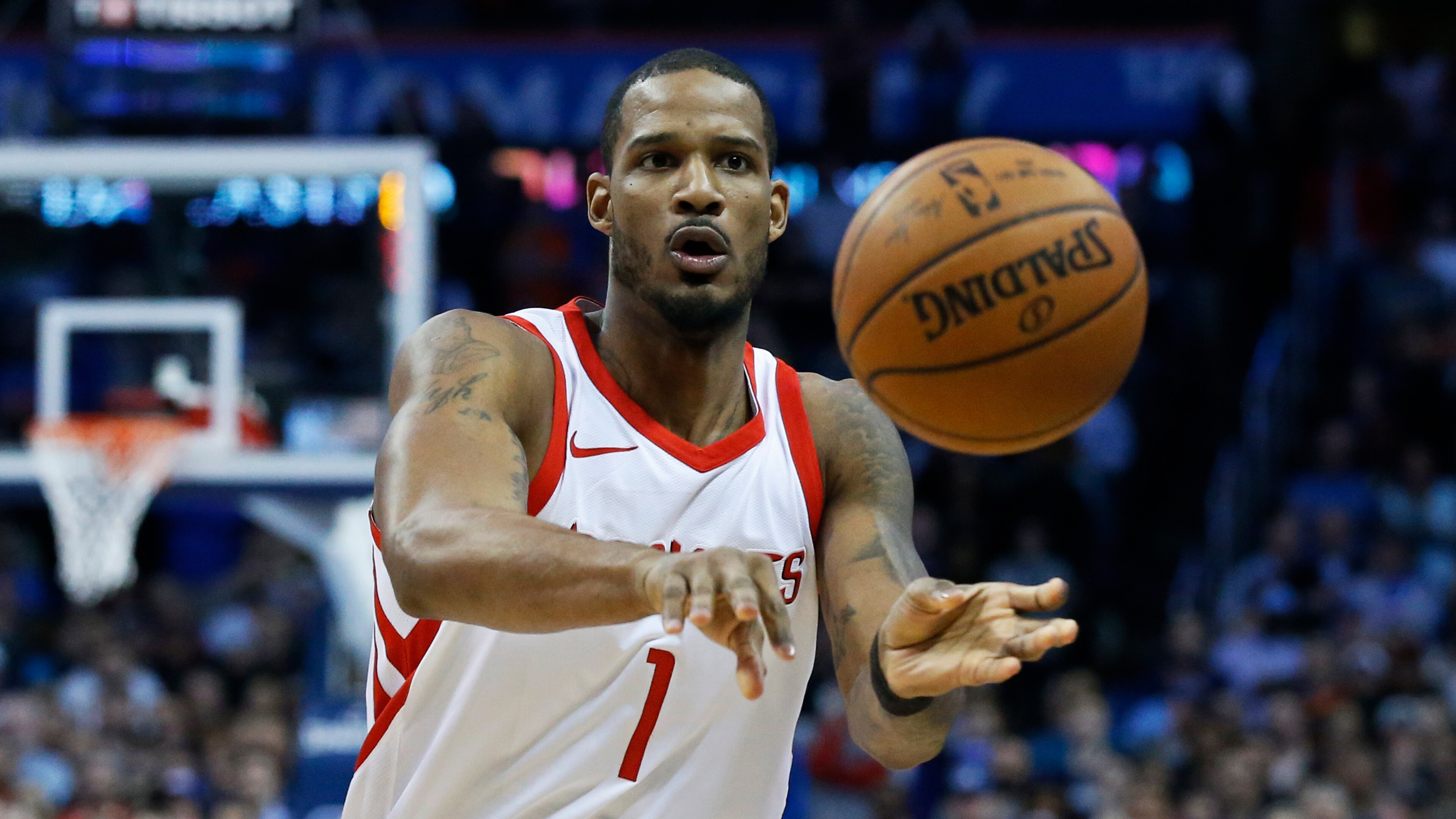
Age: 32
Free-Agency Status: Unrestricted
2017-18 Per-Game Stats: 11.9 rebounds, 4.5 rebounds, 1.6 assists, 1.5 steals, 0.2 blocks, 41.4 percent shooting
Blame this one on the Rockets' success. They've played themselves to a title-odds gridlock with the reigning champion Golden State Warriors, per OddsShark, which means they're on the verge of being Offseason Enemy No. 1 over the summer.
And that leaves us to pore over their roster searching for the next Andre Iguodala—the valuable free agent rival teams will try overpaying just to hurt Houston's depth chart or wallet.
Luc Mbah a Moute's name can—and should—be thrown into this ring. But Trevor Ariza is the more reliable shooter. Whereas Mbah a Moute's adequate accuracy from beyond the arc is still relatively new, Ariza's three-and-D credentials are playoff-proof.
Teams remain love-drunk for wings who can switch across the wings and splash in jumpers, so it wouldn't be surprising to see Ariza field over-the-top offers—especially if the Rockets come out of the Western Conference. But he's not some LeBron James stopper. Nor is he the primary reason for Houston's defensive success.
Going on 33, his next contract must account for how much longer he'll be equipped to chase around contemporary wings. The Rockets are coughing up 107.2 points per 100 possessions when using him at the 3, according to Cleaning The Glass—a not-terrible number that still pales in comparison to their fifth-place marks overall.
Houston is ruining lives when Ariza plays the 4, but even in the positionless era, he's not fit for full-time duty at power forward. His minutes up front are more matchup-dependent. He shouldn't be taking a pounding from traditional bigs and doesn't have the chops to pester many of the explosive bodies populating not only the 4 but also the wing spots in general.
Some more food for thought: Ariza is shooting just 33 percent from downtown since the end of February and failed to drop in 35 percent of his long balls last year. His next contract won't be worth what it'd cost to pry him out of Houston.
Runner-Up: James Ennis, Detroit Pistons
Power Forward: Aaron Gordon, Orlando Magic
4 of 5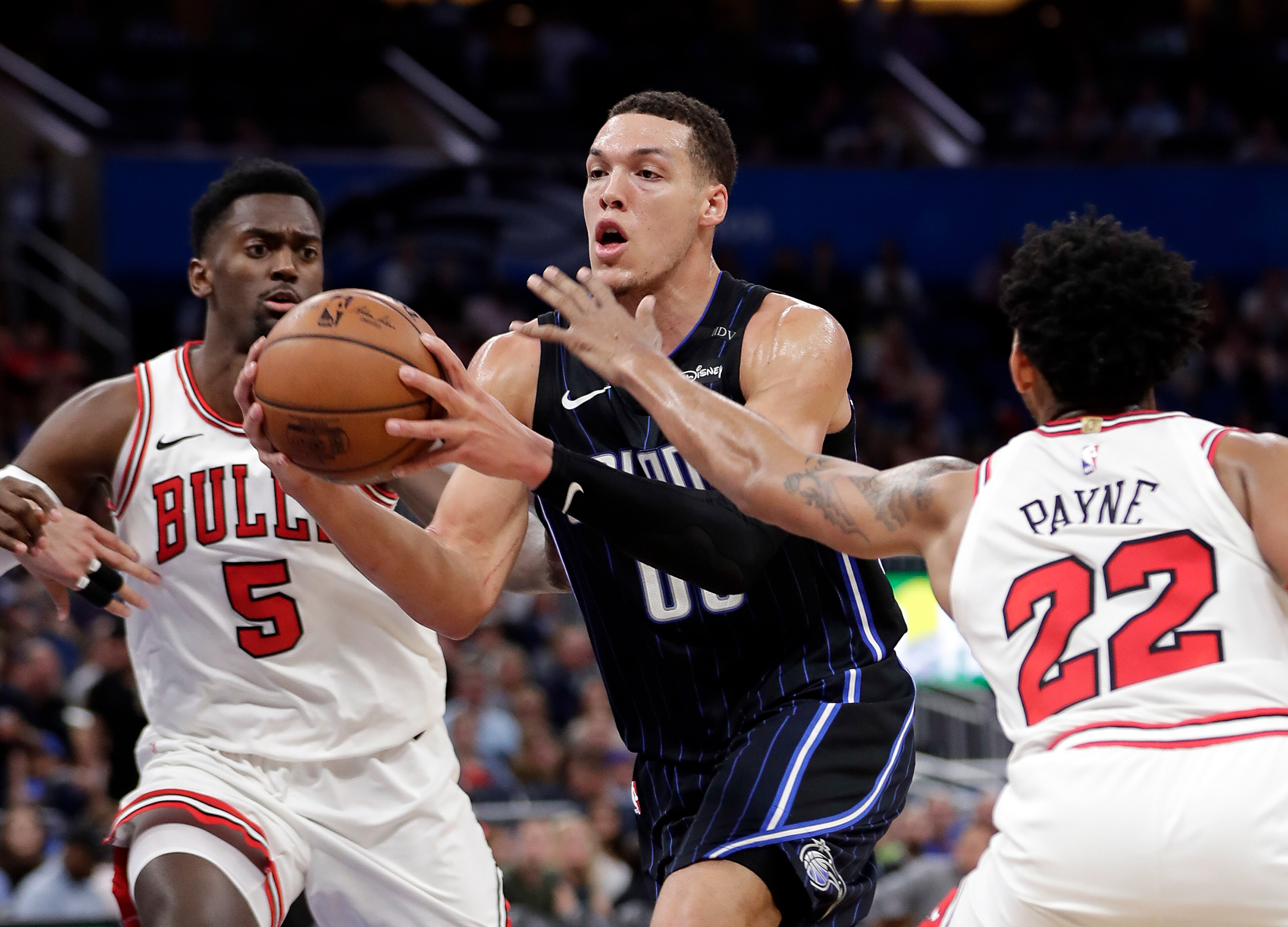
Age: 22
Free-Agency Status:
2017-18 Per-Game Stats: 18.0 points, 8.3 rebounds, 2.4 assists, 1.0 steals, 0.8 blocks, 43.7 percent shooting
Aaron Gordon has quickly become the face of this year's restricted free-agency class. He's expected to have an array of suitors over the summer, according to Sporting News' Sean Deveney. If anyone is going to coax max money out of a buyer based on tantalizing upside, it will be him.
As Bleacher Report's Adam Fromal wrote:
"Gordon hasn't shown off the necessary level of consistency at this stage of his career, but he's put so many different individual tools on display. Though the experiment to turn him into the Orlando Magic's version of Paul George failed, it still gave him the confidence necessary to become a willing perimeter shooter and display comfort handling the ball around the three-point arc. His athleticism hasn't gone anywhere. He can buckle down on defense and guard small forwards, power forwards or centers on any given possession.
"If he's ever able to link all of those skills together simultaneously, he'll make good on his enduring superstar potential, no matter how mediocre his current advanced metrics may look. Plus, working for a team with more established talent will do him good, as the Magic have been forced into overextending their young 4 and asking him to fill roles he has no business occupying at this point in his stretched-out developmental curve."
This logic is sound. But Gordon isn't worth a max-contract gamble. Too much of his improvement is embellished or an outright facade.
Yes, he's launching more threes than ever at a career-high 34.3 percent clip. But he's hitting just 30.4 percent of his long-range looks since the Magic's 8-4 start to the 2017-18 season. He doesn't have the outline of an efficient go-to option. He's shooting under 30 percent on pull-up jumpers and under 40 percent on drives.
Gordon's defense remains an in-between letdown on top of all that. He doesn't have an identity. Is he a viable rim protector? Is he better suited outside the restricted area as a secondary line of protection? Can he cover wings? Should he cover wings?
The Magic are culpable in all this. Their development of Gordon has been inconsistent, and he's never played beside optimal personnel. He might detonate and become everything his physical tools suggest he could be in a better situation.
That doesn't warrant a max offer—or anything close to one. It doesn't matter that prospective admirers must factor in the Magic's preference to keep him. Quality restricted free agents have leverage. They can be overpaid. We get it.
Dubbing Gordon a max-contract candidate, though, reeks of an attempt to pretend this year's free-agency class is anything other than underwhelming.
Runner-Up: Jabari Parker, Milwaukee Bucks (restricted)
Center: Jusuf Nurkic, Portland Trail Blazers
5 of 5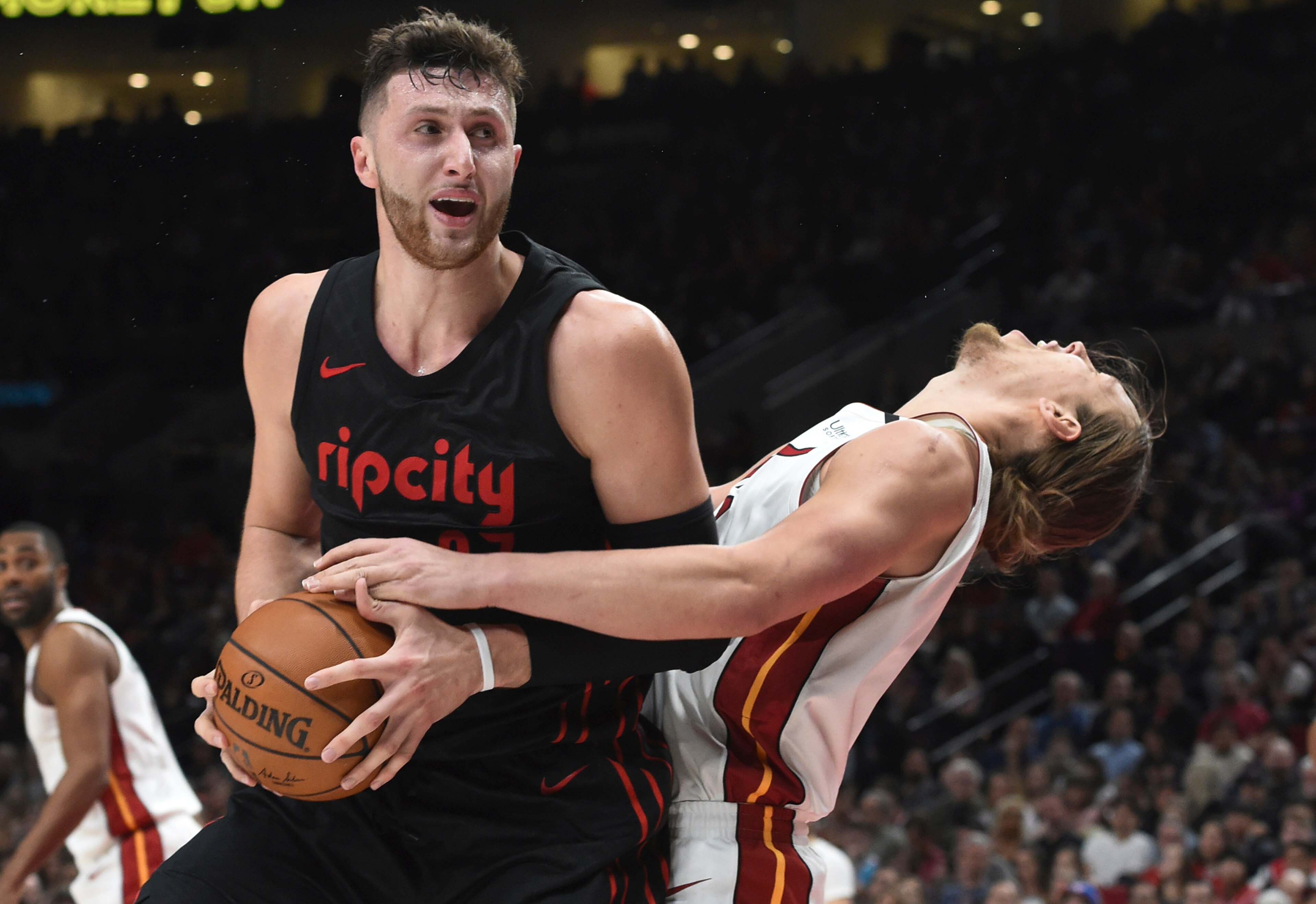
Age: 23
Free-Agency Status: Restricted
2017-18 Per-Game Stats: 14.3 points, 8.7 rebounds, 1.8 assists, 0.8 steals, 1.4 blocks, 50.0 percent shooting
Jusuf Nurkic deserves a ton of credit for anchoring the Portland Trail Blazers defense. Their system is considered simplistic, but it wouldn't work without him. They defend like a top-two team with him in the game.
Opponents are shooting 54.3 percent against Nurkic at the rim—the sixth-best mark among 83 players who have challenged at least 200 point-blank looks this season. His north and south movements are sublime; he doesn't need help to wall off the basket, which allows the Blazers to be aggressive contesting jumpers on the perimeter. They rank in the top five of both tightly and very tightly contested three-point frequency.
Sticking Nurkic on another team still stands to torpedo his defensive stock. Portland needs him to maximize its conservative scheme, but he needs said approach to accentuate what he does best. He's not going to stymie back-to-the-basket scorers, derail quick-footed rim-runners or survive when rotating into space.
Tab him for defensive success anywhere, and you're left with the matter of his offense. He isn't Clint Capela. He needs to get touches in the post, where he's shooting under 40 percent and posting the sixth-highest turnover rate among every player to eat up three low-block possessions per game.
Turning him into a screen-and-roll artist doesn't jibe with his skill set. He shoots a so-so 63.7 percent around the basket and has a tendency to throw up shots before he's at the rim. More than one-quarter of his attempts have come inside the paint but outside the restricted area, of which he's hitting just 39.5 percent.
Grooming him for a heavier pick-and-pop workload is similarly problematic. He's shooting 37 percent on mid-range jumpers and still doesn't let 'er rip with appreciable frequency when 15 feet or more away from the hoop. The Blazers lean on rookie Zach Collins when they're looking for a big to jump off screens.
Non-unicorns won't have the leverage to demand massive contracts in free agency. That should keep Nurkic's price point in check. But he's 23 and plugging the middle for a top-10 defense. Long-term offers will be available.
And yet, the lack of progress he's shown in Portland—on offense specifically—should garner more concern. Any significant investment in him, from the Blazers or another team, could be one the financier ends up regretting.
Runner-Up: DeAndre Jordan, Los Angeles Clippers (player option)
Unless otherwise noted, stats courtesy of NBA.com or Basketball Reference and accurate leading into games on Tuesday. Salary and cap-hold information via Basketball Insiders and RealGM.
Dan Favale covers the NBA for Bleacher Report. Follow him on Twitter (@danfavale) and listen to his Hardwood Knocks podcast, co-hosted by B/R's Andrew Bailey.
.png?w=3840)
.jpg?w=3840 "Kyle Shanahan Injured in Car Crash")

.jpg?w=3840 "Gonzalez Offered Historic Deal")