Predicting NBA Stat Leaders for Every Major Category During 2016-17 Season
Is the NBA about to become Russell Westbrook's personal plaything?
In the wake of Kevin Durant's departure to the Golden State Warriors, the Oklahoma City Thunder point guard is primed to pursue the championship belt of three different marquee stat categories—points, assists and steals per game. Will he get any of those individual titles, or will he fall short and watch as another star cements his place in the league's record books?
It's time to get out the crystal ball.
Only it can tell us which player will be most efficient from the field. Only it can foresee the leaders on the glass and from beyond the arc (well, pretty much everyone should be able to predict that second one). Only it can tell us who will become the newest supreme shot-swatting specimen.
Field-Goal Percentage
1 of 7
Leader: DeAndre Jordan
Death. Taxes. DeAndre Jordan leading the league in field-goal percentage.
This particular category has belonged to the Los Angeles Clippers center each of the last four seasons, and there's no reason to expect the trend to end anytime soon.
He's been over 70 percent each of the last two years—a benchmark only Wilt Chamberlain in 1972-73 had ever reached during a qualified campaign before Jordan started dunking with such ferocity and frequency. Frankly, no one is even close.
Dwight Howard was the 2015-16 runner-up, and he made "only" 62 percent of his field-goal attempts during his final season with the Houston Rockets. Hassan Whiteside was the only other qualified player on the right side of 60.
Jordan's role isn't changing. According to NBAMiner.com, he takes an insane percentage of his shots from right around the hoop, leaving him in a legitimate class of his own even among the seven players whose average shot came from within two feet of the rim:
| Rakeem Christmas | 0.5 feet | 2 | 100 |
| DeAndre Jordan | 1.41 feet | 508 | 70.3 |
| Greg Smith | 1.44 feet | 32 | 56.3 |
| Omer Asik | 1.51 feet | 195 | 53.3 |
| Salah Mejri | 1.69 feet | 78 | 62.8 |
| Clint Capela | 1.76 feet | 397 | 58.2 |
| Rudy Gobert | 1.85 feet | 354 | 55.9 |
Given his relentless proximity to the hoop, Jordan could regress severely and still lead the league in field-goal percentage with room to spare. It doesn't hurt that his primary challengers also find themselves in disadvantageous scenarios.
Runner-Up: Enes Kanter
Howard and Whiteside were Jordan's closest competitors in 2015-16, but neither should be expected to remain so efficient during the upcoming campaign.
The former is now with the Atlanta Hawks, where he'll be asked to take a few more jumpers and spend additional time away from the basket. We've already seen videos of him taking longer shots in practice, and those will depress his efficiency levels even if he proves adept in this new area.
The latter is about to take on an expanded role with the Miami Heat, and his newfound offensive responsibilities will make it tough to avoid missing looks. There's always a natural trade-off between volume and efficiency, as Whiteside will soon discover.
But Enes Kanter finished at No. 4 in 2015-16, and his situation isn't changing.
He's still a valuable offensive commodity off the Thunder bench, and he'll be counted on for close-range follow-ups and dunks off the roll. Marcin Gortat and Jonas Valanciunas are threats to take over his spot on the leaderboard, but Kanter's growing skill set and stable role with OKC give him the slight edge.
3-Pointers Made
2 of 7
Leader: Stephen Curry
Barring injury (quick, everyone knock on wood), Stephen Curry is a lock to lead the league in three-pointers.
For evidence, look no further than the all-time single-season leaderboard:
- Stephen Curry, 402 in 2015-16
- Stephen Curry, 286 in 2014-15
- Klay Thompson, 276 in 2015-16
- Stephen Curry, 272 in 2012-13
- Ray Allen, 269 in 2005-06
Curry didn't just set the record last season; he obliterated it. His mark is 1.457 times better than any number produced by a different player in NBA history, and it just so happens that the No. 2 shooter is his fellow Splash Brother.
Think about that mark. It's the equivalent of Kris Bryant not just sneaking by Barry Bonds' 73 home runs in a single go-round, but smashing 107 shots over outfield fences.
Maybe Durant takes shots away from Curry. Maybe the Association's premier sharpshooter suffers a bit of regression and looks more mortal after his struggles in the 2016 NBA Finals. Maybe he can't stay quite as healthy and is forced out of a few contests for maintenance.
He has so much cushion that he'd still be the favorite to lead the league even if all three possibilities were guarantees.
Runner-Up: James Harden
Thompson and Durant are reasonable picks. No one would be surprised if the top two spots continued to belong to the Warriors, just as they have during each of the last three seasons.
But James Harden has been knocking on the door for a while now, finishing at No. 6 in 2012-13 (179 triples), No. 4 in 2014-15 (208) and No. 3 in 2015-16 (236). Not only is he getting more comfortable taking deep shots in volume, but circumstances could push him to loft up even more.
With Howard on the floor last season, Harden made 2.6 triples per 36 minutes, according to NBA.com. That number jumped to 2.8 when the big man wasn't present, and he won't be at all in 2016-17 now that he's a member of the Hawks.
Harden was already the team's primary source of scoring and floor-spacing, and he's now even more important to the Houston schemes. Plus, said schemes should lead to even more triples now that new head coach Mike D'Antoni is at the helm, exhorting his troops to push the pace and fire away from beyond the arc whenever possible.
Blocks Per Game
3 of 7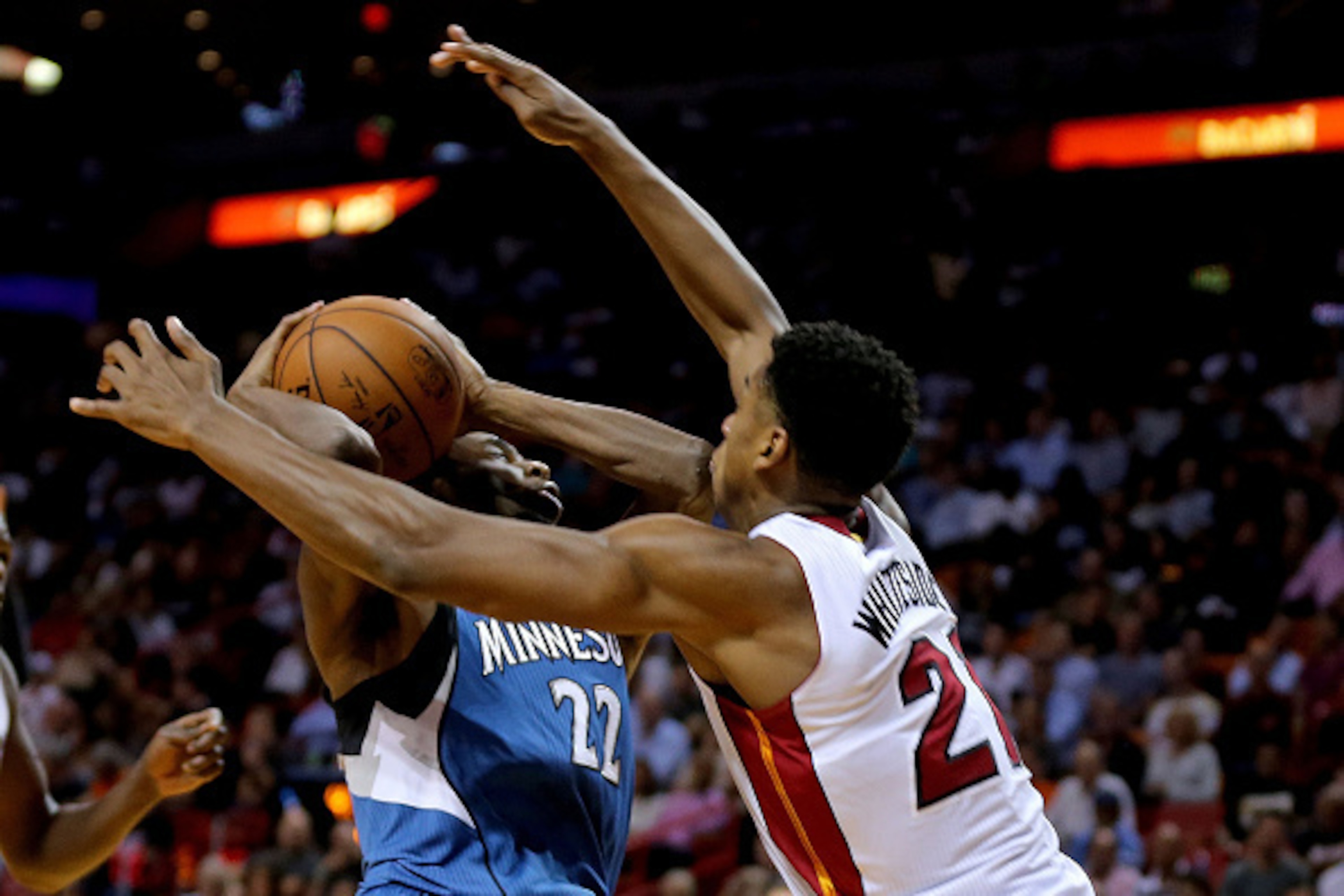
Leader: Hassan Whiteside
"He will have to be able to absorb more minutes, more responsibility, more games, which is a different level of training in the weight room," Miami head coach Erik Spoelstra said about Whiteside in an offseason video, as Ira Winderman of the South Florida Sun Sentinel transcribed.
Whiteside played only 29.1 minutes per game in 2015-16, but he still led the league by swatting away a ridiculous 3.7 shots during his typical outing. Nobody else was even close; Jordan finished a distant second with 2.3 blocks per game.
If you dig deeper, Whiteside becomes even more dominant.
He and Cole Aldrich were the only qualified players to reject at least three shots per 36 minutes. And while Aldrich checked in at 3.1, Whiteside posted a gaudy 4.6. His block percentage—the percentage of two-point attempts blocked while on the floor—tells a similar story. The difference between him (9.7) and Aldrich (No. 2 at 6.7) is greater than the gap between Aldrich and Mike Muscala. (Twenty-nine qualified players posted better block percentages than Muscala.)
Whiteside might be able to pace the field in this category while flailing around on defense with his eyes closed.
Runner-Up: Kristaps Porzingis
Despite playing only 28.4 minutes per game during his rookie season, Kristaps Porzingis finished seventh on the blocks-per-game leaderboard. A different set of six players beat him in rejections per 36 minutes, but he still finished in the same spot. As for block percentage, he sat at No. 10 but still posted an elite score for someone who wasn't just used sparsely for garbage-time purposes.
It's an important caveat that the New York Knicks could render this prediction null and void by handing Joakim Noah too large a role, but Porzingis should be in for even more playing time during his sophomore campaign. He'll have learned some nuances of interior defense at the NBA level, and his production should be all the more impressive.
Plenty of established players have serious shots at challenging for No. 2—Rudy Gobert, Jordan and Anthony Davis chief among them. But upside reigns supreme here.
Steals Per Game
4 of 7
Leader: Russell Westbrook
Even though Westbrook never lets his effort level wane, it's not difficult to see the intensity meter turning all the way up to 11. In the wake of Durant's departure, Westbrook has to prove he's not only capable of leading a team, but that he can steer it into the playoffs with inspired two-way play.
Westbrook finished fifth in steals per game last year with an even 2.0, trailing only Curry, Ricky Rubio, Chris Paul and Kyle Lowry, all of whom averaged 2.1 thefts per contest. He may have to save a bit more energy for offensive heroics, but it's not inconceivable that he could spend his time on defense darting around, doing everything possible to spark fast-break opportunities.
According to NBA.com, he already averaged an additional 0.2 steals per 36 minutes when Durant wasn't on the floor. His role changed just enough that he could afford to gamble extensively and make use of his ridiculous athletic ability.
We also have proof that Westbrook can reach that next gear in the thievery department when he's truly motivated. During each of his last three postseasons, his per-game average has gone up from where it stood in the regular season—the latter two while he was playing even heftier minutes.
Runner-Up: Stephen Curry
Many guards get most of their steals by attacking ball-handlers and jumping passing lanes. Curry is skilled at both, but it's his ability to take on bigger players after he switches assignments that allows him to challenge for the league lead in steals—a challenge he won during his unanimous MVP campaign.
If Curry is isolated on the blocks against bigger players, he shows incredible timing ripping down as they attempt to bring the ball up. The same theory applies when he battles against rollers diving toward the hoop or is bullied backward by the driving efforts of a larger guard. His underrated core strength allows him to hold an advantageous position and then use his quick hands.
Of the four players who beat Westbrook last season, Curry is the best equipped to stave off a decline.
Rubio and Lowry should spend a little less time on the floor thanks to the youthful presences of Kris Dunn/Tyus Jones and Cory Joseph/Delon Wright, respectively. Paul doesn't have an up-and-coming guard nipping at his heels, but the offseason addition of Raymond Felton gives the Clippers the ability to manage Paul's minutes throughout the season and keep him healthier for the inevitable playoff run.
Rebounds Per Game
5 of 7
Leader: DeAndre Jordan
The Clippers may have added some convincing backcourt depth, but the same can't be said about the frontcourt. Though Jordan and Blake Griffin remain entrenched as the starters, the backup contingent of Brandon Bass, Brice Johnson, Marreese Speights and Diamond Stone isn't exactly inspiring.
Jordan, through sheer necessity, will once more be forced to shoulder heavy minutes, and that means big rebounding totals yet again. He's already led the league in boards per game during two of the last three seasons, only losing out in 2015-16 to Andre Drummond by a single board and still finishing ahead of everyone else.
L.A.'s willingness to leave him alone in the middle also grants him so many uncontested opportunities. Jordan is a great rebounder in traffic, capable of skying over smaller players and boxing out strong opponents before he hauls in the missed shot. But even as he ceded this crown to Drummond last year, he still paced the Association with 8.7 uncontested rebounds per game, per NBA.com's SportVU data.
Unless head coach Doc Rivers suddenly draws up schemes that take Jordan out of the paint, big numbers are guaranteed. (And why would he ever drag this big man out to the perimeter?)
Runner-Up: Hassan Whiteside
You may be shocked Drummond isn't even getting credit as the runner-up favorite. He's still rather easily one of the league's best rebounders—a fact that won't change as his all-around game continues to mature. But a direct 2015-16 comparison to Whiteside should help begin to make it clear why the Heat center is our choice for No. 2:
| Andre Drummond | 14.8 | 16.2 | 24.5 | 22.2 | 24.3 |
| Hassan Whiteside | 11.8 | 14.7 | 23.1 | 20.1 | 24.9 |
On a per-minute basis, Whiteside generates more rebounding chances, and he's getting better at converting them into actual boards.
The Heat don't have much size behind Whiteside, setting them up to hand him astronomical minute totals as he justifies his new max deal. The defense will also be better if Chris Bosh is able to play, which could lead to even more rebounding chances. Meanwhile, the Detroit Pistons shored up their second unit with the additions of Boban Marjanovic and Jon Leuer, both of whom could keep Drummond from playing as many minutes on a nightly basis.
This will be a close battle throughout the season, but we're rolling with Whiteside to win in a photo finish thanks to the many extra chances he'll likely be granted. Don't be surprised if the last game of the year has serious ramifications in this contest.
Assists Per Game
6 of 7
Leader: Russell Westbrook
It's reasonable to think Westbrook might fail to reach double-digit assists without the benefit of passing to Durant. Of the point guard's 834 dimes in 2015-16, 255 went to Durant, per NBA.com.
But even if you remove that 30.6 percent from the equation, he still would have averaged 7.2 dimes. And that's without taking two more factors into account.
First, he'll be passing to someone other than Durant, and he'd surely rack up plenty of assists in those situations. Per NBA.com's SportVU data, his teammates shot 56.8 percent from the field off his passes, indicating he's become quite good at putting the ball into the proper spaces while leaving his running mates in advantageous positions.
Ersan Ilyasova and Victor Oladipo are by no means going to make up for Durant's absence when sharing the court with Westbrook, but the floor general will help them account for at least some of the difference.
Second, Westbrook will handle the ball even more. Durant possessed it for 3.4 minutes per game last season, and those touches have to go somewhere. Westbrook may need to create more assist opportunities to replicate last year's numbers, but he's perfectly capable of doing exactly that.
Runner-Up: John Wall
Only five players averaged more than 7.5 assists in 2015-16. Even if each member of the passing-maestro quintet gains re-entry to the exclusive club, it's unlikely that number grows by much. Ben Simmons has a chance to join the group, as do a few other guards taking on bigger distributing roles. But should they make it, they'll still be well short of double digits.
Westbrook is already projected to lead the league, and John Wall's status at No. 2 is due to his enduring role standing above the remaining three situations.
Rubio (8.7 assists per game in 2015-16) has to deal with incoming rookie guard Dunn stealing some of his minutes and touches, and Jones could eat into his role as well after a strong showing during summer league. Ditto for Paul (10.0) and Felton, if only because the Clippers will do everything possible to preserve their All-Star guard for the playoffs now that they have a legitimate upper-tier backup.
That leaves Rajon Rondo (11.7), who will be hard-pressed to duplicate his league-leading average now that he's sharing the ball with Dwyane Wade and Jimmy Butler for the Chicago Bulls. If only by attrition—and, of course, a tremendous amount of court vision from this particular Washington Wizards guard—it has to be Wall.
Points Per Game
7 of 7
Leader: Russell Westbrook
Only twice have players led the NBA in both assists and points per game: Oscar Robertson during the 1967-68 campaign by averaging 29.2 points and 9.7 assists for the Cincinnati Royals, then Tiny Archibald for the Kansas City-Omaha Kings with 34.0 points and 11.4 assists in 1972-73.
It's about time we got a third member.
According to NBA.com, Westbrook averaged 23.0 points per 36 minutes when he shared the court with Durant during their final season as teammates. That mark skyrocketed to 29.5 when the point guard was left as the lone alpha dog, and it's no fluke. His average rose from 22.3 to 33.7 points per 36 minutes in the same situation during the 2014-15 campaign, as well as from 25.1 to 40.2(!) in 2013-14.
The extra defensive attention just doesn't matter. Westbrook may be a bit less efficient, but it's still impossible to keep him from the rim without sending him to the free-throw stripe.
Expect more of the same, except now there are no minutes with Durant to drag his overall average down. It would be beyond shocking if he failed to average at least 29 points in 2016-17—a mark only Harden (29.0) and Curry (30.1) hit last year.
Runner-Up: James Harden
While Curry and Durant take touches away from each other, Harden benefits from a situation similar to Westbrook's—though not quite to the same extreme.
The bearded shooting guard saw his scoring average rise by four points per 36 minutes without Howard on the court in 2015-16, per NBA.com, and Howard's gone now. Harden becomes the first, second and third option in almost every set, which should make it far easier for him to—at the very least—maintain his gaudy scoring average.
Harden is admittedly the safe pick here, especially with D'Antoni sure to up the team's pace and grant him even more possessions, but that doesn't mean he's immune to challengers.
Either Curry or Durant could explode if the Warriors feature one of their two studs more than expected, and we can't overlook Davis, Karl-Anthony Towns (yes, Towns is a scoring contender, even as a sophomore), DeMarcus Cousins, Damian Lillard and a few others.
Adam Fromal covers the NBA for Bleacher Report. Follow him on Twitter @fromal09.
Unless otherwise indicated, all stats are from Basketball-Reference.com, NBA.com or NBA Math.

.jpg?w=3840 "NFL Players in Need of Fresh Start 🙌")

.jpg?w=3840 "Kyle Shanahan Injured in Car Crash")