
NBA Metrics 101: Which Playoffs Studs Have Needed More Rest?
Sometimes it's hard to remember, but even NBA stars are human.
They might be capable of extraordinary feats of athleticism and precision, raining down three-point buckets with ridiculous accuracy and gliding through the air to make acrobatic slams look commonplace, but they can still wear down. Rest is necessary for even the most studly athletes like LeBron James and Russell Westbrook.
Especially in the playoffs, when the league's brightest stars are tasked with even more responsibility and play increased minutes, fatigue can set in and impact performances down the stretch. Fourth quarters can be telling, because tired legs lead to more missed shots, fewer drives to the hoop and declining overall performances.
Some teams allot rest sagely, while others are determined to ride their marquee figures as frequently as possible. And we're here to tell you which is which by breaking down the fatigue levels and late-game performances of the 10 players in the 2017 postseason playing at least 35 minutes per game and posting the highest usage rates.
Stephen Curry, Golden State Warriors
1 of 10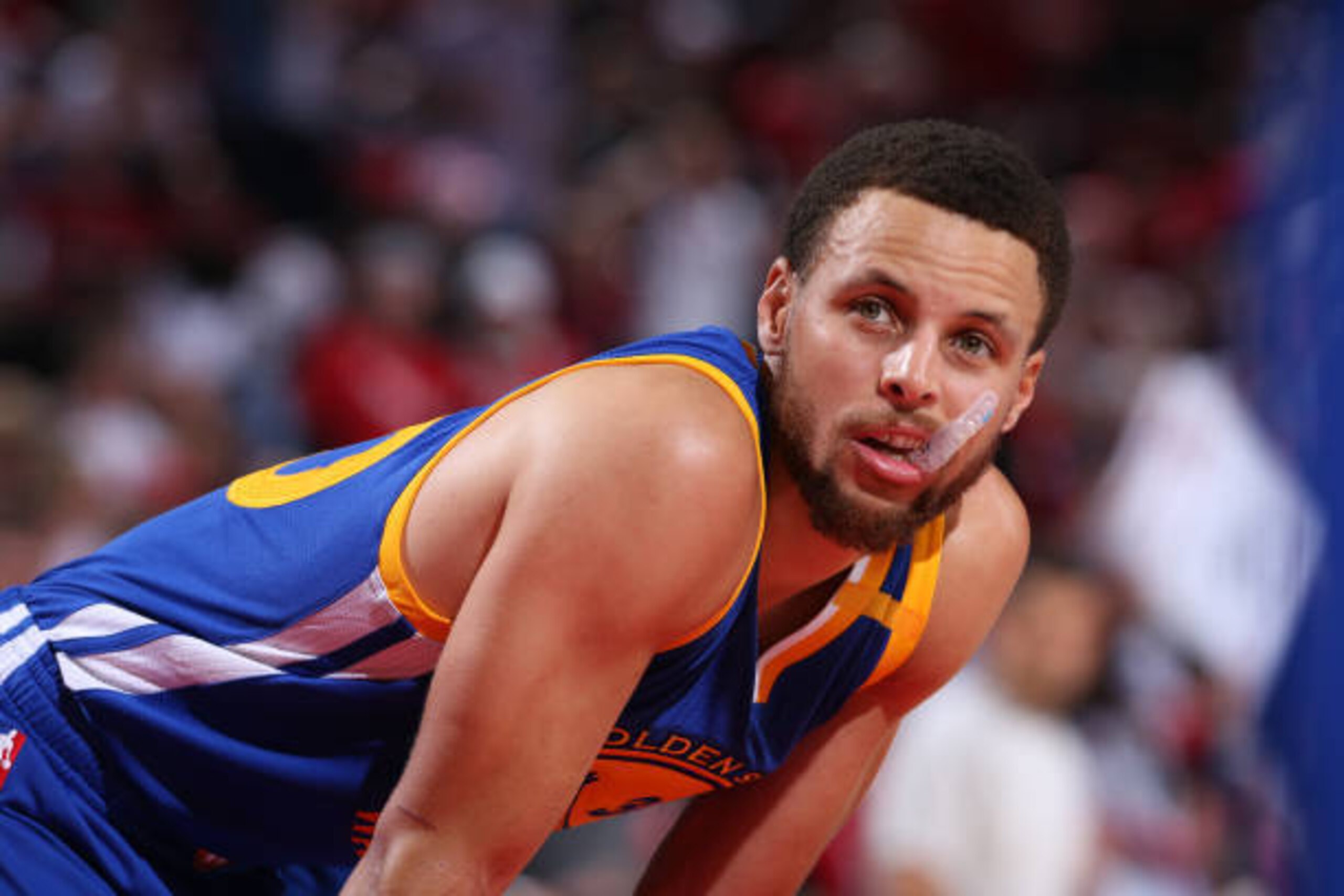
Minutes Per Game: 35.0
Usage Rate: 33.0
Pressure certainly hasn't bothered Stephen Curry, who has cooly stepped to the line eight times during fourth quarters of the Golden State Warriors' first-round series against the Portland Trail Blazers and drilled all eight of his free-throw attempts. For the sake of comparison, James Michael McAdoo and David West are the only other Dubs maintaining perfection at the stripe during the final period, and they're a combined 4-of-4.
Fatigue hasn't been an issue, either.
In fact, Curry has gone from good to great during the last 12 minutes. Through the series' first three games, all of which resulted in Golden State victories, he averaged a staggering 43.6 points, 5.1 rebounds and 12.7 assists per 36 minutes in the fourth quarter while shooting 42.9 percent from the field and 50.0 percent from three-point territory.
But the important caveats here are twofold.
First, Curry has only logged 12 relevant minutes over the course of two appearances, since contests against Rip City's overmatched troops haven't exactly been tight. It's an extremely small sample, though there's no reason to believe he'll slow down while healthy after his late-game heroics over the past two seasons. And second, Curry has done this with Kevin Durant on the floor for only seven minutes, so he'll face even less defensive attention—and receive fewer responsibilities—with his superstar teammate back in the fold.
Verdict: The Warriors should continue deploying Curry as they see fit.
DeMar DeRozan, Toronto Raptors
2 of 10
Minutes Per Game: 36.8
Usage Rate: 30.9
It's time to ease back on the throttle.
The Toronto Raptors need to stop relying on DeMar DeRozan quite so frequently down the stretch, or they need to rest him and let his teammates pick up some slack. Kyle Lowry is certainly capable of doing a bit more on offense, and the team should be able to place some extra trust in marginalized players such as DeMarre Carroll.
After all, DeRozan's quarter-by-quarter splits don't progress in a fashion that head coach Dwane Casey would like:
| 1 | 20.6 | 4.8 | 1.6 | 61.3 |
| 2 | 38.4 | 7.0 | 1.2 | 59.4 |
| 3 | 15.8 | 6.0 | 3.0 | 41.9 |
| 4 | 17.4 | 9.5 | 3.2 | 49.1 |
Throughout his career, DeRozan has been a true workhorse. He rarely misses games, and this was the sixth consecutive season in which he averaged at least 35 minutes per contest.
But that workload eventually takes its toll, especially given the increased physicality of the playoffs. DeRozan's style necessitates contact in the mid-range areas for which he's shown such affinity, and the pounding has been wearing him down during the second half of tight games—just look at his increased willingness to share the rock in the third and fourth quarters.
Handling his minutes and touches more responsibly may unlock a new offensive level for the postseason Raptors.
Verdict: Changes are necessary, or else DeRozan's mid-range jumpers will continue clanging off the rim in late-game situations.
James Harden, Houston Rockets
3 of 10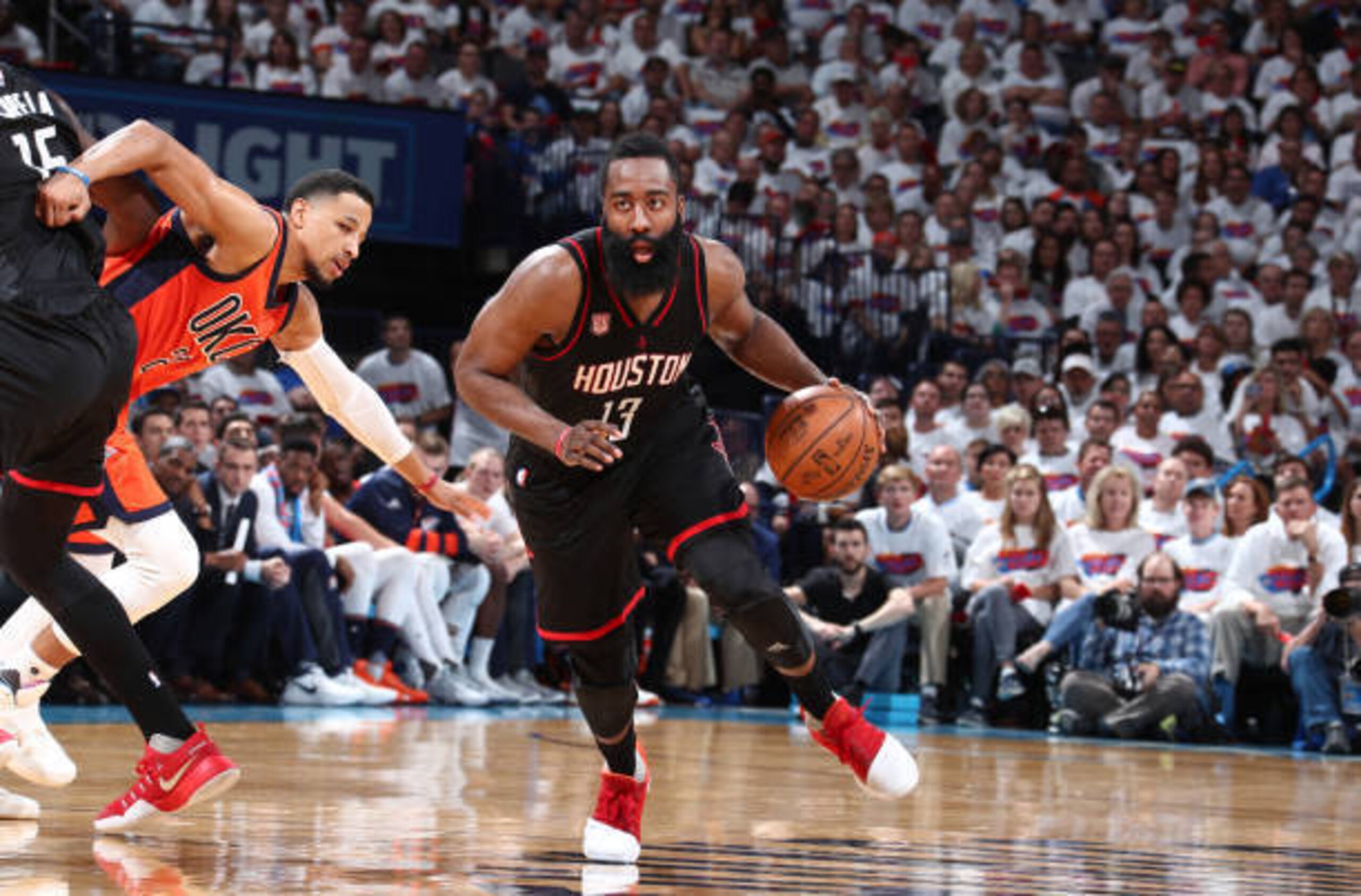
Minutes Per Game: 37.3
Usage Rate: 36.8
With 41.8 seconds remaining in Game 4 of the Houston Rockets' first-round matchup against the Oklahoma City Thunder, James Harden did what he's done so often throughout 2016-17: knock down a shot from the free-throw line.
But this one was different.
Rather than coming after he'd earned a whistle, it happened during the flow of action—the rare mid-range jumper that connected after he stepped back and fired over Victor Oladipo's outstretched arms to give Houston a 3-1 series lead.
What wasn't different, however, was Harden's performance down the stretch. Even though he's shouldered unimaginable burdens for the Rockets all season, he's just never seemed to slow down during the waning moments of a game. His minutes don't keep him in check, and neither does his lofty usage rate. He means everything to Houston, and that doesn't change during the clutch.
Maybe it's his herky-jerky style of play that never requires too much non-stop burst. Perhaps its all the respites he receives while gathering himself at the charity stripe. It could even be his lackluster defensive effort, which preserves him for the offensive end.
No matter what the explanation may be, the bearded guard has averaged 45.6 points, 6.7 rebounds and 4.0 assists per 36 minutes during postseason fourth quarters while shooting 55.6 percent from the field, 41.7 percent from downtown and 75.0 percent at the stripe.
Verdict: The status quo is working. Don't change anything.

LeBron James, Cleveland Cavaliers
4 of 10
Minutes Per Game: 43.8
Usage Rate: 32.4
LeBron James isn't human.
He's well into his 30s and has racked up minutes faster than anyone in NBA history, given his extreme importance to his teams, perennially deep playoff runs and willingness to suit up for Team USA during some offseasons. Even this season, which was supposed to feature plenty more rest for the four-time MVP, he logged a league-high 37.8 minutes per game and sat out of only eight contests.
Naturally, his usage has crept even higher during the playoffs. No one is spending more time on the floor, and his 32.4 percent usage rate is even higher than the 30.0 he recorded during the regular season.
But is that really going to affect the sport's greatest talent? It might eventually, as Henry Abbott recently wrote for ESPN.com:
"The coach who might have delivered him to April in peak condition by sitting him more probably lacks the juice to do so. The owners who could make the schedule line up with the science of human limits lack the conviction to rest someone who is so phenomenally good for ratings.
And so here we are, with LeBron in the playoffs overworked, underslept and over-traveled—a victim of his astonishing popularity. He was so good at becoming the best basketball player in the world that maybe this season, or another one soon, the preventable will become inevitable: He'll have exhausted his superhumanity, so compromised by fatigue that he won't be the best basketball player in the world anymore.
"
James' overall performances are still immaculate, and he's the main reason the Cleveland Cavaliers are already marching on to the second round. But though the Cavs swept the Indiana Pacers, every single game went down to the wire, thereby requiring more herculean efforts from the team's leading stud.
Eventually, that will come back to bite Cleveland.
It may be worth sacrificing a few games—if that's even necessary—to preserve James for later rounds. He's already showing signs of fatigue during fourth quarters, in which he averaged 24.0 points, 8.3 rebounds and 5.3 assists per 36 minutes through the opening round but shot just 39.3 percent from the field, 28.6 percent from downtown and 47.1 percent at the charity stripe.
Verdict: James can run out of steam, and he might if the Cavs don't stop leaning on him so frequently during each and every outing.
Kawhi Leonard, San Antonio Spurs
5 of 10
Minutes Per Game: 36.8
Usage Rate: 32.8
"He was standing next to me the other night and he wasn't breathing," Memphis Grizzlies head coach David Fizdale said of Kawhi Leonard midway through his team's first-round series against the San Antonio Spurs (h/t Sports Illustrated's Dan Gartland). "So I'm gonna check the rulebook and find out if robots are allowed to play in the NBA. Somehow, Pop and them have figured it out. They know something I don’t know. This guy bleeds antifreeze or something."
Robots don't get tired. They may rust and become irrelevant due to planned obsolescence, but fatigue isn't really an issue for metal. So if Kawhi Leonard really is a robot, he must keep dominating from the first quarter through the final buzzer.
And he has against Memphis, even if his teammates haven't been able to keep up their end of the bargain. The pair of losses have been more about San Antonio squandering his heroics than him failing to come through in the clutch.
As is the case for all 10 of these players, small-sample-size warnings are in effect. But through three fourth-quarter appearances—he didn't need to play during the Game 1 blowout—and 21 total minutes, Leonard is putting up some of the greatest numbers in NBA history.
That's not an exaggeration. The MVP candidate is averaging 48.4 points, 15.6 rebounds, 3.5 assists and 3.5 steals per 36 minutes. And if you're still not impressed with the man who may well become the star of Westworld's second season, he's shot 9-of-12 from the field (75 percent), 3-of-3 from deep and 7-of-7 at the stripe.
Verdict: Maybe head coach Gregg Popovich should lean on Leonard even more, then refill his oil on the flight to the next game.
C.J. McCollum, Portland Trail Blazers
6 of 10
Minutes Per Game: 36.7
Usage Rate: 32.3
It's actually C.J. McCollum, not Damian Lillard, who led the Portland Trail Blazers in usage rate during the playoffs. While the point guard played 36.3 minutes per game and posted a 30.7 percent usage rate (No. 11 among players logging at least 35 minutes per contest) through the first three games, his backcourt mate topped him by a marginal amount in each category.
Perhaps a change might have made the Blazers more competitive in their first-round matchup with the Golden State Warriors, since McCollum was overburdened. He either needed to cede responsibilities while matched up against Klay Thompson's brutally effective on-ball defense or play fewer minutes and save energy to create separation on his patented mid-range pull-ups in late-game scenarios.
This quarter-by-quarter trend wasn't ideal:
| 1 | 30.6 | 5.6 | 0.0 | 65.2 |
| 2 | 34.4 | 8.3 | 1.2 | 62.5 |
| 3 | 23.3 | 6.1 | 2.4 | 46.5 |
| 4 | 21.0 | 4.5 | 0.0 | 51.3 |
For perspective, the league-average true shooting percentage during the regular season was 55.2 percent. During the playoffs, it's actually gone up to 55.3 percent—so much for the narrative that defense always wins championships.
If McCollum had scored less down the stretch but got more efficient, that would have been be palatable. If his efficiency had dropped while he put up points in bunches, the same would ring true.
But seeing both volume and efficiency move in the wrong direction is troubling.
Verdict: This would be an easier call if Lillard had fourth-quarter success, but the Blazers still tasked McCollum with too much responsibility, and they got swept.
Chris Paul, Los Angeles Clippers
7 of 10
Minutes Per Game: 36.3
Usage Rate: 32.0
At this point, the Los Angeles Clippers don't really have any other options.
They have to find some way to puncture the Utah Jazz's impregnable defense without Blake Griffin, and they don't have anyone else to whom they can turn. Jamal Crawford isn't suddenly going to morph into a hyper-efficient scorer. Austin Rivers' return won't move the needle that much. Raymond Felton isn't going to become a Finals MVP candidate.
It's time to ride Chris Paul as much as possible.
Fortunately for head coach Doc Rivers and the rest of the organization, Paul has proved capable of handling such immense responsibilities. Not only has he maintained a 32 percent usage rate while playing 36.3 minutes per game, he's dished out dimes on 57.1 percent of the shots his teammates have made while he's on the floor. Throughout the history of the NBA playoffs, literally zero qualified men have simultaneously matched or exceeded each of those three numbers.
Even while carving out a new level of responsibility, Paul has thrived down the stretch. His 67.2 true shooting percentage leads the Clippers during the fourth quarter, and he's averaged 41.0 points, 3.0 rebounds and 2.0 assists. He doesn't share the ball as frequently, but that's perfectly fine.
So long as he continues to nail mid-range jumpers while gliding through the lane, Los Angeles will have a shot to finally get the playoff monkey off its back, even in its crippled state.
Verdict: What choice do the Clippers have? Keep trusting Paul, and success may await.
Isaiah Thomas, Boston Celtics
8 of 10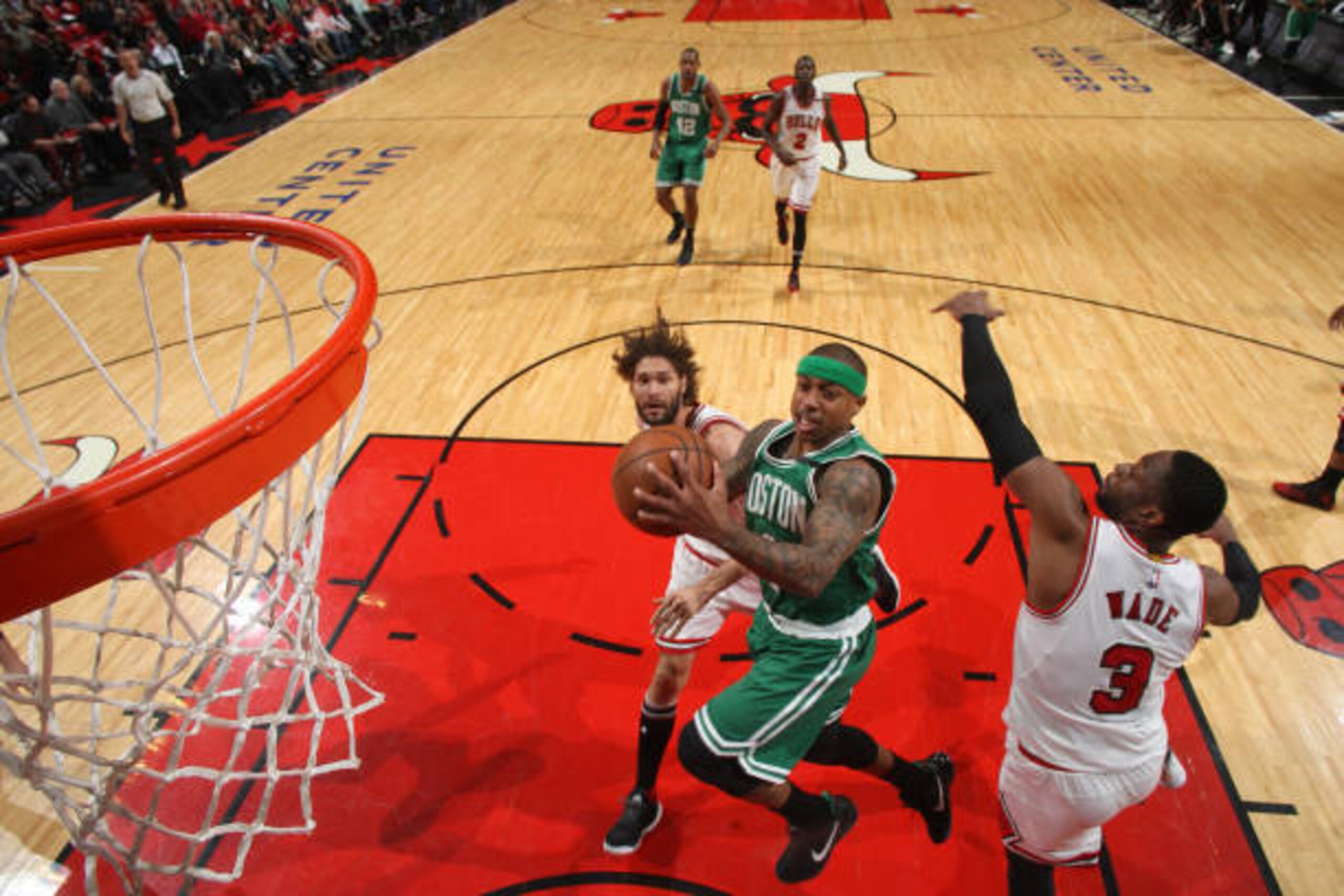
Minutes Per Game: 36.8
Usage Rate: 33.0
As Scott Rafferty wrote for SportingNews.com in a fantastic, detailed breakdown of Isaiah Thomas' scoring prowess during the fourth quarter, the diminutive point guard turns into a different beast during the final 12 minutes:
"Thomas more or less becomes James Harden or Russell Westbrook in the fourth quarter. Not only in terms of production, but in the way he looks to make something happen every time down the court. Mavericks head coach Rick Carlisle said Thomas is a difficult matchup because 'he’s got the blue light, which is greener than the green light,' and Pistons head coach Stan Van Gundy echoed similar sentiments by suggesting they should’ve triple teamed him following a loss to the Celtics."
But the playoffs are different.
During the postseason, it's tougher for small guards to thrive. They don't typically earn as many whistles when careening toward the basket, and the slowing of possessions leads to more clogged areas around the hoop that negate some driving lanes. These issues don't affect everyone, but they have plagued Thomas during late-game opportunities, making it easier for defenders to stick with him and contest his pull-up jumpers.
The 1-guard's per-36-minute averages are fine: 25.0 points, 1.1 rebounds and 6.5 assists. But Thomas is shooting just 42.1 percent from the field, 14.3 percent from three-point range and 75.0 percent at the stripe. Coupled with his cough-ups, that's made it tough for him to lead the Celtics past the Chicago Bulls in expeditious fashion.
We also have to mention the tragic death of his sister in a car accident just prior to the first-round series, since the emotion from that unfortunate event could also be a confounding factor here. But even if it is, that still means Boston would be best re-allocating some of the late-game possessions and assuming more of a team-oriented approach for the time being.
Verdict: The playoffs aren't the regular season, and Thomas' workload is making it tough to retain the Mr. Fourth Quarter title.
John Wall, Washington Wizards
9 of 10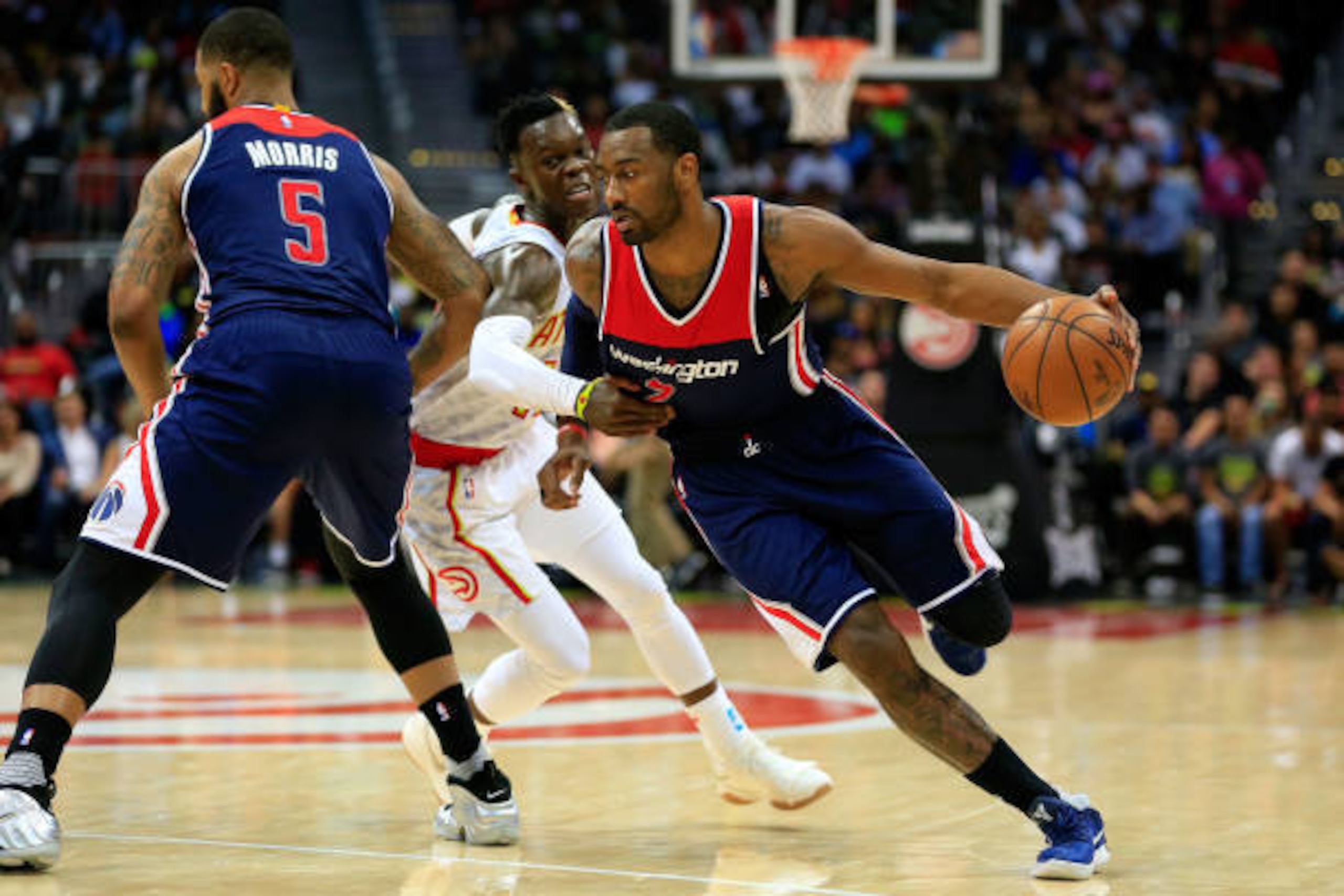
Minutes Per Game: 36.0
Usage Rate: 30.8
John Wall's game is predicated upon driving.
Whether he's operating in transition or running the show in the half-court set, he's always looking to turn on the jets and dart past the nearest defender. And as soon as he's by, possessing some sort of lane to the hoop, he's usually able to either finish the play himself or keep his eyes up in constant search of an open teammate on the perimeter who's taking advantage of the collapsed defense.
The only issue with the strategy: Drives require bursts of energy, and energy can dwindle when a player is relied upon too heavily. By playing him for 36 minutes per game during the postseason and actually upping both his usage rate and assist percentage from their regular-season levels, the Washington Wizards are pushing the boundaries of Wall's physical limits.
However, they haven't yet reached whatever asymptote may exist.
The speedy point guard has appeared in three fourth quarters against the Atlanta Hawks during the playoffs' opening round, and he's thrived in the cumulative 17 minutes. Averaging 25.0 points and 14.6 assists per 36 minutes, he's showing no signs of fatigue, especially since he's hitting 66.7 percent of his field-goal attempts, making trips to the line, limiting his turnovers and asserting himself on defense.
Many members of the Wizards have struggled to find their bearings during the most important part of the NBA calendar, which is the main reason Wall has assumed even more than his typical duties.
Thus far, it's working.
Verdict: This is Wall's team, and he's showing no signs of slowing down.
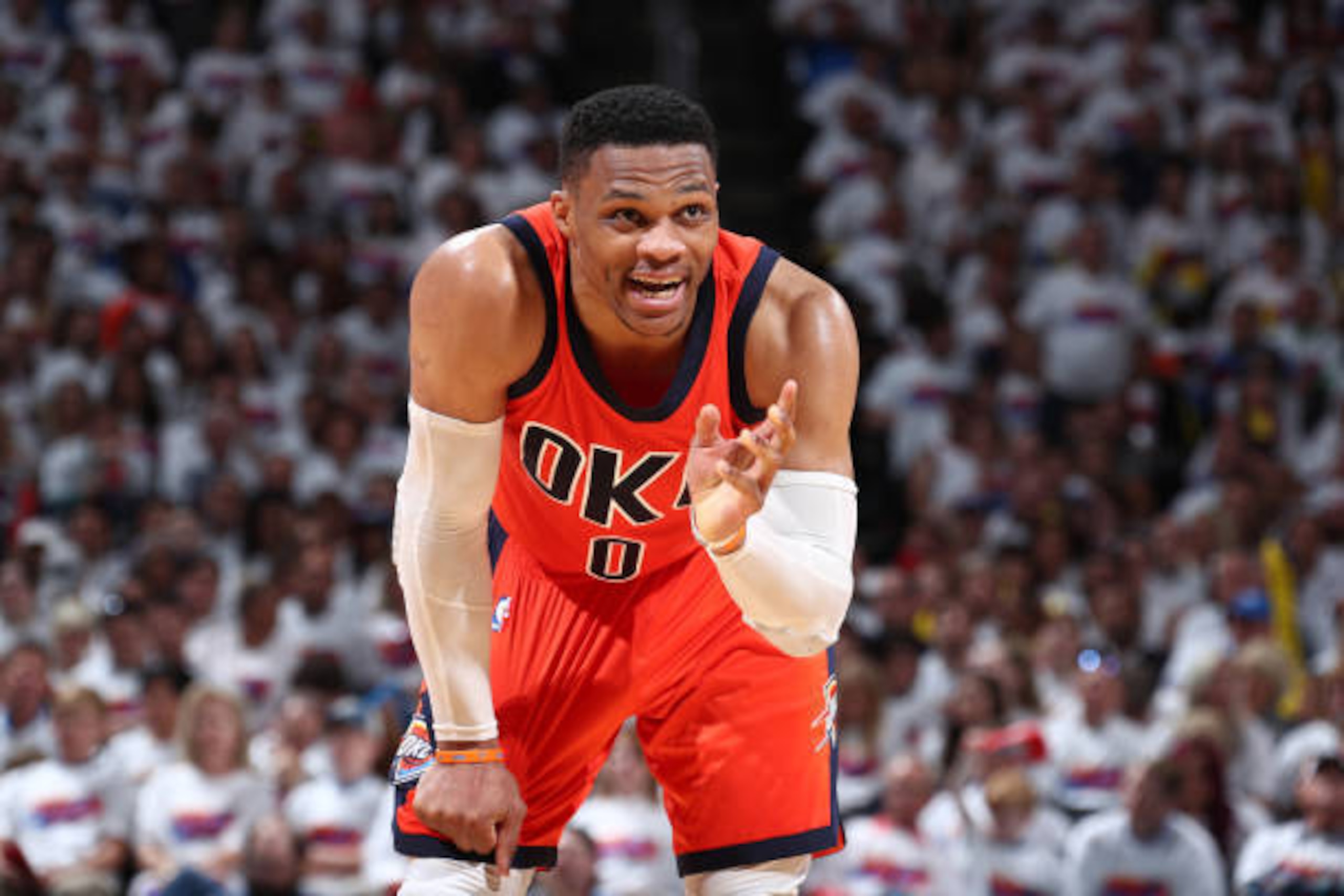
Russell Westbrook, Oklahoma City Thunder
10 of 10
Minutes Per Game: 38.3
Usage Rate: 46.6
The Oklahoma City Thunder don't have any good solutions here.
If they choose to cut back on Russell Westbrook's historic usage rate—no qualified player has ever finished a postseason north of 40 percent, and this MVP candidate is closer to 50 than 40—they have to turn to someone else on the roster. And that's an issue. Particularly with Victor Oladipo struggling to find a rhythm, the Thunder don't have anyone who can come close to replicating Westbrook's immense contributions in so many different areas.
But if they choose to continue down the current path, they run the risk of Westbrook wearing down. He's already showing signs of extreme fatigue during the fourth quarter, as his numbers shift dramatically:
| 1 | 29.5 | 16.1 | 13.4 | 57.9 |
| 2 | 34.0 | 11.7 | 17.5 | 54.4 |
| 3 | 27.3 | 7.3 | 9.1 | 44.3 |
| 4 | 42.4 | 7.1 | 4.0 | 44.9 |
Late in games, Westbroook's playing style has completely changed.
He no longer looks for teammates and instead calls his own number excessively, leading to an increased scoring average that's actually detrimental because it's coming in such inefficient fashion. Not only are the shooting numbers problematic, but the dynamic point guard is turning the ball over more frequently than in any other period—6.1 times per 36 minutes.
And if that's still not enough, he's taking a whopping 16.2 triples per 36 minutes in the final period. During the first three quarters combined, he's only lofting up 13.9 three-point attempts per 36 minutes, choosing to probe a defense and involve his teammates rather than force the issue by heaving up ill-advised attempts. It also doesn't help that his one-man efforts haven't led to leads and have instead forced him to try making up big deficits in shorter spurts.
Westbrook's superhuman efforts were often enough during the regular season, in which he did everything in his power to prove his motor served as the very definition of indefatigable. But the narrative is quickly changing against the Houston Rockets, and that's not good news for OKC's postseason hopes.
Verdict: There's no solution here because there's no one to help him out, though it's clear Westbrook is wearing down late in games.
Adam Fromal covers the NBA for Bleacher Report. Follow him on Twitter: @fromal09.
Unless otherwise indicated, all stats from Basketball Reference, NBA.com, ESPN.com or NBA Math and accurate heading into games on Monday, April 24.

_0.png?w=2560 "Wild Card Game 1 Slate Recap ✍️")