Thunder Notebook: Could OKC Really Be a Free Agency Player Next Offseason?
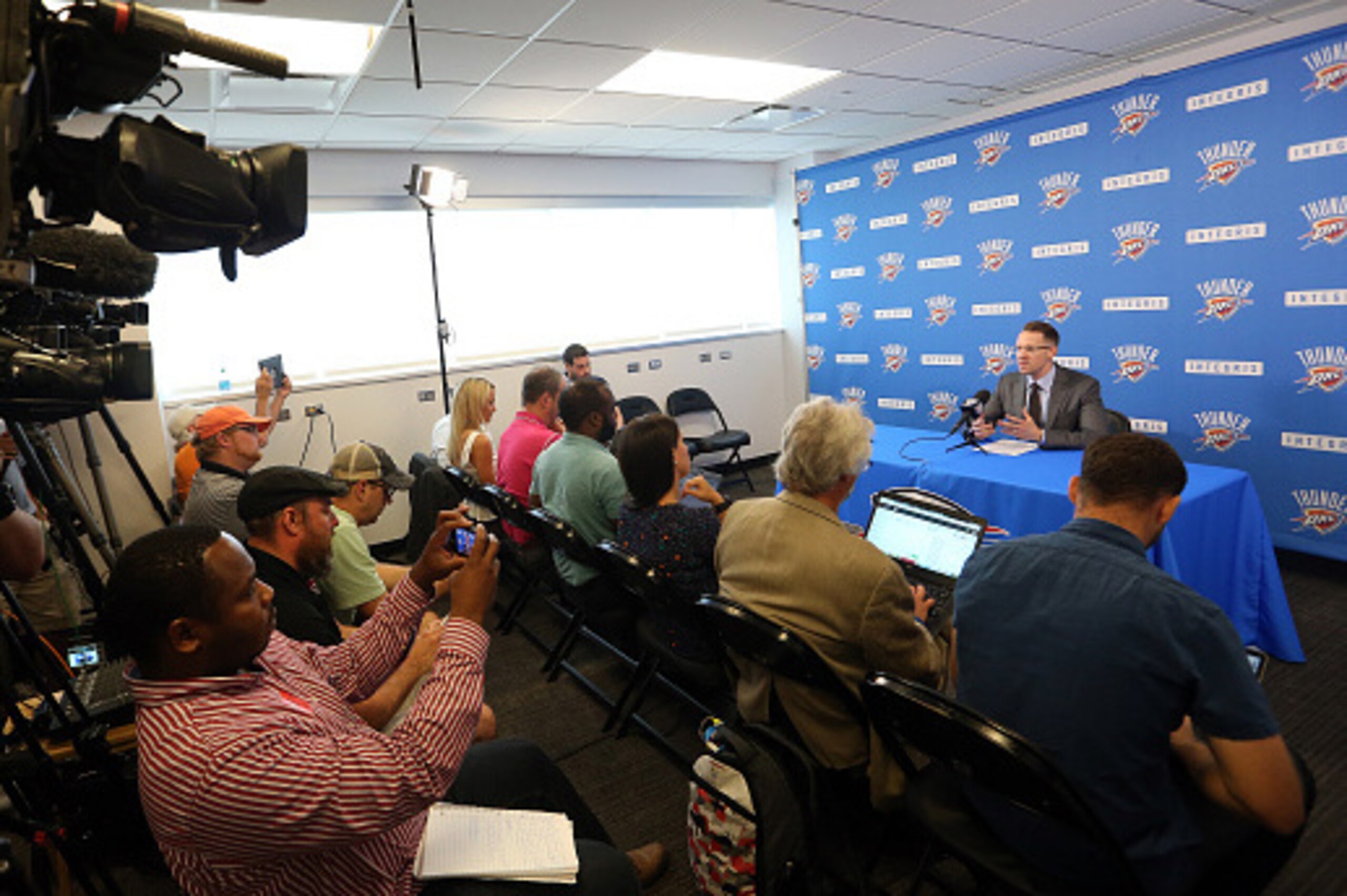
OKLAHOMA CITY — Thunder general manager Sam Presti built a team capable of competing for an NBA championship, but Kevin Durant took its title hopes with him to Golden State this summer.
Getting back to that point will be an arduous task. How OKC might do it is an impossible question.
Do the young Thunder have enough room to grow and fill the massive void left behind? Or will Presti need to maintain flexibility in order to add pieces through free agency?
TOP NEWS
.jpg?w=2560 "NBA Gambling Charges")
Malik Beasley Negotiating Plea Deal (AP)

Yaxel: Luka Not MJ 🗣️
Knicks, Spurs On Wrong Side of History
Presti’s vision for the post-Durant Thunder is still a work in progress, but decisions over the next month should reveal what he has planned for next summer and beyond.
The deadline for extending the rookie-scale contracts of 2013's draft class is October 31. The Thunder have three eligible members of that class: Victor Oladipo, Steven Adams and Andre Roberson.
Presti has been aggressive when faced with such opportunities in the past. This year, he has reason to reconsider. Take a wait-and-see approach, and he could position the Thunder to be a significant player in free agency next summer.
The Presti regime has long preferred to build through the draft rather than heavily relying on free agency. It’s a strategy born somewhat out of necessity—Oklahoma City is the NBA’s third-smallest market.
No offense to Bricktown, but it doesn’t quite compete with other small markets’ civic draws such as Memphis' boisterous Beale Street or the charm of New Orleans’ French Quarter, the two NBA markets smaller than OKC. The state has come a long way since Charles Barkley famously labeled it as "nothing but vast wasteland" and "no place for black people" as little as 10 years ago, but Oklahoma still has a tough time competing against larger markets for elite free agents.
The Thunder’s successful free-agent pursuits over the years have netted quality rotation players but no significant building blocks. Its first attempted free-agent signing came shortly after the team relocated from Seattle, nearly two months before it even had a new name, when restricted free agent C.J. Miles signed a four-year, $14.8 million offer sheet with the soon-to-be Thunder in 2008.
The price seemed extravagant at the time for a 20-year-old with career averages of 4.0 points per game on 42.3 percent shooting from the field through three seasons.
The signing is long forgotten, but in hindsight, it showed the blueprint qualities Presti would value going forward: Youth. Athleticism. Solid work ethic. Ability to retain in the program long term. Lots of growth potential. (Miles’ offer sheet was matched by the Utah Jazz, where he continued to develop into a quality NBA player.)
The Thunder later inked restricted free-agent big man Nenad Krstic. In 2014, it signed sharpshooter Anthony Morrow. Both were signed with salary-cap exceptions, which allow teams over the salary cap to sign additional players. Unfortunately, both still rate as the most high-profile offseason free-agent signings in Thunder history.
The Thunder have operated above the league’s salary cap since 2011 and haven’t been in position to bid for prime free agents, but that changed last summer with Durant’s departure.
The NBA’s collective bargaining agreement makes building through the draft a viable option but only if a team is willing to invest in collegiate and international scouting as well as player development.
First-round draft picks can be signed for up to four seasons at below-market rates. Teams can later extend those contracts for up to four additional seasons. One lucky player per team can snag a lucrative "Designated Player" tag and extend for five additional seasons at the league’s maximum salary. (The Thunder made Russell Westbrook its Designated Player in 2012, a label that will expire next summer.)
If no agreement on an extension is reached, that former draft pick can become a restricted free agent at the end of his contract. The ability to match an offer sheet from another team is valuable but can present some uncomfortable problems: Teams tend to overbid for restricted free agents in hopes their offer sheets won't be matched. They can also stack those sheets with perks such as signing bonuses, trade kickers and player options in an attempt to make matching the deal even less palatable.
Previously, the Thunder have been eager to get extensions done and lock in long-term certainty, often at a discount. Oladipo, Adams and Roberson were all asked about the possibility of extensions on media day. None seemed terribly stressed about locking in millions of guaranteed dollars right away.

"If it gets done, cool. If not, I'm still with the team right now," Adams said.
"I'm only focusing on controlling what I can control and winning basketball games," Oladipo replied.
Roberson was the most dismissive, stating simply, "I don’t really care."
The Thunder would gain a lot of flexibility in the summer of 2017 if their extension-eligible trio is willing to play along. The franchise could then manufacture maximum salary-cap space to pursue a premier free agent such as Blake Griffin, Gordon Hayward or Danilo Gallinari and then re-sign the trio as free agents.
However, the trick is with cap holds. When a player’s contract expires, a phantom salary goes on a team’s books. The amount of the cap hold varies based on a variety of factors—it can be as little as 120 percent of the player’s previous salary or as much as 250 percent.
Oladipo’s cap hold would be $13.1 million, Adams’ would be $7.8 million and Roberson’s $5.5 million. All three numbers are lower than what the players would receive in the first year of an extension. Thus, it’s likely Oladipo and Adams snag at least $20 million during the first year of their next deals. Roberson’s next contract could start at $10 million or more in this new NBA economy (all cap hold figures according to Basketball Insiders).
So those moves alone wouldn’t create the estimated $29 million needed to chase a star free agent with fewer than 10 years NBA experience. OKC would need to trade Enes Kanter and Kyle Singler—and perhaps another player or two—to a team with cap room in exchange for only draft picks. NBA teams have employed the so-called salary-dump strategy for years.
The San Antonio Spurs used this maneuver with Kawhi Leonard in 2014. By working with him on contract details and passing on signing an extension, the Spurs were able to create enough salary-cap space to sign LaMarcus Aldridge in 2015. They then turned around and signed Leonard to a new deal using his Bird rights to exceed the salary cap. The Washington Wizards also attempted a similar move with Bradley Beal during 2015 but failed to land a marquee free agent in 2016.
The potential monkey wrench could be the terms of a new collective bargaining agreement that the NBA and players are discussing. Thanks to a massive influx of national television money, the league’s salary cap made an unprecedented one-year leap in 2016. Salaries are in flux, with role players such as Timofey Mozgov, who signed a new deal in 2016 and benefited from the tidal wave of cash, earning nearly as much as All-Stars such as Klay Thompson
The league could increase cap hits for pre-2016 contracts and attempt to close this particular loophole. The projected $102 million salary cap in 2017 could also come in lower than expected.
Some unforeseen new quirk could derail the best-laid plans, and much is out of the Thunder’s control. All they can do is plan with today’s known rules.
That uncertainty could be enough to make them move ahead with the status quo. Presti and his staff will undoubtedly monitor training camp and preseason for indicators. If they come away confident enough with what they have in hand, they may choose to lock it in now and eschew free agency.
Down This Road Before
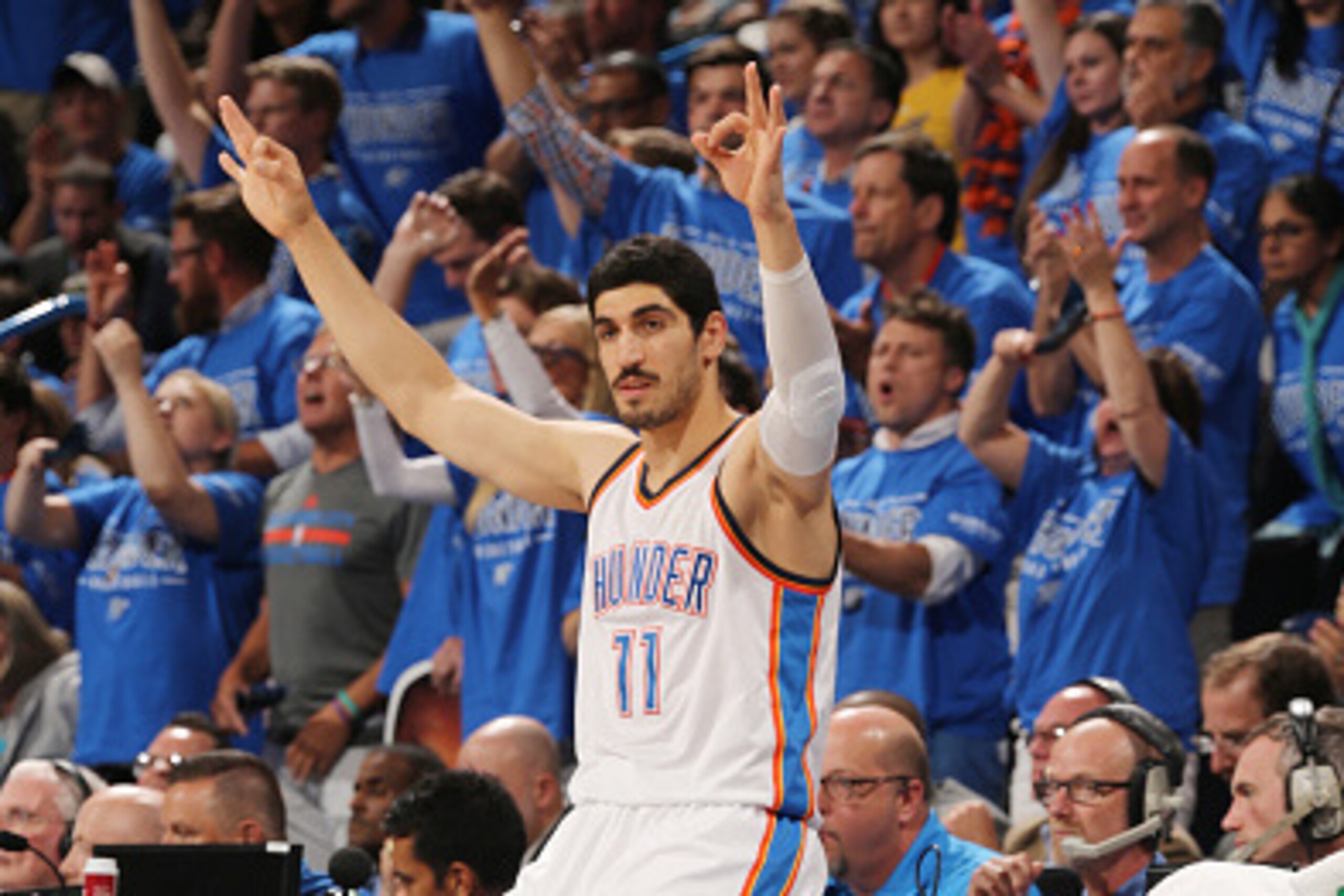
The only time the Thunder played the restricted free-agency game with a significant player of their own was with Enes Kanter. They acquired the Turkish big man via trade from the Utah Jazz during the 2014-15 season after the deadline for extension eligibility and made a qualifying offer in order to make him a restricted free agent. Presti tried to negotiate a new long-term and lucrative deal with Kanter but could never come to an agreement.
The Portland Trail Blazers eventually presented Kanter an offer sheet that would pay him the maximum salary and give a path to free agency in three years, along with a trade kicker and player option for a fourth season—two perks the Thunder would likely have never offered. With their hand essentially forced—they had no other real avenue to replace him—the Thunder matched Kanter’s offer sheet.
Oladipo Gets His Coach
During media day interviews, Victor Oladipo revealed he’s long wanted to play for the Thunder as well as head coach Billy Donovan.
"I’m looking forward to playing for Coach Donovan in general," Oladipo said. "I was definitely a huge fan in college. He didn’t recruit me, though, but it’s OK. Life has a funny way of bringing things back around. If I would have went to Florida, maybe I wouldn’t be here now."
"I literally thought about being here a year ago and thought about what it would be like to be on this team," he added.
Horford Was a Close Call
Ironically, the Thunder were apparently close to landing a premier free agent this past July despite being over the salary cap. Presti was asked about the rumors linking Al Horford to Oklahoma City during his July 4 press conference to announce Durant’s departure from the Thunder.
"I think Al was really, really interested (in coming here)," Presti said, "but obviously the timing of Kevin's situation and his just didn't link up, and that's part of free agency. That's how it goes."
Presti has a point. There are far more misses than hits in free agency. It’s yet another reason why the Thunder operate the way they do.
Follow Jon Hamm on Twitter @JonMHamm for more OKC Thunder wisdom. All quotes were obtained first-hand.


.jpg?w=2560 "Jonathan Taylor Landing Spots")