Dunking on Their Deathbeds: NBA Players on Delaying Basketball Mortality
AMERICAN FORK, Utah — The basketball court inside VASA Fitness is the backdrop to Andy Nicholson's midlife crisis.
On select Saturday mornings every other month or so, Nicholson, a 45-year-old marketing professional, and two friends meet there for what's called a "dunk session." The basketball version of a garage rock band, each takes turns experimenting with different dunks.
One friend, Dallan Findlay, 24, nails a Zach LaVine-esque, off-the-bounce, between-the-legs reverse dunk, while 33-year-old Clint Ainsworth casually completes off-the-dribble power slams.
TOP NEWS
Report: Warriors Shopping Porziņģis
Maxey Crashed Bron Chalk Toss 🤣

Every NBA Team's Top 3 Trade Targets This Season 🎯
Nicholson, the smallest (5'11") and oldest of the trio, is determined to make personal history every session. He has already gone through a half-hour (far longer than his friends), meticulous warm-up routine.
In a session last March, he nailed an off-the-backboard, one-hand dunk; a running, one-handed cradle dunk; and, for the first time ever, a two-handed dunk off the dribble. His next conquest: a windmill dunk.
While the complexity of his dunks is hardly remarkable in comparison to, say, professional dunker Jordan Kilganon, Nicholson's physical capabilities at his age are stunning. He is completing dunks he couldn't in his late teens and early 20s. He stopped dunking altogether in his 30s. And here he is, a 45-year-old throwing down in "dunk sessions" and dunk contests, all while building his brand as the "Over the Hill Dunker" on YouTube and Instagram.
But followers and likes were never his motivation a decade ago when life was inundated with family, work and, well, life. As his weight ramped up and his vertical jump went the opposite direction, he not only wanted to turn back time—he wanted to put it on hold.
"I have a big fear of getting old," said Nicholson, a native of Missouri. "I don't want to look old, feel old, I don't want to be old. As I approached the big 4-0, I wasn't in the shape I wanted to be in."
Whether you're an NBA superstar or a recreational dunker at the local gym, you need to put in the work to keep the hops. So Nicholson made the jump.
The Rewind
On Christmas Day 2016, an unlikely player bullied his way into sports highlight shows and social media feeds. In the much-anticipated Finals rematch between the Cleveland Cavaliers and Golden State Warriors, it was Cavs reserve Richard Jefferson (then 36 years old) who was catching bodies at the rim, not LeBron James.
First it was a driving, left-handed dunk over Kevin Durant at the top of the fourth. Five minutes later, Jefferson one-upped that effort with a savage one-handed baseline dunk at the expense of Klay Thompson.
"Taunt everybody, Richard! You're 36!" exclaimed ESPN NBA analyst Jeff Van Gundy.
Just the previous offseason, Jefferson was contemplating retirement. Now his name was trending on Twitter, and he was the subject of memes with cliched "turn back the clock," "still dunking," "vintage" captions.
"Seeing the oldest guy on the court dunk on and actually posterize Klay and Durant was like getting an extra Christmas present," said Nicholson, who says he jumped off the couch when he saw the plays. "Those kind of plays keep me dreaming and hoping I will posterize someone in a game."
Down in Memphis last season, Jefferson's former Nets teammate Vince Carter was also showing flashes of his former self. As documented in YouTube clips, the 40-year-old's pregame routine with the Grizzlies ended each time with either a 360-degree, one-handed slam or a between-the-legs dunk.
Carter's in-game dunks today are not the same video game aerials from his "Half-Man, Half-Amazing" Toronto days nearly two decades ago. But they aren't average either. The 19-year NBA vet was still getting dunks via tips, breakaways and backdoor cuts. Ask Corey Brewer what happens when you try to challenge him at the rim.
"I'm trying to stay as close to that guy that we all know and remember, and I know that it's possible," Carter told GQ in April. "I know I'm not going to be Vince from 2000, 2005, 2010. But I can get as close as possible if I continue putting the work in."
In a sport where players' careers are measured in dog years and athleticism is perceived to nose-dive after 30, Jefferson and Carter have been the antithesis of the aging NBA athlete.
The Play
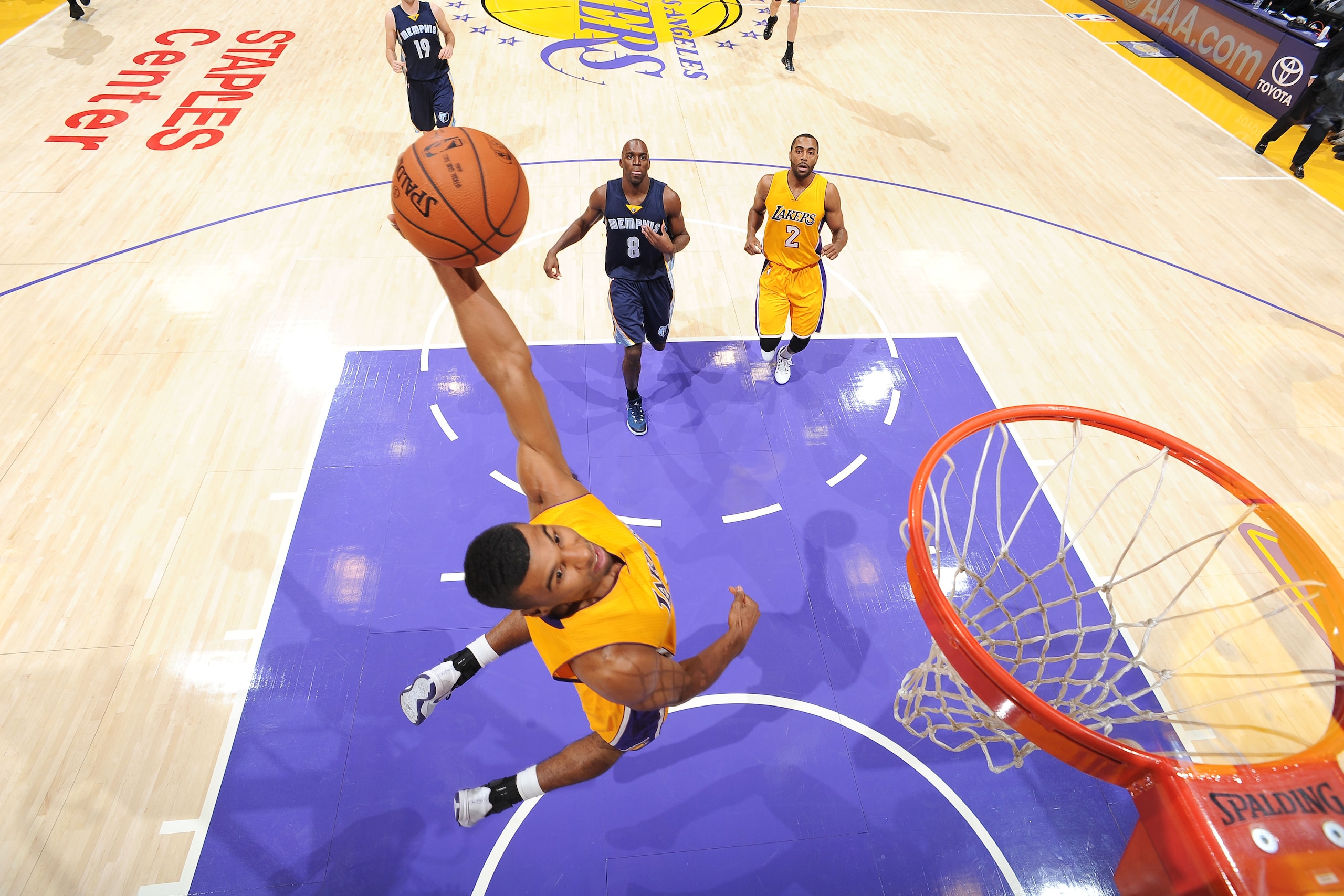
Stephen Curry may have made shooting the three cool with millennials, but the slam dunk will always be the ultimate weapon for NBA journeyman Ronnie Price.
"It has given me a big advantage," said the athletic Price, 34, who played last season with the Phoenix Suns. "I could easily do a simple layup on the break. But it's something when your point guard is out on the break and can finish with a dunk. It kind of sends a statement and gets guys off the bench a little bit and engaged."
Price was a late bloomer when it came to playing above the rim. He was 5'7" coming out of high school in Texas, and it wasn't until the end of his college career at then-Utah Valley State College that his jaw-dropping athleticism caught up to his 6'2" frame.
Despite going undrafted, has Price carved out a niche in the NBA with his defense and playmaking skills for six teams in 12 seasons. He believes his 2006 dunk over Carlos Boozer in his second year with the Kings brought attention to his talent.
"It was a dunk that sent a statement to guys that didn't know I could jump a little bit," Price said with a laugh.
In the years since, the number of dunks has slowly declined. Price admits noticing small changes in his body.
"When you are older, you have less amount of jumps in you," he said. "I would say maybe it takes a little bit longer to get your legs going, but once they're going, I feel like I'm 20 years old again."
The relationship between age and dunking in the NBA does not have a linear path, but there are trends and patterns. The drop for amateur athletes could be greater, according to Nicholson, because of the lack of access to world-class trainers, nutritionists and facilities.
"Naturally there will be a moderate decrease over time if you no longer have the ability to utilize massive contractions," said Steve Hess, the Director of Performance with the Denver Nuggets. "Your set points of muscular strength drops, your cardiovascular endurance drops, everything kind of diminishes if you haven't kept up with it."
Obvious declines in explosiveness due to injury and mileage showed with one-time high-risers Tracy McGrady, Grant Hill and Baron Davis. Even Michael Jordan and Kobe Bryant transitioned from above-the-rim repertoires to mid-range games late in their careers.
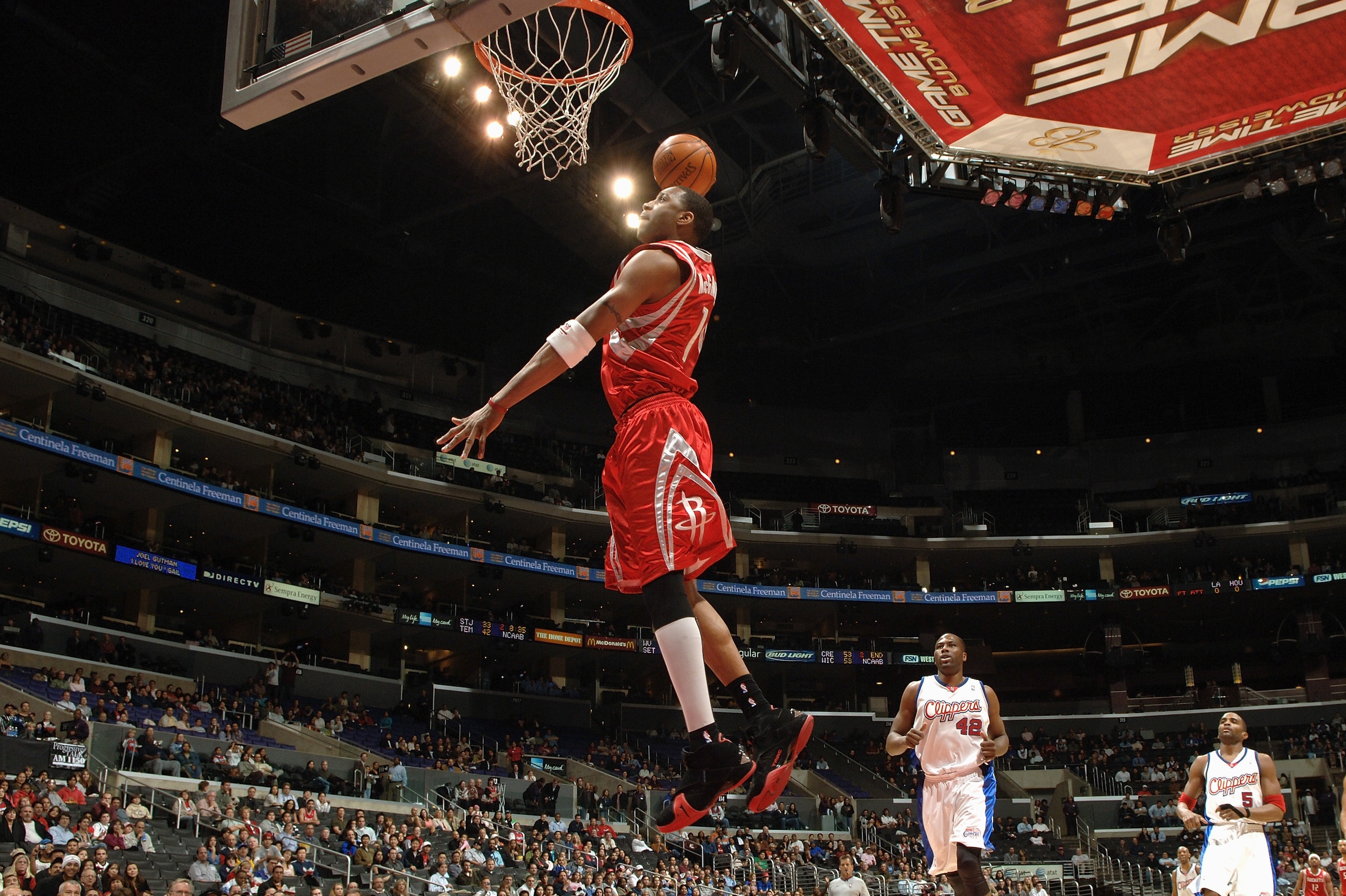
"It's only so long a guy who is dunking can do that, so you have to eventually think about preservation," said 17-year vet Jamal Crawford, who signed with the Timberwolves in the offseason. "I would trade that for longevity because you only have so many dunks in your legs."
Crawford, 37, is the NBA's version of Pharrell; his appearance almost directly mirrors his 20-year-old self as a Bulls rookie in 2000-01. Known more for his deadly crossover than his athleticism, the 6'5" Crawford dunked regularly in his Bulls and early Knicks days—even pulling off his signature, off-the-backboard pass to himself for a two-handed dunk during games several times.
"Psychologically, dunking does something for you," said Crawford, who first dunked at 15. "Once you can dunk, you try to do it all the time."
But after his first season in New York in 2004-05, he said he "saw the bigger picture." He replaced transition dunks with simple layups and traded alley-oops for mid-range jumpers. During his five-year tenure with the Clippers, he estimates he averaged only two to three dunks per season.
Price did not record a single dunk last year. But that doesn't mean he can no longer get up. With his strict diet and smarter workouts, Price claims his vertical is higher than it's ever been and is within arm's length if he needs to access the "break glass, in case of emergency" box.
"I like to maintain my athleticism and know that it's still there," Price said.
The Pause

"Coach Romar can dunk still right now. I saw him dunk last year," said Nate Robinson of his 58-year-old former college coach at Washington, Lorenzo Romar, as he sat in the locker room after the Ball Don't Stop "Battle at the Border" pro-am game in metro Vancouver, British Columbia, in July. Last seen in the NBA lacing it up with the New Orleans Pelicans for two games in the 2015-16 season, the 5'9" guard has played in Israel and the G League, and he played last season in Venezuela, winning a championship with Guaros de Lara.
Nate, now 33 and looking leaner than in his NBA days (he credits a mostly plant-based diet he adopted in Venezuela), was the star of the night. Finishing with a Russell Westbrook-like 37 points, eight assists and seven boards, he wowed the crowd with his (still) jaw-dropping athleticism, capping the night with a baseline, one-handed sideways jam. Cue the oohs and ahhs.
"Here's the thing with Nate Robinson: He is a genetic freak," said Hess, who trained Robinson for two seasons with the Nuggets (2013-15). "Nate is one of the best athletes I've freakin' ever seen in my life. He's the only dude that walks through a weight room and puts on muscle."
Indeed, Robinson is a physical anomaly. Of an average height but built like an NFL player, he was the Washington State Player of the Year in both basketball and football at Seattle's Rainier Beach High School in 2002. (Fun fact: He held the state record in the 110-meter hurdles for over a decade.) He owns a near 50-inch vertical leap, which has enabled him to win three NBA Slam Dunk titles and block a shot by 7'6" Yao Ming.
If his performance in Vancouver and his Instagram posts tell a genuine tale, age has not grounded Nate the Great. Windmill dunks off the bounce still come as effortlessly as free throws for Robinson. Earlier this year, he showed off on Instagram when he slam-dunked a tennis ball on a 12-foot rim.
Even with the natural talent, Robinson has done his part to maintain his gifts. He works out daily in the offseason, blending personal training with summer pro-am leagues in Seattle. Like many health-conscious adults in their 30s, Robinson has reevaluated his diet.
"For me, my girl does a great job, she's vegetarian," said Robinson, who has played 11 seasons in the NBA. "I'm not all the way there yet, but I'm leaning toward it. I don't drink dairy or eat red meat. For me, it's just getting rid of the sugar. I told myself, I'm trying to do a full year without candy. It's hard because I love doughnuts, cookies and candy."
Crawford made numerous adjustments to prolong his athleticism. In recent years, he has increased his cardio and calisthenics workouts. He focuses on recovery through stretching, foam rolling and utilizing the cold tub. Like NBA players Joe Johnson, Kevin Love and Blake Griffin, Crawford practices yoga three times a week.
Balancing diet, strength training and recovery can be a slippery slope for any aging athlete—amateur or pro.
"My entire 30s, I didn't feel that good," Nicholson said. "I didn't take care of myself. I didn't eat well and wasn't working out very consistently. I certainly didn't do all the things that help you as an athlete in terms of stretching, flexibility, range of motion."
"Recovery is key the older you get," Price added. "And then you don't go in the weight room just to lift; you go in there with a purpose. Everybody's body is different. I figure out areas of my body that need to be balanced out.
"I train smarter, not necessarily harder."
Strategic training and good fortune are what Price needs if he wants to accomplish his post-professional goal of dunking at 50. It is the same goal of Robinson, who declared from that small locker room in Vancouver his intention to one-up Coach Romar.
"I just want to be able to dunk once at 50 years old," Robinson said. "At my height at 50, can you imagine?"
A couple of teammates eavesdropping laughed at Robinson's bold wish. But one person who understands the human body knows better than to bet against Nate.
"I promise you, I will 100 percent take anyone in the country and bet that this dude will dunk at 50," Hess said. "That's absolutely, unequivocally no doubt."
The Fast-Forward
Both Price and Robinson were impressed when told about the 45-year-old dunker from Utah.
"It just proves my theory right. If you maintain your body and you stay active, it takes a long time for it to go away," Price said. "But if you don't use those muscles, those muscles will go away, and one day you'll try to do it and you won't have it anymore. And when you lose it, it's really hard to get it back."
What Price didn't know is that Nicholson did lose it. Andy stopped dunking at 28, and before he knew it, he gained 20 pounds and thought his hops and basketball days were long behind him.
But while surfing YouTube in 2011, the then-39-year-old Nicholson stumbled upon 5'10" dunking sensation Jacob Tucker.
"If it wasn't for YouTube, I don't think any of this would have happened," Nicholson said. "I saw that video and it lit a fire in me."
Nicholson started to Google jumping techniques and found a jumping program that he committed to religiously. He went from barely grazing the rim to dunking again just 11 weeks after a 10-year hiatus.
Like many people who share their weight loss or weight lifting progress online, Nicholson started a YouTube channel. It allowed him to track his improvement, be accountable if he was slacking and receive encouragement and praise from followers throughout the globe.
"It's super fun to surprise yourself," Nicholson said. "When you get a new dunk, you scream and get so excited and feel so good. Dunking is just like a rush of emotions. You just feel powerful and so amazing when you kill a dunk. It's addicting."
By 2016, he had built up the strength to include more than a dozen different dunks in his arsenal. He competed in his first dunk contest, completing a childhood dream.
"If he lost 20 pounds and is still fairly explosive and worked on some of his strengths, it changes the dynamics of who he is," Hess said. "And if he's able to dunk, that's an amazing accomplishment. I'm incredibly proud of the guy.
"The one thing about the human body is it's astounding. Your ability to improve is so freaking incredible. I've seen 90-year-olds run marathons. I don't care how old you are. If you have a specific goal and you are smart in trying to achieve that goal, you can achieve amazing, amazing things."
The Stop
Dunking has given Nicholson a new identity, a new sense of self. He is part of an online community of dunkers who not only support each other but make trips to meet each other and hold dunk sessions.
Nicholson spent time in Florida meeting his idol Kilganon and learning about new core exercises. He linked up with a 5'9" dunker/volleyball player from the Bay Area nearly half his age named Penuel Josh Barrina. He has dunkers from Hawaii and Hong Kong he plans on meeting up with too.
He admits and half-jokes that he has to be conscious of his obsession at home.
"My wife is super supportive, but if I did this in the evenings I wouldn't be married anymore," said Nicholson with a laugh. "I train in the mornings before anyone is awake. I try to minimize the impact on my wife and kids."
He added: "I think they like it. I think they get sick of me talking about it."
While he says he is in the best physical shape he has ever been in, there have been subtle signs of the inevitable. Often, dunk sessions are canceled because of a nagging injury. Recovery time is taking longer, and he finds himself constantly icing his knees.
"At some point, you probably won't go higher, you get to the point that's the highest you'll ever jump," he said. "I feel that I haven't reached that point. I don't think I have reached my genetic limit."
So he'll continue to organize dunk sessions. He'll continue to post videos. He'll continue to turn a blind eye to the reality that all high-risers, NBA or not, will face.
"Father Time will get me, but just not yet."
.jpg?w=2560)
.jpg?w=2560 "Breaking News")
.jpg?w=2560 "McCarthy 'Not Surprised' to Be QB1")