

Aren't the NBA Playoffs Supposed to Be More Competitive Than This?
BOSTON — Playoff basketball is supposed to be a time for the NBA to showcase its greatest players and most prolific squads. Gone are the flotsam franchises who have spent the year dragging down the competition and subjecting the league’s fans to hours of sloppy play.
The playoffs, after all, are for the best of the best, meaning the play is supposed to be cleaner, tighter and more precise. Simply put: Playoff basketball is supposed to be a pleasure to watch.
This postseason, that has not been the case, and the most recent evidence came in the form of a Wednesday night Boston Celtics beatdown over the Washington Wizards, 123-101.
TOP NEWS

LeBron's 76ers jersey breaks sales record
Rival Coach Shades LBJ, Embiid

Grading Every Team's Offseason 🔠
This series, despite having plenty of bad blood, has hardly been competitive. In five contests, not a single game has been decided by single digits. Overall, the average margin of victory is an astonishing 18 points.
But this display between Eastern Conference foes isn't the exception—it's the unfortunate rule of the 2017 playoffs.
For one, both the Cleveland Cavaliers and Golden State Warriors became the first pair of teams to ever start the same postseason 8-0, per NBA.com. And while both squads seem destined to meet in the Finals for the third straight season, the Dubs have put together a historic showing all in their own right:
Making matters worse: four of the 10 playoff series have ended in sweeps.
Also, the blowouts. There have been a ton. To be exact, an astounding 30 percent of this year’s postseason games (19 out of 62) have ended with one team winning by 15 points or more.
Still, it’s one thing for stacked powerhouses like the Cavaliers and Warriors to be running circles around the competition.
“That’s just unbalanced talent,” one Eastern Conference assistant coach told Bleacher Report when asked for a theory behind this recent stretch of lopsided victories.
But how do you go about explaining all the crooked scores we’ve seen in battles between more evenly matched teams?
Take, for example, this second-round series between Boston and Washington. The Celtics jumped out to a 2-0 series lead with a pair of victories at home, then headed south to Washington where they were run off the floor. The Wizards won Game 3 by 27 points and Game 4 by 19 points.
In Wednesday's Game 5, Washington scored the first four points of the night—only to surrender the next 16 to the Celtics.
Three games, three straight blowouts.

“Hometown crowds, in our series especially,” Wizards forward Jason Smith told Bleacher Report afterward when asked about this trend. “I mean, we play a lot better at home, and Boston plays a lot better at home. There’s an electric atmosphere here.”
Smith was quick to point out that he was only talking about his team's series against the Celtics and not the playoffs overall. But he was adamant that loud crowds can indeed lead to tangible differences on the court.
“It’s an impressive thing that you don’t put in the stat sheet, that you don’t put in anything like that, but it is loud here, it’s loud in D.C., it’s loud in the playoff atmosphere overall,” he said. “It’s not like the regular season. It’s tough to go in there; it’s tough to get calls.”
He added that many of the miscommunications during playoff games are the results of a player simply not being able to hear his teammates.
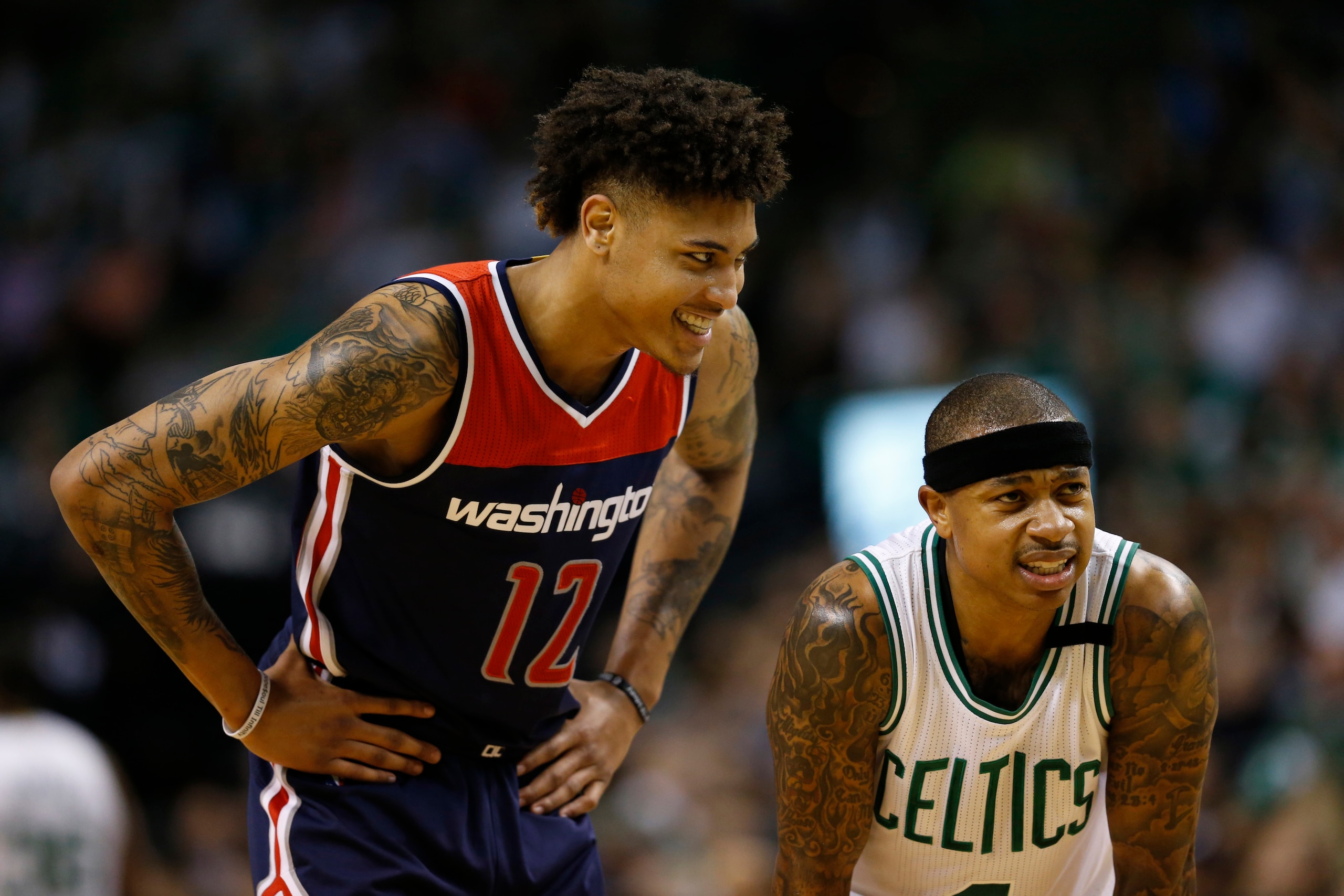
Wednesday night’s Celtics crowd was especially vocal, with the team’s first-quarter burst and 15 first-quarter fast-break points sending it into an early frenzy. The Celtics also drilled 16 of their 33 treys—always a crowd favorite. The presence of Wizards swingman Kelly Oubre Jr., who was suspended for Game 4 after getting into a scuffle with Celtics big man Kelly Olynyk, and who Boston fans greeted Wednesday night with the warm, profanity-soaked embrace that one would expect, only further fueled the fire.
“I think energy has a lot to do with it. You know, on the road, foreign territory, your energy is not the same as it at home,” Celtics rookie Jaylen Brown told Bleacher Report. “So I think energy levels have a lot to do with it—and we came out with a different energy tonight than we came out with on the road.”
Celtics guard Terry Rozier agreed.
“It just feel like an extra boost,” he told Bleacher Report.
But again: This isn't just about this series. Most fans would consider a double-digit loss something of a blowout. Nobody likes to get blown out, right? Well, in this postseason, teams are winning (or losing, depending on your rooting interest) by an average of 12.5 points per night through 62 games.
And while you'd think things would change the further into the playoffs we get, ESPN Stats and Info tells us that may not be the case:
That teams now launch more three-pointers could also be playing a role. Not only can a barrage of jumpers pad a score, but they can also lead to long misses and opposing fast breaks.
The good news for the NBA is that none of this has harmed the league’s ratings. According to Turner Sports, TNT has seen a 7 percent ratings boost this year compared to last.
Still, it would be nice if the league’s teams could figure out a way a way to keep these games close. If clamoring crowds are such a major issue, perhaps coaches should take a page out of NFL playbooks and try piping in noise during practice.
“No, it’s tough to emulate or simulate anything like that,” Smith said when asked if the Wizards have tried this. “... That’s why playoffs are special.”
Perhaps in years past.
So far this postseason, that word doesn't apply.
All quotes obtained firsthand unless otherwise noted.
Yaron Weitzman covers the NBA and other things for Bleacher Report. Follow him on Twitter: @YaronWeitzman.


.jpg?w=2560 "Taysom Hill Posts Goodbye to Saints")
.jpg?w=2560 "Ja'Marr Chase in Camp Fight 😳")

.jpg?w=2560 "AEW Dynamite Grades 🔠")
.jpg?w=2560 "Photos: Broncos reveal new practice facility")