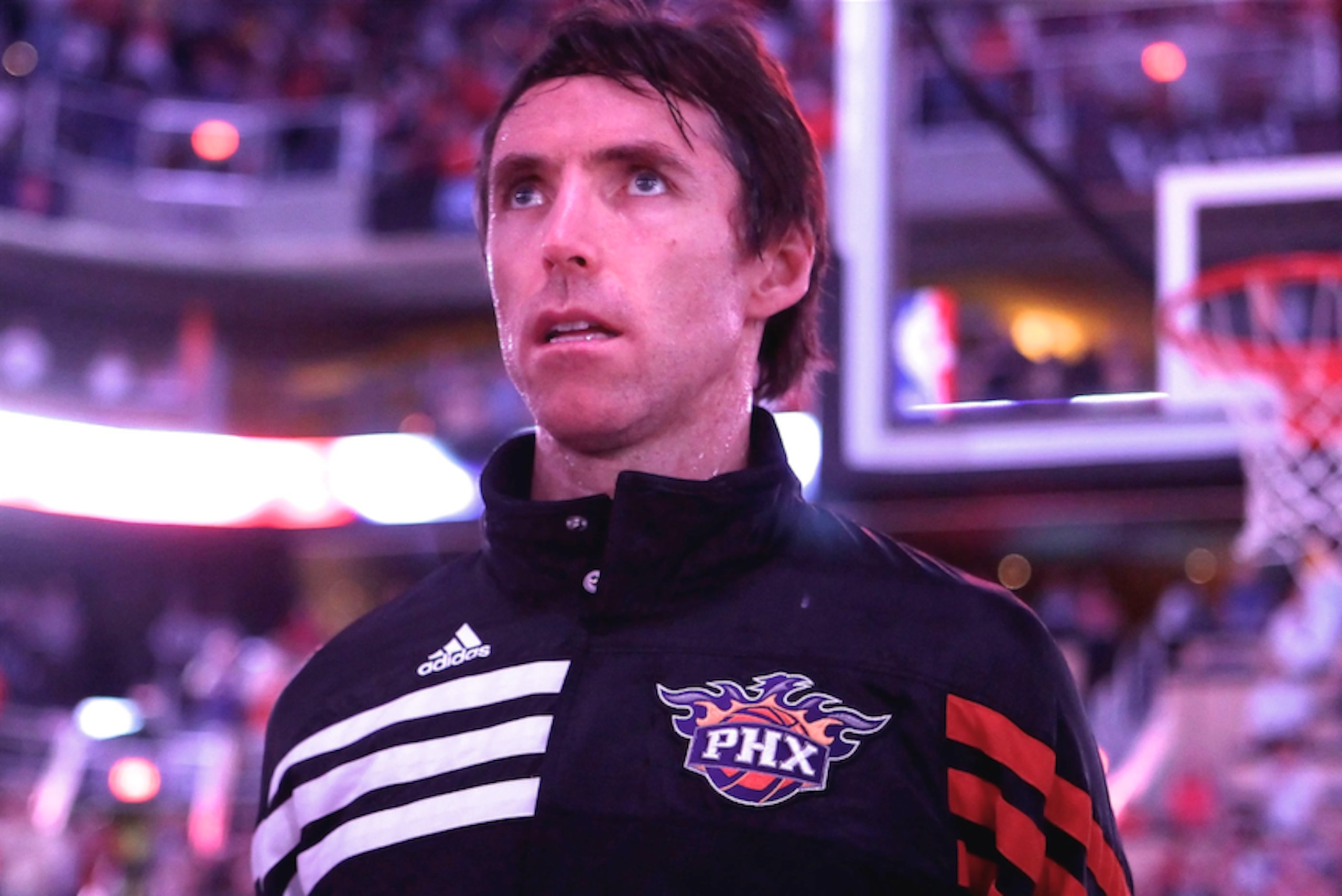

If This Is It, How Will the NBA Remember Steve Nash?
Is it the way he sneaks and creeps his way through and around forests of flailing limbs, somehow finding the faintest view from which to kiss the ball off the glass?
Is it the brief reverse of course on a fast break to feed a trailing teammate, flopping mop of hair not thick enough to cover the second pair of eyes?
Is it the teasing seesaw ball-handling on a high pick-and-roll, finished with a pass pulled from so deep within his pocket it might as well have come from his shoe? Or the same seesaw the next time around, except a chin-cranked downtown dagger instead of a dime?
TOP NEWS

NBA Power Rankings Entering Preseason 🔢
Giannis' Warning to NBA ⚠️
Watch: LeBron's 1st 76ers highlights
If it really is the end for Steve Nash, who was ruled out for the entire 2014-15 season Thursday, as first reported by Bleacher Report's Kevin Ding and later confirmed by the Lakers, this—all of it—is how we’ll remember him: A singular maestro who defied age, angles and odds to become one of the greatest pure point guards the game has ever seen.
That’s not all we’ll remember, of course. The quartet of 50-40-90 seasons—the only player ever to do it.
The pair of MVPs, eight All-Star appearances, five assist titles, three All-NBA First Team nods—the stuff of Springfield shrines.
The Phoenix Suns teams he turned from formless speed into methodical basketball machine—a tempting template even today.
The rest of the list—long enough to burn out the induction microphone:
More important than any marks Nash may have bludgeoned on the box score, however, are the ones Toronto Raptors general manager Bryan Colangelo highlighted in a recent interview with the National Post’s Sean Fitz-Gerald—they are the marks of a man for whom giving was much more than a means to specific statistical end:
"He brings something to the table that most players, most athletes, just don’t bring. It’s not just basketball IQ or his ability to play the game. He brings an emotional intelligence, I think, to the team and the organization, and to the process, that is unrivaled. And I’ve often said that, as far as stars go, he was a low-maintenance star. You can probably count those on your hand. Tim Duncan-types. There’s not many of them that you go to bed at night not worrying about.
"
Considering the superlatives, you’d think Nash’s was a career charmed from the start. But the 15th overall pick in the 1996 draft—widely considered one of the best in history—was anything but a bankable asset. Over his first four seasons (first with the Suns, where he served as a backup to Jason Kidd and Kevin Johnson, then the Dallas Mavericks), Nash averaged just 7.2 points and 3.8 assists.
Even after assuming the reigns of the Mavericks following a trade in 1998, Nash wasn’t exactly considered a top-tier floor general in the making. Finally, during the 2000-2001 season, Nash blossomed, tallying 15.6 points and 7.3 assists.

More importantly, the 26-year-old had begun to forge a unique chemistry with Dallas’ other rising star: a sweet-shooting 7-foot forward by the name of Dirk Nowitzki.
Three more years of steady success followed, highlighted by an appearance in the Western Conference Finals opposite the San Antonio Spurs—the eventual champions—in 2003. At that point, Dallas’ core trio of Nash, Nowitzki and Michael Finley seemed destined to continue its Western Conference ascent.
Instead, Nash shocked the NBA when, in the summer of 2004, he chose to return to the Suns, who had gone 29-53 the season previous.
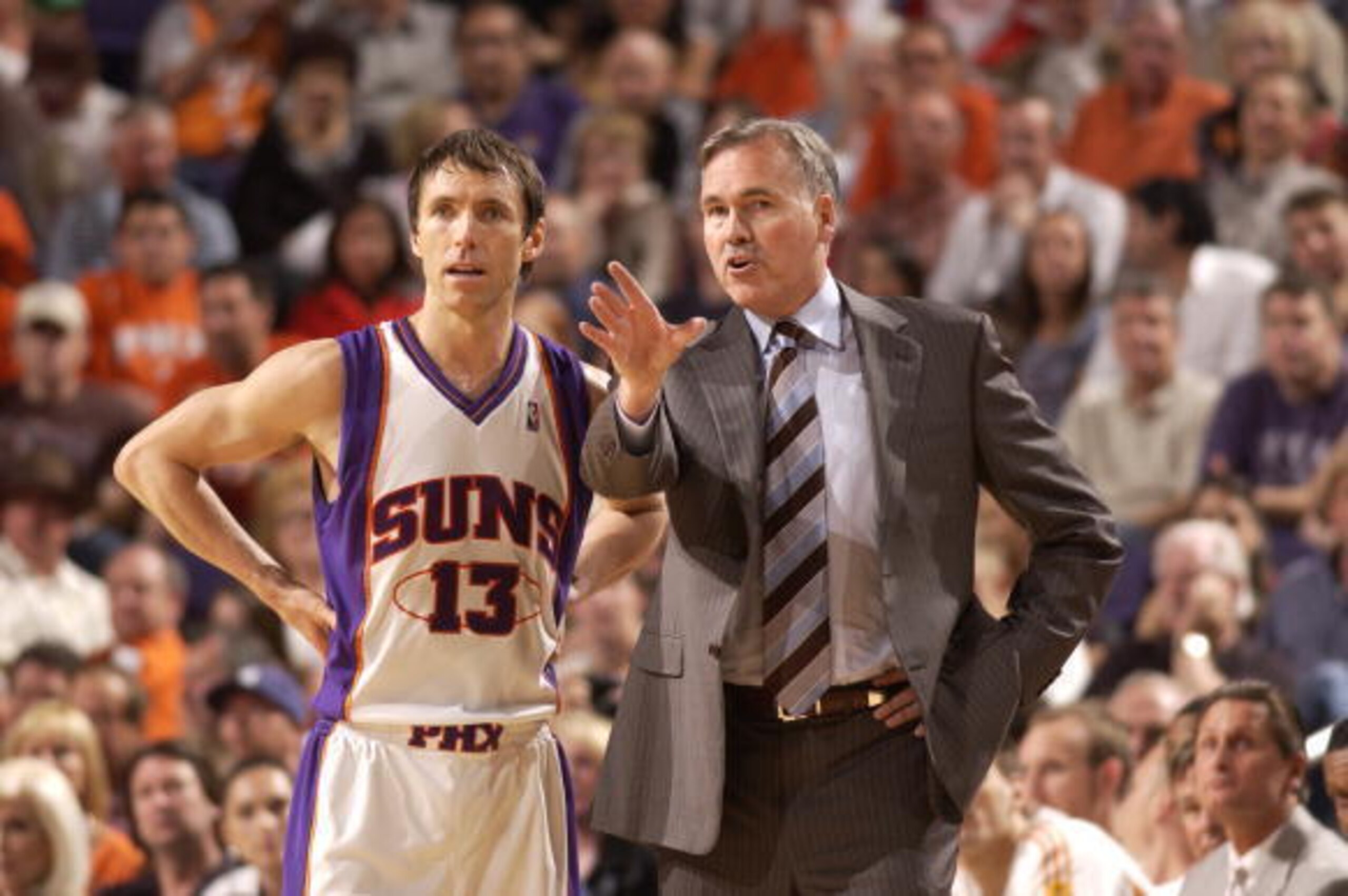
The rest is hardwood history: five 50-win slates in six years and a pair of trips to the West Finals for a team that, under head coach Mike D’Antoni, rewrote the modern offensive record books. At the center of it all was Nash, who marshaled a core that included Amar’e Stoudemire, Boris Diaw, Shawn Marion and Joe Johnson to two MVP nods and a string of assist titles, in the process becoming the game’s unquestioned best point guard.
All the while, the Suns’ incendiary brand of ball—helter-skelter and Swiss-clock precision in equal measure—helped redefine what an NBA offense not only could look like, but feel like. From SB Nation’s Paul Flannery:
"It's hard to remember now, but the Suns felt like a counter-cultural movement as much as a basketball team. They played fast, free and loose and threatened to subvert the time-honored tropes that defense-first, isolation basketball wins championships. Nash and the Suns attacked the entire ecosystem from the outside-in with pick-and-rolls and wide open threes. That they couldn't ultimately succeed felt at the time like a tragic letdown. It's not an accident that a lot of the great early basketball writing on the Internet was influenced by their philosophies.
"
Sadly, the Suns were never quite able to scale the Spurs, and by 2012, Nash—by now without his Seven Seconds or Less stalwarts—was making it known, albeit somewhat clandestinely, that he needed a change of scenery.
Enter the Lakers, who acquired the aging star in a sign-and-trade ahead of the 2012-13 season. Teamed with Kobe Bryant and Dwight Howard, Nash looked to have his best chance yet at securing that ever-elusive first championship.

By then, though, the wear and tear had begun to take its toll. Over the next two seasons, a disappointing stretch punctuated by Howard’s bitter departure, Nash would appear in just 65 games. The culprit: a lingering, ever-worsening back injury—for a player who’d relied so heavily on stealth quickness and changes of pace, a veritable death knell.
| Category | Number | All-Time Rank |
| Assists | 10,335 | 3rd |
| Assists Per Game | 8.49 | 9th |
| Three-Pointers | 1,685 | 12th |
| Free-Throw Percentage | 90.4 | 1st |
| Three-Point Percentage | 42.8 | 9th |
| True Shooting Percentage | 60.5 | 15th |
Still, hope was high that the 2014-15 season—a rebuilding year for the Lakers if ever there was one—would at the very least give Nash a bit of career closure in what the eight-time All-Star had claimed would be his last season in the Association.
"I was in a really, really bad place last year during the winter," Nash told Bleacher Report’s Kevin Ding during training camp. "I was largely unaware of how bad I was until I got out of it. Now I realize this is my last year. There's no guarantee I'll get to play any games this year. The truth is, I have a lot of miles on my back, and a day or two into training camp, it could all be done."

Sadly, such perspective proved to be prophetic. Even after an impressive 11-point, five-assist showing in L.A.'s first preseason game, even after the 10 assists in 22 minutes in an otherwise meaningless tilt against the Portland Trail Blazers last April. Signs of life proved to be last gasps only with the cruel benefit of hindsight.
Barring some unforeseen medical mend, Nash has all but certainly footed his final minutes in an NBA uniform—compelled to a post-career course that, for whatever business bona fides or general manager genius may come of it, will never equal the wondrous wizardry of what’s been wrought already.
In the hours following the Lakers’ announcement, one couldn’t help but see in the sea of tweets and solemn retrospectives the disparate lines of some loquacious eulogy. As if Nash had passed from this to some other realm completely.
"I'm crushed," Golden State Warriors head coach Steve Kerr told CSN Bay Area's Monte Poole. "And at the same time, it's awfully quick to reflect. But, man, what a career. What an amazing player, an innovator, somebody who will affect generations of players. ... He's one of the most remarkable human beings I've ever met."
But for as outsized as the sorrow may seem, the morbid analogies aren't so far afield. It’s always the best, brightest and boldest among us, after all, whose departure stirs the saddest of palls.
.jpg?w=2560 "Insiders: Cowboys Overpaid for Porter")
.jpg?w=2560 "Every Trade's Best Trade Asset 🔁")
.jpg?w=2560 "Top NFL Trade Targets")
.jpg?w=2560 "Daniels Eyeing Week 5 Return")
.jpg?w=2560 "No Rift Between Maye, Vrabel")