
Jrue Holiday, Serge Ibaka and 4 Other Players Poised for Breakout Seasons
While fans and media fixate on the Rookie of the Year race, how a player performs in his second year is often a better indication of his career trajectory.
There’s a reason why the “sophomores” usually win their annual match-up with the “freshmen” during All-Star weekend. The biggest improvement a player makes is often between his first and second year in the league.
A college season lasts 30-40 games over five months. Even at a high-level conference like the ACC or the Big East, players might match-up with NBA-level athletes once or twice a week.
They go from being a big fish dominating a large “pond” of over 300 D1 teams to a tiny creature in a small “fish-bowl” of 30 NBA teams, with all the older fish eyeing them and ready to attack.
Their first year is mostly about survival, as they face better and more skilled athletes than they’ve ever seen before five nights a week for a good six months.
In their second year, players have the benefit of a full off-season of NBA-level strength and conditioning workouts.
More importantly, they have a feel for the rhythms of an NBA season and how their opponents play the game. A scouting report can’t do justice to the brute athleticism of Dwight Howard or the physical defense of Ron Artest.
While players drafted in the top 5 go to bad teams who need their help right away, later-drafted players have to work their way into the rotation and earn the trust of their teammates and coaches.
NBA coaches, with the rare exception of a Jerry Sloan or a Phil Jackson, are transient beings, hired to be fired.
They would rather trust their paychecks to steady veterans who won’t make simple mistakes than deal with the ups and downs of rookies, no matter how much fans scream at their short-sightedness.
Here are six second-year players, none of whom made the Rookie Challenge, poised for break-out seasons. Each is in a position to make a significant impact on their team and fulfill their considerable potential. And in deeper fantasy leagues, they may still be available:
For more, check out the FanTake Blog: Get Buckets
Follow on Twitter at: GetBucketsFT
Follow on Facebook: Get Buckets
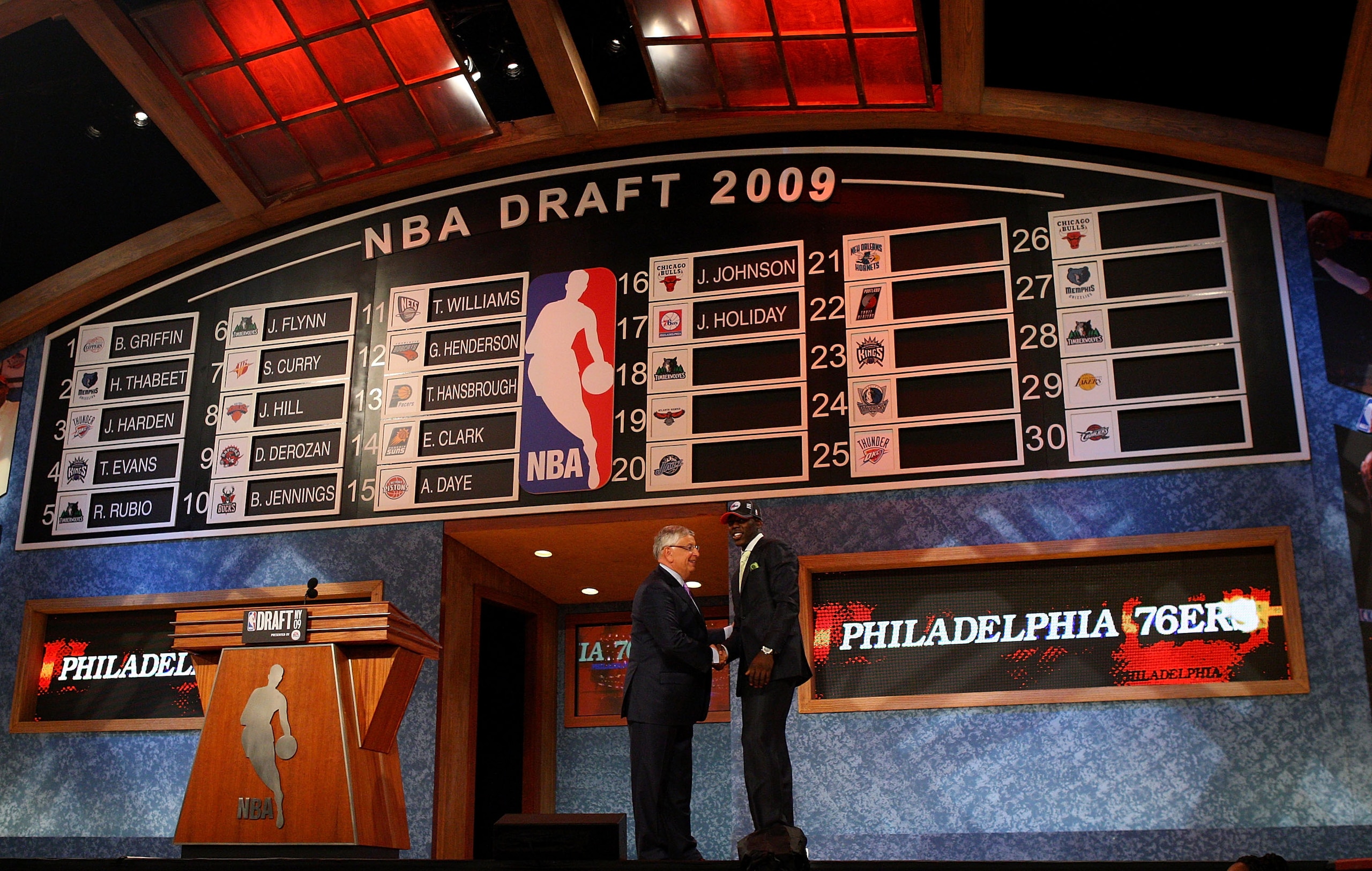
Jrue Holiday, Philadelphia 76ers
1 of 6Playing the point guard position as a rookie in the NBA is a baptism by fire. Holiday, at only 19 years old, was thrust into that role last season, eventually starting 51 games.
While he didn’t have gaudy statistics, he held his own, with a 12.3 PER (10.0 being the number an exactly average guard would have) as one of the youngest players in the league.
It’s even more impressive when you consider that he spent his only year at college playing out of position next to Darren Collison at UCLA. An excellent athlete at 6’3 180, he has the tools to be an elite NBA defender.
And after posting a 2:1 assist to turnover ratio and a 39% shooting percentage from the 3-point line as a rookie, he has the skills to match.
Serge Ibaka, Oklahoma City Thunder
2 of 6Ibaka had his coming out party in the Thunder’s first-round series with the Lakers. At 6’10 235, he combines a massive 7’4 wingspan with a vertical leap of over 30’.
With the Thunder starting two finesse jump-shooters at the 4 and 5 positions, Ibaka’s defense off the bench is critical if they want to take the next step in the playoffs.
Despite playing only 18 minutes a game as a rookie, he still managed to lead the team with 1.3 blocks a game.
He should be most effective as a small-ball center teamed with Jeff Green, and should be the beneficiary of plenty of lobs at the basket from Kevin Durant and Russell Westbrook.
Rodrigue Beabouis, Dallas Mavericks
3 of 6A lightning-quick combination guard out of Guadalupe, France, he wowed Maverick fans in limited minutes as a rookie. The rest of the NBA got a glimpse of his potential in Game 6 of the Mavs first-round series with the Spurs, when he exploded for 16 points in 20 minutes.
With the ability to get to the rim and guard faster point guards, he has two skills an aging Dallas team desperately needs.
Look for him to be the starting shooting guard and cross-switch on defense with Jason Kidd by the season’s end.

Jeff Teague, Atlanta Hawks
4 of 6Playing in a crowded back-court behind Mike Bibby, Joe Johnson and Jamal Crawford last season, Teague didn’t get much of a chance to earn minutes.
But with Bibby’s defense slipping from marginal to abysmal, Teague will be given every chance to carry a significant portion of the point guard role this year.
At Wake Forest, the 6’2, 180-pound guard was able to use his speed to get into the lane and rise up for easy jumpers, averaging 19 points a game as a sophomore and shooting 44% from the college 3-point line.
While he’s more a scoring than a pure point guard, this won’t be a problem in Atlanta, where the majority of their players can score off of isolation moves anyway.
DeMar DeRozan, Toronto Raptors
5 of 6DeRozan was one of the most physically impressive guards in last year’s draft, at 6’6, 210 pounds with a 6’9 wingspan and a 39’ vertical. That’s Kobe Bryant/Vince Carter-type athleticism.
But like so many physically gifted young basketball players, he got by more on athletic ability than skill in high school and AAU ball.
As a result, he was still very much an unfinished product as a rookie in Toronto. The majority of his baskets came in the paint (46% of his attempts), while he shot an abysmal 39.9% from the perimeter, including only four three-point attempts all season.
His place here is more a function of how abysmal the situation in Toronto is. Without Chris Bosh, there are plenty of shots to go around, and the rebuilding Raptors will undoubtedly give their second-year player every opportunity to take some of them.
Earl Clark, Phoenix Suns
6 of 6The ultimate sleeper, this multi-talented 6’9, 225-pound combo forward spent his first year chained to the bench in Phoenix. And with the addition of three veteran combo forwards and wings (Hedo Turkoglu, Hakim Warrick and Josh Childress), he might never get a chance to show his skills with the Suns.
He was a miniature Lamar Odom at Louisville, and a good percentage of the offense ran through him. With an excellent dribble-drive game, he could get to the lane and finish while showing the ability to create for others by averaging over 3 assists a game as a junior.
No one on the team can match his combination of size, length and athletic ability at the 4 position, but an inability to space the floor makes him a poor fit in a Steve Nash offense.
At the very least, he should be getting minutes as a second-unit shot-creator.

.jpg?w=2560 "SEC Sues LSU (AP)")
.jpg?w=2560 "Skattebo Considered Retirement")
.jpg?w=2560 "Chicken equity? This may be the wildest jersey number trade yet")
.jpg?w=2560 "Surprises That Could Shake Up Season")
.jpg?w=2560 "Mark Sanchez to Plead Guilty to Charges Related to Fight")
.jpg?w=2560 "New Fantasy Mock Draft ✍️")