The Theory of Kobe Bryant As the NBA's Top Player Is Deeper Than Numbers
 Trying to determine which player stands atop the ladder of NBA supremacy is a highly subjective matter, and although numbers do play a strong role in deciding who belongs in the conversation conclusions are still based on opinion.
The past few years have seen the importance of statistics as a measuring tool increase, as the inclusion of situational stats and formula ratings systems like PER, or player efficiency ratings, became more popular.
These complex statistical systems have been incorporated into the arguments of many people who offer their own opinion on who the NBA's top player is. And in some cases people have even created their own tools based on the same science.
TOP NEWS
NBA Vegas expansion bids nearing $10B
Silver Wants Team in Portland 📍
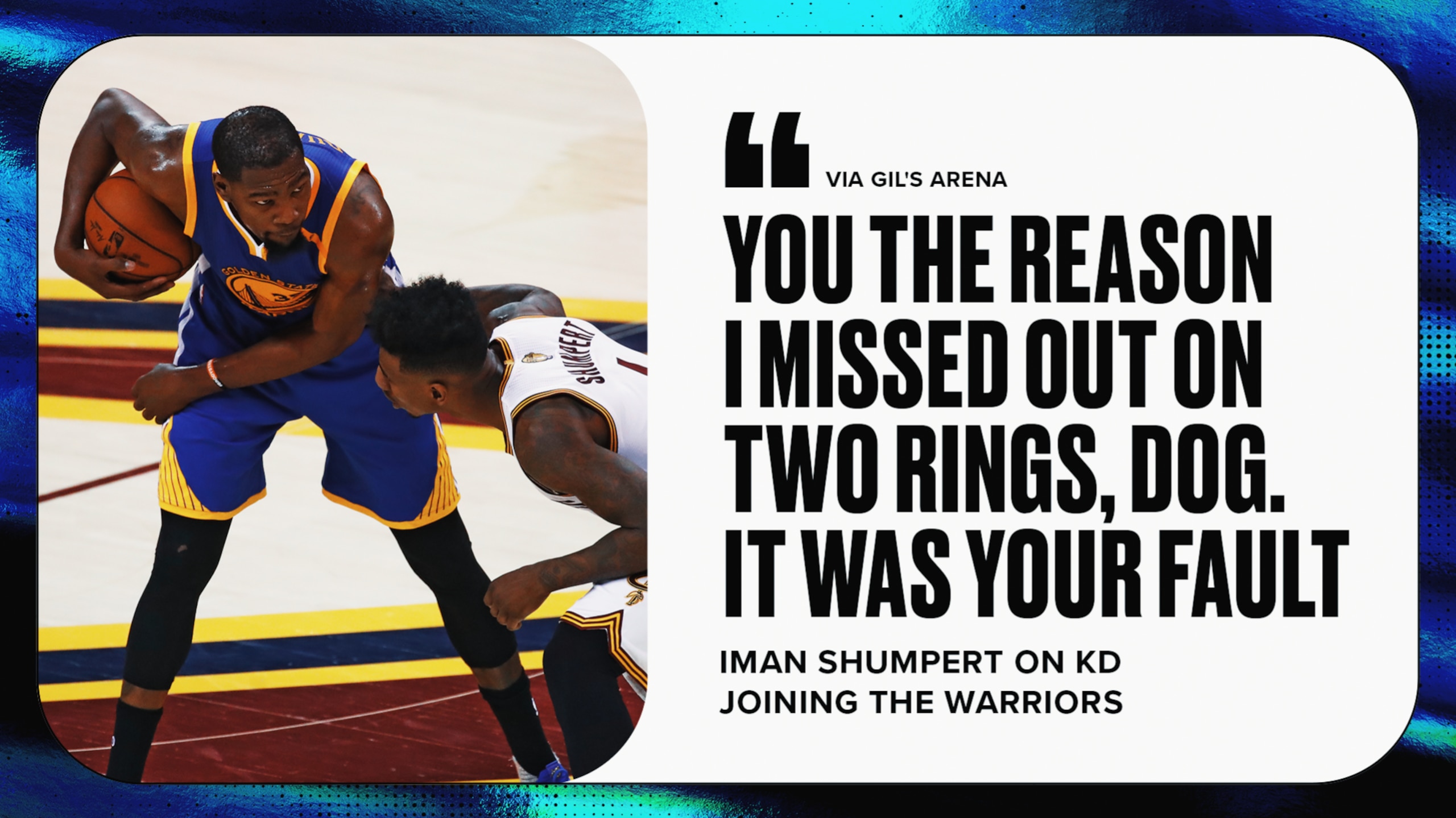
Iman Shumpert Calls Out KD 😅
There is a wide range of opinions regarding who the NBA's best player is, but the arguments usually end with Kobe Bryant, Dwyane Wade, and LeBron James residing at the tops of various lists.
Based on many of the statistical formulas Bryant has been surpassed as the league's best player, and according to some people's calculations, he may not even belong in the top three.
Some observers feel the argument has shifted to Wade and James, and numbers as well as some obvious truths have been used as evidence to advance this theory.
For instance, Bryant's age and the fact his physical skills have began to erode is frequently used to explain why Wade may now reign as the league's top shooting guard.
Wade gets to the rim more frequently, has more lift in his legs, and is perceived to impact the game in more areas than Bryant.
To be fair, Bryant no longer possesses the lightening quick first step which made it nearly impossible to stay in front of him, and knee ailments have robbed him of the explosiveness he used to attack the basket.
Age and the wear of 14 seasons have definitely taken a toll on Bryant's body, but numbers fail to paint a clear picture in a season where Bryant still excelled, despite extenuating circumstances.
Bryant's 27 points per game during the regular season was the fourth highest in the NBA, and his 29.2 points per game during the course of the playoffs was second.
But what statistic does one use to measure the fact Bryant posted those types of numbers while playing with a fractured finger on his shooting hand?
How do you measure the quality which enabled Bryant to calmly sink seven game-winning shots last season, many of which occurred after his finger was injured?
This does not prove that Bryant is the NBA's top player, but the fact he accomplished those things does not usually reflect in statistics.
Neither does public opinion.
James captured his second consecutive NBA MVP award last season, and was generally considered as the NBA's top player, until his Cleveland Cavalier's team failed in the playoffs.
After that loss the majority of the public opinion shifted back towards Bryant as the league's top player, and it was only affirmed after Bryant earned his second consecutive Finals' MVP award.
Few would argue that James remains the NBA's most talented player after his playoff debacle, but many people were now hesitant to call him the league's best, because of his body language in the postseason.
During this period, Wade existed mostly in the shadows of the discussion but he was thrust into the spotlight after this Summer's historic free agency signing period.
When Chris Bosh and James decided to join Wade in Miami the public's attitude began to shift again as Wade became a more prominent figure in the conversation.
In the public's eyes Bryant had lost the mantle of the NBA's top player, even though he was only weeks removed from his fifth NBA championship.
In recent weeks, more statistical evidence has began to mount in the case against Bryant, and people who cling to the theory that he remains the game's best are roundly accused of refusing to accept the inevitable.
Even Bryant's 2010 NBA Finals' MVP award is being devalued in the wake of his 6-24 shooting performance in Game Seven, but that performance also offers evidence that supports Bryant.
Bryant did have a horrible night from the field, but his 23 points were still the most scored by any player in the game, and his 15 rebounds were second only to Pau Gasol's 18.
Bryant's ability to remain relevant in the contest despite his shooting woes is another instance that is hard to measure with statistics, because it's impossible to gauge instincts and competitive nature with a number.
To say Bryant would rank high in those categories is an understatement, and if one looked solely at career achievements to this point, who really ranks as the NBA's top player?
It would be equally hard to argue with Bryant's 25,000-plus career points, eight first team all-NBA defensive team selections, or five NBA championships, but even those numbers are victims to the public's perception.
The fact that Bryant has spent half of his career as a participant in the NBA Finals is but a minor detail when it comes to the subjective rankings of NBA players today.
The simple truth is, there is no definitive way to judge who the NBA's best player truly is, and any attempt to do so will always come down to a matter of opinion.
Numerous formulas have been used to advance any number of theories, but in Bryant's case where does his impact on the overall success of his team last season rank, and how much weight does it hold in the debate?
.jpg?w=2560 "Report: Darnold Could Miss 3-6 Weeks")
.jpg?w=2560 "Breaking News")