Promising but Flawed: Isn't $146M Max Extension Too Much for Andrew Wiggins?
When your team has a 22-year-old former first overall pick averaging 23.6 points per game, it's a no-brainer to ink him to a max contract.
At least, it is on paper.
The Minnesota Timberwolves signed Andrew Wiggins to a multiyear extension, the team announced on Wednesday, for the maximum five years and $146.5 million, per Shams Charania. But the decision was not so clear-cut.
With Karl-Anthony Towns surpassing Wiggins as the face of the franchise and the organization hitting a grand slam in its trade for Jimmy Butler, it's understandable that Wolves owner Glen Taylor might have some concerns about paying the team's third option almost $30 million per year.
This summer, Taylor told the Associated Press, via ESPN.com, that he would meet Wiggins at a max-level deal, but that didn't stop him from having reservations.
"To me, by making this offer, I'm speculating that his contribution to the team will be more in the future. We've got to be better. He can't be paid just for what he's doing today," Taylor explained. "... I'm already extending to him that I'm willing to meet the max. But there are some things that I need out of him, and that is the commitment to be a better player than you are today."
So, how did Wiggins respond to the offer initially? "... I'm pretty much the same guy, same mood," he said, per Jerry Zgoda of the Star Tribune.
That's all well and good in terms of who he is on a personal level—after all, the last thing anybody wants is to see a young player become content after his first big payday. But considering what Taylor had to say, he should be focused on improving and not being "pretty much the same." And apparently, he is. Per the team's release on Wednesday, Wiggins believes "the best is yet to come."
With his 23rd birthday coming after next year's All-Star break, Wiggins is not done refining his game. His physical tools remain tantalizing and his scoring touch should only reinforce his high ceiling. It was fair for Taylor to be hesitant about giving Wiggins all that cash, even if it's for what he will do, not what he has done. Because he hasn't done much to this point other than become an accomplished scorer on a bad team.
All Points, Little Production
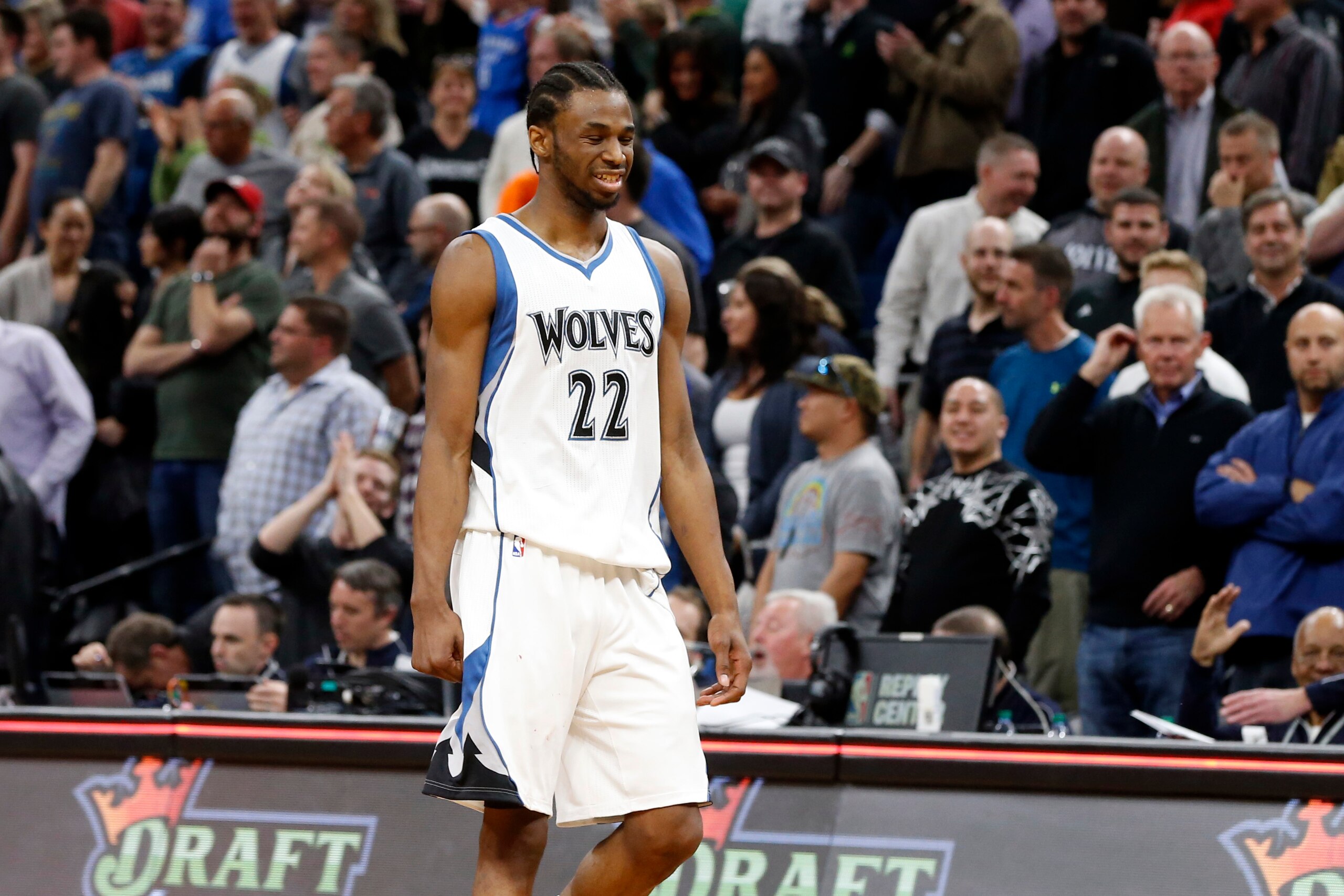
Wiggins led the NBA in minutes last season. And yet, all-in-one metrics like box plus-minus (BPM) and ESPN's real plus-minus (RPM) do not rate him very highly. For example, his numbers are comparable to Eric Gordon in offensive RPM and Tony Snell in offensive BPM.
Defensively, he's a sieve, ranking 460 out of 468 in defensive RPM (similar to Jamal Crawford) and 453 of 479 in defensive BPM (think Jerryd Bayless or Chasson Randle). Combine this with his top-of-the-charts usage rate and sub-average shooting efficiency, and Wiggins becomes the chips and soda of the NBA: empty calories—an inefficient, volume scorer.
Part of this is because Wiggins, like his new teammate Butler, likes to operate in the mid-range. Wiggins averaged the sixth-most mid-range shots per game last season but converted just 37.9 percent of those attempts. If you thought the Dwyane Wade-Butler tandem was too old-school, this might be even worse.
Those kinds of stats make analytics nerds cringe, but it's important to note that Wiggins did improve his three-point percentage from 30.0 to 35.6 last season. If that improvement continues, he may be the most equipped he has ever been to operate off the ball.
After averaging just 4.0 rebounds and 2.3 assists per game last year—and even fewer during the preseason, 2.0 and 1.3, respectively—all while struggling to defend, it's fair to criticize Wiggins for being one-dimensional. Having such a great scoring responsibility cripples his ability to expend energy on those other box-score stats. And being on a generally poor team his entire career can't be a good motivator on defense.
Despite the enamoring physical tools, he has yet to put it together on that end. Last year, the Timberwolves were a bottom-five defense in Tom Thibodeau's first season. With another campaign to learn the scheme (not to mention a pair of Thibodeau lieutenants ready to demand execution in Butler and Taj Gibson), Wiggins will have no choice but to share the ball and learn to succeed within his new environment.
Can a New Big Three Bring the Best Out of Wiggins?
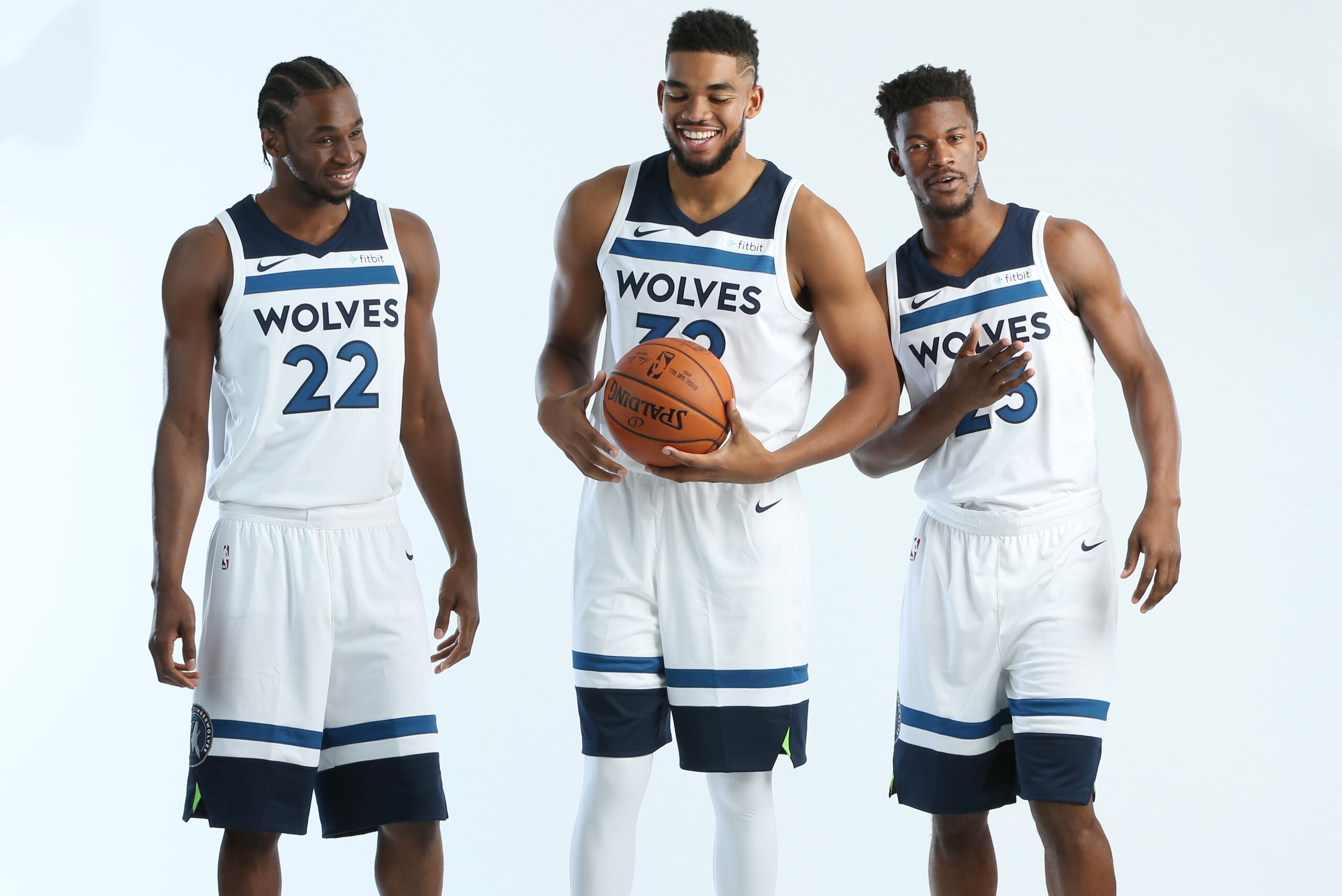
As is true with most Big Threes, at least one player, if not all of them, will have to sacrifice touches. Considering Towns' development and the Butler addition, Wiggins may end up the Chris Bosh of this group.
At the very least, he will have to expand his comfort zone to learn how to work alongside Butler.
Having two bully-ball wings who can expose mismatches off the dribble or in the post can be a luxury, and the Wolves will likely utilize these mismatches regularly. But, more than the general inefficiency of some of his looks, when Wiggins backs his defender into the post with six dribbles before spinning baseline for a fadeaway jumper, there is an opportunity cost, a chance for a better shot.
Not only is Towns cut out of this set—or used strictly as a floor spacer in similar ones—but there is also no off-ball movement, no weak-side threat to prevent the defense from collapsing into the paint.
The Wolves must find a way to keep all three of their stars (as well as Jeff Teague and Gibson) involved. Per Basketball-Reference, the projected starting five combined to use 124.4 percent of their possessions last season: Wiggins (29.0), Towns (27.5), Butler (26.5), Teague (22.1) and Gibson (19.3).
How can you use more than 100 percent of possessions, you ask? Well, you can't while they're all on the floor. For this to work, Towns, Butler and Wiggins will have to share, each hovering around 25-26 percent usage rate.
Butler's presence will force Wiggins to adapt. It also gives the burgeoning star a true veteran leader in his prime to learn from, which is something Wiggins hasn't had up to this point.
Of course, Butler's leadership has been questioned after moments like the "coach harder" call-out. Even Scottie Pippen, during a guest appearance on ESPN's The Jump following the trade, said Butler "wasn't showing the type of leadership that you'd expect from your best player," via Ryne Nelson of Slam Online.
But having reunited with Thibodeau, he can get back to the culture that turned him into a superstar. Now he can be the Thibs whisperer the young Timberpups have needed and help Wiggins do the same.
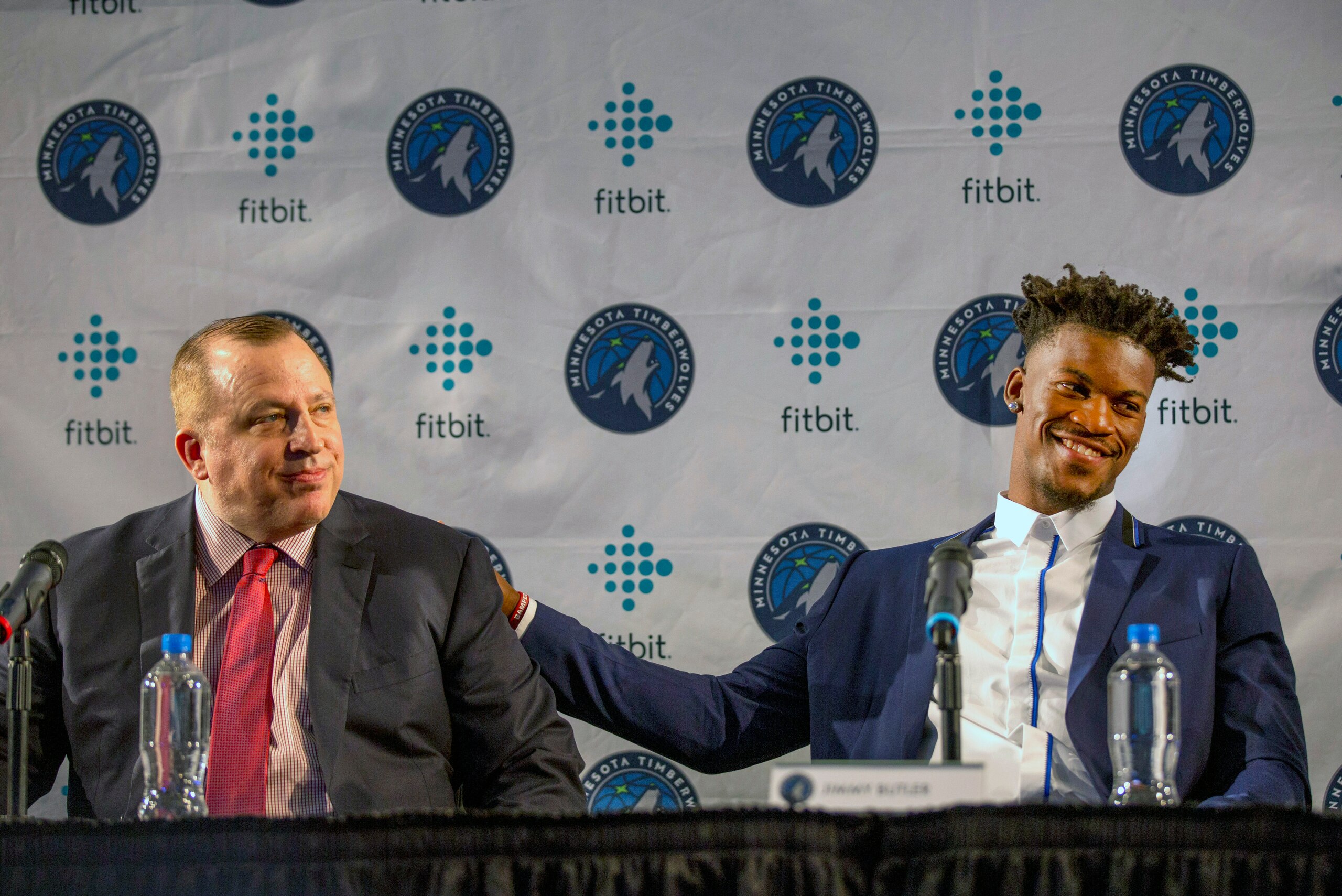
This re-establishment of the culture only stands to benefit Wiggins. Butler is demanding of his teammates and notoriously hard to win over.
"I hear so many good things about how the young guys here work, and I love that," Butler expressed at media day. "I mean, if you go back and look, all I ever wanted was a guy that just relentlessly worked. When they're bored, they go to the gym. When they get to choose ‘hey, do I want to play a video game or go shoot,' they're picking to go shoot. Those are winning habits. That just shows how great you want to be, and that's what I want to be a part of."
Entering his fourth season, Wiggins hasn't figured it all out. There's no doubt $146.5 million is a lot to pay a third option—maybe too much—but the Timberwolves were left without much of a choice.
With the overhaul of the roster and win-now motivation, the Wolves will try to bring him along quickly. The good news, however, is the pressure is off him to be the lead dog. Wiggins' being worth his deal will not be determined by his scoring, but rather his ability to round out his game: grabbing more boards, hitting the 37-38 percent mark on three-pointers and not just becoming a passable defender but the lockdown stopper he projected to be at Kansas.
And with the new core in place, the Timberwolves have to hope that Wiggins will develop the way they want.
Stats via NBA.com unless otherwise noted.

.jpg?w=2560 "Daniels Comments on Diggs Penalty")
.jpg?w=2560 "WWE x AAA Triplemanía Night 2 📝")