


Who says NBA rookies are the only ones allowed to have a progress meter in the form of a ladder?
Sophomore contributors deserve one just as much. They are still relatively new to the Association themselves. For many, their second year is the first time they get a regular, sometimes prominent, spot in the rotation.
For the ones who enjoyed rookie-season staying power, well, it's always good to check on their development and see whether they're trending in the right direction.
This pecking order does not seek to pass judgment on career outlooks. It says a lot that these second-year fledglings are here, but we're interested in the best 2016-17 campaigns alone. One sophomore is not necessarily more likely to have the better NBA tenure than another just because he's higher up in this single-year hierarchy.
Individual performances—stats, play styles, historical context, etc.—will mold the standings, but team impact matters a great deal. Close calls and deadlocks will go to the player buoying the best situation.
Honorable Mentions (Nos. 15 Through 11)
1 of 11
15. (Tie) Dante Exum, Utah Jazz and Frank Kaminsky, Charlotte Hornets
Have you seen what Dante Exum has done since the All-Star break? Before laying an egg against the Sacramento Kings on March 30, he was shooting 45 percent from the field, including 38.5 percent from three, improving his decision-making off the bounce and just generally gaining confidence through garbage-time detonations.
How about what Frank Kaminsky started doing just prior to said All-Star break? He's averaging 15.7 points and 2.3 assists while shooting 37.2 percent from distance over his last 15 games. His rim protection is still blah, but he's holding his own on defense overall.
Keep your eyes on both basketball cubs. They could be gearing up for third-year breakouts.
14. Stanley Johnson, Detroit Pistons
Anyone else prepared to die on the Stanley Johnson hill?
Johnson's playing time is down from last season, but that says more about the Detroit Pistons' wonky spacing and personnel. His intensity on the defensive end seldom wavers, and he can already be a frightening playmaker off the bounce—despite the complete lack of a jump shot.
13. Rondae Hollis-Jefferson, Brooklyn Nets
Rondae Hollis-Jefferson still can't shoot and has regressed as a pick-and-roll distributor (turnovers, man). But he continues to be a happy surprise as an overall playmaker. His assists per 100 possessions are up more than a tick from his rookie season, and he's drawing a lot more fouls.
Brooklyn Nets head coach Kenny Atkinson is using Hollis-Jefferson more liberally at the 4, and it's working. His defensive efforts would be viewed more favorably if he played for another team. He is the third-most valuable sophomore on the less glamorous side, according to NBA Math's Defensive Points Saved.
12. Norman Powell, Toronto Raptors
Norman Powell has ambled in and out of a second-year offensive coma, and his defensive intensity has fluctuated by the game and assignment. But he remains active enough for the Toronto Raptors to spin trading Terrence Ross as a win.
P.J. Tucker's arrival has helped bring Powell's defensive workload to a manageable head, and the 23-year-old has been a constant in one-on-one situations. Opponents are shooting 9-of-28 against him in isolation (32.1 percent) while coughing up the rock almost 16 percent of the time.
11. Montrezl Harrell, Houston Rockets
Listed at 6'8", Montrezl Harrell somehow spends almost half of his floor time at center without giving up an inch.
He rates as a better rim protector than Nene and more effective post-up blockade than Clint Capela. He doesn't have three-point range (that we've seen) or rebound particularly well, but he's shooting almost 75 percent at the rim and nearly 60 percent as the pick-and-roll diver.
Surprised? Impressed? Surprised as how impressed you are? Good. You're supposed to be.
10. Larry Nance Jr., Los Angeles Lakers
2 of 11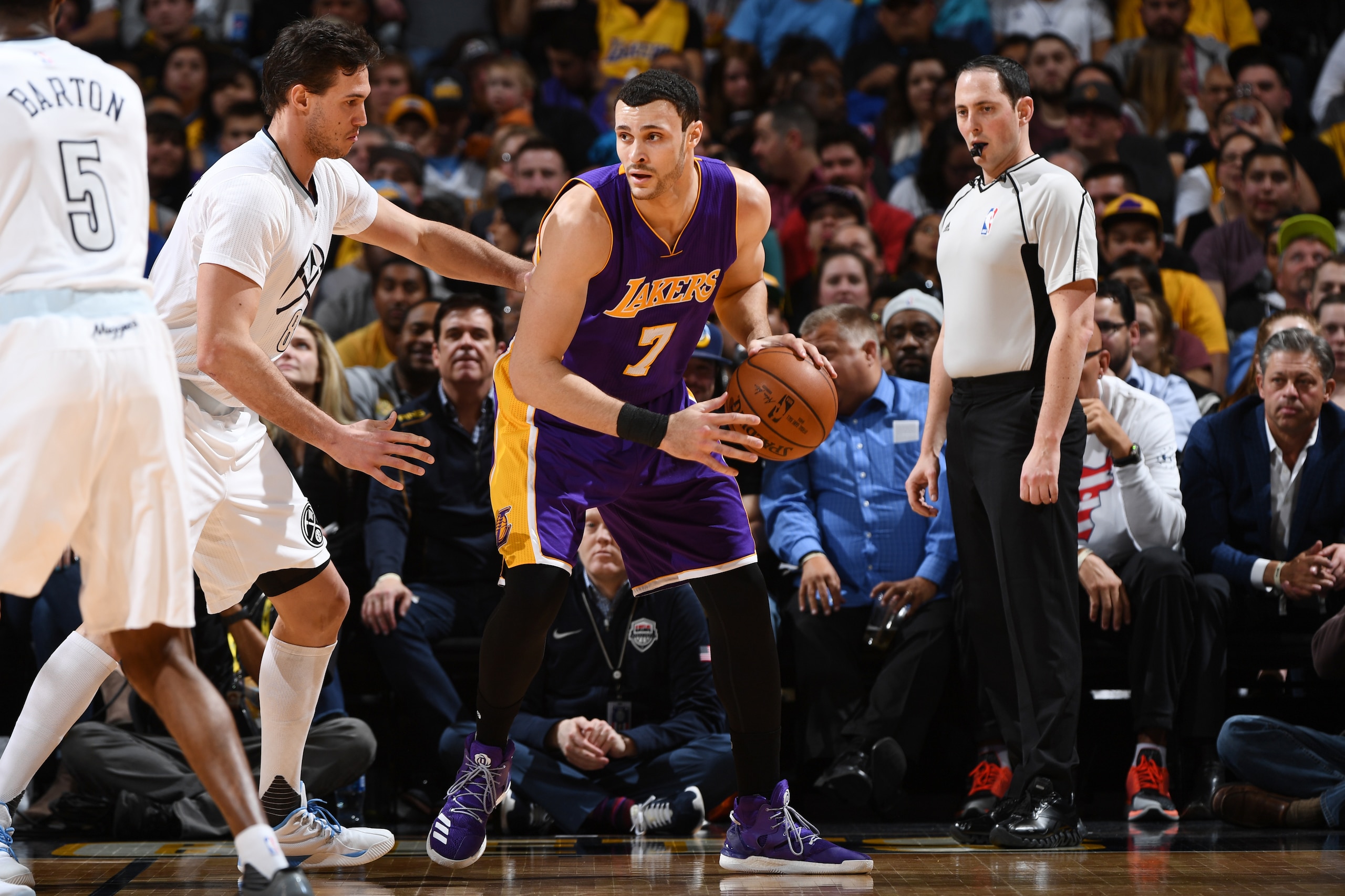
Age: 24
2016-17 Per-Game Stats: 6.8 points, 5.5 rebounds, 1.5 assists, 1.2 steals, 0.6 blocks, 53.7 percent shooting
With Lou Williams gone, Larry Nance Jr. is now the only member of the Los Angeles Lakers adding positive value to the cause, according to NBA Math. He's the closest they come to deploying a finished two-way product, even though his offensive game is undefined.
Nance averages 8.8 shot attempts per 36 minutes, the fourth-lowest mark among sophomores. He's hitting more than 72 percent of his looks around the rim but is not yet a viable pick-and-roll diver. And while the Lakers give him the green light to shoot, he prefers to do the dirty, oft-unquantifiable work, as ESPN.com's Zach Lowe explained:
"Nance loves to pass. He talks about setting flare screens with the glee of Kobe Bryant discussing footwork in the post. Luke Walton, the Lakers coach, has to order Nance to shoot. Every good team needs a role player who loves the little things. (The Lakers do need Nance and [Julius] Randle to hit more jumpers when they are open, and catch the ball in rhythm.)
"
Nance's usage is laughably low (13.3), and yet he's still dropping a healthy number of dimes. Andre Iguodala and Shaun Livingston are the only other players with inferior usage dishing at least 3.2 assists per 100 possessions—and they play beside the Golden State Warriors' thicket of automatic shot-makers.
It's hard for anyone to distinguish themselves on defense with the Lakers. Nance is no different. Opponents shoot almost 59 percent against him at the rim, and he isn't the guy you want cutting off a big man slashing toward the basket. He has, however, shown the occasional ability to switch pick-and-rolls and guard wings in no-man's land without getting toasted.
Already, perhaps, the Lakers' most well-rounded player, Lance is a prime candidate to be counted as one of the league's most underrated talents in the years to follow.
9. T.J. McConnell, Philadelphia 76ers
3 of 11
Age: 25
2016-17 Per-Game Stats: 6.7 points, 3.0 rebounds, 6.4 assists, 1.6 steals, 0.1 blocks, 47.0 percent shooting
Some people (me) have a tough time getting over T.J. McConnell's shaky outside touch. Defenses blatantly slink off him in the half court, and he doesn't hide his hesitation from beyond the arc. He's shooting under 40 percent on jumpers, according to NBA.com's shot tracking data.
But McConnell has been a steadying floor presence for the Philadelphia 76ers—good enough to rank as one of this year's top-30 point guards, Bleacher Report's Adam Fromal notes:
"The Philadelphia 76ers may still look to find an upgrade at point guard at the top of the 2017 NBA draft, but T.J. McConnell should, at the very least, have staying power as a top-tier leader of the second unit. Even without a consistent jumper, which allows defenders to duck underneath screens, he's proved a savvy floor general who can capably direct his troops into the right spots while playing tough, physical defense.
"
Philly's defense doesn't statistically improve when McConnell is in the game, but he plays within some of its most important five-man fortresses. And he rates as the team's best (active) pick-and-roll pest. Ball-handlers shoot under 36 percent against him, and he forces turnovers in volume without burning through a ton of fouls.
McConnell makes up for his offensive shortcomings by playing within his strengths. He uses the extra space defenders leave him to reach the rim, where he's shooting better than 60 percent, and his first, second and third instincts are to pass.
No sophomore comes close to averaging as many assists per 100 possessions (12.1). McConnell is seventh in that department throughout the entire league, experience be damned. If he ever develops into a long-range threat, or even perfects his floater in traffic, he'll have the chance to be a quality pilot for an above-average offense.



8. Willie Cauley-Stein, Sacramento Kings
4 of 11
Age: 23
2016-17 Per-Game Stats: 7.5 points, 3.9 rebounds, 1.0 assists, 0.7 steals, 0.6 blocks, 53.1 percent shooting
In the 18 games since DeMarcus Cousins was traded, Willie Cauley-Stein has come alive. He's averaging 12.4 points, 7.1 rebounds, 2.3 assists, 1.1 steals and 0.9 blocks on 49.4 percent shooting—modest numbers that trounce his previous production.
Greater usage isn't behind his rise. He's just getting more minutes—over 31 per game, more than anyone on the team. And he's proving to be so much more than a rim-runner. He has active hands on defense, looks comfortable switching assignments (some of his rotations close to the rim need work) and has all the trimmings of an exceptional passer at his position.
There isn't another sophomore clearing 10.0 rebounds, 2.5 assists, 1.5 steals and 1.5 blocks per 100 possessions. Just seven other second-year players have hit those benchmarks since 2011-12, and almost all of them make for good company: Cousins, Gorgui Dieng, Rudy Gobert, Draymond Green, Markieff Morris, Nerlens Noel and Kyle O'Quinn.
Cauley-Stein might not develop into more than a (much) better version of this player. He wasn't asked to create his own shot at Kentucky, and the limited number of post-ups he's churned through with the Sacramento Kings hasn't yielded good results. And that's fine.
Hyper-active lane-sprinters with high IQs will always have a prominent place in the Association. Plus, the Kings give him some leeway to shoot outside eight feet. There's a chance, however slim, he hones a baby jumper or even a legitimate outside stroke—in which case he'd become one of the league's foremost matchup nightmares.
7. Richaun Holmes, Philadelphia 76ers
5 of 11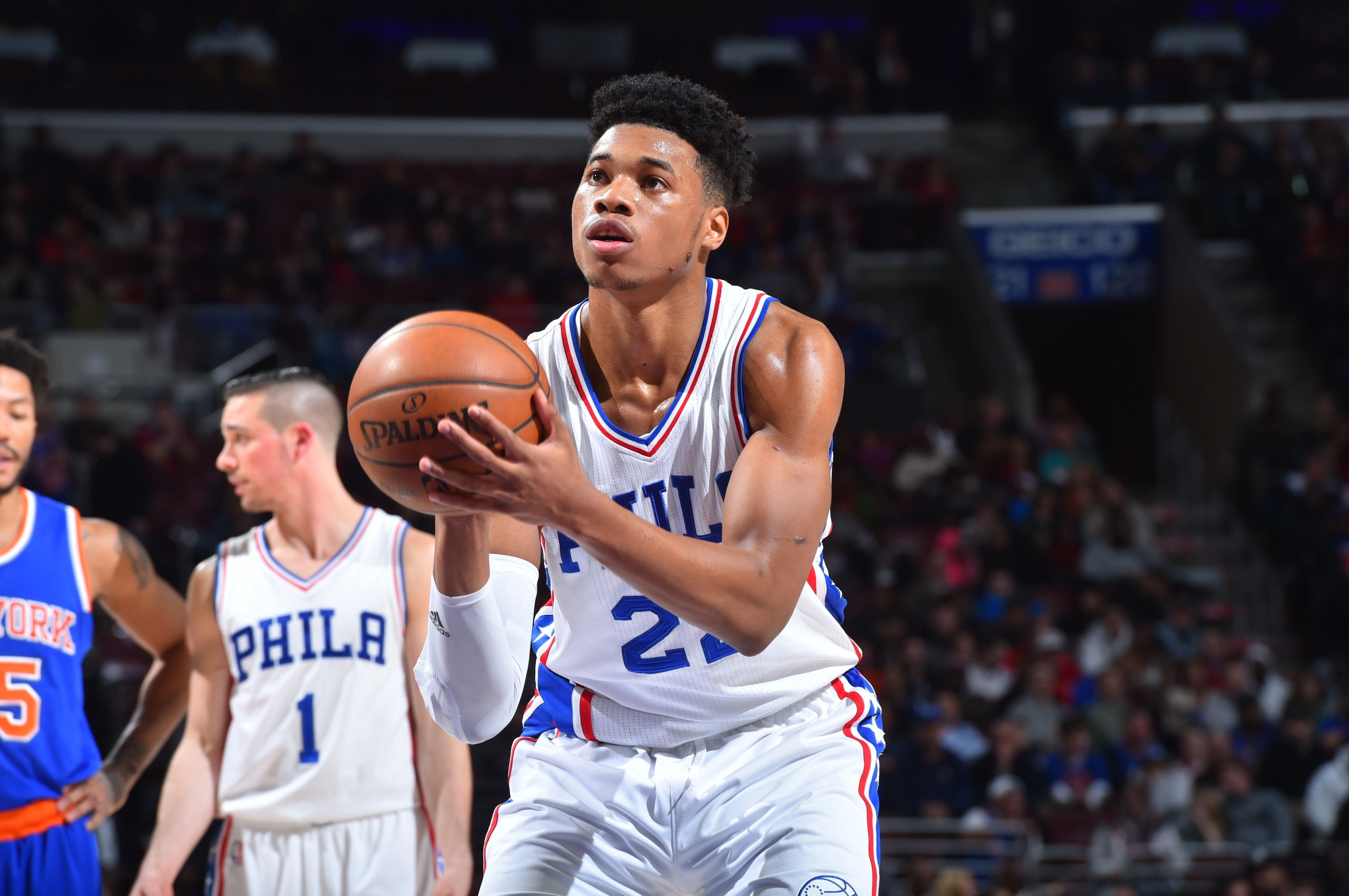
Age: 23
2016-17 Per-Game Stats: 9.2 points, 5.1 rebounds, 0.9 assists, 0.7 steals, 1.0 blocks, 56.2 percent shooting
You didn't have to like the Sixers' haul in the Nerlens Noel trade to know it would be great for Richaun Holmes. He is a per-possession superhero who now gets to play. It's no surprise he's making the most of the opportunity, which is why he gets the nod over other sophomores.
Three other second-year kiddies over the last decade have eclipsed 20.0 points, 12.0 rebounds, 1.5 steals and two blocks per 100 possessions in as much playing time: Anthony Davis, Andre Drummond and Paul Millsap.
Definitely consume this with a side of skepticism, but Holmes should clear the 1,100-minute plateau by season's end. That's not an insubstantial sample.
Holmes is a worthy heir to Noel's throne. He might end up being an upgrade. He doesn't distribute as well but has three-point range and averages 1.29 points per possession out of the pick-and-roll—a top-three mark among 75 players who've cycled through 75 or more of those sets.
His frame (6'10", 245 lbs), like Noel's, doesn't hold up when guarding back-to-the-basket buzz saws, and he doesn't excel when defending in space. But he's a lively presence. Opponent field-goal percentages inside six feet of the hoop plummet when he's in the vicinity, and he holds shooters to a 46.4 percent clip at the rim—third-best of the sophomore class (minimum 50 challenges).
Dwight Howard boarded the Richaun Holmes hype train after he racked up 25 points against the Atlanta Hawks on March 29. So, clearly, the rest us of need to follow suit.
6. D'Angelo Russell, Los Angeles Lakers
6 of 11
Age: 21
2016-17 Per-Game Stats: 15.7 points, 3.5 rebounds, 4.8 assists, 1.4 steals, 0.3 blocks, 41.0 percent shooting
D'Angelo Russell remains inconsistent. He's also ridiculously good.
"D'Angelo Russell's per-36 numbers this year, his age 20 season: 19.9 points, 4.6 rebounds, 6.1 assists, 1.8 steals," Forum Blue & Gold's Darius Soriano tweeted on March 23. "LeBron [James] is the only player in NBA history to reach/surpass those thresholds in those stats in his age 20 season."
Although Russell's per-36-minute splits have shifted a bit since, James is still his only company. Russell's efficiency isn't anywhere near his age-20 counterpart. He barely sneaks above 40 percent shooting from the floor and commits far too many turnovers. But he's still an offensive positive while learning the ropes, and that's not easy to do.
Teammates shoot roughly 45.8 percent overall off Russell's passes, and that number climbs above 50 percent on three-pointers. He already has little trouble running a functional pick-and-roll and will only improve as he gets his turnover rate in those situations (18.9 percent) under control.
Like almost everyone else in purple and gold, Russell needs to get his defense in order. At 6'5", though, he goes through stretches when he survives guarding either backcourt slot. That not only makes life easier on the Lakers now, but it also allows them to be more flexible with who they draft in this year's prospect pageant (assuming they get to keep their top-three-protected pick).
Lonzo Ball, Markelle Fultz, Josh Jackson—it doesn't matter. Russell should be able to coexist with them all.
5. Devin Booker, Phoenix Suns
7 of 11
Age: 20
2016-17 Per-Game Stats: 21.6 points, 3.2 rebounds, 3.2 assists, 0.9 steals, 0.3 blocks, 42.3 percent shooting
Holster any "Devin Booker's 70-point game against the Boston Celtics wasn't good, let alone great" takes for, oh I don't know, let's say forever.
A 20-year-old dropped 70 points. In an NBA game. Against a defense that had every opportunity to, you know, guard him despite Phoenix Suns head coach Earl Watson's flurry of timeouts and calls for intentional fouls. There isn't a scenario in which scoring 70 points at this level is unimpressive.
The bigger issue is whether Booker's offensive outburst portends something spectacular. As the Washington Post's Tim Bontemps wrote:
"He's shooting 42.3 percent from the field — exactly the same as his rookie season. He's shown only modest improvement to 36.4 percent from three-point range and notching the same percentage from the foul line. While shooting the same percentage at a higher volume is obviously a good thing, it still is a little surprising for a player that, when you apply the eye test, has all the makings of an all-star for years to come.
"
Even if you're not a fan of Booker's shooting percentages, it's hard to be against youth. There is time for him to become a human flamethrower. And he makes up for any efficiency gaps with a capacity to serve as the primary playmaker.
Booker's assist totals don't boggle the mind, but he's not surrounded by a proven supporting cast. He averages about as many potential assists (6.4) as Bradley Beal (6.5). He's initiated more pick-and-rolls than Elfrid Payton, even with Eric Bledsoe logging heavy minutes for most of this season, and could do more on-ball work if Phoenix wasn't overrun with guards.
What becomes of Booker's rising star is tied to his defensive progression. He can guard multiple positions but struggles immensely in one-one situations. Offensively, though, he's arrived—in a big way.
4. Myles Turner, Indiana Pacers
8 of 11
Age: 21
2016-17 Per-Game Stats: 14.6 points, 7.2 rebounds, 1.3 assists, 0.9 steals, 2.1 blocks, 50.9 percent shooting
Myles Turner built a case to be placed ahead of a certain Latvian monolith before March. But then March happened, and his stock fell.
Turner's shot attempts have declined over the last 15 games, from 11.2 to 9.7, without his experiencing a dip in court time. His field-goal percentages have dropped—especially from three-point range—and there have been five occasions this month on which he's launched fewer than eight shots.
Pacers head coach Nate McMillan chalks some of this up to Turner's attempts to find his teammates, per the Indianapolis Star's Jim Ayello:
"His reads have been to get the ball to the weak side where we have an advantage as opposed to shooting every shot when it comes to him. It's growth involved in that, and we're seeing that from him, which is really, really important. Once he gets that feel for rotating to the weak side ... all of a sudden, teams get fearful of the pass, and they'll start leaving him open. And that's the reward when teams respect your ability to make good decisions.
"
The most demonstrative slump cannot detract from Turner's entire body of work.
He's shooting 51.9 percent as the pick-and-roll slasher, up more than 10 percentage points from his rookie campaign. His overall three-point success rate has improved amid a significant uptick in volume, and he's putting down 44.3 percent of his deep twos. He's challenged more shots at the rim than everyone in the NBA except Rudy Gobert while holding opponents to a sub-50 percent shooting clip.
That Turner has risen this high, after a debut crusade in which he was used more sparingly than not, bodes well for his future.
3. Kristaps Porzingis, New York Knicks
9 of 11
Age: 21
2016-17 Per-Game Stats: 18.1 points, 7.3 rebounds, 1.5 assists, 0.7 steals, 2.0 blocks, 44.6 percent shooting
Not even the New York Knicks can drive Kristaps Porzingis' stock (all the way) down.
His usage rate is still lower than it was during his rookie jaunt, but that was inevitable when Derrick Rose joined the orange-and-blue ranks. New York has countered the terrible, horrible, no-good, very bad dynamic between Porzingis, Rose and Carmelo Anthony by running its 7'3" myth within bench-heavy lineups.
In the time Porzingis has played without those two, Courtney Lee and Joakim Noah (injured/suspended/probably washed up), he's averaging 27.1 points, 9.6 rebounds and 2.4 blocks per 36 minutes with an identical shooting percentage. And the Knicks are outscoring opponents by 10.5 points per 100 possessions—a would-be second-place net rating for the year.
Porzingis has received flak for his defense in space. News flash: Most human high-rises aren't lockdown stoppers when they play the perimeter. That Porzingis is trying speaks volumes, and he's been adequate for someone his size on islands.
Good luck scoring when he's allowed to function as a stationary rim protector. He's holding enemy shooters to 43.7 percent conversion rates around the iron—fourth-lowest clip among 57 players who face five or more close-range attempts per game.
All of us should be hardened to the unicorn references by now. They're bland. Overused. Cliche-like, even. But it's become necessary to reinforce Porzingis' uniqueness. Many are borderline immune to that, too. He's a genuine superstar-in-training, with more than enough time and skill to catch the two sophomore sensations standing in front of him.
2. Karl-Anthony Towns, Minnesota Timberwolves
10 of 11
Age: 21
2016-17 Per-Game Stats: 24.6 points, 12.1 rebounds, 2.7 assists, 0.6 steals, 1.3 blocks, 53.6 percent shooting
Speaking of the general public being numb to a phenomenon, Karl-Anthony Towns continues to exist in a perpetual state of dominance, people.
He isn't having the best season of any sophomore, but he's coming pretty darn close. And he may still end up having the best career of his class.
Towns leads all sophomores in minutes, points and rebounds per game. He is third in blocks and tied for fourth in effective field-goal percentage. He's fifth in assists (!).
Oh, Towns is also the fourth sophomore in league history to average more than 24 points per game with a true shooting percentage—cumulative measurement of two-point, three-point and free-throw accuracy—north of 60. He joins Kareem Abdul-Jabbar, Shaquille O'Neal and David Robinson.
Here's the thing: Towns, unlike any of his sophomore soul mates, shoots threes. (Abdul-Jabbar didn't have the option.) On average, his shots come from 9.7 feet away from the basket. Similar data isn't available for everyone else's second season, but in the years we can track, O'Neal never had an average distance beyond 4.7 feet and Robinson never exceeded 7.1. It's incredible how efficient Towns has been given his more expansive shot selection.
There are strides Towns needs to make on defense. His rim protection fails to keep pace with Holmes, Turner and Porzingis, and he's not yet a pick-and-roll deterrent. But he's a sustainable option while defending in space, and he'll improve even more once the Minnesota Timberwolves get at least one usable perimeter stopper.
1. Nikola Jokic, Denver Nuggets
11 of 11
Age: 22
2016-17 Per-Game Stats: 16.3 points, 9.5 rebounds, 4.7 assists, 0.8 steals, 0.7 blocks, 58.0 percent shooting
Don't be afraid. You can say Nikola Jokic is having a better, more impactful season than Towns and every other sophomore. It's OK. This is a safe space.
Above all else, this sentiment has the benefit of being true.
Jokic is averaging 19.1 points, 10.7 rebounds and 5.7 assists on 59.3 percent shooting since re-entering the Denver Nuggets' starting five on Dec. 15—a stretch spanning more than half the season. His three-point efficiency has spiked during this time (35.9 percent), and he's the inarguable No. 1 option for what's been the NBA's best offense over the last 50-ish games.
Porzingis, Towns and Turner are all further along on defense, but it doesn't matter. Jokic's offensive value makes up for everything.
Pick a catch-all metric. Box Plus-Minus, ESPN's Real Plus-Minus, NBA Math's Total Points Added—any catch-all metric.
Jokic, who is already one of the best passing bigs ever, will register as a top-10 player across the board.
Dan Favale covers the NBA for Bleacher Report. Follow him on Twitter (@danfavale) and listen to his Hardwood Knocks podcast co-hosted by B/R's Andrew Bailey.
Stats courtesy of Basketball Reference or NBA.com and accurate leading into games on March 30. Team salary information via Basketball Insiders.
.jpg?w=2560 "Raiders Could Start Mendoza")

.jpg?w=2560 "Rodgers Iced Out on Plane 💎")

.jpg?w=2560 "🚨 Week 8 AP Top 25 Poll")