

Three years ago, Anthony Davis and Damian Lillard suited up for the Rising Stars Challenge on Friday and the NBA All-Star Game on Sunday. Since then, nobody has done that double dip, nor is anyone set to reverse that trend in New Orleans later this month.
But the rosters for this year's rookie-sophomore game are replete with young studs who will be making their marks during future All-Star Weekends. There's no fewer than a handful of players (i.e. Karl-Anthony Towns, Kristaps Porzingis, Joel Embiid, Nikola Jokic) who have that type of talent, with others sporting the upside to join that discussion down the line.
And that's to say nothing of the third-, fourth- and fifth-year phenoms who can legitimately gripe about being snubbed from this year's All-Star festivities—including Lillard, who's followed up consecutive selections with back-to-back shuns.
There's a flood of fresh blood bubbling up beneath the more established generation of superstars. And it's nearly ready to assume its rightful place in the league's hierarchy.
These seven up-and-comers, listed in alphabetical order, won't be playing alongside basketball's best and brightest in the 2017 midseason showcase. But based on their current production and team-wide impact, they should be angling for invites in 2018 and beyond.
Honorable Mentions
1 of 8
Devin Booker, Shooting Guard, Phoenix Suns
Whenever the Suns rise from the ashes again, they'll likely do so with Devin Booker as the foundation of their franchise. It will likely to take them more than a year to do so, though.
The 20-year-old has already logged more 30-point games this season (nine) than he did as a rookie (six). But like most young guards, he struggles defensively, though his stroke (36.5 percent from three) helps to make up for it on the other end.
C.J. McCollum, Shooting Guard, Portland Trail Blazers
C.J. McCollum shoots better from the field than Damian Lillard (48.8 percent to 44.2 percent) and better from three (42.0 percent to 34.8 percent) with superior clutch splits (58.1/52.0 to 36.1/23.5). They split crunch-time duties, but against the Dallas Mavericks on Tuesday, it was McCollum, not Lillard, who scored on the last three possessions of the game to lift the Portland Trail Blazers, 114-113.
Dennis Schroder, Point Guard, Atlanta Hawks
The Atlanta Hawks liked Dennis Schroder enough to trade away their longtime point guard, All-Star Jeff Teague, to accommodate him. The result? The Hawks are once again challenging for a top-four seed in the East, with Schroder chipping in 17.3 points and a team-high 6.3 assists.
"He's a very competitive, edgy kid, which works both ways," Hawks head coach Mike Budenholzer told Bleacher Report's Ric Bucher. "But if you're going to bet, he's the kind of kid you bet on."
Myles Turner, Center, Indiana Pacers
In Myles Turner, the Pacers feel like they've found a bona fide sidekick for Paul George—and for good reason. He's already a top-20 rim protector and an above-average three-point shooter (39.3 percent), with 15.5 points, 7.2 rebounds and 2.3 blocks to boot.
Andrew Wiggins, Small Forward, Minnesota Timberwolves
The Wolves aren't good enough to garner one All-Star spot, let alone two. But if they were, Andrew Wiggins would deserve serious consideration. The 21-year-old is averaging 22.2 points per game and has upped his three-point percentage to a respectable 34.3 percent this season. If he keeps up his current rate of all-around improvement, he'll be one of the league's premier scoring wings in no time flat.
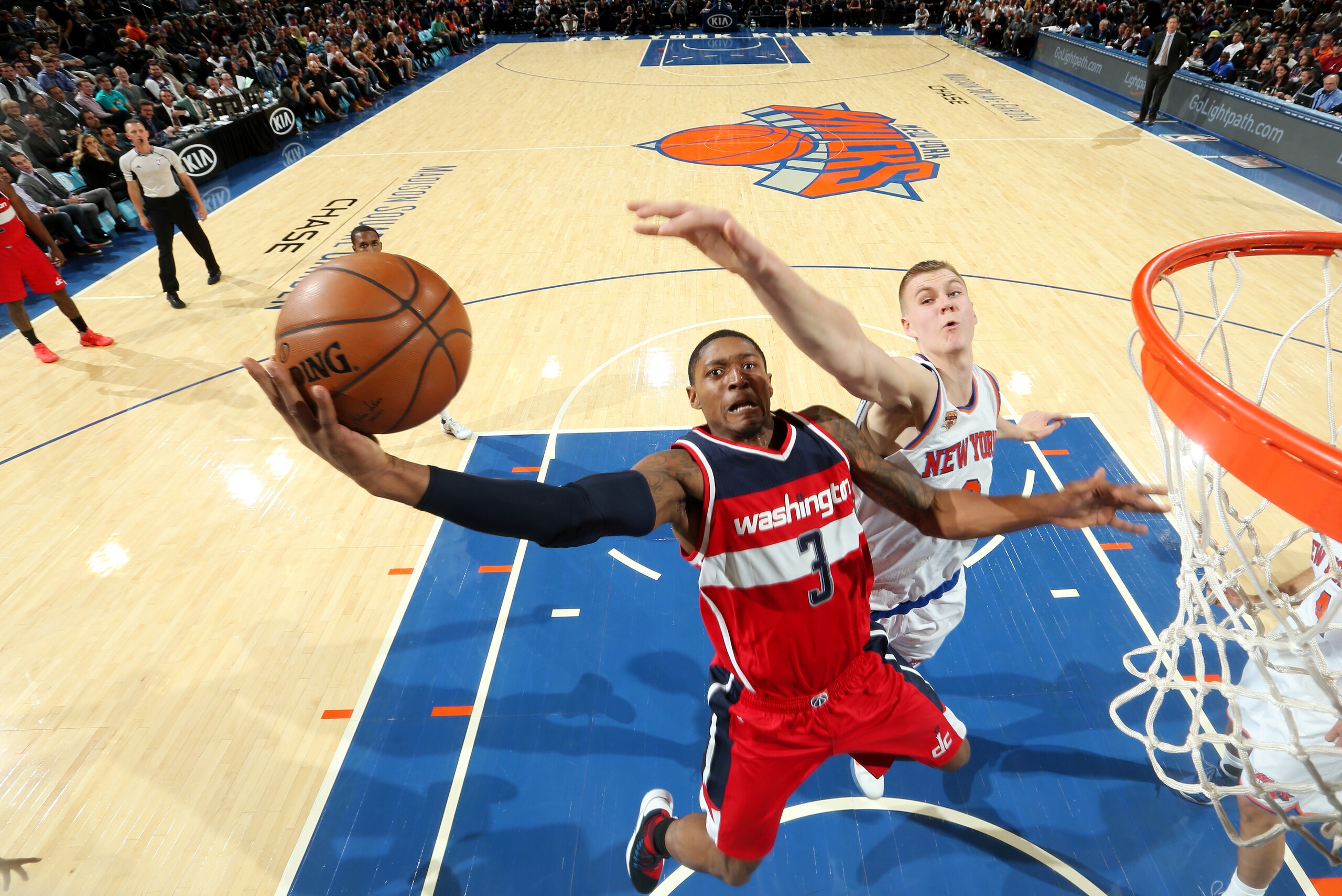
Bradley Beal, Shooting Guard, Washington Wizards
2 of 8
Bradley Beal has had All-Star talent since he came into the NBA. He's begun to get paid that way after inking a $128 million extension this past summer. Now, his body is cooperating, too.
Through his first four pro campaigns, Beal averaged more than 20 games missed, mostly because of recurring stress injuries in his leg. So far through the 2016-17 season, he's played in 47 of a possible 51 games for the Washington Wizards.
Never had Beal looked more worthy of elite consideration than during Washington's 140-135 overtime loss to the Cleveland Cavaliers. He scored 15 of his 41 points (one shy of his career high) after the third quarter, including a clutch three to tie the score at 116 with 43 seconds left in regulation and another to put the Wizards up 133-131 during the extra period.
But it's Beal's eight assists without a turnover that point to what the 23-year-old already is and could soon become: Where once he seemed to be the next Ray Allen, with his picture-perfect jumper and hops to attack the rack, he now looks like...well, Ray Allen with a pick-and-roll game. Beal ranks in the league's top 20 percent when it comes to point-per-possession efficiency in that critical set.
If he didn't already play with one of the game's premier point guards (John Wall), Beal might have the chops to run his own team. Instead, he's the superstar-caliber sidekick for one of basketball's most potent backcourts.
Joel Embiid, Center, Philadelphia 76ers
3 of 8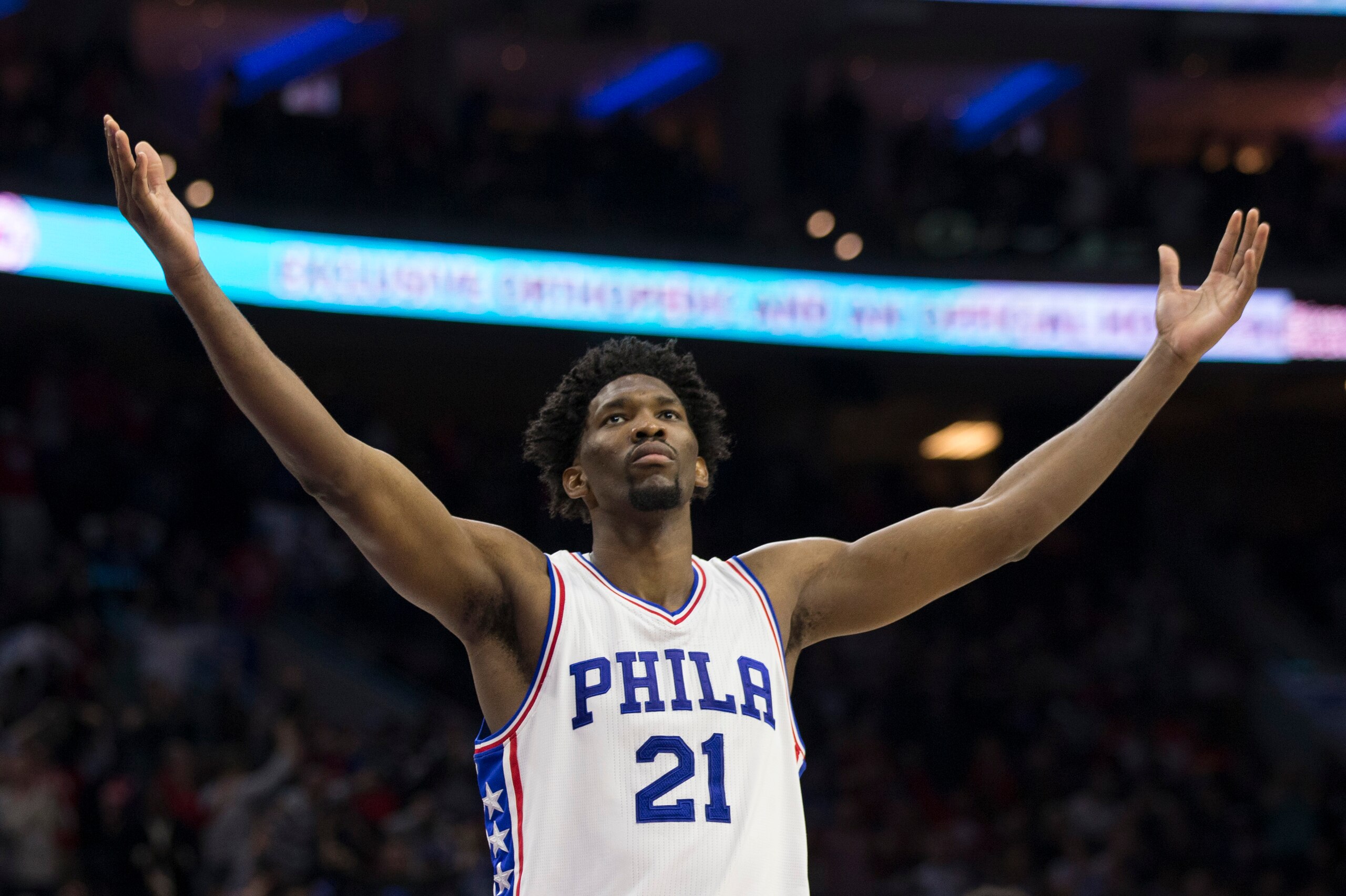
If fan voting were still all that mattered in selecting All-Star starters, Joel Embiid would be playing center for the Eastern Conference squad in New Orleans.
That he came close at all—as a rookie playing under a minutes restriction on a team (the Philadelphia 76ers) that had been the league's laughingstock since 2013—should make it clear he'll be back in the running for years to come.
Prior to his recent knee troubles, 2014's former No. 3 pick had averaged 19.8 points, 7.9 rebounds, 2.1 assists and 2.6 blocks in just 25.3 minutes per game. He returned from a three-game absence with one of his best all-around performances to date—32 points (4-of-6 from three), seven rebounds, four assists, three steals and two blocks—during a 123-118 loss to the Houston Rockets, then returned to the training table for another bout with his left knee.
"Look, they're missing a great player," Stan Van Gundy said prior to his Detroit Pistons pounding Philly on Monday, 113-96, per MLive.com's Aaron McMann. "They're missing a 20-point-a-game guy who's only playing 25 minutes a game to get his 20 [points]. So, I mean that's a high level of production in just over half the game. I mean, the guy has been tremendous."
Embiid will run away with Rookie of the Year honors as much by his own excellence as by the lack of competition in this year's class. But if his per-minute productivity holds once the Sixers stop handling him with kid gloves, he'll be competing for more substantial hardware in short order.

.jpg?w=2560 "NBA Gambling Charges")

Rudy Gobert, Center, Utah Jazz
4 of 8
If you took umbrage with DeAndre Jordan's All-Star selection, chances are, you probably had Rudy Gobert pegged ahead of him.
And you wouldn't be wrong, either.
By most measures against, Gobert either sees eye-to-eye with Jordan or stands a head (and maybe shoulders) above him: He leads the league in blocks (2.6 per game) and is the league's third-toughest player to score on at the basket. Jordan, on the other hand, doesn't even rank among the top 25 in rim protection and anchors a defense that, in terms of points allowed per 100 possessions, has been far inferior to Gobert's Utah Jazz.
The Los Angeles Clippers' starting center owns the edge in rebounding (13.7 to Gobert's 12.5) but trails the Stifle Tower in scoring (13.0 points to 12.0 points). That's partially because Utah's man in the middle can hit a free throw frequently enough to thwart hacking (65.5 percent to Jordan's 50.7 percent).
However you slice it, the case between them is close, but Jordan has been shining among the NBA's screen-roll centers on one of the league's better teams for nearly four years. If Gobert keeps up his pace—and at 24, he should—he'll get a nod of his own before long.
Nikola Jokic, Center, Denver Nuggets
5 of 8
Wilt Chamberlain. Kevin Garnett. David Robinson. Bill Walton. Alvan Adams. Chris Webber. Joakim Noah. What does Nikola Jokic have in common with these distinguished names? Aside from playing center in the NBA, not much...yet.
But if Jokic keeps up his sharing ways, he could join those listed above as pivots who've led their teams in assists over a full season. His 4.2 dimes per game put him on par with Denver Nuggets point guard Emmanuel Mudiay (4.2 per game) and just behind veteran floor general Jameer Nelson (4.5 per game).
The slick Serbian is gaining fast: He's paced the Nuggets in helpers during two of his three games back from a hip injury, including the 11 he tallied as part of his first career triple-double (with 20 points and 13 rebounds) during his return against the Milwaukee Bucks.
As the Denver Post's Christopher Dempsey explained, that skill could make Jokic the fulcrum of the Nuggets' long-term future, so long as the front office surrounds him with players who move well without the ball.
"Jokic is his most effective when the activity allows him to pick out the right pass at the right time, setting teammates up for easy baskets," Dempsey wrote. "Kenneth Faried and Gary Harris are the two biggest beneficiaries of Jokic's assists. That makes sense, given their constant rim-running and cutting activity."
Denver has only just begun orienting its roster around Jokic, who became a full-time starter again in mid-December. Yet, the Nuggets are already on track to end a three-year playoff drought, albeit as the best of an underwhelming bunch among the West's lower rungs.
That's still a significant step in the right direction for both the former second-round pick and the team that plucked him from overseas. Should Jokic and the Nuggets continue their current trajectories, the latter will be in postseason contention for years to come, with the former taking annual midseason trips to the All-Star Game.
Jabari Parker, Power Forward, Milwaukee Bucks
6 of 8The Milwaukee Bucks were 21-24 at the time that All-Star reserves were announced—well outside the usual range in which a team might anticipate a second selection.
Giannis Antetokounmpo had already been voted in as a starter, all but leaving Jabari Parker on the outside looking in.
Not that Parker would've beaten out the East's other subs (Isaiah Thomas, Paul George, Paul Millsap, Kyle Lowry, John Wall, Kemba Walker, Kevin Love) on his own merits, though the Chicago kid still has a case worth considering.
In just three pro seasons—two-and-a-half if you discount the time he missed after tearing his ACL as a rookie—Parker has fashioned himself into a prototypical stretch 4. Through his first 50 games of 2016-17, he's averaged a career-high 20.2 points on 48.9 percent shooting (36.7 percent from three) with 6.2 rebounds and 2.8 assists in just over 34 minutes a night.
That production is on par with the promise Parker had as the No. 2 pick out of Duke in 2014. But the outside shot is a newer development, after he hit just 25.5 percent of his 0.5 attempts per game between his rookie and sophomore seasons. And the athleticism that made his size (6'8", 250 lbs) and strength all the more threatening has returned in full, if the clip above (among countless other highlights) is any indication.
With Khris Middleton set to return from a gnarly hamstring injury, Milwaukee should have the goods to challenge for a playoff berth in the East. A strong showing on that stage, followed by another run up the conference standings next season, would do wonders for Parker's All-Star chances if he keeps up his end of the bargain.
Kristaps Porzingis, Power Forward/Center, New York Knicks
7 of 8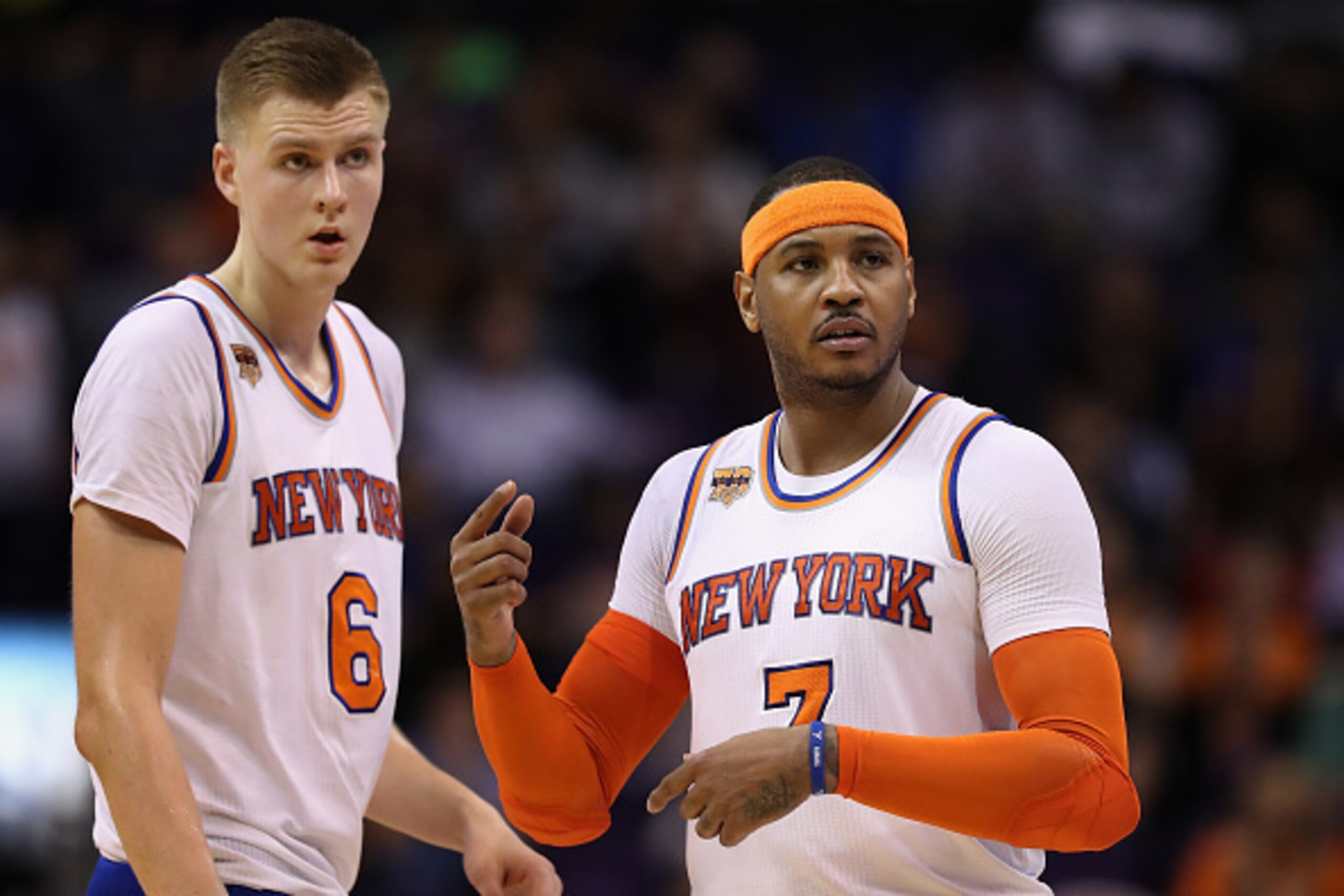
Kristaps Porzingis doesn't want the New York Knicks to trade Carmelo Anthony.
"I think it would make life harder for me on the court [if Anthony was traded]," Porzingis told the New York Daily News' Stefan Bondy. "He makes stuff easier for me."
He is right in some respects: On the court, the Knicks are 0-8 when Porzingis plays and Anthony doesn't, and 0-3 when the latter gets ejected from a game featuring the former. Off the court, the lanky Latvian doesn't have to endure constant criticism from the team's fans and local media since Anthony absorbs the lion's share of abuse.
But concerns about fit between New York's current star and the franchise's future aren't unfounded. Anthony's impact on the game—from the pace of play to the available real estate on the floor—often comes at Porzingis' expense. 2015's former No. 4 pick is far less accurate from three without Anthony but shoots a much better percentage overall and gets to the line twice as often per 36 minutes:
| FG% | 3P% | FTA/36 | |
| Porzingis w/ Anthony | 43.5% | 39.4% | 3.2 |
| Porzingis w/o Anthony | 47.1% | 32.8% | 6.4 |
It doesn't help that Anthony prefers to set up inside. Nor is it to Porzingis or the Knicks' benefit that Anthony drags a New York roster replete with younger legs into a grinding half-court game.
"[Porzingis] is still a high-caliber scorer when used properly and when they run plays for him," an NBA scout told the New York Post's Fred Kerber. "They're at a slower pace. He was getting 3s as a trailer. How many do you see him get now?"
It's no wonder, then, that the Knicks have been so persistent in their pursuit of landing spots for Anthony, according to Adrian Wojnarowski and Chris Mannix of The Vertical. They know what kind of player Porzingis is as a side act, and they are champing at the bit to see what K.P. can do on center stage at Madison Square Garden.
Karl-Anthony Towns, Center, Minnesota Timberwolves
8 of 8
Zach LaVine's torn ACL opened the door for the Minnesota Timberwolves' top two stars to go full supernova.
So far, both have obliged, to different degrees. Between the T-Wolves' first two post-LaVine games, Andrew Wiggins went for 50 points on 20-of-45 shooting with six rebounds, five assists, three steals and 10 trips to the free-throw line. Karl-Anthony Towns, meanwhile, amassed 62 points on 21-of-35 from the floor (16-of-20 from the stripe) with 24 rebounds and three steals.
Granted, neither stud could stop Minnesota from what's become a four-game skid.
Towns seems like the better bet to be the T-Wolves' first All-Star since Kevin Love in 2014. During his second year, he's already more efficient and effective by most measures than Wiggins is in his third:
| Points | FG% | 3P% | FTA | FT% | Rebounds | Assists | Blocks | |
| Towns | 23.3 | 51.1% | 35.0% | 5.1 | 80.6% | 11.9 | 3.0 | 1.5 |
| Wiggins | 22.2 | 45.0% | 34.3% | 6.2 | 74.5% | 4.1 | 2.4 | 0.4 |
That comparison isn't entirely fair, given how different they are as players. Wiggins is a freakishly athletic wing who does most of his damage from the outside in. Towns, on the other hand, is a 7-foot force who typically operates inside before migrating outward.
From a wider angle, though, Towns looks more like the sun at the center of Minnesota's emerging solar system, with Wiggins as the most important planet in his orbit. Each should be an All-Star someday, but Towns figures to be the first to make that leap once the T-Wolves start winning consistently again.
All stats via NBA.com and Basketball-Reference.com unless otherwise noted.
Josh Martin covers the NBA for Bleacher Report. Follow him on Twitter, Instagram and Facebook, and listen to his Hollywood Hoops podcast with B/R Lakers lead writer Eric Pincus.



.png?w=2560 "Week 8 Winners & Losers 📊")
.jpg?w=2560 "Jonathan Taylor Landing Spots")
.jpg?w=2560 "Aikman Blasts Cowboys WR 🫣")