

OKC Thunder Must Improve in Crunch Time to Become Serious Contenders
If you want to scare Kevin Durant, Russell Westbrook or any other member of the Oklahoma City Thunder, just sneak up behind them and whisper "crunch time."
Based on their performances during clutch situations in 2015-16, they may immediately break out in a cold sweat.
Friday night, the same old story rang true.
TOP NEWS

Broadcaster sorry for false LeBron rumor
76ers HC Addresses Bron-Embiid Rumors
Buss Siblings File Response
Randy Foye's three-pointer gave OKC a seven-point lead against the Minnesota Timberwolves with 8½ minutes remaining in the final period. But when the final buzzer sounded, the Thunder were on the wrong end of a 99-96 score, victims of a wide-open triple by Ricky Rubio:
There's no doubt the Thunder have asserted themselves as one of the NBA's elite. Even after the loss to Minnesota, they're sitting pretty at 44-21, behind only the Golden State Warriors and San Antonio Spurs in the Western Conference standings.
Every team has a weakness, but problems like poor rim protection, shoddy mid-range shooting and a lack of perimeter depth can typically be overcome. If Oklahoma City doesn't shore up its performance in the final moments of tight games, that's a fatal flaw that will—not could—doom it against postseason opponents.
According to NBA.com's statistical database, the Thunder are being outscored by 3.9 points per 100 possessions during the last five minutes of games with a margin of five points or fewer. To put that in perspective, the Orlando Magic and Washington Wizards have posted net ratings of minus-1.7 and minus-2.1 this season, and both are struggling to stay alive in the Eastern Conference playoff race.
Already, we've seen a few memorable collapses.
Remember when Oklahoma City was up by 11 points with less than five minutes to play in a Feb. 27 contest against Golden State, only to hemorrhage points, botch its final possession of regulation and lose in overtime on an unforgettable Stephen Curry triple?
How about four days later, when the Thunder let the Los Angeles Clippers win the fourth quarter by 22 points after entering the final period with a 17-point advantage? And just for good measure, they finished that back-to-back by allowing the Dubs to go from a deficit after three quarters to a 15-point victory after four.
This is quickly becoming an ugly trend, and when looking at other contenders, it's a problem unique to the Thunder.
Inability to Match Up Against Other Elites

At this point in the season, six teams have emerged as legitimate threats to make the NBA Finals. In the West, we have the Warriors, Spurs, Thunder and Clippers. The Cleveland Cavaliers and Toronto Raptors are the East's only serious contenders.
The three strongest challengers for the Larry O'Brien Trophy feature exactly what you'd expect: great net ratings in clutch situations.
Golden State has been on another level when games are tight, outscoring opponents by a mind-numbing 41.8 points per 100 possessions. San Antonio is well behind but boasts the league's second-best clutch net rating at 22.8. Cleveland rounds out the group, outdoing its foes by 13.1 points per 100 possessions, which ranks seventh.
The Clippers (nine) and Raptors (5.8) are both easily in the positives, leaving the Thunder (minus-1.7) looking like a serious aberration:

Note: This chart and the associated numbers in the two paragraphs above and below it are accurate through games played on March 10.
The Portland Trail Blazers (minus-3.2) are one spot behind Oklahoma City, which ranks 16th, and they're barely outscoring their opponents on the season. It's not like you'd call them a contender.
Thus far, this hasn't been a huge deal for the Thunder. Only 34 of their games have featured even a single second that qualifies as a clutch moment. But that's going to change during the playoffs, when tougher opponents await around every corner.
If you're going to win a second-round matchup against the Warriors or Spurs, you know you'll need to perform well down the stretch of tight contests. And that means two players in particular need to turn it on.
Shoddy Superstar Showings

Westbrook and Durant have established themselves as top-five players in 2015-16, but they've struggled when the game is tight and the clock is winding down. Westbrook in particular hasn't been able to shoot.
Per NBA.com, he's averaging 28.9 points, 9.4 rebounds and 7.5 assists per 36 clutch minutes, which sounds great until you realize how inefficient he's been. Not only is he turning the ball over 4.8 times per 36 minutes, but he's shooting just 38.6 percent from the field and 13 percent from beyond the arc.
Though his decision-making has improved drastically over the years, Westbrook can still settle for jumpers rather than attacking the hoop. Plays such as this are the result:
It's not mid-range jumpers dooming him in 2015-16, however. Instead, it's his willingness to drive into traffic. Far too often, he's been rejected at the rim, had the ball stripped away or just flat-out missed his look.
This aggression is what makes Westbrook tick. It's an integral part of his game, and asking him to dial it down would likely throw him off. But his decision-making has to get better because there's no doubt he's had blinders on during plays like this one against the Atlanta Hawks:
On that particular possession, it's clear Westbrook doesn't have much of a plan. He's content to take the inbounds pass, barely use a screen and pull up for a mid-range jumper despite contests coming from multiple defenders.
And this is when we blame the coaching.
When Billy Donovan replaced Scott Brooks as OKC's head coach in April 2015, it was easy to get caught up in the hype and expect more offensive creativity. His predecessor's rotations and play-calling had grown stagnant, and the team often devolved into running isolation sets during crucial moments.
At the very least, Donovan was going to aid the offense by introducing some secondary motion that would help his stars if opponents sniffed out the initial plan.

"[Poor clutch shooting is] a league-wide epidemic that's plagued the Thunder more than most," Anthony Slater of the Oklahoman wrote at the start of the season. "But now OKC has a new coach [...] preaching pace and space and ball movement. There's an expectation that it'll lead to more structure and success late in games."
It hasn't.
The team still seems to rely almost exclusively on isolation packages in crunch time, and Durant is no exception. Though the 2013-14 MVP is averaging 4.7 assists per 36 minutes this season, that number dwindles to just 2.6 in the clutch, per NBA.com.
Durant is shooting 45 percent from the field and 38.7 percent on treys during these situations—respectable numbers, to be sure—but he still has a tendency to call his own number and exhibit tunnel vision in big moments.
That is not a good shot, and there was never the tiniest hint of desire to do anything but attack in isolation. Steven Adams half-heartedly posted up, but Durant immediately decided not to consider feeding him the ball.
The All-Star forward has developed into a great playmaker for Oklahoma City. But that element of his game is completely negated in close-and-late situations. It's not so much a knock on him as a problem with the team's schemes.
Is There a Quick Fix?
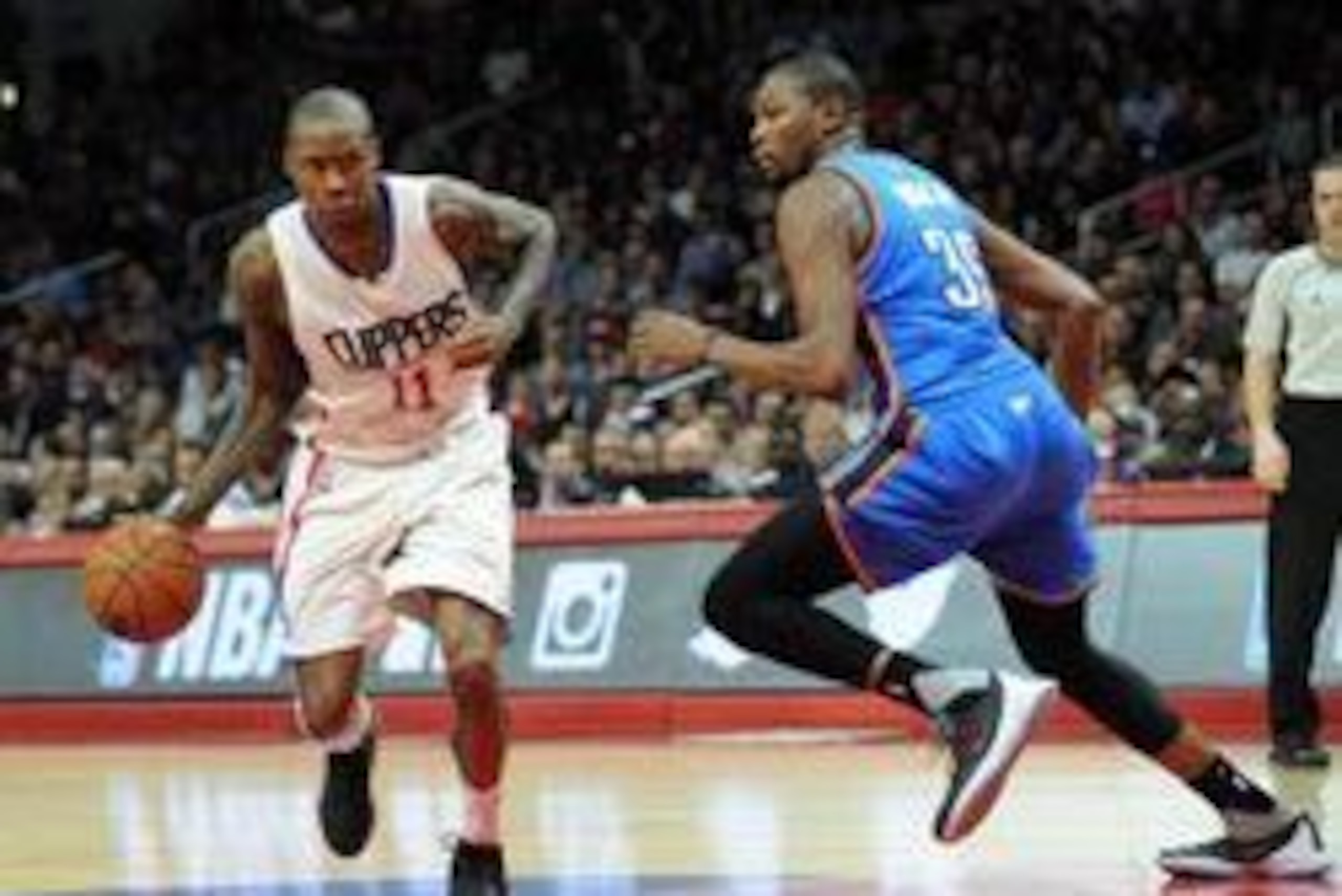
Westbrook and Durant are deadly in isolation, and they've fortunately been able to keep the clutch offense more than afloat. While there's plenty of room for improvement, NBA.com shows they've scored 112.5 points per 100 possessions—the league's No. 8 crunch-time offensive rating.
Defense is the bigger issue.
The league's website shows OKC has posted a 115.2 defensive rating in the last five minutes of close games, and that mark only beats the Phoenix Suns, Philadelphia 76ers, Utah Jazz, Los Angeles Lakers and New Orleans Pelicans. That's not a group of teams you want to be associated with this season.
Part of the problem, strange as it may seem, is the offense. Westbrook's misses have created plenty of easy run-outs for other teams. He attacks with such ferocity that his momentum is going in the wrong direction when the team's opponent begins its fast-break opportunities.
Take this play against the New York Knicks for example, even if Langston Galloway missed the transition layup:
League stats show Oklahoma City has given up 13.4 points per 36 minutes off turnovers in the clutch. Only the Suns, Sixers, Brooklyn Nets and Sacramento Kings have been worse.
That's not the only problem, however. To see what's going in the wrong direction, let's take a peek at how the Thunder's defensive Four Factors have changed in crunch time:
Note: This chart is accurate through games played on March 10.
Astoundingly, OKC is holding opponents to worse shooting percentages in these situations. But it's still far inferior because it's not forcing turnovers, won't box out and fouls way too frequently.
All of this may sound like terrible news, but there's also a positive.
Teams always shoot more free throws down the stretch, simply because they often foul in close situations to try to aid comebacks. We can basically ignore that portion of the Four Factors, though it's worth noting Oklahoma City allows the 17th-most free-throw attempts per 36 minutes throughout entire games and the 10th-most in clutch situations.
Its rebounding woes and inability to force turnovers, however, are problems that can be remedied. The Thunder must grow more disciplined in late-game situations.
This team is excellent despite its failures at the end of marquee matchups. But if it starts focusing on defense and runs its offense instead of relying on the individual talents of its superstars, it could get even better.
Adam Fromal covers the NBA for Bleacher Report. Follow him on Twitter: @fromal09.
All stats, unless otherwise indicated, are from Basketball-Reference.com, NBA.com or Adam's own databases and accurate through games played on March 11.


.jpg?w=2560 "Vikings HC Called OBJ Before Release ☎️")
.jpg?w=2560 "Dak to Stroud: Get Some Wins 💯")
.jpg?w=2560 "5 NFL Players Getting Trade Buzz")
.jpg?w=2560 "NFL Won't Fine 'Beverage' Celebrations 🍻")