Minnesota Vikings: Updated Draft Big Board After 1st Wave of Free Agency
General manager Rick Spielman and the Minnesota Vikings have essentially treaded water during this year's free-agency period.
Filling depth needs with familiar faces has been a primary focus. Re-signing Tom Johnson keeps a disruptive interior defensive line intact for the foreseeable future, and returning both Joe Berger and Mike Harris provides the Vikings with backup offensive linemen who are already familiar with Norv Turner's offensive scheme.
Minnesota also replaced the departed Matt Cassel and Christian Ponder by agreeing to terms with journeyman quarterback Shaun Hill.
After getting "their guys" under contract, Spielman and the Vikings turned their attention to the wide receiver position. In what appeared to be a definitive steal, Minnesota acquired lightning-fast wide receiver Mike Wallace and a seventh-round pick for a fifth-round pick—the Vikings had recently acquired a fifth-round pick in exchange for Cassel.
By acquiring Wallace, it appeared that Minnesota would no longer be in the market for an elite wide receiver prospect. This draft-board update lasted for less than 24 hours.
The following morning, the Vikings attempted to negotiate a restructured contract with Greg Jennings, but the two sides were unable to reach an agreement, according to ESPN's Ben Goessling:
"League source says #Vikings asked Jennings to restructure, but sides couldn't reach an agreement.
— Ben Goessling (@GoesslingESPN) March 14, 2015"
As a result, Minnesota released Jennings, electing to take on $6 million in dead money in order to save $5 million, according to Spotrac.
While Wallace forecasts as an upgrade due to how well his skills correspond with Turner's system, releasing Jennings neutralized any change to the team's draft needs. It may come off as redundant, but the potential upgrade of drafting a wide receiver was not to replace Jennings.
Essentially, the Vikings have filled depth needs at defensive tackle, offensive guard, offensive tackle and quarterback while swapping in a more scheme-appropriate, younger No. 1 wide receiver (Wallace) for an aging No. 1 wide receiver primarily used as a safety net (Jennings).
In terms of the draft, Minnesota should not be concerned with defensive tackles—including USC's Leonard Williams—or defensive ends due to these being positions of strength. Brian Robison may be on the decline, but the Vikings invested an early-round selection on Scott Crichton last year.
However, the Vikings should address needs at offensive guard, cornerback, linebacker and wide receiver. Minnesota will almost certainly prepare for a worst-case scenario and address the running back position as well.
Keeping all of this in mind, let's take a look at 15 draft prospects who fit the Vikings' needs as this year's free-agency period creeps closer to the finish line.
Rounding Out the Top 15
1 of 11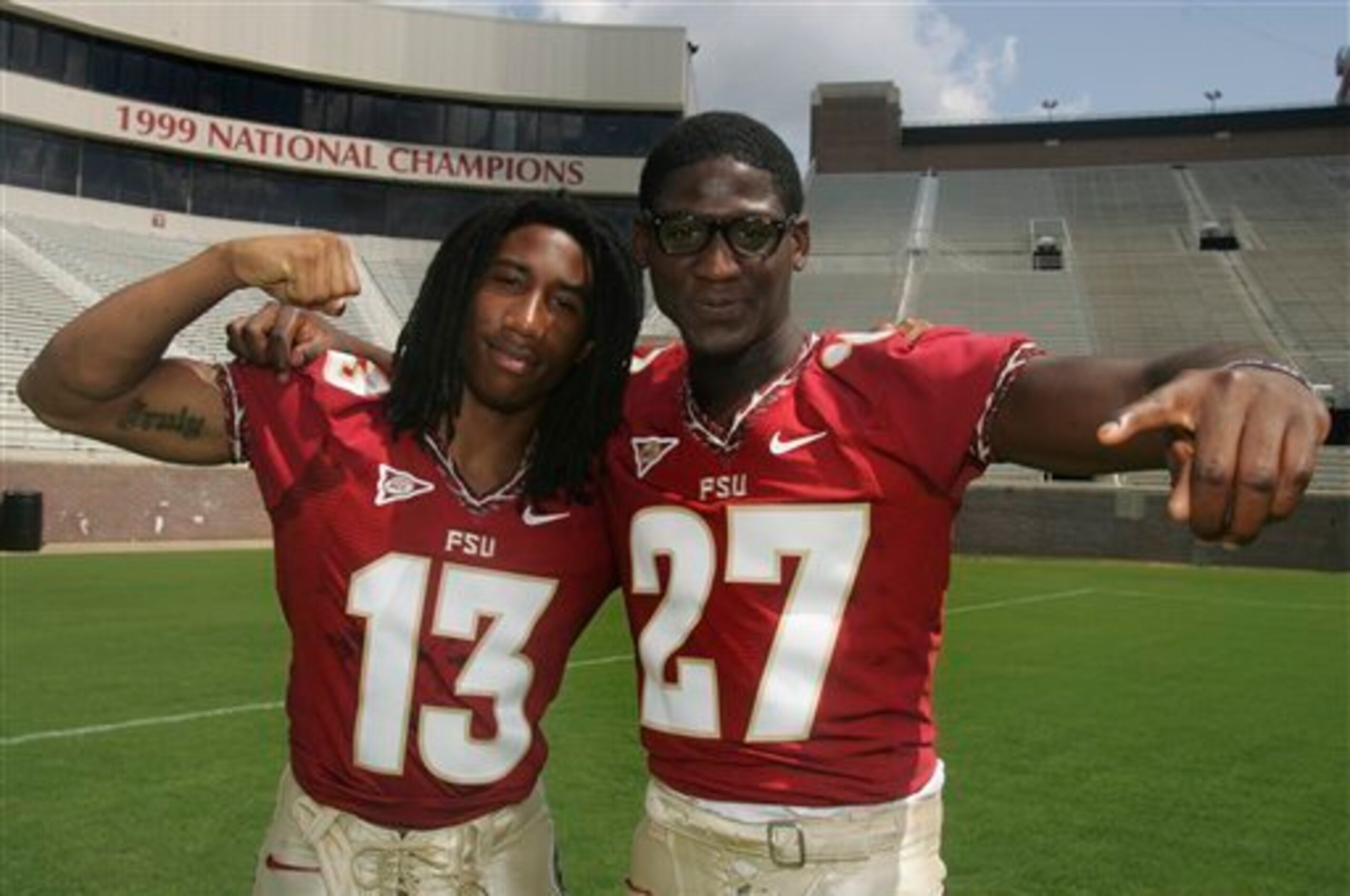
15. RB Todd Gurley, Georgia
NFL.com's Daniel Jeremiah recently noted that Gurley may be in play for the Vikings at 11th overall: "I look at a team like the Minnesota Vikings, if they decide to move on from Adrian Peterson, they're at No. 11 and could make some sense."
By this point, the injury-ridden Gurley shouldn't have much left to prove. He is a generational talent capable of impacting the game in a number of ways. He is a dynamic runner and capable receiver. He's above-average in protection and can also have an impact as a return man.
Is he worth taking 11th overall, especially after suffering a torn ACL? Probably not, but if the Vikings decide to move down, drafting Gurley to replace Peterson is the running back equivalent of moving from Peyton Manning to Andrew Luck.
14. S Landon Collins, Alabama
The 2015 draft class doesn't boast much safety talent, but Collins has some impressive traits.
He is an above-average tackler and is capable of landing monstrous hits on unsuspecting receivers. Collins is disciplined in that he plays his game, but this also can be an Achilles' heel as well. Paired with Harrison Smith, his lackluster ball and recognition skills wouldn't be as great of a concern early on. The combination of Collins and Smith could be lethal, making him a definitive upgrade over Robert Blanton.
13. OT Jake Fisher, Oregon
If Gurley wasn't already, then Fisher is likely the first surprise on this list—but he deserves to be here. The 6'6", 306-pound tackle has been rising up draft boards since the NFL Scouting Combine and has only continued to make a name for himself after an outstanding pro day.
Fisher not only possesses the necessary size for his position—gaining some weight wouldn't hurt, however—but he is also ridiculously athletic, as his MockDraftable spider chart shows. The players he shares a high percentage of common traits with—Jake Matthews (81.3 percent) and Matt Kalil (73.2 percent)—should give a vague idea as to his pro upside. He is an intelligent, charismatic player who is an above-average pass-blocker and run-blocker.
If Fisher isn't on your radar by now, he should be, as he could vault into being considered a top-three 2015 offensive tackle prospect.
12. WR Jaelen Strong, Arizona State
With size (6'2", 217 lbs) and athleticism (namely his 42" vertical jump), Strong should be considered a top-five wide receiver prospect. Despite being a bit raw in comparison to the wide receiver prospects rated above him, Strong may be a steal at his current draft projection.
He can beat defensive backs physically and athletically, and once he gets his hands on the ball he is as dangerous as anyone in open space. However, Strong is still developing the traits necessary to be a dynamic all-around receiver, and he needs to give a better effort when fighting for a poorly placed throw.
If the Vikings miss out on Kevin White and DeVante Parker, Strong is capable of fulfilling the vacant red-zone threat spot on Minnesota's wide receiver depth chart.
11. CB Ronald Darby, Florida State
Another potential surprise, Darby has been overshadowed by fellow Florida State cornerback P.J. Williams, but he may actually be more talented.
Darby is exceptionally athletic, ranking in the 90th percentile at his position in both vertical (41.5") and broad (129") jump, 40-yard dash (4.38 seconds) and 10-yard dash (1.47 seconds), as shown by his MockDraftable spider chart. When he does put himself at a disadvantage in coverage, he often is able to rebound quickly and efficiently due to his outstanding speed.
Darby possesses all the traits of an adept cover cornerback and should only get better with recognition and anticipation.
With that said, he loses his footing and gets spun around by wide receivers far too often for his level of positional intelligence and athleticism—these issues were common in his terrible performance against Miami, courtesy of Draft Breakdown. He is also a subpar tackler who struggles to get off blocks.
As a whole, he has average size (5'11", 193 lbs) but would be a great fit in Minnesota, as he formed a dynamic duo with Xavier Rhodes a couple of years back at Florida State. His toughness is frequently called into question, specifically by an unidentified ACC assistant coach referenced in Lance Zierlein's scouting profile, which is an area Mike Zimmer can help him strengthen.
10. ILB Eric Kendricks, UCLA
2 of 11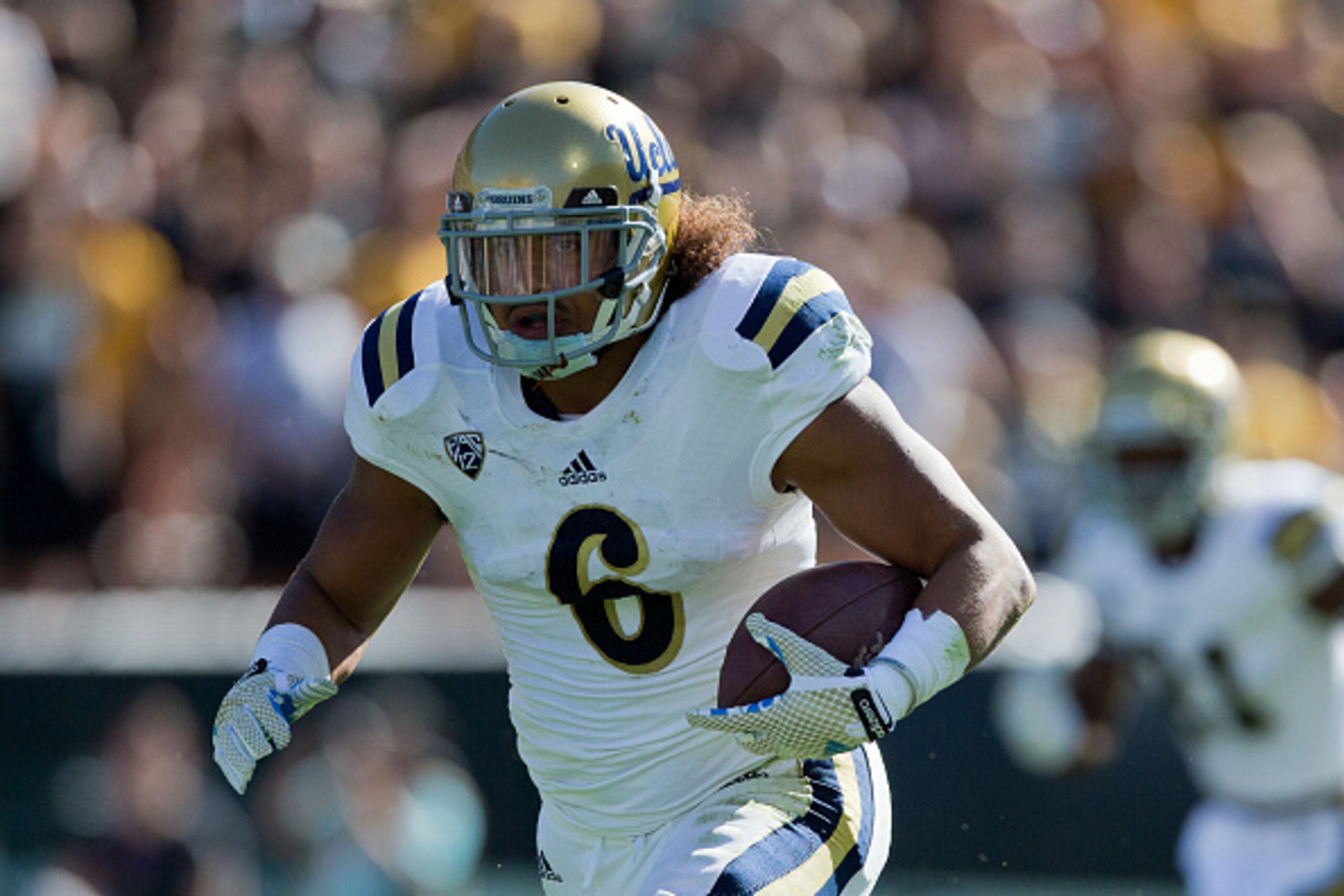
Continuing with the theme of going against popular round projections and conventional analysis in favor of acquiring the ideal, team-specific positional replacement, I give you UCLA inside linebacker Eric Kendricks.
While Mississippi State's Benardrick McKinney and TCU's Paul Dawson (pre-NFL Scouting Combine) have been soaking up praise for their natural athleticism and/or instincts, Kendricks has quietly begun to rise up draft boards. He represents a bit of a rarity, in that he is capable of impacting a game as a downhill tackler while also providing exceptional coverage—and not just relative to linebackers.
Kendricks doesn't jump off the page physically (6'0", 232 lbs), and his strength is consider far below-average (19 bench press repetitions, 16th percentile)—as shown by his MockDraftable spider chart—but physical measurements are irrelevant if the player is capable of maximizing his stature. Think about Tampa Bay Buccaneers linebacker Lavonte David, whose MockDraftable spider chart makes him look more comparable to a high school football player than a first-team All-Pro.
As previously stated, Kendricks is beginning to rise up draft boards, but he was initially tagged with a second-round grade. Based on his skill set and production, this expectation can only be supported by him being undersized for a 4-3 inside linebacker.
The UCLA standout has no issue making hard contact, despite his "physical defect." As impressive as his nose for the football is, his recognition and anticipation in coverage make him special. To paint the picture, take a gander at this pick-six courtesy of Draft Breakdown, or take it from someone who knows a little about prospect scouting, Bleacher Report's Matt Miller:
"Kendricks RT @JoaoHMacedo: if you needed an ILB good in coverage, who'd be your pick?
— Matt Miller (@nfldraftscout) March 16, 2015"
In fairness, Kendricks does have weaknesses, just like every other prospect. In addition to his subpar size, he is a complete non-factor as a pass-rusher. With that said, he wouldn't need to be as a member of the Vikings, due to the presence of Anthony Barr.
While it is merely coincidence, Kendricks (similar to the Darby-Rhodes combination) also played together with a current Viking. Specifically, he played alongside Barr at UCLA just one season ago. Here is an example of the linebacking duos chemistry at its most basic level:
"true @EKLA6 RT @JoshNorris: Eric Kendricks. Top 10 talent.
— Anthony Barr (@itheeayb) February 17, 2015"
One could make a fair and (nearly) definitive argument that Minnesota has not had the luxury of having a playmaker at middle linebacker since before E.J. Henderson broke his leg back in 2009. Assuming Kendricks is used within his skill set—and this shouldn't ever be a concern with Zimmer at the helm—he can certainly be this player.
Between McKinney, Dawson, Denzel Perryman, Stephone Anthony and Kendricks (generally considered the five best inside linebacker prospects), the UCLA product arguably has the highest floor. His ceiling may not be as high as McKinney's or Perryman's, but he can get the job done consistently at an above-average level.
For a Vikings team that only put its middle linebacker on the field for 471 snaps in 2014, according to Pro Football Focus, Kendricks may not be worth a top-20 selection.
With that said, Jasper Brinkley's low snap count could be a result of his physical limitations, as opposed to this being roughly the number of snaps Zimmer has a middle linebacker on the field. If this is the case—or if Minnesota views him as a capable weak-side linebacker as well (as some analysts do)—trading down (in accordance with how Kendricks is valued by popular opinion, not ability) to add him would be an immediate and definitive upgrade at middle linebacker.
He is only ranked 10th on this list, but Kendricks is a pro-ready inside linebacker who will have an impact when he steps on the field during Week 1 of the 2015 season.
9. OT La'el Collins, LSU
3 of 11
This edition of the NFL draft is loaded with talented Collinses, and La'el ranks No. 1 on the Collins big board. For reference, OT La'el Collins, SS Landon Collins and CB Jalen Collins all qualify as first- to early second-round talent.
Anyways, Matt Kalil had another disappointing year with Minnesota in 2014—but he actually did play average football from Week 13 to Week 17, according to Pro Football Focus.
His unbelievable Pro Bowl season as a rookie back in 2012—when many were viewing him as the next Joe Thomas (Cleveland Browns)—is beginning to be painted over by the Byron Bell (Jacksonville Jaguars) version of Kalil that appeared (and won't leave) during the 2013 season.
The former top-five pick is under contract with the Vikings for one more season, at which point Minnesota will have the option to cut its losses, assuming he continues to struggle next season. This is where the "consistently boring" Collins, as SB Nation's Stephen White put it, comes in.
White has a number of excellent observations in his article, but there may not be a better description of Collins' technique than this:
"One of the things I prize in offensive linemen is consistency. That is especially true when it comes to pass blocking technique. Watching Collins sit back to pass block reminded me of watching Taylor Lewan last year; everything looked the same from play to play no matter the opponent. Collins was so consistent with his patience and footwork that I had to rewind to make sure I wasn't watching the same play over and over again.
"
Consistency tends to be a good thing in just about every rhythmic concept in sports. Personally, I like to compare a pitcher's windup in baseball to the technique of an offensive lineman, specifically tackles because their form is more critical to having sustained success.
Simply put, the same consistent pitching delivery in baseball—see Greg Maddux, who literally told baseballs where they were going to land in the catcher's mitt—allows one to control the placement of a ball better. This tends to be, at the very least, similar with linemen—the more consistent an offensive tackle is, the easier time he will have moving one defender to the left and another defender, who uses a completely different pass-rush technique, to that same spot on the left side.
Getting back to White's point, it is rare to see Collins change his form; it's almost like he is set to a tune. Without this impeccable form and above-average athleticism, he probably isn't a first-round draft pick (at least as a tackle), because, as shown by his MockDraftable spider graph, his size (6'4", 305 lbs) is barely even comparable to other tackle prospects.
However, returning back to how he fits in Minnesota with Kalil, his stature in comparison with other guard prospects ranks in a noticeably higher percentile (still below-average but considerably higher), and his athleticism generally scores better as well. Since he is so consistent with his technique and style, he likely wouldn't have much difficulty applying his approach to the left guard position.
Assuming Kalil has success next season, and Collins does as well, the pairing could form a barrier along the left side, but if Kalil can't regain his 2012 form (again), Collins could transition over to left tackle when Minnesota allows Kalil to sign with a different team in free agency after the 2015 season.
Collins would basically serve as a safety net with a purpose. He represents an immediate upgrade to Charlie Johnson, and he would be a significant upgrade over 2013-14 Kalil as well.
Aside from being undersized, Collins doesn't have any run-and-hide issues in his game. As noted by Zierlein, an AFC offensive line coach believes that his hands are "bad" as a pass-blocker. Honestly—and I know I'm disagreeing with a professional offensive line coach here—I don't see this issue consistently, and it doesn't appear to keep him from completing his objective.
Obviously, there is something to this comment, as coaches don't just talk down about NFL prospects to hurt their feelings. The underlining point is that his "bad hands" are an issue that is coachable, which leads me to believe that he can become even more fundamental and consistent than he already is, which would make him the human equivalent of a robot.
The videos embedded within White's article do an excellent job of showing his consistency, and this video, courtesy of Draft Breakdown, does a definitive job of showing Collins' mauling tendencies as a run-blocker—and yes, that is top-five prospect Dante Fowler Jr. he is throwing to the side like a rag doll.
Simply put, Collins is a complete player with above-average marks in consistency, fundamentals, pass blocking, run blocking and attitude. The only knocks on him are his size, which is irrelevant if he is maximizing his stature, and his alleged "bad hand technique."
He is a great fit with the Vikings, as he can contribute immediately as a guard (a position he likely has even better potential at) and provide stability in a worst-case scenario with Kalil.

.jpg?w=2560 "Commanders Eagles Football")
8. CB Marcus Peters, Washington
4 of 11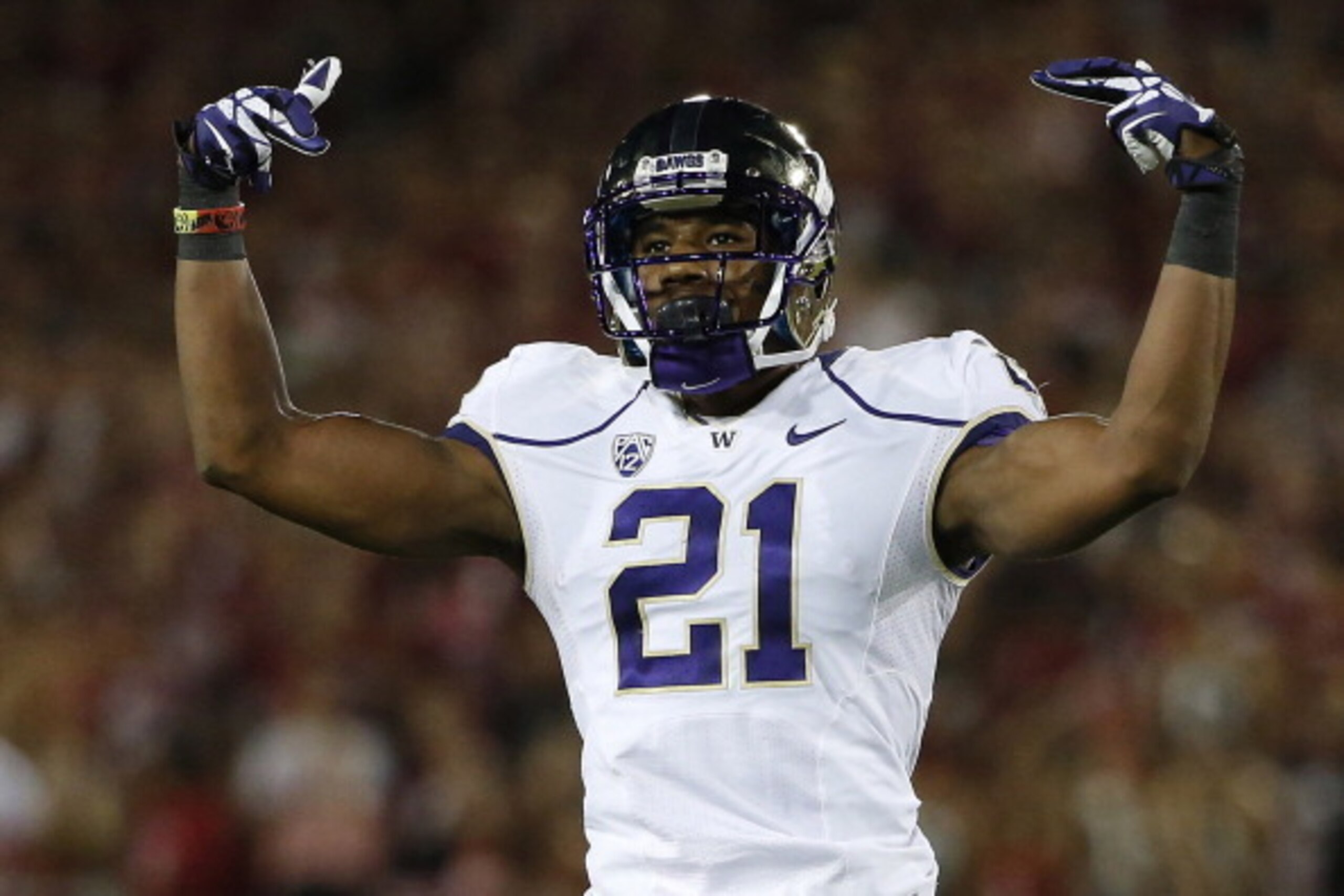
To make a long sports opinion short, this guy belongs in the Seattle Seahawks secondary.
Standing at 6'0" and weighing 197 pounds, Marcus Peters ranks close to the 70th percentile in physical stature, as shown by his Mock Draftable spider graph. More importantly, however, Peters uses his size to his advantage, which is something that opposing wide receivers are supposed to be doing to him.
He consistently controls the route tree of receivers while in press coverage, throwing them off their cuts or simply taking them out of the play. He is strong and moves fluidly, which are two traits that make breaking his press coverage an issue.
At times, Peters' movements are so fluid and definitive in press coverage that he looks like the one running a route.
While his game is built around physicality and toughness, he also possesses a strong understanding of his position, great anticipation and adept recognition skills. Combined with his outstanding ball skills—there isn't a better defensive back prospect this year at turning into a wide receiver with the ball in the air—these traits make him a weapon on defense.
If a wide receiver loses track of the flight of the ball, doesn't attempt to high-point the pass or just waits for it to reach him, Peters will turn into the wide receiver and take advantage of these fundamental errors.
This video, courtesy of Draft Breakdown, displays Peters' attack dog-style of cornerback play in a nutshell. Using his anticipation and a quick read of the opposing quarterback's eyes, Peters ditches his man and launches his body in front of the incoming crossing pattern. Despite possessing below-average speed (38th percentile in 40-yard dash) and explosiveness (17th percentile in three-cone drill), the former Washington cornerback is capable of getting from Point A to Point B faster than the opposition due to a combination of intelligence, anticipation and play recognition.
Although it may come secondary to cornerbacks, Peters is also an aggressive tackler who wraps up at the legs and forces the opposition to tumble. Here is a video, courtesy of Draft Breakdown, that captures both his solid form and intensity.
He also has much less of an issue shedding blockers, likely a result of his size and physical nature, and takes good angles to the ball-carrier. Peters seems to enjoy the process of getting to, wrapping up and bringing down opposing ball-carriers more than most cornerbacks.
Since Peters, a former standout at Washington, doesn't rely on one specific physical or athletic trait (that likely is common at the NFL level), he projects as a Day 1 starter, according to Miller. This tweet also signals good news for No. 11 on the big board, Ronald Darby:
"Sorry, missed the "help" part. Marcus Peters, Ronald Darby can be rookie starters. Both top 15 talents though @awesomedawson69
— Matt Miller (@nfldraftscout) March 12, 2015"
So, to recap, Peters is slow and lacks explosiveness, but this rarely affects the results of his performance, and he receives above-average marks in virtually every other cornerback-specific area. Plus, he's one of the better tackling cornerback prospects this class has to offer.
What could go wrong?
When using the term "former Washington standout," it is important to mention that he dismissed from the football program after nine games in 2014. This dismissal comes following a suspension, multiple meltdowns and tantrums and frequent run-ins with coaches that may indicate one thing: He does not accept coaching, per Zierlein.
Essentially, Peters is an eight-year-old kid who plays cornerback at an NFL-caliber level. Although there are other logical fits (New England Patriots, always), Peters seems to have the talent and issues of a Zimmer rebuilding project. The Minnesota coach has been a major factor in revamping the personalities of multiple "character issues" cases, including linebacker Vontaze Burfict and possibly the most publicized "character issue" in NFL history, Adam "Pacman" Jones.
Zimmer's no-nonsense coaching style and powerful demeanor that commands the respect of his players make perfect sense for a player like Peters, who brings considerable "emotional issues" to the team that drafts him.
While concerns about his personality and overall dysfunction may drop him into the late first round or early second round, Peters is a top-10 talent in this class. The Vikings may be better off going with one of the players higher on this list at No. 11, but Peters can have the immediate impact that warrants being selected in the top 15 and more specifically at No. 11.
7. CB Trae Waynes, Michigan State
5 of 11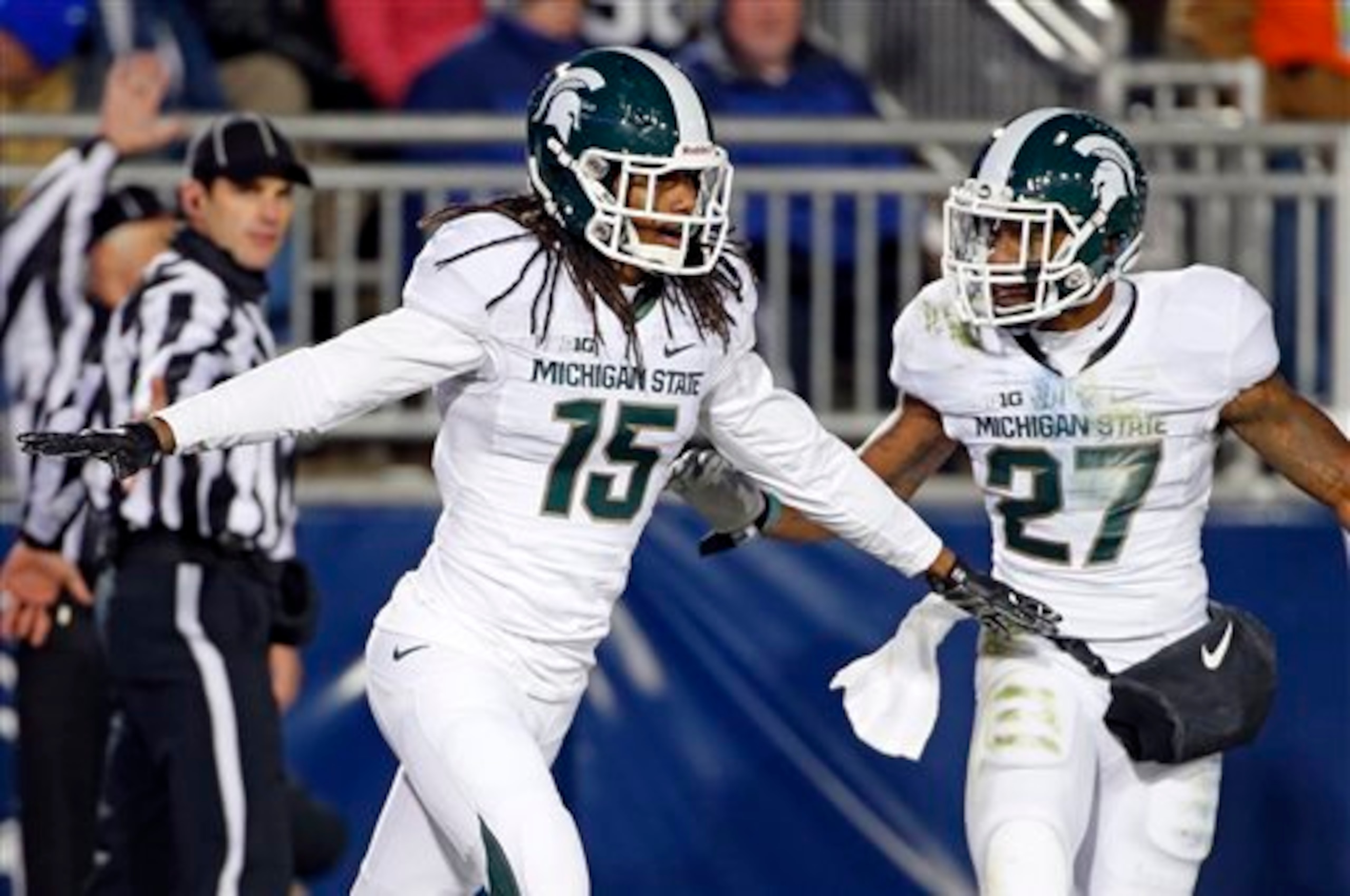
2013 first-round pick Xavier Rhodes took the next step for the Vikings this past season, but the cornerbacks playing opposite of him still leave a lot to be desired.
Captain Munnerlyn's history suggests he will be considerably better in his second year playing in Zimmer's defensive scheme. He recorded a minus-8.2 Pro Football Focus rating in his first year with the Carolina Panthers before improving to a plus-3.9 in his second season. With that said, Munnerlyn primarily handles the slot coverage in Minnesota, so he won't line up opposite Rhodes on most plays.
Assuming the Vikings don't add a cornerback in free agency or through the draft, this means that Josh Robinson likely will handle the No. 2 cornerback duties again in 2015. He wasn't consistently ineffective, but he is what he is—an undersized cornerback (5'10", 199 lbs) who struggles in coverage against tall wide receivers.
Brandon Marshall won't be haunting Robinson and the Vikings next season, but Calvin Johnson and Alshon Jeffery still inhabit the NFC North, and it should be expected that Joe Lombardi (Detroit Lions offensive coordinator) and Adam Gase (Chicago Bears offensive coordinator) will find ways to get their tall targets matched up on Robinson.
Marcus Peters will be an option, but the supremely athletic Trae Waynes is the better choice for Minnesota.
Waynes (6'0", 186 lbs) doesn't possess the length (31" arms, 29th percentile) that generally helps in defending against tall wide receivers, but his elite speed (4.31 second 40-yard dash, 98th percentile), vertical jump (38", 73rd percentile) and surprising upper body strength (19 bench press repetitions, 84th percentile)—as shown by his MockDraftable spider graph—are (very) basic indicators of potential success against big-body receivers.
More importantly, Waynes utilizes his physical assets in coverage. Arguably his greatest selling card to interested teams is his excellence in man-to-man coverage. During his time at Michigan State, he frequently played the "Darrelle Revis" role for the Spartans defense, going head-to-head with the opposing team's most dangerous receiving threat.
According to Zierlein, Waynes allowed just two touchdowns over the course of his final two seasons in college. The fact that he was only responsible for two scores in 27 games played is impressive enough, but the fact that he consistently did so in one-on-one coverage against the opposition's best chance to score through the air puts him in a different league entirely, relative to the 2015 class of defensive backs.
As notable as these statistics are, Waynes' film is even more telling of his potential greatness. He's not perfect by any means, as no cornerback is, but he rarely fails consistently. In fact, the mirror coverage displayed in this video, courtesy of Draft Breakdown, represents a microcosm of his coverage career at Michigan State.
Even when Waynes is beaten off the line, he possesses the necessary speed to close the gap quickly enough to make a play on the ball. While he almost always factors into balls thrown in his direction, Waynes doesn't have great ball skills. There are far too many instances like this one, courtesy of Draft Breakdown, when he can use his perfect positioning to create a turnover but fails to catch the ball cleanly.
Waynes also tends to be too aggressive with his hands. He was frequently penalized in coverage for placing his hands on the opposition too early or after the wide receiver made it more than five yards off the line of scrimmage. This isn't a skill-set issue, but it is something Waynes will have to improve on immediately due to the increased number of illegal contact flags being thrown at the NFL level.
Regardless of these weaknesses, Waynes is still the best cover corner in the 2015 class. Additionally, he also is a fundamental tackler and isn't afraid to gets his hands dirty like the stereotypical coverage specialist.
The Vikings have already noticed the upside of Waynes, as he has plans to meet with the organization, according to Chris Tomasson of the Saint Paul Pioneer Press. Minnesota may have better options available with the No. 11 pick, but adding this Michigan State product would be a definitive boost to the team's secondary.
"Michigan State cornerback Trae Waynes to visit Vikings. http://t.co/O47y01i7XR
— Chris Tomasson (@christomasson) March 16, 2015"
If nothing else, a potential Rhodes-Waynes duo would garner some excellent nicknames:
"@christomasson #WaynesWorld and #RhodesClosed
— Ryan (@r_mack) March 16, 2015"
6. OT Brandon Scherff, Iowa
6 of 11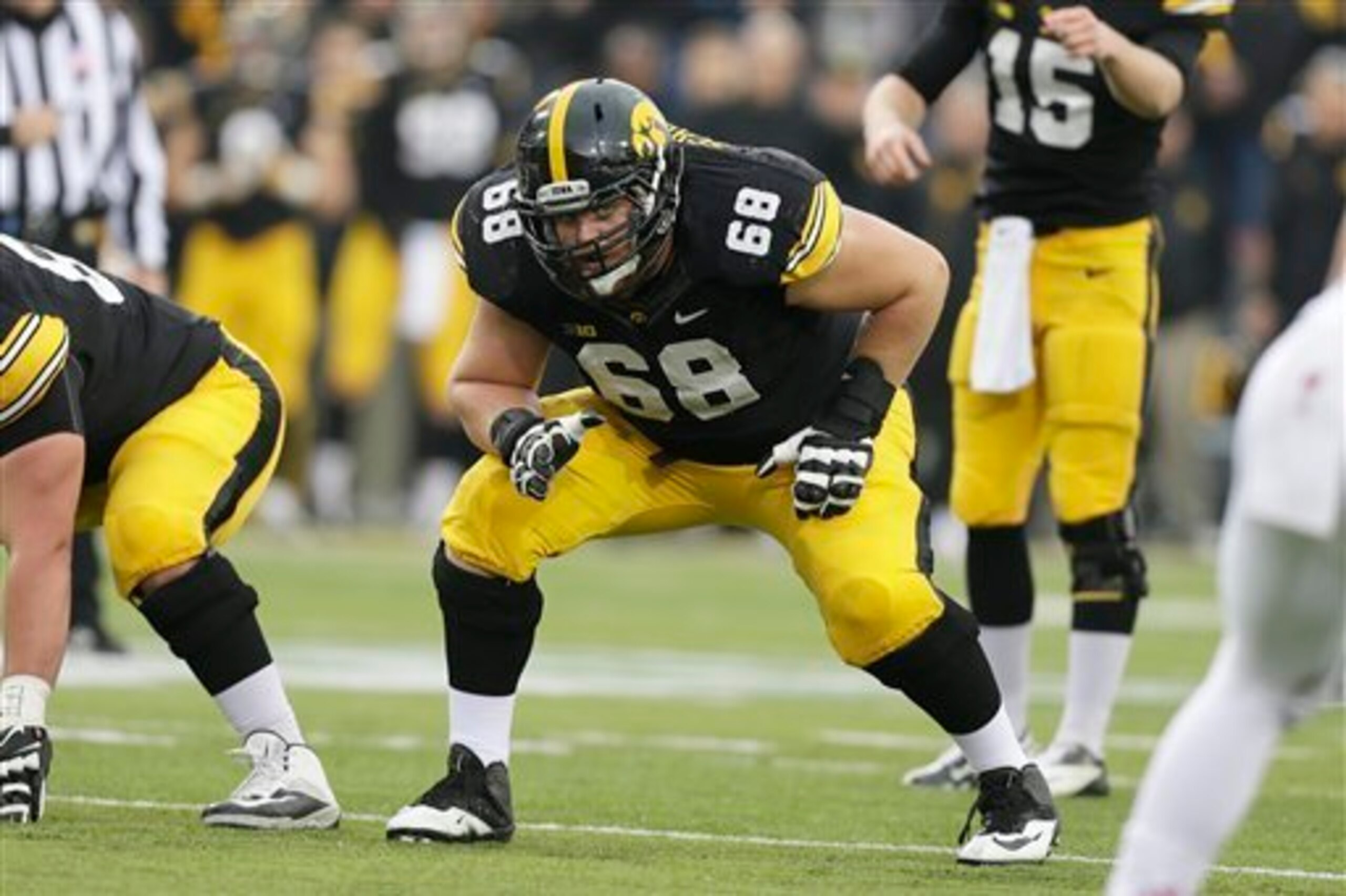
Following the Mike Wallace acquisition, many Vikings fans shifted their focus to improving the team's offensive line. If addressing their offensive line is the Vikings' next plan of action, Brandon Scherff is the man for the job, as he is the top-rated offensive tackle for nearly every draft analyst.
Scherff isn't a monster by any means, as his height falls in the 14th percentile, relative to other offensive line prospects, as shown in his Mock Draftable spider graph. At 6'5", 319 pounds, Scherff looks more like a guard than a tackle. As one would expect, his measurements in comparison to guard prospects are far more favorable, as his height and weight rank in the 63rd and 67th percentile, respectively.
Similar to Collins, Scherff is a nice fit with the Vikings due to being both a safety net and an immediate impact player. Given Minnesota's growing need for a difference-maker at left guard, drafting him at No. 11 to fill this hole (and potentially replace Matt Kalil down the line) isn't too much of a stretch.
Generally speaking, quality guards don't hear their names called until the second or third round due to positional importance—this is why there aren't any guard prospects on this list. While drafting a guard in the first round would be a mistake, acquiring a player such as Scherff to play guard until he is needed at tackle is a solid investment, especially considering the importance of protecting quarterback Teddy Bridgewater.
In terms of his skill set, Scherff already run-blocks at an NFL level. According to Zierlein, he doesn't maintain the dominating, violent personality that many of the best offensive linemen do. With that said, neither does Browns left tackle Joe Thomas, and he seems to be doing just fine—this is not a comparison between Thomas and Scherff but rather a note on offensive linemen personality traits.
As good as Scherff is as a run-blocker, he's still developing his technique as a pass protector. NFL.com's Daniel Jeremiah notes his flaws in this role:
"Iowa OT Brandon Scherff has some flaws in pass pro but I love the way he finishes as a run blocker...Snap to whistle every time.
— Daniel Jeremiah (@MoveTheSticks) December 31, 2014"
Although Scherff is still working toward becoming a dominating pass-blocker, he is by no means a liability in this facet of the game. His athleticism, solid technique and ability to sustain a block can be seen during his game against Indiana, courtesy of Draft Breakdown.
If Minnesota pulls the trigger on Scherff, chances are he would begin his career playing guard anyways, a position that puts less of an emphasis on pass protection. Due to Scherff's need to improve in pass protection and the Vikings' interest in allowing Kalil one final year to regain his Pro Bowl form, this could be a mutually advantageous business venture.
While adding an offensive lineman in the first round is never a sexy pick, this may be something Spielman and the Vikings feel is necessary to protect their investment (Bridgewater).
5. OLB Shaq Thompson, Washington
7 of 11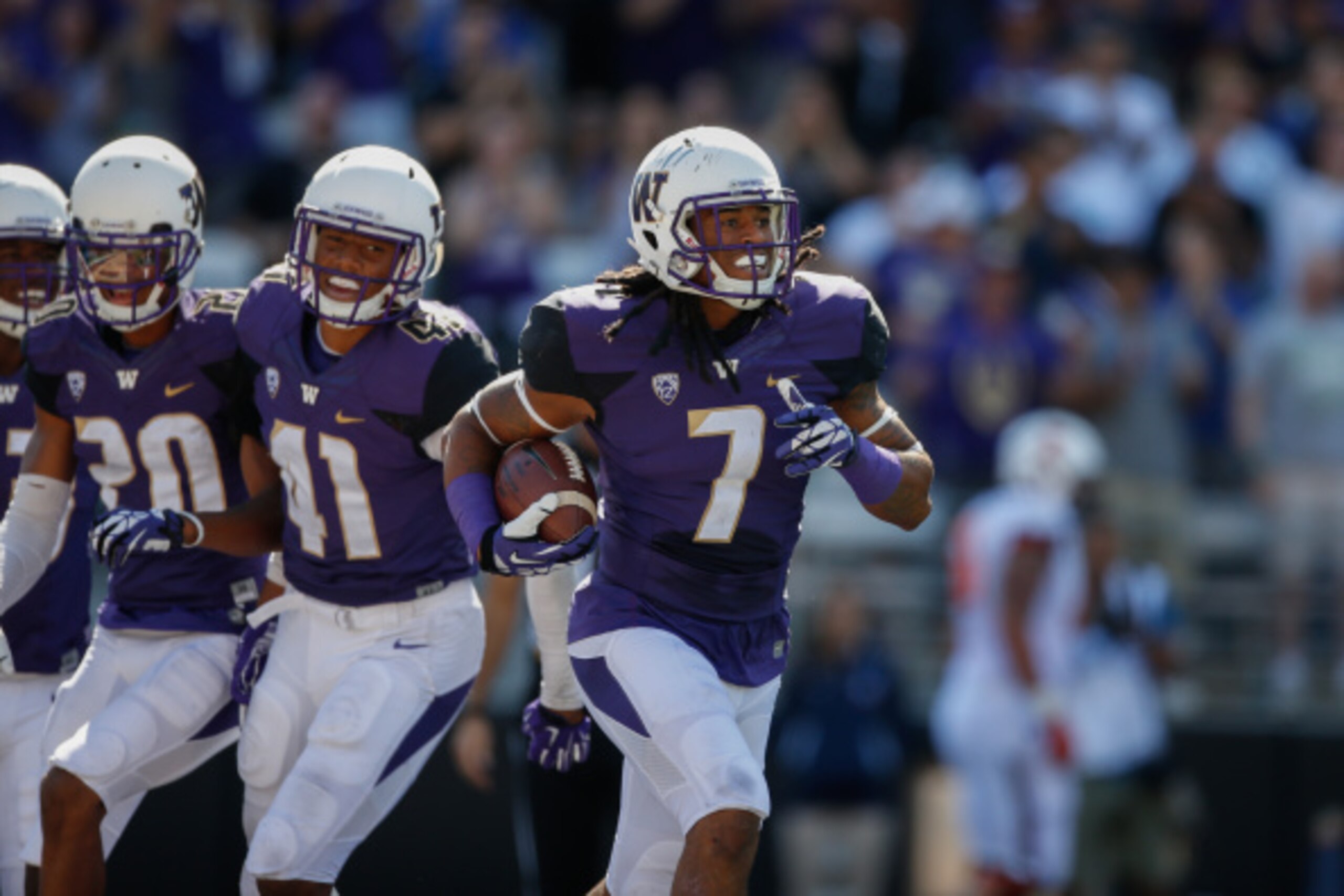
There may not be a more debated prospect than former Washington linebacker, safety and running back Shaq Thompson.
Not only is his skill set frequently scrutinized, but his versatility creates further debate as to what position he should play at the NFL level. Thompson, the recipient of the Paul Hornung Award given to the most versatile player in college football, successfully played three different positions.
As a true junior last season, Thompson accumulated 81 total tackles, one sack, one interception, one defensive touchdown, four pass defenses, 456 rushing yards, two touchdowns, four receptions, 56 receiving yards and a per-touch average of 7.9 yards, according to Sports-Reference.com.
Given his extensive, diverse statistical totals, it shouldn't be too surprising that different analysts have him listed at different positions based on his skill set. It is worth noting that he participated at the NFL Scouting Combine as a linebacker and has said he intends to play linebacker in the NFL, per NESN.com.
For example, NFL.com's Mike Mayock has the Washington gadget listed as his No. 2 safety. NFL.com's Chris Petersen believes he is best-suited at running back, and almost everyone else, including me, ranks him as a top-five outside linebacker.
In fact, Miller was willing to suggest a pretty generous NFL comparison for Thompson:
"I compared Shaq Thompson to NaVorro Bowman...could be a rare athlete in coverage + range. Only question is instincts from LB.
— Matt Miller (@nfldraftscout) March 16, 2015"
Given Bowman's track record, it's easy to be skeptical of this comparison. With that said, Thompson is solid in coverage, relative to the safety position, which puts him in elite territory when compared to other outside linebacker prospects.
In terms of combine measurements, Thompson and Bowman actually match up pretty well against each other. However, Thompson and Bowman could have identical measurements and combine results, but if Thompson lacks the necessary instincts to play outside linebacker—as Miller notes—he won't ever come close to reaching Bowman's NFL status.
As flattering as a comparison to Bowman may be, Thompson could have more success blazing his own trail. It's almost a certainty that he doesn't possess the 49ers standout's tackling ability or instincts, but Thompson's positional versatility is one-of-a-kind. If paired with the right defensive mind, the Washington standout's NFL potential could be limitless.
Based on this notion, Thompson's future impact is difficult to project because his impact will largely be determined by how well his diverse traits are utilized. As it turns out, the Vikings head coach happens to be one of the most creative and well-respected defensive minds in the NFL.
Since I am not Mike Zimmer and do not possess his gift to develop prospects and maximize their potential by utilizing their skill set in the best possible ways, it's difficult to describe how he may potentially fit in a Vikings uniform.
Given what is known about Thompson—he has excelled both as an outside linebacker and safety—however, Minnesota could potentially fill one or two of its draft needs by adding him.
For example, in the base 4-3 defense, Thompson could line up at safety opposite of Smith, utilizing his coverage and ball skills to make Minnesota's secondary more dangerous and unpredictable. In this scenario, either Chad Greenway or Gerald Hodges could line up at weak-side linebacker.
When the Vikings utilize their nickel defense, however, Thompson's role could change—initially, these frequent positional changes should be hard for opposing offenses to account for, which is an asset in itself. In this formation, Thompson would, in theory, line up at weak-side linebacker with Robert Blanton being inserted at strong safety. Inherently, the nickel defense intends to protect against the pass, with an excess of defensive backs on the field.
Although Thompson possesses (much of) the skill set of a defense back, he would line up as a linebacker, effectively maximizing Minnesota's range in coverage. In theory, Anthony Barr, another versatile athlete, could be used in a number of different ways as well, creating a bunch of different defensive looks, and in turn, creating somewhat of an advantage.
Sure, much of this is dependent on Thompson's instincts at both safety and weak-side linebacker. However, instincts can be developed with the right defensive mind in charge, and Thompson possesses the necessary athleticism, coverage skills and tackling ability—courtesy of Draft Breakdown—necessary to excel in both roles.
As a whole, Thompson is an interesting gadget to mess around with in different roles—I didn't even note that he could fill in at running back if Adrian Peterson doesn't return. Between Zimmer and Turner, Minnesota maintains one of the most experienced and creative coaching staffs in the NFL, making Thompson and his diverse skill set a perfect fit for the Vikings.
4. WR Amari Cooper, Alabama
8 of 11
Between Amari Cooper, Kevin White and DeVante Parker, a wide receiver-needy team can't really choose wrong, so deciding which to draft comes down to scheme fit.
Cooper is arguably the most complete and dynamic member of this trio of receiver prospects, and those skeptical of the level of importance of the NFL Scouting Combine likely have him listed as the class' best option at this position.
Essentially, what his position on this big board comes down to is his size and best skills in comparison to both White and Parker.
Beginning with size, Cooper's 6'1", 211-pound frame is the smallest of the compared receivers. As shown by is MockDraftable spider graph, he ranks in the 35th and 71st percentiles in height and weight, respectively.
As important as this may be when compared to the other top receivers relative to the Vikings, Cooper's size won't hold him back at all, and he will dominate wherever he ends up—this big board assumes that all 15 of these prospects reach the Vikings, which obviously will not happen, but in terms of Cooper specifically, it would be surprising to see him make it past the New York Giants at pick No. 9.
Stop and consider a duo of Odell Beckham Jr. and Cooper for just one moment and ask yourself if you would pass up that opportunity.
Moving on, Cooper is surely the most fundamental receiver of the trio, as he runs the tightest routes, has an excellent release from the line and possesses top-notch body control and ball skills. He basically is a machine limited only by his lack of above-average height. To put these skills in perspective, here is a video—courtesy of Draft Breakdown—epitomizing his release, route running, ability to cut on a dime and overall perfect model of his position.
By this point in the draft process, Cooper's positional excellence should not come as a surprise. He has received marveling reviews from everyone who has had the pleasure of watching him work.
Most recently, former defensive back and current Fox college football analyst Charles Davis recently told the Saint Paul Pioneer Press' Chris Tomasson that his status as one of the year's top prospects is effectively sealed as a top selection:
"Just talked to Charles Davis at Alabama Pro Day. Lauded Amari Cooper saying, “He did not change anybody’s opinion of him. Can flat-out play"
— Chris Tomasson (@christomasson) March 11, 2015"
This praise is nothing new to the Heisman finalist, as he has always been considered a top wide receiver and elite prospect. With that said, he would be a huge addition to the Vikings offense—he may already be a better option than Mike Wallace at this point in their careers.
There is a realistic chance that Cooper would compete to be the No. 1 wide receiver on Minnesota at some point during the 2015 season. His chemistry with Bridgewater—the duo were teammates back in high school—cannot truly be quantified, but one would assume the pairing would have an instant connection.
However, Cooper's skill set, while significantly more refined than the majority of Minnesota's current receivers, does not add a new pass-catching dimension to the depth chart. On the other hand, both White and Parker offer a unique element that Minnesota's offense currently lacks.
These aspects will be examined further later.
As a whole, drafting Cooper would upgrade the Vikings offense and pair Bridgewater with not only his high school teammate but also a talented pass-catcher to develop and succeed with.
3. WR DeVante Parker, Louisville
9 of 11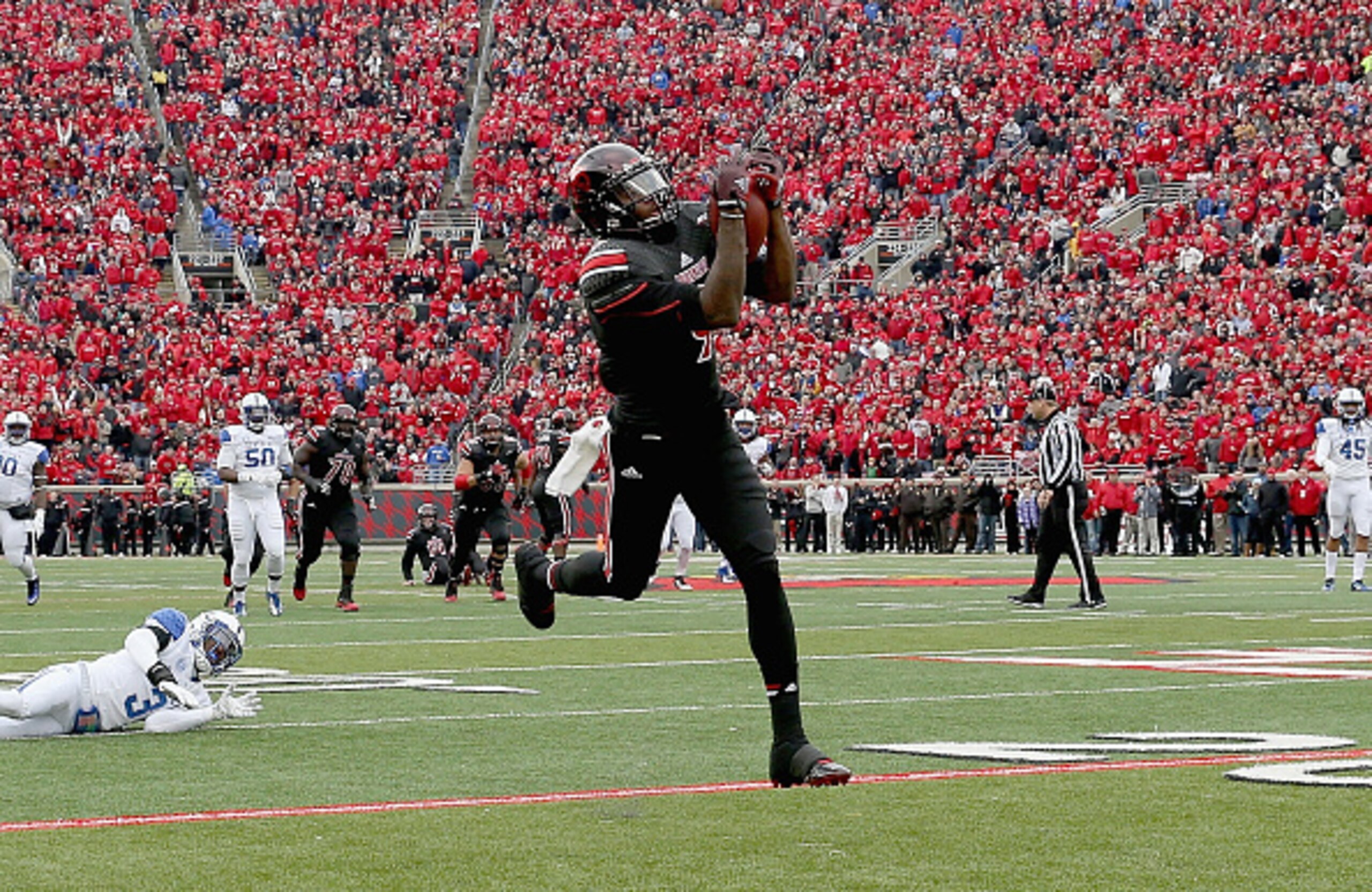
Vikings fans and prominent readers of mock drafts have become familiar with Louisville's DeVante Parker and Minnesota being paired together.
Despite being a little lost in the debate between Cooper and White, Parker maintains a host of desirable abilities. Most importantly, he demonstrates the pass-catching quality the Vikings desperately need: height and length.
More importantly, he uses these physical qualities to gain an advantage over the opposition, something Cordarrelle Patterson (6'2") and Charles Johnson (6'2") have not yet shown an ability to do.
As shown by his Mock Draftable spider graph, Parker's 6'3", 209-pound frame places him in the 78th (height) and 65th (weight) percentile, relative to wide receiver prospects. In addition, he possesses an arm length over 33" (82nd percentile) and a 36.5" vertical leap (60th percentile). Each of these physical assets combined with an adept understanding of how to use them to create an advantage is what makes him an elite prospect.
Many analysts put Parker behind Cooper and White because he is not as fundamentally sound as the higher-ranked pair of wideouts. This is a fair observation, but it also insinuates that Parker possesses unrefined receiver skills, which is false.
In fact, of the top three receiver options, Parker may be the best at releasing from the line of scrimmage, creating instant separation from the defensive back in coverage. Brendan Leister of DraftBrowns.com put a bit of a humorous spin on Parker's prowess at releasing from the line of scrimmage:
"DeVante Parker could hold a clinic on WR releases.
— Brendan Leister (@BrendanLeister) March 14, 2015"
This video—courtesy of Draft Breakdown—showcases just how difficult Parker is to break off his route and definitively proves the reality of Leister's statement.
As this brief clip shows, Parker has no issue breaking away from press coverage. He uses his above-average athleticism, agility and surprising explosiveness to break free from the defensive back's first line of defense.
Next, Parker utilizes his size and refined route-running ability to create a spot for his quarterback to place the ball. Generally speaking, an accurate quarterback is capable of placing his pass right into this space where only Parker is capable of making a play on the ball. Although the defensive back did fall down, this video—courtesy of Draft Breakdown—gives a good idea of how Parker gains this edge.
In the above referenced clip, Parker turns on the jets and blows past the safety without even having to utilize his belittling open-field skills.
Had Parker been taken down at the goal line, he would have had the chance to exhibit the abilities that make him a nightmare in the red zone. Parker is also an above-average blocker, which he proves in this video—courtesy of Draft Breakdown.
The opposing defensive back was forced to play off Parker to respect his receiving skills at the goal line, which allowed him a running start into this lane-creating block. He sustains the block for more than five seconds, allowing his running back plenty of time to cross the goal line.
Finally, Parker is great at catching the ball at its highest point, which specifically comes in handy at the goal line. Minnesota has lacked a true red-zone threat for the majority of the past two seasons due to injuries to tight end Kyle Rudolph. It is this specific element of Parker's game that places him ahead of Cooper on Minnesota's big board.
Understand that Parker utilized this ability all over the football field throughout his Louisville career, but it his consistency in the red zone that truly has teams salivating. This video—courtesy of Draft Breakdown—diagrams this key element of Parker's game.
As a whole, Parker isn't nearly as refined as Cooper—few wide receivers are—but his height, length and physicality are a perfect match opposite of Mike Wallace in Norv Turner's offensive scheme. For those who remember the dominating San Diego Chargers offense from the late 2000s, think of Parker as the Vincent Jackson of that top-ranked system.
The Vikings don't necessarily need a wide receiver like Parker, but with the combination of a deep threat (Wallace) and a tall, physical receiver (Parker) at his fingertips, the exceedingly accurate Bridgewater would have all the elements necessary to turn this currently average group into a top-ranked unit.
2. OLB Vic Beasley, Clemson
10 of 11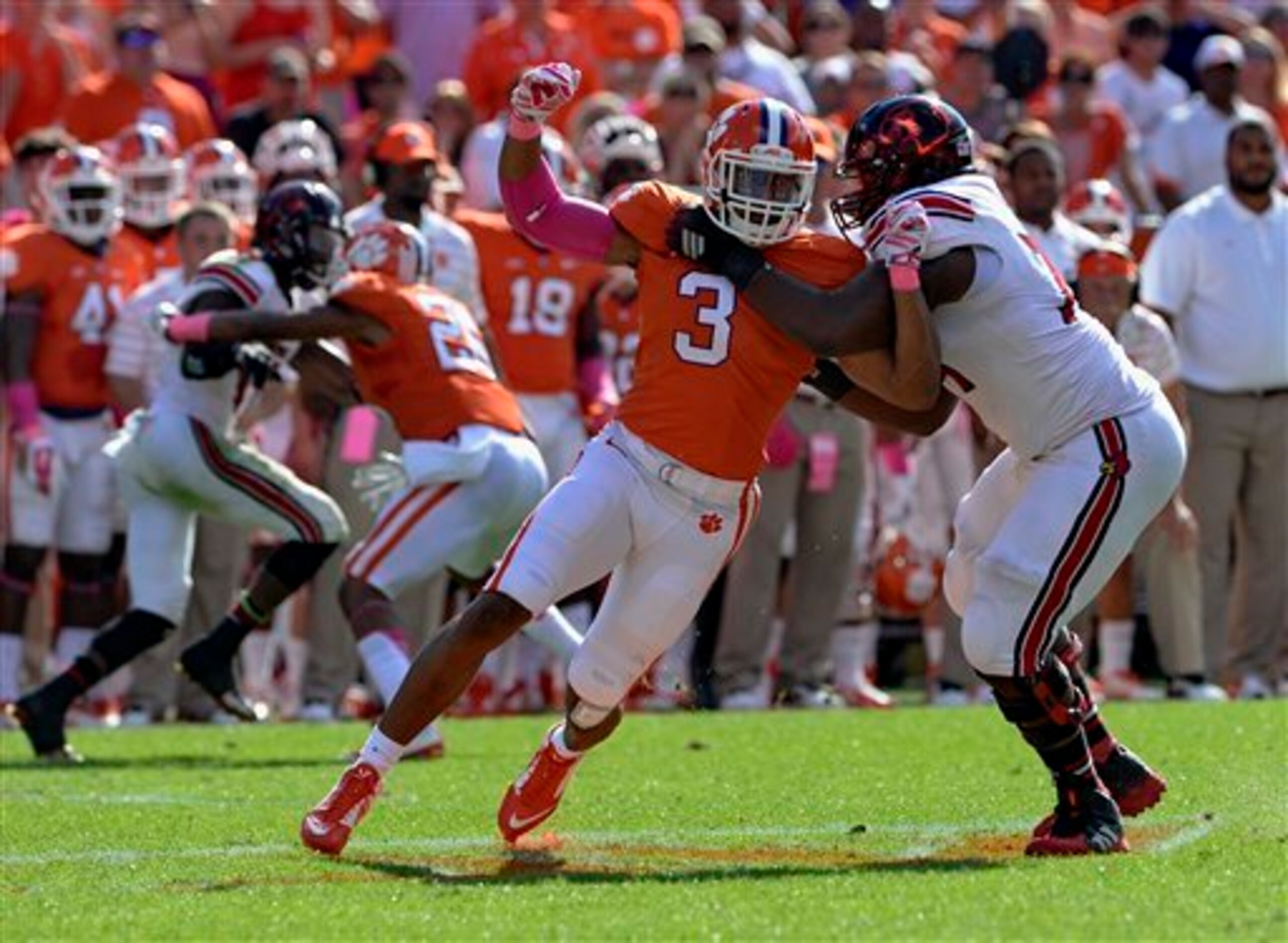
Separating the pair of sizable wide receiver prospects is scouting combine legend and Clemson defensive end/outside linebacker Vic Beasley.
To set the tone, the following is a statement from former Clemson and current Pittsburgh Steelers quarterback Tajh Boyd, a graduated teammate of Beasley's, classifying his level of athleticism:
"I think that he's an instant-impact player in the NFL," former Clemson quarterback Tajh Boyd told reporters during Clemson's Pro Day. "People talk about [Florida's] Dante Fowler and how he could be the No. 1 defensive player taken. But I think it be a mistake not to take Vic first. Somebody asked me who you could compare him to. You can't do it with J.J. Watt, because J.J. Watt is not as explosive as Vic, and J.J. Watt is the best defensive player in the league.
"
Label him biased or bold, but Boyd actually makes a number of good points about the Clemson edge-rusher. As shown by his MockDraftable spider graph, Beasley ranks in at least the 84th percentile in every athleticism-based measurement, with his broad jump (130"), vertical jump (41") and 40-yard dash (4.53 seconds) all ranking in the 99th percentile relative to defensive end prospects.
Although Beasley could claim the left defensive end spot from Brian Robison, lining him up at weak-side linebacker opposite another ridiculous athlete in Anthony Barr would be a nightmare for opposing offensive coordinators. His percentile ranks drop a bit, with each athleticism-based measurement ranking in the 73rd percentile or above, but his height (6'3") and weight (246 lbs) jump into the 66th and 74th percentile, respectively.
In terms of professional player comparisons, he is 73.7 percent similar to the dynamic DeMarcus Ware at outside linebacker, and, coincidentally, Beasley is 69 percent similar to Robison when compared with defensive ends.
As intriguing as statistics, measurements and comparisons may be, these numbers never truly define the likeness of a player. Beasley isn't Ware or Robison—he is himself, and that is a game-breaking athlete.
Boyd already noted this point, but the best way to characterize Beasley is "explosive." He gets from his stance into the backfield in a blink of an eye on a number of occasions. This video—courtesy of Draft Breakdown—from his dominating performance against North Carolina certainly passes the eye test.
This play is truly indescribable; Beasley quite literally blows through the unfortunate soul in charge of protecting against him, throws a powerful hand technique—which knocks 295-pound offensive tackle John Ferranto onto his heels and into a spin cycle—and then explodes toward the Tar Heels quarterback, bringing him down for a sack. For those counting, this entire sequence lasted a total of six seconds, which can only be described as inhuman.
According to Sports-Reference, Beasley reached the quarterback for a sack 33.0 times throughout his college career, and yes, this total is now recognized as the all-time school record.
Simply put, he is a jaw-dropping athlete and outstanding football player. However, his 246-pound stature likely is too small to play defensive end at the NFL level. Assuming he isn't able to put on a considerable amount of weight, Beasley appears poised to take on a Von Miller-type role in the NFL.
While Beasley projects more as a 3-4 outside linebacker, he is more than capable of performing in a 4-3 outside linebacker role. This transition may yield some growing pains, but the Clemson sack master is just too dominating of an athlete for Minnesota to overlook. The defensive alignments, sets and play calls would consistently keep opposing offenses on guard with Beasley and Barr lining up across the line of scrimmage.
In a league that values the quarterback position so highly, it is the players who protect and disrupt him that rank in the second-most valuable category. Beasley is an athletic juggernaut, a pro-ready pass-rusher and the type of player that opposing offensive coordinators are forced to game-plan for.
It seems unlikely that Beasley's hometown Atlanta Falcons (who base in a 3-4 defensive alignment) would pass on this unparalleled athlete at pick No. 8, but if they do make this critical mistake, Spielman and the Vikings must be prepared to capitalize.
1. WR Kevin White, West Virginia
11 of 11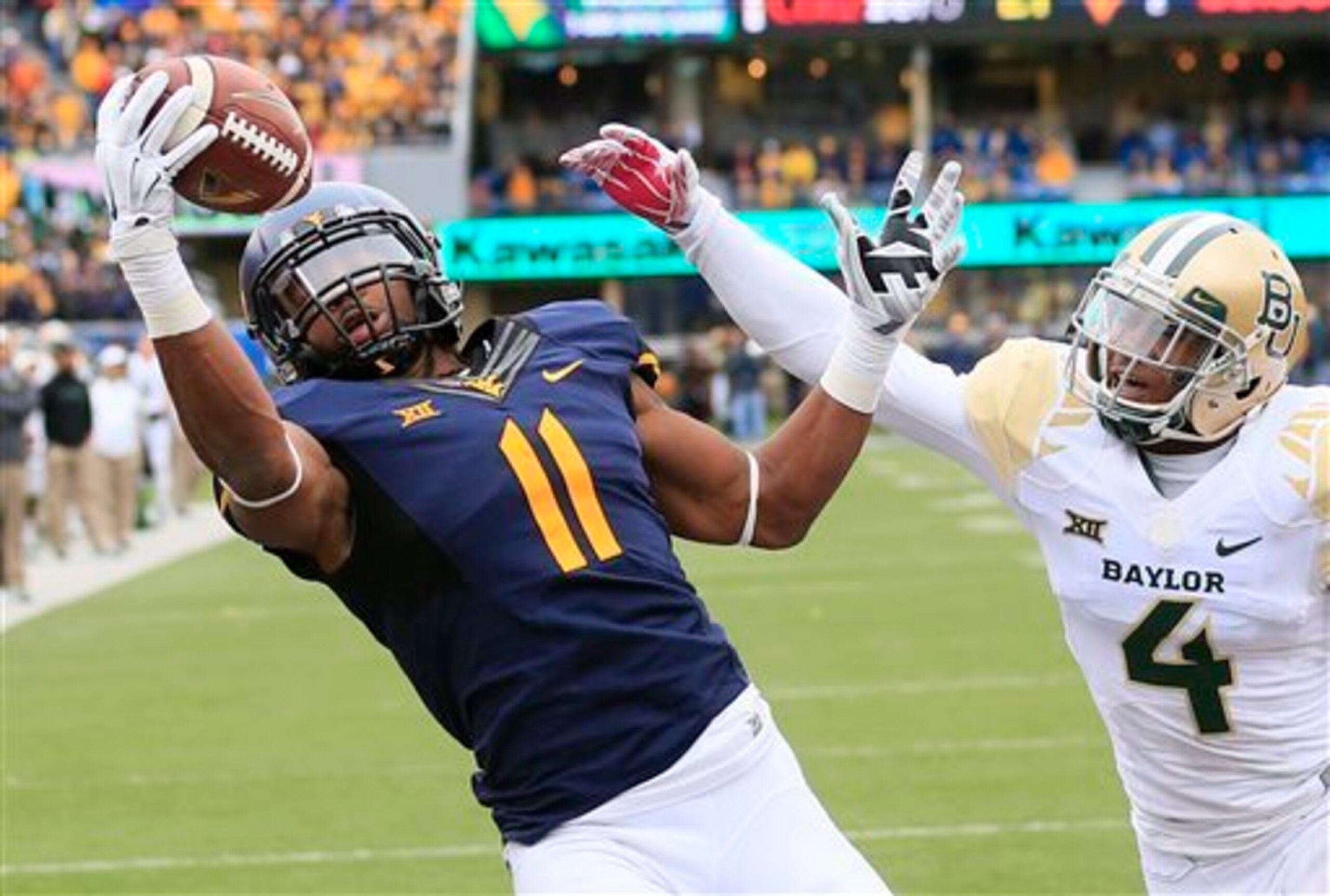
As one may have inferred through a close reading of previous slides, West Virginia's Kevin White is the No. 1 2015 NFL draft prospect on the Vikings' big board.
But Minnesota just acquired Mike Wallace in a trade. The Vikings don't need another receiver. What about the offensive line? Xavier Rhodes and Harrison Smith can't cover everybody. Amari Cooper is better.
Nevertheless, the 6'3", 215-pound blazing-fast Mountaineers wide receiver lands No. 1 over every defensive prospect and every other offensive prospect.
As shown by his MockDraftable spider graph, White is a supreme athlete. His height and weight rank in the 78th and 80th percentile, which makes his 36.5" vertical jump (60th percentile), 4.35 second 40-yard dash (92nd percentile), 23 bench-press repetitions (96th percentile) and nearly 33" arms (65th percentile) that much more concerning.
Essentially, White is a big, strong, lengthy, ridiculously fast, athletic freak who plays the wide receiver position with elite fundamentals.
His measurements and combine results are fairly definitive, which makes his fundamental wide receiver traits the definitive difference between him, Cooper and Parker.
White can do everything necessary to excel at wide receiver. He is able to create initial separation with a release that is only bested by Parker. As important as the initial release is, it is the route running and downfield separation that truly characterize a wide receiver's ability to get open.
Upon creating a release at the line of scrimmage, White frequently accelerates to either shoulder of the opposing defensive back, which often forces him to adjust his form. He then uses his mighty frame to keep a notable distance from the coverage man before looking up to track the trajectory of the incoming pass. Once he has found the ball, he shifts his weight and squares his shoulders toward the ball before jumping away from the defensive back (who is often turned all the way around chasing him at this point).
Video 1 and video 2—courtesy of Draft Breakdown—both exemplify these techniques and result in White finding the end zone. He can be seen using his powerful hands to keep both defensive backs off him. In the first instance, the ball is well-thrown, and all White has to do is utilize his athleticism to go up and high-point the football. In the second video, the pass is slightly under-thrown, but White stops on a dime and readjusts to the flight of the ball before launching skyward.
Potentially the most impressive part of these diagrams is that in neither instance, regardless of how well the pass is thrown, White never allows the defensive back to come close to defending the pass. The Alabama defender—defensive back Bradley Sylve—gets his hands up and comes close, but White's size, timing and ball skills are difference-makers.
Here is a similar play—another vertical route against Baylor—but this time, White burns his defender. Unfortunately, the pass is severely under-thrown, but White plants his feet, waits, keeps positioning on his defender and leaps out to bring down the ball. This clip can be viewed here—courtesy of Draft Breakdown.
Against Baylor once again—courtesy of Draft Breakdown—White makes a one-handed catch on an end-zone fade route. He doesn't need much time or space to create separation, dancing at the line before branching off over the leaning cover man's outside shoulder. Drawing a flag in the process, White allows his defender to pull away his left hand, which helps create an extra length of separation, before reaching out with his right to pull in the well-thrown pass.
In all four instances, White displays an elite control of his body—both in the air and on the ground—excellent tracking ability and innate ability to create separation right before the ball reaches him, regardless of the trajectory of the football or positioning of his defender. He also keeps his shoulders squared and catches the ball at its highest point, traits that exemplify catching fundamentals.
However, running routes and catching passes aren't the only jobs of a wide receiver. The most complete receivers—see Brandon Marshall—also are top-notch blockers, which, of course, White is as well.
Here—courtesy of Draft Breakdown—White squares up his man, shuffles his feet to push him away from the football and sustains a five-second block. The West Virginia running back notices the outside lane his block created and follows White's block into the right corner of the end zone. White is standing upright with bended knees and squared shoulders, which is defines a textbook blocking technique.
On his way to 109 receptions, 1,447 receiving yards and 10 touchdowns, White ran fades, screens, go routes, slants, crosses and more. His route tree is about as complete as a coach can ask.
As a whole, the only true knock on White is that he isn't quite as fundamentally sound as Cooper. However, it is close enough to give White an edge due to his size.
If Minnesota manages to draft White, his role in the offense would be almost identical to the role described for Parker. Again, he would be in line to play the Vincent Jackson role in Turner's offensive scheme. However, his skill set is more diverse than Jackson's, and his speed and acceleration make him almost as much of a deep threat as Mike Wallace. With Wallace and White running seam routes and Bridgewater launching accurate passes downfield, this hypothetical offense could begin to resemble the Daunte Culpepper-Randy Moss offense.
Unfortunately, this appears to be unlikely, barring a trade, as multiple teams, including the Oakland Raiders who select at pick No. 4, will be seeking an elite pass-catching talent come draft day.
White is the type of wide receiver who makes quarterbacks look good; he is fundamental, can run all the routes, possesses elite speed and athleticism, sustains his blocks and has a strong understanding of what he needs to do to be successful.
For a little icing on the cake, ESPN's Josina Anderson reported that White is a stand-up guy with a likable personality:
"I have to say...Kevin White, very impressive in person. Magnetic personality. I can see why he interviews well with teams. Confidence shines
— Josina Anderson (@JosinaAnderson) March 13, 2015"
Honestly, it is more difficult to find something wrong with him than it is to find something right. Whichever team is lucky enough to land the West Virginia stud will receive immediate offensive dividends. This is a guy who makes his team and everyone around him better; White is a rare talent.
All video clips courtesy of DraftBreakdown.com. Prospect measurements and percentiles courtesy of MockDraftable.com. Prospect statistics courtesy of Sports-Reference.com, unless otherwise noted.
For more Minnesota Vikings statistics, analysis and draft discussion, find me on Twitter @RobertReidell. Want more Minnesota Vikings draft materials? Check out MinnesotaVikingsDraft.com for big boards, mock drafts and scouting reports.
.jpg?w=2560 "Packers Vikings Football")