Pressed to Adjust, LeBron James Proving There's More Than One Right Way to Play
CLEVELAND — Initially by necessity, due to the injuries to Kevin Love and Kyrie Irving, but now increasingly by design, LeBron James has transformed himself into the sort of player he and we hardly recognize, as he heeds the call of teammates and associates to unburden his brain, clear his conscience and "empty the clip" to carry the Cavaliers to the championship. In taking a playoff-career-high 26.3 shots per game, including an average of 36.5 in these NBA Finals, he's become the flash point for a raging basketball debate.
That debate is between the old and new ways of analyzing the game and, specifically, scoring. There's the way that was accepted for decades, with quantity coming first: the higher the scoring average, the better. And there's the way that has become more prevalent and prominent recently, with a premium placed on quality, the "how" rather than just the "how much," and a stigma attached to supposed "gunners."

The proponents of the latter, more "analytics"-based approach, aren't necessarily at odds with aggression, but they also promote some prudence. And, as James has increasingly become the embodiment and endorser of their emphasis on efficiency, he has endeared himself to them even more. So it may be stunning to some to see him stray, and jarring to hear him extolling the virtues of what is viewed as a more archaic style: volume shooting, even if many of the shots aren't falling.
But maybe this need not be black and white, and there can be some room for gray.
Perhaps, though, it is possible for one player to represent the best of both worlds.

To rank at the top of class in the old and new schools of hoops analysis.
To pick one approach in one situation, and pick the other in another, and keep picking opponents apart.
Because that's what James, and perhaps James alone among active players, can do.
That's what he is proving in these unexpected and unexplainable NBA Finals against the Warriors, as he takes a tie into Game 3 on Tuesday night and tries to get Cleveland closer to a title in what is, for him, unfamiliar fashion.
What he's doing doesn't necessarily make either side—traditionalist or modernist—any more right about the way they view the game, about what matters most.
It just means he's the right guy to choose the right way to lead his team.
It's important here to acknowledge that field-goal percentage is not the only efficiency stat, nor is it technically an advanced one: More complex formulas, such as effective field-goal percentage and true shooting percentage, account for other factors such as three-point accuracy and free-throw regularity. But it will suffice here, because it is the efficiency stat most fans and players still cite.
It's also the one that became an overriding James obsession during his days in Miami, when he and teammate Dwyane Wade held contests to see who could shoot over 50 percent more times in a season, each letting the buzzer sound before launching long shots, and James specifically, frequently passing up good opportunities while waiting for the prospect of a better one. James spoke with pride of how his percentage had increased in seven straight seasons, soaring to the stratospheric levels of 56.5 and 56.7 percent in his final two years with Miami.

Those stats became the way to separate James from other sensational, but less selective, stars, such as Kobe Bryant, Carmelo Anthony, Allen Iverson, even Michael Jordan. When Derrick Rose won the MVP in 2011, while shooting 44.5 percent compared to 51.0 percent for James, his supporters referenced the articles of analytics-driven reporters to render their own argument that James, who finished second, had been snubbed. And whenever critics carped about James passing on a last shot, his backers countered the "un-clutch" narrative by pointing out that James always made the "right play," another means of distinguishing him from those who were unwilling to share late opportunities.
There's hardly a need to do so now, not after James missed a difficult step-back jumper and a driving layup on the last possession of regulation in each of the first two games of these Finals, with Cavaliers teammates getting chances to beat the buzzer after a carom, not a pass. Nor is there any need to explain away passive play, the way there was in the 2011 NBA Finals, when James took just 16, 15, 14, 11, 19 and 15 shots as the Heat dropped a six-game series to Dallas; Sunday, he took 21 shots in the second half and overtime alone, never blinking even as he kept clanking, making just four of them.
He insisted again Sunday night, after taking 35 shots total, three fewer than in Game 1 but more than 171 of his 172 other playoff games—with the only exception Game 3 of this postseason's Eastern Conference Finals against Atlanta—that he's "not a high-volume shooter…I've never been in my career." He added that "I would not like to" but "if that's what the case has to be to help us win, then I don't have a choice." He made it clear that he's only ignored his inhibitions due to the injuries to Love and Irving. So maybe the restraint returns when they do or, in Love's case, if they both do, next season.
Still, it's hard to believe that he's not somehow savoring this. Even as he was in the midst of the aforementioned efficiency obsession in Miami, he would speak enviously at times of those unshackled by that statistic, when it came to public perception. He would often explain that he could lead the league in scoring if he "wanted to," if he let himself go, but that he believed his other duties were at least as essential.
Now he is letting himself go, and letting the ball fly.
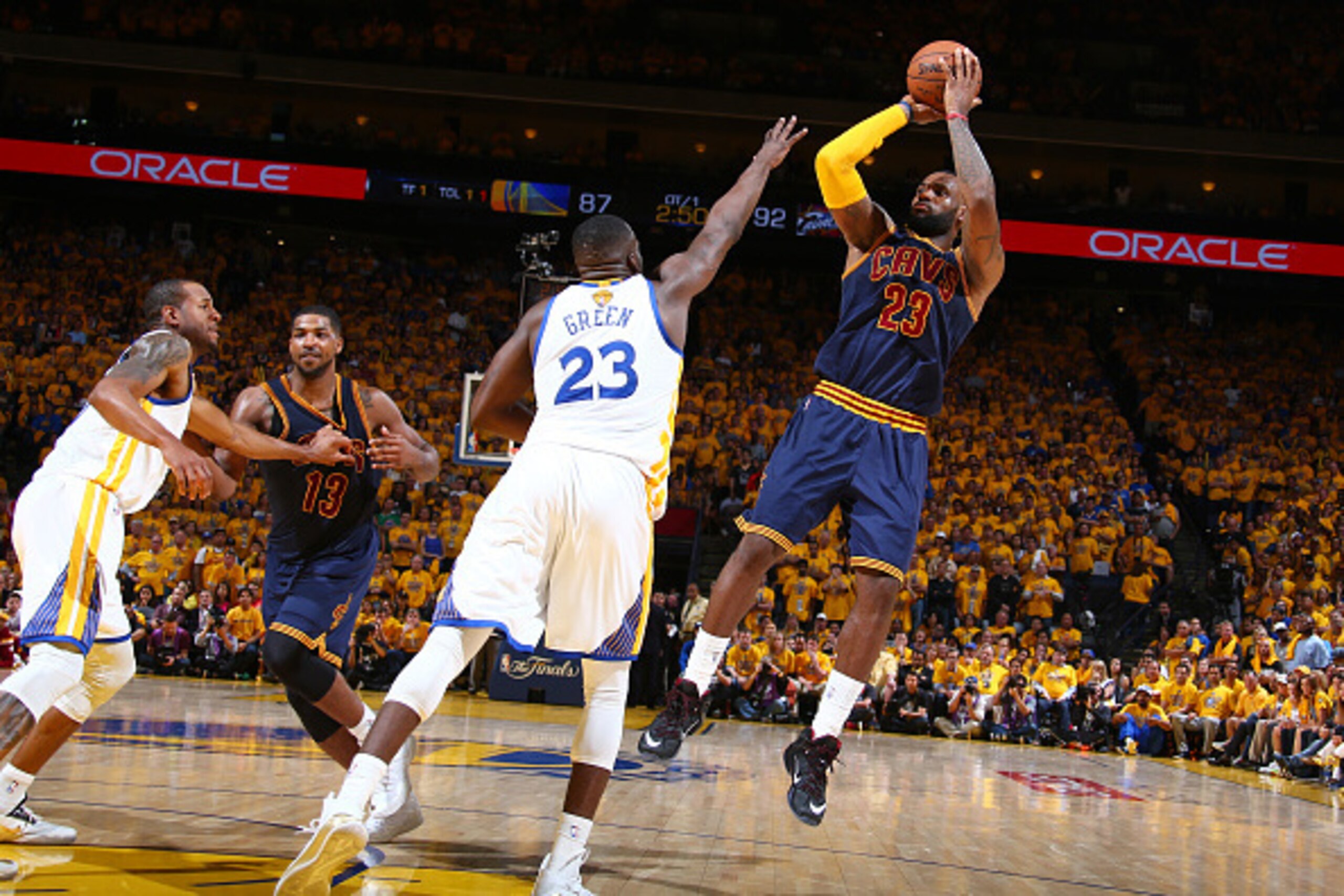
And whether he goes back to his former, more cautious ways, or continues on this current course, this respite from restraint may make us rethink the way we view this debate. It speaks to the need for more nuance and context in our narratives. Of course efficiency matters, and of course the Cavaliers could have cruised if James had made, say, 18 of his 35 attempts, rather than just 11.
But efficiency doesn't matter the same for every star, in every situation. The best can find the right blend of both for the circumstances at hand.
If James played anywhere near this aggressively in the 2011 NBA Finals, rather than averaging just 15 shots, he might have won his first ring then. His aggression against Boston in Game 6 of the 2012 Eastern Conference Finals saved that season and that era. Still, the key wasn't that he took 26 shots, but that he made 19. Then, in his last two NBA Finals with Miami, both against the Spurs, he averaged 21.4 attempts and shot 44.7 percent in a seven-game triumph, and averaged 18.2 attempts and shot 57.1 percent in a five-game defeat.
Would the results have been reversed if he had shot less in 2013 and more in 2014?
Probably not, not when accounting for other circumstances, such as the Heat's stronger spirit in 2013 as compared to 2014, and the Spurs being hardened in 2014 by the previous June's heartbreak.
But in this situation, with this undermanned Cavaliers team? Well, he wouldn't seem to have any choice but to change his strategy, not just because, Sunday's shooting struggle aside, he has the capability for better accuracy than most of his teammates, but also because of something that can't be empirically analyzed—the energizing effect he has when he seizes control of the situation. That doesn't mean he should neglect his teammates (and, as he pointed out, he did have 11 assists in Game 2), because his trust can be empowering. But, on balance, it's better now if he is applying constant pressure to the Warriors' defense, making them scramble, think, even doubt.

He can do that better than anyone. That doesn't erase the 24 misses, not enough that an 11-of-35 outing could ever be deemed his best offensive play, even if he willed his team to victory in other ways. An impartial arbiter, the online statistical site Basketball-Reference, did not give a pass for the poor shooting. Its formula called "Game Score" combines several conventional offensive, defensive and rebounding statistics—including field-goal percentage—to provide a rough measure of a player's productivity. By that formula, Sunday's game ranked as the 28th best of the 174 that James has played in the postseason, while Thursday's Game 1 ranked 65th, even though James made 18 of a career-high 38 shots in that one. So if anyone says that it was his best back-to-back performance, that would seem a stretch.
There's no question that winning can sanitize shooting statistics, and it seemed to Sunday. That's not new. It's been common for the scoreboard to dictate the discussion about how well James played. For instance, in Game 4 of the 2007 NBA Finals, James shot 10-of 30, scored 24 points and got a good share of the blame for the Cavaliers getting swept by the Spurs. In Game 4 of the 2015 second round against Chicago, he also shot 10-of-30, scored 25 points and was roundly praised after the win for his relentlessness and the willingness to take a game-winning shot when he'd been scuffling.
If teammate Matthew Dellavedova doesn't grab a critical rebound and Stephen Curry doesn't come apart late, you might be hearing that James had shot too much in this series, on a night that he posted the 162nd-best shooting percentage in his 174 playoff games (31.4 percent). Instead, you heard about his evolution. Instead, you heard some of his closest friends and confidantes call it one of his greatest nights.
Maybe it's not either-or. Maybe, some nights, you can be inefficient and effective, even while preferring the alternative—James' teams are 11-3 in the 14 playoff games he's posted his highest field-goal percentages. Maybe some nights, the aggressiveness alone is imperative, simply due to the tone it sets, even if the shots rim out.
And maybe it depends on the time, team and place.
Consider Bryant. James matched the Lakers guard's playoff high with his 38 shots on Thursday, but Bryant has taken at least 32 shots in nine of his 220 playoff games. The Lakers won just two of those, but it's hard to pin all of that on him, especially when he shot at least 54 percent in two of the losses. Bryant wasn't a starter until his third postseason, but if you start from there, the Lakers were 16-5 in games in which he shot fewer than 15 times, and 48-20 when he shot fewer than 20 times.
So less is more?
It could be, when you're playing with Shaquille O'Neal or Pau Gasol.
But what if you're called upon to carry a more limited group, like James is now, like Iverson usually was? While many admired Iverson's attacking, enough to award him the 2001 MVP, he became, for others, the poster child for poor efficiency; when he went 11-for-34 in a Game 1 loss of the 2001 Eastern Conference Finals against Toronto, it wasn't close to as celebrated as James' nearly identical stat line Sunday. But, unlike Bryant, Iverson's higher shot totals tended to lift his teams. He won three of the four playoff games in which he had at least 34 attempts, including his only NBA Finals victory, when he made 18-of-41 shots to beat Bryant's Lakers.
What about when he held back?
There were 16 games in which he shot 23 or fewer times.
His team, whether the 76ers or the Nuggets, won just one of those.
Jordan?
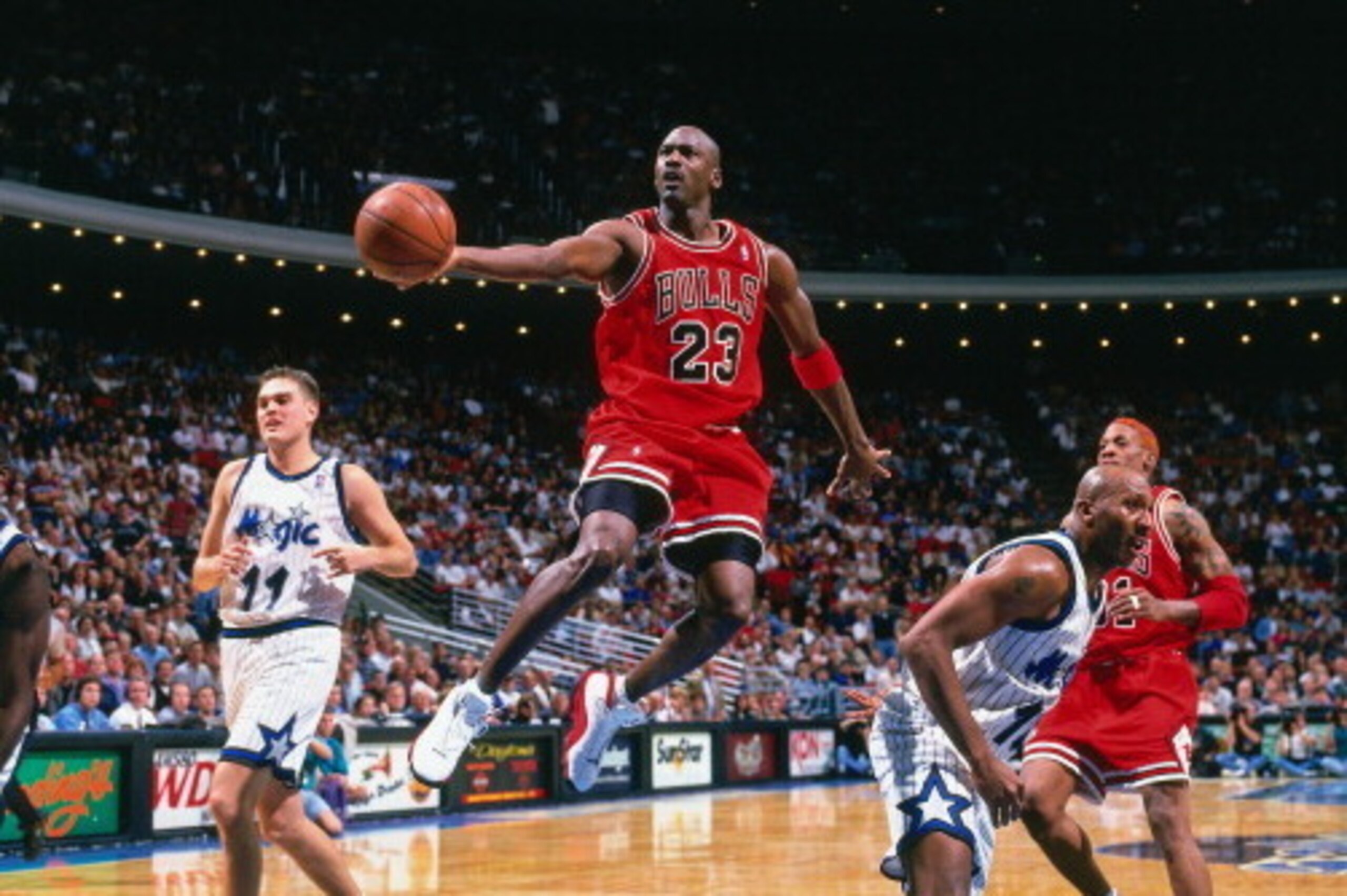
He had three playoff games in which he shot more than James ever has—45, 43, 41—and was 1-2 in those games. But there's no clear correlation between his shot totals and the Bulls' success. Chicago was 42-23 in the postseason when he shot fewer than 23 times, and 45-25 when he shot 27 or more.
They were quite good either way, because Jordan was great enough to understand what the situation called for. So is James. Which way is best for him? Hunting shots, anywhere on the floor, at any time, against any defender, and from virtually any angle, to keep the pressure on? Or pausing, prioritizing, sometimes resisting if it doesn't feel right? That's hard to say. It's much easier to assert that, whatever approach he adopts, he's still currently better than all the rest.
Ethan Skolnick covers the NBA for Bleacher Report and is a co-host of NBA Sunday Tip, 9-11 a.m. ET on SiriusXM Bleacher Report Radio. Follow him on Twitter, @EthanJSkolnick.


.jpg?w=2560 "Chiefs, Steelers Eye WR Trades")