
NBA Rankings: The 15 Biggest Second Option Playoff Shots of All Time
First, to get it out of the way, this list applies to players who are not considered the number one scoring option on the team; the players who usually don''t have the final play drawn up for them.
This list does contain a few players that are the team's second leading scorer, but either are overshadowed by a dominant clutch force on the team, or haven't historically come through in those circumstances.
These are the role-players, the sixth men, the journeymen, the unsure and the just-plain-lucky, who've been thrust into the ultimate pressure cooker whether they like it or not.
Alas, this may still be a point of serious contention for some readers due to the fact that being a role-player sometimes means that your role is to hit huge game-ending shots, a la Robert Horry. Still, that trait is exceedingly rare, and if that is your role then maybe the Hall of Fame should consider clutch assassins and indomitable winners more highly in its selection.
That being said, any NBA or sport aficionado will tell you that winning is the most important measure of posterity and true greatness.
Well on that level, as you'll see, the following players deserve some of that distinction.
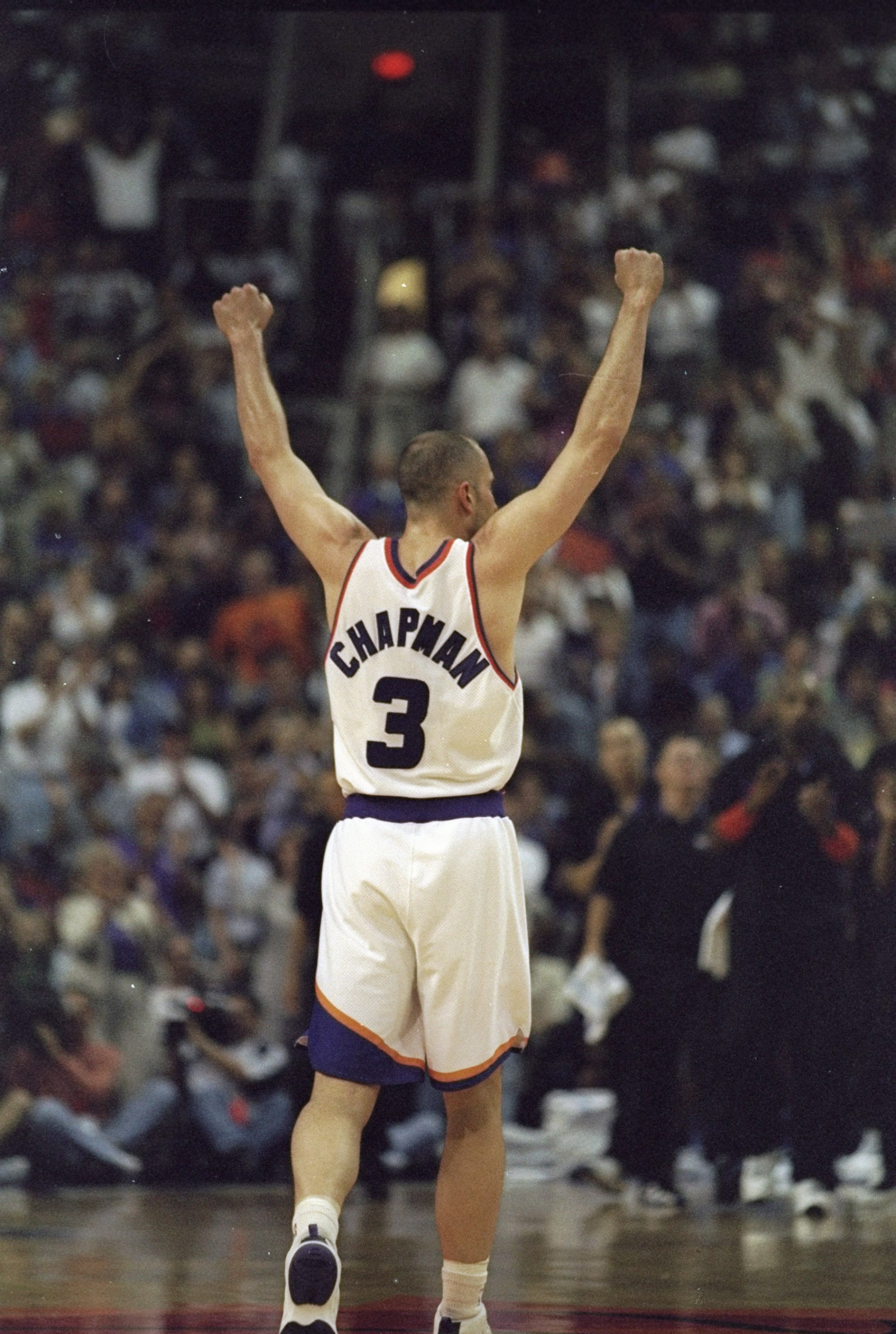
No. 15 Rex Chapman's One-Foot Miracle
1 of 15Rex Chapman was a journeyman two-guard who had other-worldly hops for a white guy - just check out the '90 Dunk Contest - and is now the vice president of player personnel for the Denver Nuggets.
Although he posted some solid scoring seasons in Charlotte early on the Hornets lost, a lot, and Chapman was shipped out in '92, bouncing from the Bullets to the Heat then finally to the Suns.
He was a fan favorite right away with his gutsy determination and streaky flair, but his moment of glory finally came in the first round of the 1997 NBA playoffs.
Up 2-1 in the series, the Suns were down three with seconds to go as an errant inbounds pass looked like it was about to go out of bounds. Chapman ran it down and in one motion, off one foot, turned and sank about a 24-foot three-pointer, throwing his hands up in jubilation, and sending the Suns into overtime.
Although the Suns would lose there, and eventually drop the series in five, Chapman's play was immortalized at that moment, and although he's expressed not liking to talk about it because of the loss, it will always be one of the greatest and most indelible shots in NBA history.
No. 14 Rik Smits' Last-in-Line Buzzer Beater
2 of 15Game Four of the 1995 Eastern Conference Finals was a barn-burner.
First, the Magic's Brian Shaw hit a jumper with around 15 seconds remaining to put them up one.
Then clutch-king Reggie Miller hit a deep three with 5.2 remaining theoretically sending the Pacers off into the sunset with a 92-90 lead.
But a young, healthy Penny Hardaway had other ideas, nailing a leaning three with 1.3 left on the clock, swinging the series momentum back in the Magic's favor.
Now, who should get the last shot? Well, with uber-shooter Miller just having hit the three Larry Brown drew up a play to give his star the ball, but the play went south.
Now Rik Smits, who hadn't yet hit a playoff shot of this caliber in his career, was called into action.
Planting himself on the left elbow, "The Flying Dutchman" caught the Derek McKey inbounds pass and with a swooping up-and-under on Tree Rollins shot a soft 10-footer as time expired.
Smits' shot was the biggest of his career, and proved that even with the Knicks-Killer on the court the Pacers' had clutch depth.
No. 13 Ron Artest's Redemption
3 of 15In a career known for rash and almost inexcusable decisions, Ron Artest finally found a winning team that could showcase the talent that brought him into the League.
But early on there were questions as to whether this known pariah could fit into and understand Phil Jackson's vaunted triangle offense, and more importantly whether he could keep his cool on the court.
Best case in point: Game Five of the 2010 Western Conference Finals.
Up three with time closing down, the possession is safely in the Lakers' hands
Suddenly, Artest bricks an out-of-rhythm 20-footer, then in completely random fashion clangs a three so early in the shot clock as to warrant a cringe from Jackson's perpetually stoic face.
Then, like it is written in some karmic-script, the Suns' Jason Richardson sinks a trey with 5.5 second left to tie the game at 101.
Luckily, in the NBA, not so much in life, gratification and redemption come rather quickly.
An off-target Kobe shot lands right in the hands of a cutting Artest who turns and hits a running five-foot bank as time expires and the city of L.A. lets out a collective sigh of relief.
Finally, Artest, formerly known as crazy, can add playoff hero to his rap sheet.



No. 12 Hedo Turkoglu's Clutch Three
4 of 15Originally proving his late-game value with the Sacramento Kings in the early 00's, Turkey's Hedo Turkoglu eventually found himself in Orlando with playoff aspirations deeply rooted to his winning ways.
In 2009 the Magic had a strong core of players including Dwight Howard, Rashard Lewis and Jameer Nelson.
While Tukoglu was the third-leading scorer on the squad, Howard and Lewis were team veterans that had hit big shots in the the past, but not on the level of Turkoglu's last-second bombs.
Flash forward to the first round of the 2009 NBA playoffs versus the Philadelphia 76ers. The young Philly team is oozing confidence after going up 2-1 on the deeper Magic squad.
And with the game tied at 81 with 14.8 showing, the Magic decide not to go in down low to Howard or have Lewis do his work, but instead give the ball to role-player extraordinaire Turkoglu to find a way.
Getting the inbounds, Turkoglu shows his mettle.
He sets his man up with a series of crossovers and then like an old school ground play, rises for an unnecessary yet clinical three-pointer that finds only a small piece of the rim and the bottom of the net.
The Magic would go on to win the series, due in no small part to this 6'7" forward's last-second instincts.
No. 11 Sam Jones' Wrong-Legged Shot
5 of 15In the 1969 NBA Finals third-scoring option Sam Jones was called on for a series-changing shot.
He was no stranger to big plays after garnering an unbelievable nine titles with the Boston Celtics between 1957 and 1968.
Now in these twilight games Jones' focus and determination couldn't be wavered.
There was simply no way he was going to allow the most hallowed franchise in sports history to lose in the Finals, especially not to the Lakers.
With younger clutch wizard John Havlicek and shooting ace Bailey Howell on the court, it would be easy to see player-coach Bill Russell call on them for a shot that if missed would give the Lakers a commanding 3-1 series lead.
Not that day. Russell was feeling nostalgic and the Celtics, as per their hallmark, absolutely believed in eachother's abilities.
An old play was drawn up, the Picket Fence, which is basically a triple screen from the top of the key down, that would have Jones as its recipient.
Havlicek received the inbounds and waited while Don Nelson and Bailey Howell set up the final picks. Jones' defender Jerry West was cut off just long enough for Jones to brake and get a wrong-legged, high-arcing shot off that he admitted later he tried to pull back in at the last second.
It didn't matter as the shot hung over the outstretched arms of Wilt Chamberlain and dropped, clanging the front-rim then backboard before gently falling in.
The Lakers took it to seven games before Jones' notched his 10th title, but likely would have finished the series off in L.A. in five if Jones' had faltered.
No. 10 Glen Davis' Big Man Shot
6 of 15LSU-product Glen 'Big Baby' Davis is a big guy who in his second year in the league had to come up even bigger.
Throughout the '08-'09 regular season season Davis showed flashes of the player he could be, but was predominantly limited to a bench-role that saw him average around 21 minutes per contest.
Then the playoffs began and the sophomore forward had to grow up quickly - which he did just fine.
'Big Baby' nearly doubled-and-a-half his regular season scoring average dropping 16 per night to go along with six boards and 2 assists Suddenly, he was getting more recognition for his strong post moves and use of his wide frame.
But like all young NBA players, the area he would have to cut his teeth on to prove his worth was in the final seconds of a playoff game.
Down 2-1 to Orlando in the 2009 Eastern Conference Semi-Finals, with the Magic up 94-93 and 10 seconds left, Paul Pierce waits for the double-team then passes off the most open guy on the court, Glen Davis.
Without hesitating, Davis goes up for a quick but assured 20-footer that hits nothing but net as time expires tying the series up for the 2008 Eastern Conference Champions.
Boston would go on to lose to the Finals-bound Magic in seven games, but not before Davis gained invaluable experience and confidence in a postseason nail-biter.
No. 9 Toni Kukoc Serves Notics
7 of 15Toni Kukoc's dead-on buzzer-beater is probably more famous for what happened off the court, namely, a prima donna Pippen refusing to be a part of a final play not drawn up for him.
No matter, "The Waiter" served it up just right, turning and fading and hitting with 1.8 seconds on the clock to slice the Knicks series lead 2-1.
And though they would lose the hard-fought series in seven games, Kukoc would go on to win three titles with the Bulls, becoming one of the G.O.A.T.'s favorite late-game targets.
No. 8 Mario Elie's Kiss of Death
8 of 15Houston sixth man Mario Elie sported a slow shot-put-style jumper, if you could call it that, and a penchant for melodrama.
Reaching the Western Conference Finals for the the second year in a row in '95, Houston looked all but beat after falling down 3-1 versus the Barkley-led Phoenix Suns.
Then the heart of a champion took over and the Rockets battled all the way back, winning in overtime in Game five, to stretch the series to a Game Seven.
Throughout the series Elie had played admirably, scoring 10 a night and shooting over 40% from the arc, all while subbing in behind Clyde Drexler and Vernon Maxwell.
Yet his true worth lie in the most decisive game.
With the league's MVP Hakeem Olajuwon and Clyde "The Glide" Drexler in the game, as well as a young Sam Cassell and Robert Horry, the Rockets were stacked in the clutch department.
But it was 31-year-old Mario Elie, who fought his way into the league at age 27, that saw his number come up.
With 12 seconds remaining and Phoenix up 114-112, Horry made a hard cross-court pass to Elie in the deep left corner.
Elie jumped, caught, stepped back and launched a three in his signature style.
Swish!
Then to punctuate the moment, Elie ran down court and blew what Greg Gumbel coined "The Kiss of Death" to further enrage the stunned fans at America West Arena.
The Suns would never be the same after that, while Elie and the Rockets battled on to earn their second Larry O'Brien trophy.
No. 7 Eddie Johnson's Long Distance Winner
9 of 15At 37 years of age the ultimate journeyman Eddie Johnson, a very dependable scorer who played for seven franchises and netted over a 1,000 points in a season 12 times, finally came to the last team on his journey - the Houston Rockets.
Plagued by injuries before being traded from the Indiana Pacers, Johnson found considerable new life in Houston, upping his scoring average three points while donning jerseys with Drexler, Olajuwon and Barkley — all of which were in the later stages of their respective careers.
The camaraderie and confidence built up as the season went along and the Rockets finished second in the Midwest Division with a 57-25 record.
In the playoffs they battled all the way to the 1997 Western Conference Finals where found themselves down 2-1 to the Utah Jazz.
Johnson, with player roles and fatigue being the likeliest factor, saw his scoring average and field-goal percentage dip in the playoffs.
Still, his timeless touch was never in question when Game Four in Houston went down to the wire.
Tied at 92, guard Matt Maloney took the inbounds pass with 6.7 seconds left and quickly flung it over to a double-teamed Drexler, who then passed it back after seeing trap and almost no time left.
Maloney then swung it hard over to Johnson who stood about 30 feet from the bucket. Johnson never looked back as his shot followed a perfect rainbow to the bottom of the cup as time ran out.
He then ran around the court with arms up in celebration forgetting every injury he'd ever sustained and feeling like he could play another 10 years.
Unfortunately, the Jazz took the series back and defeated the Rockets in six games.
But Johnson's remarkable shot proved a fitting career-capper in a deep and decisive playoff war.
No. 6 Sean Elliot's Memorial Day Miracle
10 of 15Sean Elliot was a tough, reliable two-guard out of Arizona who, since his rookie season in 1990, remained the second scoring option behind David Robinson.
But in 1998 times started to change dramatically as power forward Tim Duncan's arrival signaled a changing of the guard for the Spurs.
The dynamic four's presence ushered in new winning ways for a Spurs team that had found itself pushed to the bottom of the playoff barrel underneath the great Sonics, Rockets and Jazz squads of the mid-to-late 90s.
But with Duncan, Coach Gregg Poppovich, Avery Johnson, "The Captain" David Robinson and their shooter Sean Elliot on-board, the Spurs had a matchup nightmare of team inside and out.
After 1996, Elliot, who should have been in his physical prime in his late 20s, suffered through a series of injuries that limited his playing time and scoring touch. But it was nothing in comparison to what he would eventually face.
Then came the lockout shortened season of '98-'99 at a time when all the Spurs' pieces began to fit.
San Antonio finished first in the West with a 37-13 record and rolled through the first two rounds of the playoffs, dispatching Minnesota 3-1 and L.A. 4-0 before facing the Portland Trailblazers in the 1999 Western Conference Finals.
It was here in Game 2 that one of the most memorable playoff moments of the 90s occurred.
Down as much as 18 in the third quarter, the Spurs battled all the way back into the game trading momentum with the Blazers in the final minutes.
After Portland's Damon Stoudamire hit a free throw with 12 seconds left that put the Blazers' up 85-83, the Spurs drew up their final play.
Inbounded by forward Mario Elie, now on the assisting end of a game-winner, the path this play would take forever became known as the "Memorial Day Miracle."
First, Elie's inbounds pass barely sailed past "Plastic-Man" Stacey Augmon's outstretched fingertips causing the first gasp.
The ball then somehow found its way into Sean Elliot's sure hands, but he was so deep in the right corner that the only play he could make was to tip-toe the sideline then turn and fire and land with his heels up just to stay inbounds.
Still another obstacle emerged just before getting the shot off. A lengthy 6'11" presence named Rasheed Wallace jumped straight up toward Elliot's release and nearly nicked the ball as it sailed out of his fingertips.
The arc looked impossible, the spacing nil; the shot had no business going in - but it did.
The Spurs won the game and the series and eventually the NBA title.
The circumstances surrounding Elliot's miracle play were soon made even more miraculous when months later it was discovered that he had concealed a life-threatening kidney disease which had required major surgery long before the Game Two drama unfolded.
Elliot received a kidney transplant operation following the Spurs championship run, and on March 13th, 2000 became the only player to ever come back from major transplant surgery in NBA history.
A true inspiration to those afflicted with life-threatening illness and the hope for recovery, Elliot, well aware of his condition during the '99 playoffs, created the miracle he so badly needed.
No. 5 Vinnie Johnson Cools Down the Blazers
11 of 15Because he could heat up quickly and drop shots from all over the court, the aptly named Vinnie "the Microwave" Johnson was an instant fan favorite after being traded from the Sonics to the Pistons in 1981.
His high-release jumper, precise body control in the air and contortionist-like moves made Johnson a perfect instrument for netting key buckets.
Just check out VJ's work in the '87 and '88 NBA Playoffs where he came in for a tired or injured Thomas or Dumars and kept the Pistons close versus the Hawks, Celtics and Lakers with shots that other team's coaches would wince at.
Those kind were his specialty though, and there is no better example of his ability to get his shot off at any time than in his career-defining NBA Finals buzzer-beater.
With a dominant 3-1 series lead in the 1990 NBA Championship Series, Game 5 played out with a desperate Portland Trailblazers team trying nearly anything to fight its way back into the series.
After a Thomas jumper tied the game at 90, 30 seconds remained. Then, Portland's Terry Porter made a crucial mistake, throwing a crowded pass right off of teammate Jerome Kersey's fingers, giving Detroit the ball with 20.1 seconds left
During the timeout, the consensus was that Isiah Thomas would be trapped immediately and that another player had to step up and take the biggest shot of his life.
Play resumed and Thomas got the ball with little resistance at first, but on a drive to the bucket two Blazers' defender hedged him off forcing Isiah to pass over to Johnson.
With only seconds remaining, Johnson eyed the clock and then dribbled left a few steps before abruptly pulling up for a high-arcing 20-foot jumper over Kersey that fell right through the cup with 0.7 seconds remaining.
A last-ditch heave by Porter came up short and Johnson and the Pistons had captured a repeat championship for only the second time in 30 years.
The Microwave would heat up for the last time as a Piston in '91, eventually retiring the following year after being traded to the Spurs with Dennis Rodman.
shot at 6:44 inbounds from Rodman pass from Isiah Thomas
No. 4 Derek Fisher's 0.4!
12 of 15Zero-point-four seconds shouldn't be enough time to get a shot off, but somehow the powers-that-be deemed a shot can be released in 0.3. So, in fact, 0.4 is plenty of time, right?
Well, for Derek Fisher, the crafty bulldog-built charge-taking extraordinaire, it was just enough.
Flashback to the 2004 Western Conference Semifinals.
The Spurs were the defending NBA champions having dispatched the Lakers' dynasty in the '03 Western Conference Semifinals with a 4-2 series victory.
The Lakers now had veteran and future Hall of Famers Karl Malone and Gary Payton on their roster, as well as the unstoppable Shaquille O'Neal and offensive wizard Kobe Bryant anchoring this verifiable NBA Dream Team.
In Game Five, usually the most decisive game in any series, the fever pitch of defensive tenacity had manifested itself in vicious elbows, ground-swallowing shoves and a whole host of borderline flops.
Still, the end of the game belonged to offense, starting with wunderkind Kobe Bryant's deep deuce with 11.5 remaining that put the Lakers up 72-71.
Now the Spurs' rock Tim Duncan would create his own Magic driving left to the top of the key with Shaq defending and floating a rainbow 22-foot jumper right to the bottom of the net, leaving 0.4 seconds remaining and the Spurs up 73-72.
To draw a play up with this amount of time is pretty much futile unless your talking an inbounds basket heave for the tip-in, or, God-willing, an alley-oop dunk a la Dwight Howard's "Superman" jam in order to get the ball out of the hands in a hurry.
Getting a real shot off? No way.
Enter Derek Fisher.
With only winning on his mind, the seven-year veteran took the Payton overhead pass right into his waiting shot-form and in a fluid motion put the ball in the air. Net.
So ecstatic after the play and put best by ABC's announcers, Fisher ran wildly off the court trying "to get to the plane before the officials got to the scorer's table."
It made no difference, the shot counted, justifying better than any shot yet attempted the "0.3 Second Shot Rule" and proving that it ain't over until Derek Fisher says it is.
No. 3 Avery Johnson's Garden Silencer
13 of 15Once again the shortened and shook-up 1999 NBA season brought the best out of some people.
In this frame is Avery "The Little General" Johnson, a gifted passer, pesky defender and a vocal force, leading a squad of future Hall of Famers, including David Robinson and Tim Duncan.
Johnson, an NBA journeyman who still holds the NCAA single-season record with 13.3 assists per game, had been waived and traded by more than a few franchises before finding his place with the Gregg Popovich led Spurs.
Fortuitously, the Spurs' coach and Johnson were like two sides of the same page - with Johnson perfecting the "coach on the floor" mentality so many NBA coaches coveted in their point guards.
So good at this was Johnson, his old moniker "The Little General" took on a new meaning in San Antonio, a city known for military leadership in which he was now commanding a fearless calvary dressed in black.
With all that Johnson brought to the team, his shortcomings were evident in more ways than one.
First, Johnson was a dependable and capable defender but his size limited his effectiveness versus bigger points.
Second, and most importantly, he wasn't a good shooter by guard standards, shooting 14% from the arc and 66% from the line for his career. Yes, he knocked down a very respectable 48% from the floor during his career, but the bulk of his shots were layups and pre-Tony Parker teardrops.
Flash forward to Game Five of the 1999 NBA Finals Spurs versus Knicks.
In a series marred by poor shooting and injuries, the Spurs solid team defense consistently frustrated the Cinderella Knicks squad who squeaked in the playoffs as an 8th seed.
After building a 3-1 series lead, the Spurs were back in Madison Square Garden, where legendary shots were born and a player could fix his reputation in a single moment.
One minute remained with the Knicks holding onto the slimmest of leads, when, fittingly, Sean Elliot, who had hit the biggest shot of his career a few weeks prior, gave the assist Johnson.
From around 20-feet out Johnson put the game on his back, coolly knocking down the go-ahead jumper with 47 seconds left to put the Spurs up 78-77.
Three-quarters of a minute's worth of stellar defense and the series was over.
"The Little General" had led his team to a title by believing and doing what others said he couldn't - a true champion.
No. 2 John Paxson Sets the Suns
14 of 15The first thing you notice about this play is the beautiful passing that culminated in veteran John Paxson's series-winning three.
From Jordan to Pippen to Grant to Paxon, the play was reminiscent of the early 70's championship Knicks squads.
It perfectly illustrates how the ball movement and equality of the triangle offense can allow John Paxson, perhaps a fourth option on a team of fourth quarter heroes, to become the man.
In 1993 Paxson was on the decline, having lost the starting position he'd held since the '89-'90, to the younger, quicker B.J.Armstrong.
But the role the 32-year-old Paxson filled at that time was as an experienced Phil-phile, a sure-handed facilitator and dead-eye three-point specialist.
In the next to last season of his career, Paxson was shooting the highest three-point percentage in his playoff tenure, nailing nearly 63% heading into the NBA Finals.
Versus the Suns the Bulls knew their fourth option was a particularly deadly one, especially Jordan, who, just as he would with Steve Kerr three years later, told Paxson to be ready for the "big moment".
Though Paxson averaged just a little over 17 minutes per game in the '93 playoffs,dropping a meager five point a night, the steadiness of his play helped the Bulls pull through in Game 3, which went into an unheard of triple overtime, and the decisive Game 4, where Paxson buried some key jumpers.
With Phoenix forcing a Game 6 at America West Arena, the Bulls, for most of the second half of play, seemed like a one-man squad relying too heavily on their demi-god in basketball shoes, while ignoring the equal-option principles of the triangle.
In the fourth quarter it more of the same as Jordan carried his Bulls scoring all nine of their points, that is until the final 14.1 seconds.
What came out of that Phil Jackson-led huddle was balance and poise, and as it played out, the perfect championship team play at the moment it was needed most.
Just seeing John Paxson - who'd been a Bull before Jordan arrived - become the focal point of a beautifully executed passing scheme, displaying in an almost literal sense, from Jordan to Pippen to Grant to Paxson, that a team is only as great as it's belief in itself and every one apart of it.
Still, somewhere after the crowd noise died down you could likely hear MJ telling Paxson,"Didn't think I'd give it up for no reason, did you? I knew you'd hit it."
No. 1 Steve Kerr's "I'll Be Ready" Shot
15 of 15Steve Kerr may be the gutsiest person on the planet, or perhaps just the smartest.
With the series-clinching, title-winning moment at hand the entire basketball-watching world knew who should and, almost definitively, would take the last shot.
The only person who wasn't sure was Michael Jordan.
And in the huddle before the play a simple phrase was uttered with fearless desire and deadly seriousness.
"Be ready."
Kerr must have had at least a little lump in his throat after the man who had built the house, whose likeness stood in bronze outside of the arena, had given him some of his God-given responsibility.
Yet second-thoughts, shortcomings and fear never came Kerr's mind; just as it had never entered his coach's mind nor the collective mind-set of the team.
And nowhere on this stage, on his canvas, would Jordan let anyone bring doubt.
So Kerr, the 10-year veteran journeyman who couldn't scare a mouse with his physical appearance, assured the scariest person on a basketball court, "I'll be ready."
Better be.
The 6'1" point guard was, taking Jordan's assist and throwing an 18-foot dagger through the hearts of the Jazz nation with an eerily reminiscent poise and accuracy.
Some people say fear is what drove Jordan's squads to greatness. Fear of him and the retribution that would follow a setback on the path to a title.
Kerr knew it all too well having taken a punch from Jordan during training camp in '96.
But true champions can not succeed using fear-tactics because what they strive for everyday is to eradicate fear, knowing that if it's present it spreads instinctively. Fear especially has no place in winning because winning consistently is harmony, and harmony only exists in our world because of love.
That was his gift to basketball, his irrefutable, impenetrable, undying love for the game, totally absent of fear.
That is how a skinny guard picked 50th overall, who didn't start a game for the Bulls the entire '97 season, can tell Michael Jordan he's ready. Love.
.jpg?w=2560 "NFL investigating 2 referees for separate viral exchanges")
.jpg?w=2560 "Report: Chiefs Contact Hill's Agent")

.jpg?w=2560 "OBJ Calls Out Giants After Release")
.jpg?w=2560 "Tyreek makes another cryptic post amid Chiefs rumors")