Did Atlanta Hawks Do Enough to Save Eastern Conference Contender Status?
For a 60-win team, the Atlanta Hawks sure have done a lot of roster shuffling this offseason.
Some of the shuffling was unplanned, like starting small forward DeMarre Carroll's spurning the Hawks for a larger role and contract with the Toronto Raptors. However, other moves were completely deliberate, like two separate trades that brought Tiago Splitter and Tim Hardaway Jr. to the Peach State for draft picks.
The big question is: Did Atlanta do enough to keep its lofty Eastern Conference standing? And will the Hawks' season end with a thud, like it did in May's conference finals sweep at the hands of the Cleveland Cavaliers?
TOP NEWS
KAT's Contract News Quote 😬

1 Player Every Team Should Trade 🔀
Most Fascinating Players This Season 😲
We'll look at how Atlanta improved this summer and how it took a step back, then ultimately judge whether this team will remain an Eastern Conference contender.
Getting Stronger?
Frontcourt depth, frontcourt depth, frontcourt depth.
Atlanta's overall improvement in the post will be obvious right from the get-go next season. Paul Millsap and Al Horford are back as starters and should contribute similarly strong campaigns, but the huge jump will come from the reserves.
On the way out is backup center Pero Antic, who signed with Turkish club Fenerbahce, and Elton Brand, who will not return to the team, according to the Atlanta Journal-Constitution's Chris Vivlamore.
One of the two post replacements is Tiago Splitter, a three-year starter with the San Antonio Spurs and an NBA champion in 2014.
Words cannot properly express how much of an upgrade a healthy Splitter is over Antic as the Hawks' third big man. Antic provided some floor spacing with mediocre three-point shooting that Splitter won't, but his Brazilian replacement is better in literally every other aspect of the game.
The former Spurs center is an excellent screener and passer, a decent rebounder, rolls to the basket well (instead of the three-point arc) and is an above-average defender in all circumstances. The 6'11" Splitter is not a dunker, much like his Macedonian predecessor, but Hawks fans will be pleasantly surprised by his crafty layups inside.
Take a look at some highlights from one of Splitter's best career games, in the 2014 playoffs.
The 30-year-old veteran is also a nice fit next to Millsap or Horford. Both starting big men have the requisite outside touch to keep the floor spaced, which allows Splitter room to operate down low. The two All-Stars from last year can also guard power forwards when Splitter is in, an ideal situation for both Millsap and Horford.
Plus, it doesn't hurt that he's arrived from San Antonio. The Spurs run a very similar offensive system to the Hawks.
The other replacement on the interior is Walter "Edy" Tavares, the Hawks' second-round pick from last summer. Tavares spent last year in Spain with Gran Canaria and turned down offers from several of Europe's top teams.
After signing with the Hawks, Tavares said the following about leaving Europe for Atlanta, via Vivlamore:
"For me, it’s a dream come true to sign with Hawks. I worked all year to sign with the Hawks. It was difficult because I had good offers in Turkey, in Madrid, in Barcelona. It was difficult decision for me but I think I worked every week to be here with the Hawks. The Hawks came to Gran Canaria to talk to me, to speak with me, to motivate me to work. That was part of the decision to come because of the way they support and motivate me.
"
The 23-year-old is a big man in the truest sense of the term. He's 7'3", 260 pounds and also possesses a freakish 7'9" wingspan, according to the Hawks' official website.
Chances are that Tavares and his still-raw skill set will spend a year adjusting to the NBA game, mostly from the bench. But with his physical tools, who knows? Tavares and Splitter will provide much-needed help on the glass, even if the former plays a small role.
You also have to like some of the moves Atlanta made on the perimeter.
Hardaway Jr. and Justin Holiday give the reserves added three-pointing shooting ability, a skill that wasn't a strength for the two main bench wings from last season: Thabo Sefolosha and Kent Bazemore.
Like Splitter, Holiday's fit in Atlanta will be aided by experiences with his previous team.
Also, natural player progression should be most evident in reserve point guard Dennis Schroder and backup big man Mike Muscala. The 21-year-old Schroder showed his star potential last season, and the 24-year-old Muscala stepped up as Atlanta's third-best big man during the playoffs.
Erosion?
Atlanta's starting lineup probably won't be quite as good as it was last season, despite switching out only one player.
Carroll was the unit's No. 5 scoring option, but the fact that a player with his offensive skill set was so far down the totem pole was what made Atlanta's top group so dangerous. If the opponent started a weak defender, the Hawks could exploit him no matter who he was guarding.
Presumably, Sefolosha will slide in to replace Carroll at the starting small forward spot.
Sefolosha estimated last Wednesday he would need about four more months to recover from his leg surgery, per Hawks writer KL Chouinard. If he comes back 100 percent from his leg surgery, there won't be any defensive slippage at that the 3 position. In fact, you can argue that he is actually a better perimeter stopper than Carroll. The Swiss swingman had a better defensive box plus-minus (2.5 to 0.5), compiled a lower defensive rating (100 to 104) and limited his opponents to a lower field-goal percentage (37.4 to 45.0) than Carroll.
However, the offensive chasm between Sefolosha and Carroll is wide.
| D. Carroll | 14.5 | 48.7 | 39.5 | 117 |
| T. Sefolosha | 10.3 | 41.8 | 32.1 | 106 |
Thabo is not close to the three-point shooter the Junkyard Dog is, which shows in the different ways opposing teams defend them. Sefolosha receives a cushion of several feet when he roams the perimeter, which clogs the lane for Atlanta's penetrators. Carroll's coverage, on the other hand, was much tighter.
The health issues of Kyle Korver are also a concern. The 34-year-old shooting guard has had three surgeries since March, which is not a good sign for someone his age.
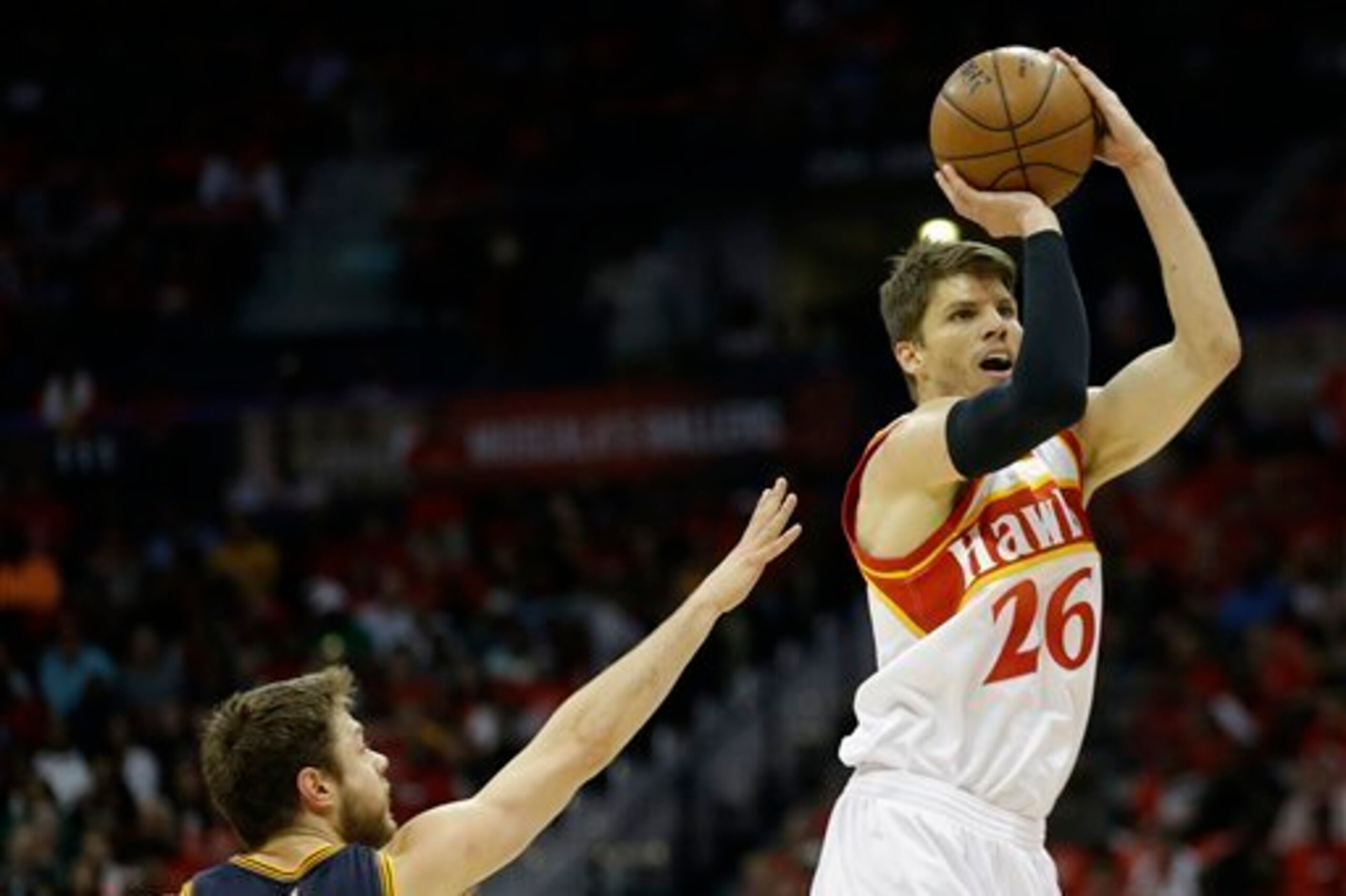
His immaculate three-point stroke already started to show signs of slippage in this year's postseason (35.5 percent from downtown), and we don't know how good he'll be this fall after returning from surgery.
Lastly, Carroll's departure will also have a trickle-down effect for Atlanta's small forward depth. After Sefolosha, not a single player currently on the roster has both the frame and skill set to play big minutes at the 3. Bazemore and Holiday will see some playing time there, as will Millsap, but all three are more accustomed to playing elsewhere.
What Will The Hawks Look Like in 2015-16?
Atlanta does have one roster spot available, and if the team chooses to fill it with an impact player, that could slightly tweak the team's rotation.
Below is my depth chart and minute projection for the Hawks next season, as of now, with players slotted at the position they'll play most. Remember, the total minutes per game will be more than 240 because of overtime contests, injuries and some players' only seeing court time in certain games.
| PG | SG | SF | PF | C |
| J. Teague (30) | K. Korver (28) | T. Sefolosha (25) | P. Millsap (31) | A. Horford (30) |
| D. Schroder (23) | T. Hardaway (21) | K. Bazemore (18) | M. Muscala (17) | T. Splitter (21) |
| S. Mack (8) | J. Holiday (12) | M. Scott (11) | W. Tavares (8) |
But what exactly does that mean?
A strong starting lineup is more important to a team's success than a strong bench, in general. According to HoopsStats.com, the top five teams in starter scoring last season were the Los Angeles Clippers, Golden State Warriors, Cleveland Cavaliers, Hawks and Washington Wizards. All five squads won at least one playoff round in 2014-15.
On the other hand, the five best scoring benches all came from teams (the San Antonio Spurs, Indiana Pacers, Boston Celtics, Milwaukee Bucks and Toronto Raptors) that either lost in the postseason's first round or missed the playoffs altogether.
However, the bench made a substantial leap, while the starting five's step back should be more modest. The strong Big Three of Horford, Millsap and Jeff Teague are still on the roster, which keeps this team's floor relatively high.
Conclusion
Atlanta is probably not going to win 60 games again in 2015-16.
Now that the Hawks have a full season of Eastern Conference prominence under their belts, opponents have worked hard to scout their strengths and weaknesses, which showed late in the season and during the playoffs. Injuries were a factor in the team's lackluster postseason showing, but so was regression to the mean.
However, factoring in Atlanta's improved inside presence and bench scoring, plus the expectation that they'll be healthier in the playoffs in 2016, the Hawks are better prepared to give any potential postseason foe a run for its money.
Let's be clear: The Hawks still aren't nearly as talented as the Cavaliers. If Atlanta and Cleveland meet in the playoffs next spring, the Cavaliers will be favored, and rightfully so.
But if you're expecting the Hawks to drop into the lower half of the Eastern Conference playoff bracket based on Carroll's departure and a rough postseason, you're underestimating them.
With a head coach like Mike Budenholzer and newfound depth inside and out, Atlanta should have better Finals odds than any Eastern Conference team not named Cleveland.
All statistics and measurements are from Basketball-Reference.com, NBA.com and ESPN.com (including ESPN's Hollinger Stats) and updated through July 13 unless otherwise indicated.

.jpg?w=2560 "Cam Ward Says He's Not A Loser")
.jpg?w=2560 "🚨 Texans Trade for MHJ")
.jpg?w=2560 "Grading MHJ Trade 📝")
.jpg?w=2560 "Chargers Fall to 0-5 🤢")

.jpg?w=2560 "MHJ Bought Own Jugs Machine")