How the Indiana Pacers Can Remain in the Eastern Conference Playoff Picture
No Paul George. No Lance Stephenson. No good for the Indiana Pacers.
Only a year after finishing with the best record in the Eastern Conference, Indiana would find itself fortunate if it were playing in May. Injuries and general roster attrition have seemingly killed the Pacers' season, but in a weak conference, it's too soon to count the team completely out of the picture.
It almost feels like the basketball gods have banned Indiana from the East's top eight with the same vigor as the Soup Nazi would reject a loud customer.


No playoffs for you.
And unfortunately, the Pacers didn't even get to pull a Constanza and leave last season on a high note, losing to the Miami Heat in the Eastern Conference Finals after dropping 13 of their final 23 regular-season games.
The aforementioned basketball gods seemed to have it out for Indiana over the summer. The Pacers lost All-Star Paul George for the season when he broke his leg during a Team USA scrimmage back in August. But not all of the 56-win Pacers' summer downfall was due to bad luck. At some point, the organization has to take on blame.
The Pacers didn't exactly put themselves in the best situation for the upcoming season when they let Lance Stephenson walk to Charlotte for only $27 million over three years. You get the feeling, though, that ridding themselves of Stephenson wasn't completely a basketball move.
The 23-year-old may have vastly improved in each of the past couple seasons, but he hasn't necessarily shed his abrasive reputation, which helped him earn far fewer dollars on the open market than he could've if he were known for a more peachy personality.
So now, Stephenson heads to the Hornets to make up an all-NYC backcourt, and the Pacers are stuck with a George Hill-Rodney Stuckey tandem capable of throwing up so many bricks that "the Commodores" are already starting to write songs about it. But even with the potential to be the worst-shooting team in the league (yes, there's certainly a real possibility of that after losing its two best wings), Indiana still has an outside shot of sneaking into the Eastern Conference playoff picture.
It is, after all, the Eastern Conference. When we talk about the "picture," this isn't exactly an Annie Leibovitz. It's more of an unwanted selfie from that vain girl who made you follow her on Instagram. You know, the one who literally can't even believe she took such a gorg pic.
Like the ones on Facebook or the insufferable Snapchat, we don't really care about the Eastern Conference playoff picture. In today's NBA, it's all about the West. But sadly, that's exactly why the Pacers have a chance.
38 wins got the Atlanta Hawks the No. 8 seed last season. Even if there's been an infusion of talent at the top (the Hornets, Cleveland Cavaliers, Chicago Bulls, Washington Wizards and Toronto Raptors all have good chances to improve), the depth of the East is still relatively nonexistent. The bottom feeders are as present as the annoying Instagrammer.
The losses of Stephenson and George won't exactly help an offense that finished 22nd in points per possession last season. But we are missing one major point: Even with all their struggles down the stretch, this was still the NBA's top-ranked defense a year ago.
Of course, George and Stephenson were tremendous contributors to Indiana's success in preventing points, as well. Those guys are two-way players. And both of them mastering the über-aggressive closeout has done wonders for Frank Vogel's defense, which calls for taking away the long ball, running opposing shooters off the three-point line and funneling them in toward the league's best rim-protector, a guy who conveniently still plays for this organization.
That's right. Roy Hibbert still exists. Shocking, I know.
How quickly we forget where Hibbert finished in Defensive Player of the Year voting last year (second, and deservingly so). He's not the style defender of Joakim Noah or Marc Gasol. Hibbert is a stationary guy who does stationary things. That's part of what makes the wing defenders so important on this team.
That "funneling" strategy the Pacers have performed so well the past few years—it's completely predicated on Hibbert's strength: defending the rim. But even though the Indiana center has become one of the league's premier defensive players, Hibbert has his fair share of weaknesses.
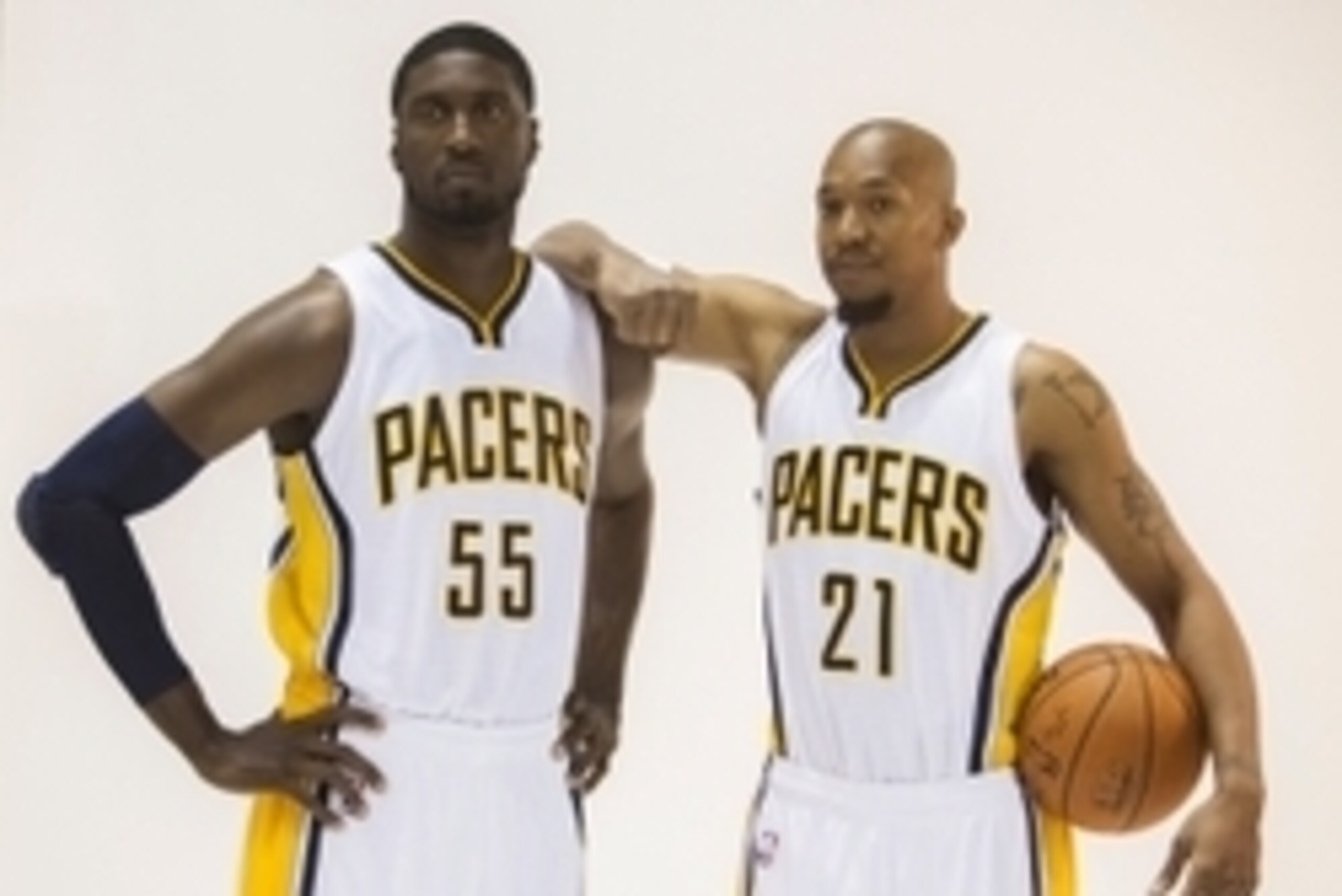
He doesn't move quickly laterally. He doesn't defend the perimeter. He just kind of stands there and does his "verticality" thing. And in that respect, he's brilliant. He's probably the best in the league. But this year, it's going to be harder than ever for the Georgetown alum to implement his greatest attribute.
Without the wing defense Stephenson and George provide, the Pacers may not be able to properly funnel guys to the middle. That would lead to open shots near the basket, forcing Hibbert to stray from the paint without the quickness to recover. If people were worried about him during the Miami Heat playoff series, when the sharp-shooting Chris Bosh found himself with loads of open looks, there's reason to fret this year, as well.
So, what needs to happen? Hibbert has to adjust. From the outside, we haven't necessarily seen how change will occur, but an intelligent and talented defender can evolve and adapt. Now, it's Hibbert's turn, and it's possible the transition will be slightly easier for him than it would for another big man who might be changing teams and schemes.
Defense has as much to do with personnel continuity and coaching as anything else. Just look at the NBA's best defensive teams. They're all squads who have been together for long enough to develop some semblance of chemistry.
The Chicago Bulls, San Antonio Spurs, Golden State Warriors, Memphis Grizzlies and Oklahoma City Thunder all have consistent cores who know each other's tendencies.
Chicago's Taj Gibson heads toward the outside to defend a ball-screen, and Joakim Noah intuitively understands exactly how to recover. Zach Randolph of the Grizzlies beats up opponents in the post with such physicality because he knows that Marc Gasol will be right behind him to clean up any potential messes. When OKC's Russell Westbrook jumps passing lanes, it seems like Serge Ibaka almost moves to recover for him before Russ even takes off for the attempted interception.
That's partly on the fact that those teams all have good-to-great defensive schemers on the bench. Tom Thibodeau, Gregg Popovich, Dave Joerger and the lot know what they're doing when it comes to putting together defensive sets. But it's also because those guys just know each other. They know everything about each other. And that's not something which can be contrived. It can only happen over time. That's it.
The Pacers have that time. And they have that coach in Vogel. They still employ Hill, David West and Ian Mahinmi among others who have worn blue and yellow in the past. That's hardly an All-Star lineup, but it does breed some sort of familiarity. That's a trait which, with some help from other teams expected to finish ahead of it, could bring Indiana up to a possible No. 8 seed.
Because of that, in an Eastern Conference that is improved but still weak, the Pacers have the potential to finagle enough victories to squeeze themselves into the playoff hunt, even if the chances are slim.
Fred Katz averaged almost one point per game in fifth grade but maintains that his per-36-minute numbers were astonishing. Find more of his work at WashingtonPost.com or on ESPN's TrueHoop Network at ClipperBlog.com. Follow him on Twitter at @FredKatz.
Unless otherwise noted, all statistics are current as of Oct. 10 and are courtesy of Basketball-Reference.com and NBA.com.

.jpg?w=2560 "NFL House in Paris Closes for Protests")
.jpg?w=2560 "Trevon Diggs Cut by Seahawks")