

MLB's New Post-Steroid Era Home Run Explosion Is Officially Here to Stay
There eventually will come a day when Major League Baseball hitters stop hitting home runs in bunches.
But it is not this day. And probably not tomorrow. Or the day after that. And so on.
It was no secret coming into 2017 that home runs had been on the rise. The only question was whether pitchers would find a way to fight back.
TOP NEWS

Realistic Offseason Trade Ideas 💡

Yankees Sloppy in Game 2 Loss 😬

Players Who Were Worse Than You Think in 2026 ⚾
So far? Nah. Very, very nah.
As recently as 2014, home runs were few and far between at 0.86 per game. Thanks to a second-half push of 1.09 per game, that number rose to 1.01 in 2015. And then to 1.16 per game in 2016, a mark topped only by the 1.17 per game in 2000, the height of the so-called "Steroid Era."
So far, 2017 is making even 2000 look like child's play. The average is at 1.26 home runs per game and going up. After slamming 1.17 homers per game in April, hitters have slammed 1.30 homers per game in two-plus months since.
Wherever you look, there are home run feats aplenty.
In New York, young Yankees stud Aaron Judge has an outside shot at 60 home runs with 30 homers through 84 games. And the 6'7", 282-pound giant really hits his homers. Like so:
Judge, 25, is hardly the only young slugger hogging home run headlines.
Bryce Harper (20 home runs) is at it again. Mike Trout (16) will presumably be right there with him once he recovers from thumb surgery. Kris Bryant (18) is still raking following his MVP win last year. Cody Bellinger (25), Joey Gallo (21) and Miguel Sano (21) have also announced their presence with authority.
Shoot, even non-sluggers are getting in on the fun.
Of all the things that have happened in 2017, nothing was on the nose quite like Scooter Gennett—all of 5'10" and 185 pounds and previously the owner of just 38 career homers—kicking off a surge to a career-high 15 homers by going yard four times in one game in June:
"That's pretty crazy, man," Gennett said afterward, per Mark Sheldon of MLB.com. "Especially when you think of a guy like me, not a huge guy. But that's baseball. It's not how big or strong you are; it's how efficient and sometimes lucky."
However, there is that nagging question: Is this actually baseball, or is it a return to an era of faux baseball that was supposed to be dead and buried?
It is bad optics that home runs have gone first from as prevalent to now even more prevalent than they were in the Steroid Era. The introduction and subsequent strengthening of performance-enhancing drug protocols seemed to have squeezed the flow of homers for good. Are they back now because players are back on the juice?
It's possible. Yet, doubtful.
Here, perhaps this chart (using stats from Baseball Reference) will put everyone's mind at ease:
In 117 seasons of Major League Baseball, home runs have been trending ever upward. There have been sputters along the way, but nothing has yet to stick. So what's happening now is actually sort of normal.
Besides, the Steroid Era isn't even as scary as it's portrayed to be. While the role of PEDs can't be discounted, it was just one part of a larger home run recipe. Also included: rapid expansion that diluted the league's pitching talent, a shift toward smaller ballparks and possibly a juiced ball.
A juiced ball could also be at the heart of the current home run explosion. Studies by Ben Lindbergh and Mitchel Lichtman for The Ringer and Rob Arthur for FiveThirtyEight suggest as much. The league denies this, of course. But the idea is certainly more plausible than juiced players.
Lindbergh and Arthur said it well at FiveThirtyEight last year: "To believe that PEDs are responsible, one would also have to believe that during the 2015 All-Star break, the whole league decided in unison to start taking a powerful, undetectable substance that helped only hitters. That seems like a stretch."
Conspiracy theories aside, it's becoming less of a secret what absolutely is at the heart of the home run explosion: data.
That fateful 2015 season was the one in which MLB introduced Statcast. Officially, it's "a state-of-the-art tracking technology" that's "capable of measuring previously unquantifiable aspects of the game."
Thus, terms like "exit velocity" (the speed of the ball off the bat) and "launch angle" (the angle of the ball off the bat) have rapidly become household statistics.
They've also caught on with hitters. Particularly launch angle, which has sent a loud and clear message to get under the ball.
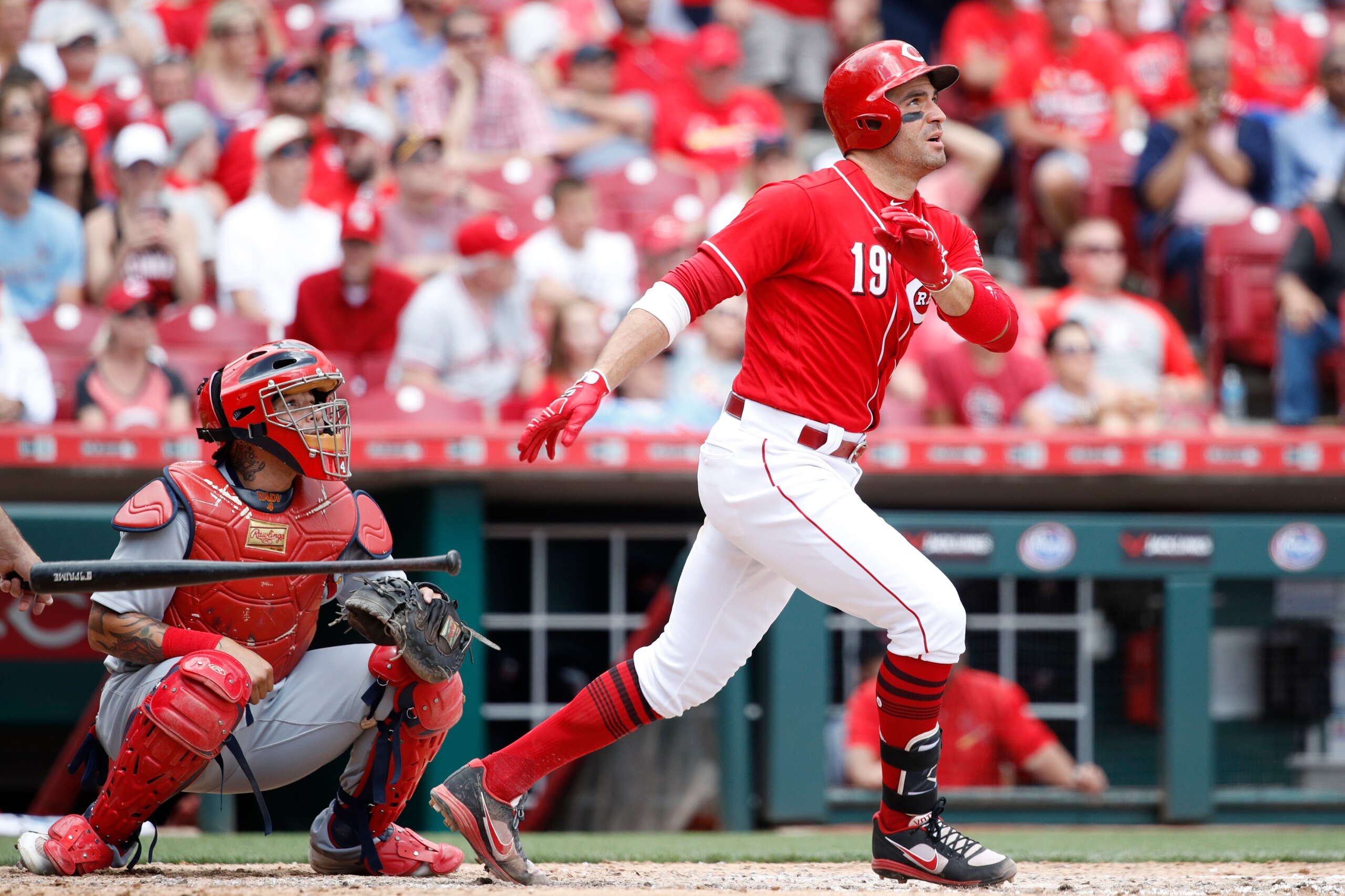
"Slugging happens when the ball's hit in the air," Pittsburgh Pirates infielder David Freese said this spring, per MLB.com's Adam Barry. "Especially now, the way infielders are lined up. Balls shot down the line, it's hard to get doubles. ... With the launch angles, I think people are understanding that to slug, you have to hit the ball in the air."
"The consensus among all the hitters I've spoken to, and hitting people I've spoken to, is ground balls are bad, fly balls are good, line drives are good," Cincinnati Reds first baseman Joey Votto, presently on track for a career-high 48 homers, told Travis Sawchik of FanGraphs.
According to Baseball Savant, the league's average launch angle was 10.1 degrees in 2015. It rose to 10.8 degrees last year. So far in 2017, it's ticked up to 10.9 degrees.
Ah, but why doesn't the increase in home runs this year correspond with an even higher launch angle?
Well, batters know intuitively that you don't want to get too under the ball. That's how pop-ups and harmless fly balls happen.
Rather, the trick is to hit it as hard as possible at just the right angle. This chart from MLB.com's Mike Petriello reveals the ideal combination of launch angle and exit velocity:
It's roughly between 20 and 35 degrees and anywhere over 95 miles per hour.
Not surprisingly, this is where the revolution has taken its next step. The league's launch angle may be steady, but the percentage of batted balls in that magical slugging bracket is up:
| 2015 | 7.33% |
| 2016 | 8.00% |
| 2017 | 8.32% |
And it's making a difference. On balls hit between 20 and 35 degrees and at least 95 miles per hour, the league is slugging 2.320.
To their credit, pitchers are trying to stop this. They're throwing 51.6 percent of their pitches at or below the knees. That's up from 51.3 percent last year and 51.2 percent in 2015.
But obviously, it's not working. In fact, given the rate at which balls are going over the fence, it's arguably doing more harm than good.
Don't take this to mean the ongoing home run era will last forever. History shows that home runs can disappear in bunches just as quickly as they can appear in bunches. There may be nothing that can kill baseball's desire for home runs, but a way for pitchers to fight back is always just around the corner.
But for now, there's no end in sight. So as long as dingers are your thing, enjoy.
Data courtesy of Baseball Reference and Baseball Savant.

.jpg?w=2560 "Grading WWE Raw 🔠")

.jpg?w=2560 "Bijan's INSANE 1st Half 🤩")
.jpg?w=2560 "Viral Rams Coach Vid 🖕")
.jpg?w=2560 "Injury-stricken Seahawks signing veteran RB")


.jpg?w=2560 "2 NFL Officials Suspended")
