

The Numbers Game: Where Would Golden State Warriors Be Without Steph Curry?
Despite the Milwaukee Bucks putting the first blemish on their record, the Golden State Warriors are still the NBA's best team, and Stephen Curry continues to be the biggest catalyst behind their historic levels of success.
One year after adding an MVP trophy to his resume, he's the prohibitive favorite to go back-to-back. Basketball-Reference.com's MVP Award Tracker even shows the floor general has an 86.8 percent chance of earning the NBA's top individual honor during the 2015-16 season, based on historical factors and previous voting results.
But what if Curry didn't exist? How far down the league's hierarchy would the Warriors drop?
TOP NEWS

LeBron's Special Helicopter Deal

MJ Makes Record-Setting Donation 🙌
Collins on Brooks Scuffle 👀
On/Off Analysis
The easiest way to account for Curry's impact on the Warriors is to look at his on/off splits during the 2015-16 campaign. Though there's a lack of context—this doesn't factor in the effects of teammates—it does show the substantial drop-off when the MVP candidate takes a seat.
With Curry, Golden State is unstoppable. Without him, the team falls apart on both ends of the floor.
Offensively, Golden State can only muster up a mere 103 points per 100 possessions, which would leave it below the league-average mark of 104.1 in 2015-16. The team would be sitting in 19th place, slightly ahead of the New York Knicks (102.9) and Washington Wizards (102.9).
Unfortunately, the story isn't more positive on defense, where the rating skyrockets to 107.5. Only the Sacramento Kings (108.2), Los Angeles Lakers (110.5) and New Orleans Pelicans (110.7) have been more porous than the Curry-less Warriors.
Combining the two, the net rating isn't pretty:
That shows a massive drop-off, as the league-best Warriors suddenly plummet toward the bottom of the NBA with a net rating comparable to that earned by the Wizards (minus-3.6) and Memphis Grizzlies (minus-5.5), both of whom have struggled during the first quarter of the season in progress.
But we can get even more detailed by looking at my FATS model (based on historical similarities and explained in full here). According to NBA.com's databases, the Warriors' Four Factors on offense get substantially worse when Curry is taken off the floor:
| Effective Field-Goal Percentage | 58.8 | 49.5 |
| Offensive Rebounding Percentage | 25.3 | 29.4 |
| Turnover Percentage | 15.4 | 16.5 |
| Free Throws per Field-Goal Attempt | 0.219 | 0.155 |
With the exception of the team's offensive rebounding, every offensive aspect trends in the wrong direction when Curry takes a seat. And the same is true on the defensive end, so long as we replace offensive rebounding with work on the defensive glass:
| Effective Field-Goal Percentage Allowed | 45.6 | 49.5 |
| Defensive Rebounding Percentage | 75.5 | 75.6 |
| Opponents' Turnover Percentage | 14.8 | 14.1 |
| Free Throws Allowed per Field-Goal Attempt | 0.194 | 0.226 |
Based on the off-court numbers, the Warriors no longer compare to some of the best teams in NBA history, as they do when Curry is leading the charge. Instead, their closest historical similarity comes courtesy of the 1989-90 Los Angeles Clippers, who ended up winning just 30 games.
Here's the full top 10:
- 1989-90 Los Angeles Clippers, 30-52
- 2010-11 Los Angeles Clippers, 32-50
- 1985-86 Phoenix Suns, 32-50
- 1991-92 Seattle SuperSonics, 47-35
- 2004-05 Orlando Magic, 36-46
- 2000-01 Cleveland Cavaliers, 30-52
- 2014-15 Utah Jazz, 38-44
- 1984-85 Philadelphia 76ers, 58-24
- 2012-13 Utah Jazz, 43-39
- 2005-06 Boston Celtics, 33-49
There's a wide variety of teams represented there, but FATS' weighted average of the top matches indicates the Curry-less Warriors would win 38 games over the course of a full season.
Great? Of course not. Respectable? Certainly, considering we're taking away the runaway favorite for the league's top individual honor and expecting his teammates to pick up the substantial amount of slack.
Shifting Lineups
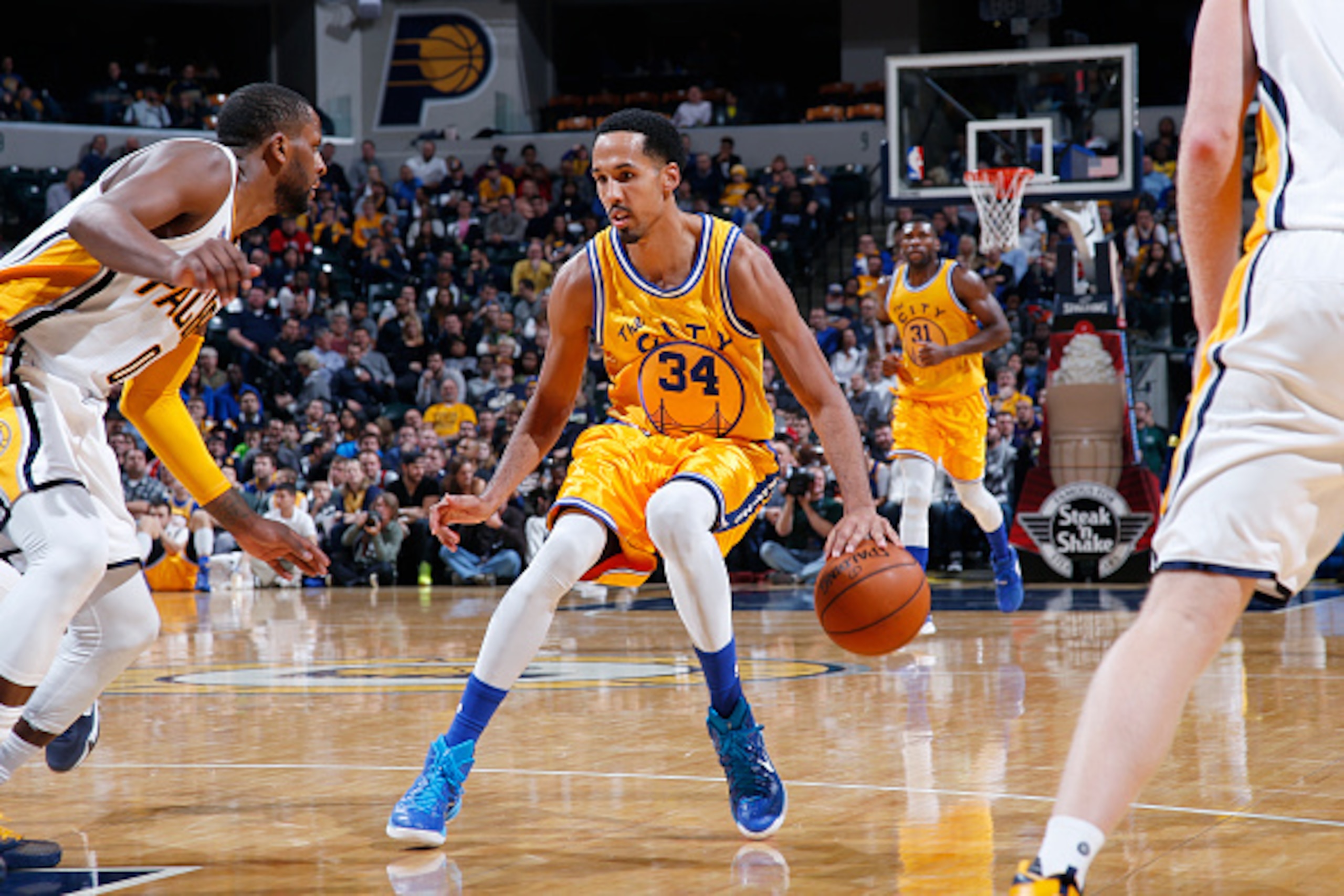
Earlier this season, we looked at how strong every other team in the NBA would become if Curry were added to the mix. Now, using the same methodology, we can shift around the depth chart of the Warriors and see what the impact would be if we took the reigning MVP away from the defending champions.
Obviously, we're losing the 34.9 minutes per game Curry typically plays. But we're doing more than bumping up the minutes of the backup point guards. The full list of changes is below:
| Shaun Livingston | 20.9 | 34.6 |
| Ian Clark | 7.2 | 15 |
| Leandro Barbosa | 14.9 | 20 |
| Andre Iguodala | 28.2 | 32 |
| Brandon Rush | 13.5 | 18 |
Every alteration hurts.
Even giving minutes to a player such as Andre Iguodala, one who has been fantastic when on the floor, has a negative impact. Quite simply, no one can replicate the massive success Curry is currently enjoying.
Using this methodology, just replacing the point guard with Iguodala for 3.8 minutes during the average outing drops Golden State's net rating by 0.6 points per 100 possessions.
However, it's not all bad news.
Though each change yields a negative result, the cumulative effect of the rotation differences listed above has the Warriors posting a net rating of 3.4. For the sake of comparison, that put the defending champions slightly behind the Indiana Pacers (3.7 net rating), leaving them in eighth place throughout the Association.
But what does that mean in terms of wins? Using a regression between net rating and wins (prorated to 82-game seasons where necessary), we can figure out the historical expectations:
According to the best-fit equation you can see in red, the real-life Warriors and their scorching net rating of 13 points per 100 possessions should be expected to win 74.7 games during a full season.
But on a per-possession basis, these Dubs aren't outscoring their opponents by nearly as much with Curry off the court. In fact, the current methodology indicates the score would drop all the way down to 3.4, though that still yields a relatively impressive number of victories.
Throughout all of NBA history, just 11 teams have managed to finish a campaign with that exact net rating. The results have ranged anywhere from the 2011-12 New York Knicks (36-30 during the lockout-shortened go-round, which put them on pace to win 44.7 games in a typical season) to the 1979-80 Phoenix Suns, 1993-94 Chicago Bulls and 1994-95 Knicks, all of whom earned 55 victories.
The Curry-less Dubs could certainly swing toward either end of the spectrum, but the regression here indicates they'd go 50-32 over the course of a full year.
Player Effects
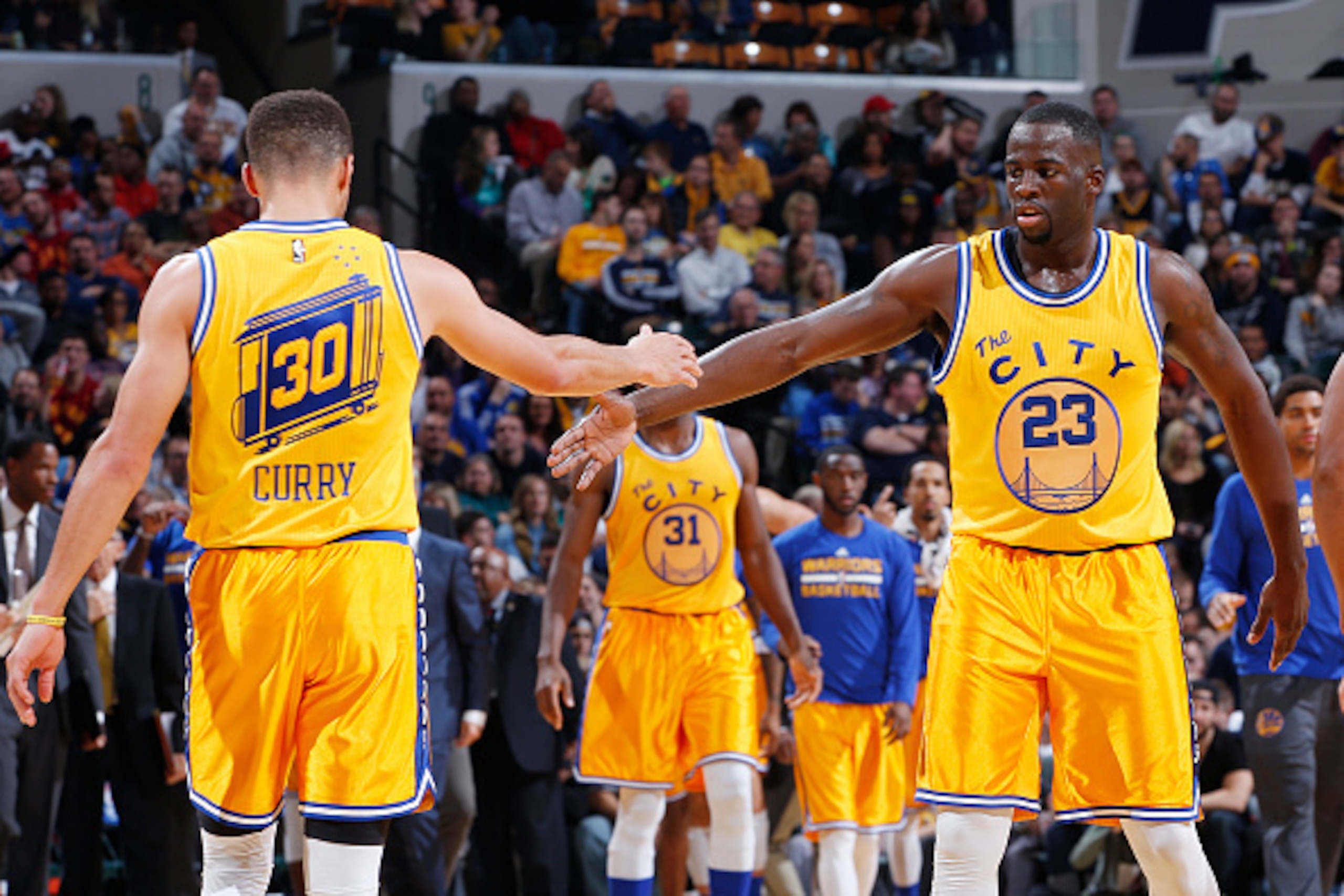
FATS says the Warriors will win 38 games without Curry. The analysis based on total points added points toward 50 wins.
What gives? What's behind the 12-victory discrepancy?
Each of these methods fails to account for all potentially confounding factors—as would any type of analysis. The former doesn't consider the increased levels of chemistry players would gain while suiting up alongside each other for longer periods of time. The latter ignores effects stemming from certain lineup combinations, which can often be rather significant.
In reality, the answer to the original question would likely fall somewhere between the two, though the largely positive impact Curry has on teammates could push the Dubs' actual sans-Curry win expectations closer to 38. Keeping in mind we're dealing with many small sample sizes, the following graphics show how Golden State's primary rotation members fare with and without their usual starting point guard.
First, true shooting percentage, which accounts for players' success from the field, beyond the arc and at the charity stripe:
Second, individual offensive rating:
Finally, individual defensive rating:
Harrison Barnes and Festus Ezeli are the only players who shoot with more accuracy when Curry isn't accompanying them on the hardwood. Even they join the rest of the Warriors when looking at offensive rating, since every player is significantly better when paired up with the reigning MVP.
Defensive rating tells a similar story.
Even though Curry isn't much more than an average defender who generates steals and pushes his mark into advantageous positions, his consistent presence still aids most of his teammates. Draymond Green is the lone exception who fares better all by his lonesome.
The 50-win estimate doesn't take any of this into account, and almost all the omissions are decisively negative. Without Curry, the rest of the Warriors aren't receiving the boosts in the above graphics. Simultaneously, the 38-win projection could either be accurate or represent the floor for this team, since the unaccounted for chemistry effects most assuredly won't be harmful to the Bay Area representatives.
Chances are, we're looking at a team capable of winning anywhere from 40 to 45 games without Curry stepping onto the floor even once, though the total could admittedly vary slightly in either direction.
Seeing as how the Dubs still justifiably have their sights set on 73 wins, can we just hand this point guard the Maurice Podoloff Trophy already?
Note: All stats, unless otherwise indicated, come from Basketball-Reference.com or my own databases and are current heading into Dec. 14's games.
Adam Fromal covers the NBA for Bleacher Report. Follow him on Twitter: @fromal09.

.jpg?w=2560 "Grading WWE Raw 🔠")


.jpg?w=2560 "2 NFL Officials Suspended")
.jpg?w=2560 "Viral Rams Coach Vid 🖕")