

Seahawks 2014-15 Scrap Book: Reviewing Seattle's Remarkable Season
The Seattle Seahawks were defending Super Bowl champions entering the 2014 season, but don't tell them that means the path was easy. Take a look at a sampling of articles about the team throughout the regular season and postseason, and the phrase "overcoming adversity" is one that pops up again and again.
"Well, there were challenges throughout the season in a lot of ways," offensive coordinator Darrell Bevell said prior to the divisional round matchup with the Carolina Panthers, via Brady Henderson of 710 ESPN Seattle.
Bevell cited such events as the Percy Harvin trade, losing tight end Zach Miller to season-ending injured reserve, the rotation at center behind the injured Max Unger and even Golden Tate's departure in free agency as challenges his squad had to overcome.
TOP NEWS

New NFL Power Rankings 📊
Takeaways from Falcons' dominant MNF win
The Robinsons POUND the Rock 🪨
For all the talk about adversity, however, the Seahawks offense certainly didn't appear to struggle much this season. Aside from being 3-3 to start the season and some questions that were raised, Seattle finished the season ranked ninth in total offense, its highest finish since 2007.
That was split fairly significantly between having the No. 1 rushing offense and the No. 27 passing offense, and Russell Wilson had hiccups during the season, due in part to a below-average receiving corps.
Seattle's defense got off to a slower-than-expected start as well. Opponents scored 174 points through the first eight games of the season; 119 of those were against Seattle's defense. But the unit roared back to finish in first place, allowing a stingy 56 points through the last eight games. Opponents scored just 80 points total in that time frame.
The Seahawks faced a tall order to become the first team in 10 years to win back-to-back Super Bowls, and ultimately that did not happen on February 1, as Seattle watched its victory slip through its fingers. Nonetheless, even reaching a Super Bowl in consecutive seasons is no small feat, and Seattle demonstrated that it is a well-built team primed to contend for years.
Let's take a look back at Seattle's remarkable 2014 season and path to the Super Bowl.
Building a Dynasty: Draft and Free Agency
As defending Super Bowl champions, Seattle faced the No. 32 pick in the 2014 NFL draft after a free-agency period that saw many of its key championship players depart.
General manager John Schneider and head coach Pete Carroll let wide receiver Golden Tate, defensive ends Red Bryant and Chris Clemons, right tackle Breno Giacomini, linemen Clinton McDonald and Paul McQuistan, and corners Brandon Browner and Walter Thurmond walk in free agency.
Schneider and Carroll, however, had a plan—a vision—that their stable of young players would step up into the important roles vacated by those players and lead the team to another successful postseason. And though it may have been hard to see at the time, they were right.
There was a careful method to it all, however. Schneider and Carroll were willing to spend money where it was necessary, including signing Michael Bennett to a multiyear contract extension to prevent him from hitting the open market.
It was a crucial move; Bennett graded out as the second-best 4-3 defensive end in the league by Pro Football Focus, and his 72 total quarterback pressures were the second most of any defensive end in the league behind Houston's J.J. Watt.
Seattle also re-signed kicker Steven Hauschka to a three-year deal; though his percentage of field goals made was down from 2013, he was responsible for 134 Seahawks points this season, the second most of his career.
Entering the draft with just six selections, Schneider and Carroll hedged their bets. For the most part, Seattle didn't need first-year production out of its draft class, so instead the Seahawks invested in their future with an eye toward need. Schneider traded picks to end up with nine selections, focusing on immediate needs of offensive line and wide receiver:
| 2 | 45 | Paul Richardson | WR | 530 / 6 |
| 2 | 64 | Justin Britt | OT | 1,148 / 17 |
| 4 | 108 | Cassius Marsh | DE | 72 / 0 |
| 4 | 123 | Kevin Norwood | WR | 178 / 2 |
| 4 | 132 | Kevin Pierre-Louis | OLB | 83 / 0 |
| 5 | 172 | Jimmy Staten | DT | PS; Released Nov. 22 |
| 6 | 199 | Garrett Scott | OT | Reserve non-football injury list |
| 6 | 208 | Eric Pinkins | S | Reserve non-football injury list |
| 7 | 227 | Kiero Small | FB | Cut prior to season |
Seattle filled a position of need by drafting tackle Justin Britt with the final pick in the second round, whose development was escalated during training camp as he prepared to start at right tackle in the season opener against Green Bay. He won the starting job over veteran Eric Winston.
Britt missed the NFC Championship Game against the Packers with a knee injury, which would have proved a fitting bookend to his Week 1 debut. But he was back in the lineup for the Super Bowl, where he had a key block for Lynch on a three-yard touchdown run.
Rookie receiver Paul Richardson also helped buttress a middling Seahawks receiving corps. Richardson started six games, the majority coming after the midway point of the season. Richardson was placed on injured reserve late in the season after tearing his ACL in the win over the Carolina Panthers in the divisional round.
Aside from Britt and Richardson, none of Seattle's other 2014 draft selections had notable seasons. ESPN's Mel Kiper gave the draft class a C+ grade, Sports Illustrated a B- and Fox Sports, atoning for passing judgment on Schneider's and Carroll's 2012 class, gave an A- grade.
In hindsight, however, Seattle's class looks a little worse for the wear. Two players are no longer with the team, two more are on the reserve non-football injury list and one is on injured reserve.
The Seahawks didn't need much immediate help getting back to the Super Bowl—and when they did, Britt stepped up—but Schneider and Carroll will need to make the most out of picking at the bottom of each round for the second consecutive draft in 2015.
Taking Flight: Training Camp and Preseason
Holdouts, sellouts and music blaring: such were the sights and sounds of Seahawks training camp last summer. In June, when registration opened for the team's 12 open practices, tickets sold out in 45 minutes, as fans invigorated by the Super Bowl win wanted to see their team go for another.
After his holdout saw him miss eight total days of practice, Marshawn Lynch reported to training camp on July 31. Lynch would have been subject to over $500,000 in fines, but as part of "financial concessions" that Seattle added to his contract, he did not have to pay the fines and got a higher base salary in 2014.
Was it worth it? It certainly seems so. During the regular season, Lynch amassed 1,306 yards on 280 carries and 13 touchdowns—the most of his career.
Defensive tackle Jesse Williams received a blow when he suffered a knee injury in practice on July 30 that landed him on injured reserve for the second consecutive season. Tight end Anthony McCoy also landed on the IR list in late July.
Wide receiver Sidney Rice announced his retirement from the NFL in late July, after playing only 17 games over the 2013 and 2011 seasons combined due to multiple injuries.
On August 30, the Seahawks made a flurry of moves to get down to the final 53-man roster. One surprise was the release of veteran tackle Winston, whose potential spot at right tackle was won by the rookie Britt. Punt returner Bryan Walters was also waived.
Schneider traded a sixth-round pick in the 2015 draft to the Indianapolis Colts in return for cornerback Marcus Burley, who ended up playing 328 snaps at corner for Seattle in 2014, per Pro Football Focus. He had one interception for a touchdown and one pass defended.
As the final move to end up at the 53-man roster, Seattle activated linebacker Bruce Irvin off the physically unable to perform list. He had a great season, starting 15 games with 37 tackles, 6.5 sacks, four tackles for loss, a forced fumble, two interceptions for scores and three passes defended.
Seattle went 2-2 in the preseason, losing the opener against the Denver Broncos, stringing together consecutive wins against the San Diego Chargers and Chicago Bears and losing to the Oakland Raiders. The Raiders loss was rife with technical mistakes and penalties, but that didn't worry Carroll.
"All in all, I think we’re ready to go," Carroll said, via Seahawks.com. His team backed up that assertion in Week 1.
The First Half: Week 1-Week 9
Facing the Green Bay Packers at home for the first time since the infamous 2012 meeting, the Seahawks proved that they were not going to fall victim to a Super Bowl hangover.
In the 36-16 rout, Wilson threw two touchdowns and no interceptions while Lynch rushed for two more, gashing the Packers for 110 yards on the ground. Richard Sherman didn't bite when Packers head coach Mike McCarthy tried to lure him away from the right side of the field by moving Jordy Nelson there, and as a result Aaron Rodgers didn't throw to his right all night.
Percy Harvin also played a large role in the win, as Seattle used him in the jet sweep and multiple other formations against Green Bay. Harvin totaled 100 all-purpose yards.
The win was, in a word, dominant.
By the conclusion of Week 7, however, Seattle was sitting at 3-3 and pundits were beginning to talk. "Are the Seattle Seahawks in serious trouble?" a USA Today Sports headline blared.
In Week 2, Seattle suffered its largest margin of defeat in a 30-21 loss to the San Diego Chargers since the 2011 season, when the Seahawks lost to the Dallas Cowboys 23-13. Philip Rivers and tight end Antonio Gates connected for 96 yards and a whopping three touchdowns.
In fact, many teams in 2014 were able to best Seattle through the use of tight ends. Of the 32 touchdowns that Seattle's defense allowed in the 2014 season (including the postseason), 12 were to tight ends, the most to any positional group.
That speaks to the way teams game-planned against Seattle's stout secondary all season. Against the Seahawks' Cover 3 defense, opponents worked to get the tight end the favorable matchup on the edge.
| Tight Ends | 12 |
| Wide Receivers | 11 |
| Running Backs | 9 |
| TOTAL | 32 |
After beating the Broncos and Washington Redskins, the Seahawks dropped another game to the Cowboys in Week 6. It wasn't pretty—Wilson went 14 of 28 for only 126 yards with one touchdown and an ill-fated interception. The defense played uncharacteristically—the 30 points it gave up to Dallas were the most at home since Wilson became the starter.
But it wasn't until Seattle suffered a surprising loss to division rival St. Louis in Week 7 that tongues really began to wag. Wilson couldn't have had a better game, becoming the first player in NFL history to pass for 300 yards and run for 100 in the same game, via the Seattle Post-Intelligencer.
Yet Seattle couldn't overcome the Rams' special teams prowess, including a 90-yard punt return for a touchdown and a fourth-quarter fake punt. Injuries certainly didn't help the situation, as starters corner Byron Maxwell, linebacker Bobby Wagner, center Max Unger and tight end Luke Willson were all inactive due to injury.
"The Seahawks’ present is precarious at best, and grim at worst," wrote Larry Stone of the Seattle Times after the loss.
The game against St. Louis was the first Seattle had played without Harvin, but he wouldn't have made a difference in the outcome. Harvin, continually struggling with injuries, never had another game as productive as his Week 1 performance against Green Bay, and on October 17, FOX Sports' Jay Glazer broke the news that the Seahawks had traded Harvin to the New York Jets for a conditional draft pick.
Seattle got back on track in Week 8, stringing together consecutive wins against the Carolina Panthers and Oakland Raiders to finish out the first half of the season with a 5-3 record. Week 8's victory in Carolina was a nail-biter, with Wilson orchestrating a nine-play, 80-yard drive to come back from the second-half deficit to win 13-9.
The win over Oakland was also hard-won, another game in which Seattle was almost undone by special teams mistakes. Though the Seahawks had led 24-3 at the half, the Raiders began a comeback by scoring on a blocked punt and got within one score before Seattle held them off.
Though Seattle struggled at times in the first half of the season, Week 10 would begin the ascent back to dominance.
The Second Half: Week 10-Week 17
Prior to their victory over the New York Giants in Week 10, the Seahawks had only won game by 20 points or more: their Week 1 matchup against the Packers. But Seattle won three games by a margin of 20 or more points in the second half the season, including win over the Giants in addition to blowouts against the Cardinals and Rams in the last two weeks of the regular season.
Against New York, Lynch had a season high to that point 140 yards on the ground, which he would not surpass until the conference championship against the Packers, in which he motored his way to 157 rushing yards.
Lynch, in fact, was the linchpin to the win over the Giants. Wilson threw two picks and the team gave the ball away three total times, but Lynch's contributions on the ground, combined with Wilson's 107 rushing yards, paved the way for the 38-17 result.
It was at that point in the season, however, that Seattle was forced to place both tight end Zach Miller and defensive tackle Brandon Mebane on injured reserve. Additionally, safety Kam Chancellor and linebacker Malcolm Smith both dealt with groin injuries from Week 8 to Week 11.
Both returned in Week 11 against Kansas City and were expected to provide enough of a boost to the defense to overcome the Chiefs. However, Seattle fell to the Kansas City Chiefs 24-20.
It would be the last game they dropped on the season, playing to a 7-1 record in the second half of the campaign. Against the Chiefs, Seattle's defense couldn't overcome Kansas City's backfield. Jamaal Charles' 159 rushing yards and two scores were supplemented by Knile Davis' touchdown.
Lynch, though he had 124 yards on 24 attempts, was held scoreless by the Chiefs defense.
But after their final loss of the season, Seattle didn't have another close game. For six consecutive weeks, the Seahawks won by at least 10 points, but on average defeated their opponents by 15.8 points during that stretch.
Four were blowouts, all against division rivals, an accomplishment that helped secure Seattle's position as the No. 1 seed in the NFC heading into the postseason. (Seattle went 5-1 against NFC West foes in 2014, with the sole loss coming at the hands of the Rams.)
After the loss to the Chiefs, the Seahawks strung together back-to-back 19-3 victories against the 49ers and then the Cardinals. They then had another pair of blowouts to close out the season, beating the Cardinals 35-6 and the Rams 20-6.
The second half of the season was marked by a huge decrease in scores allowed on the part of the defense. Though the unit allowed 17 touchdowns through Week 9, it allowed just eight after that and seven in the postseason.
| TDs Allowed | |
| Weeks 1-9 | 17 |
| Weeks 10-17 | 8 |
| Postseason | 7 |
And tight ends no longer got the best of the Seahawks; Seattle's defense had given up 10 touchdowns to tight ends in the first half of the season but gave up just one in the second half.
In total, the Seahawks defense allowed just 36 points in the final five games of the season. The unit became a stalwart at just the right time in the season, propelling the Seahawks into the postseason and their second straight Super Bowl appearance.
Push to the Super Bowl: The Postseason
With the No. 1 seed and home-field advantage throughout the playoffs for the second consecutive season, the Seahawks used their bye week to get healthy. For the first time in franchise history, per the Seattle Times, Seattle started four different centers due to injury exigencies.
Unger missed the last six games of the season after injuring his ankle in November, but he was set to return in the divisional round against the Carolina Panthers. So too was wide receiver Jermaine Kearse, who had been dealing with a hamstring injury.
Unfortunately for the Seahawks, however, the win against Carolina brought new injury concerns to the table that set the stage for a dramatic final showdown against Green Bay in the championship game.
Carolina
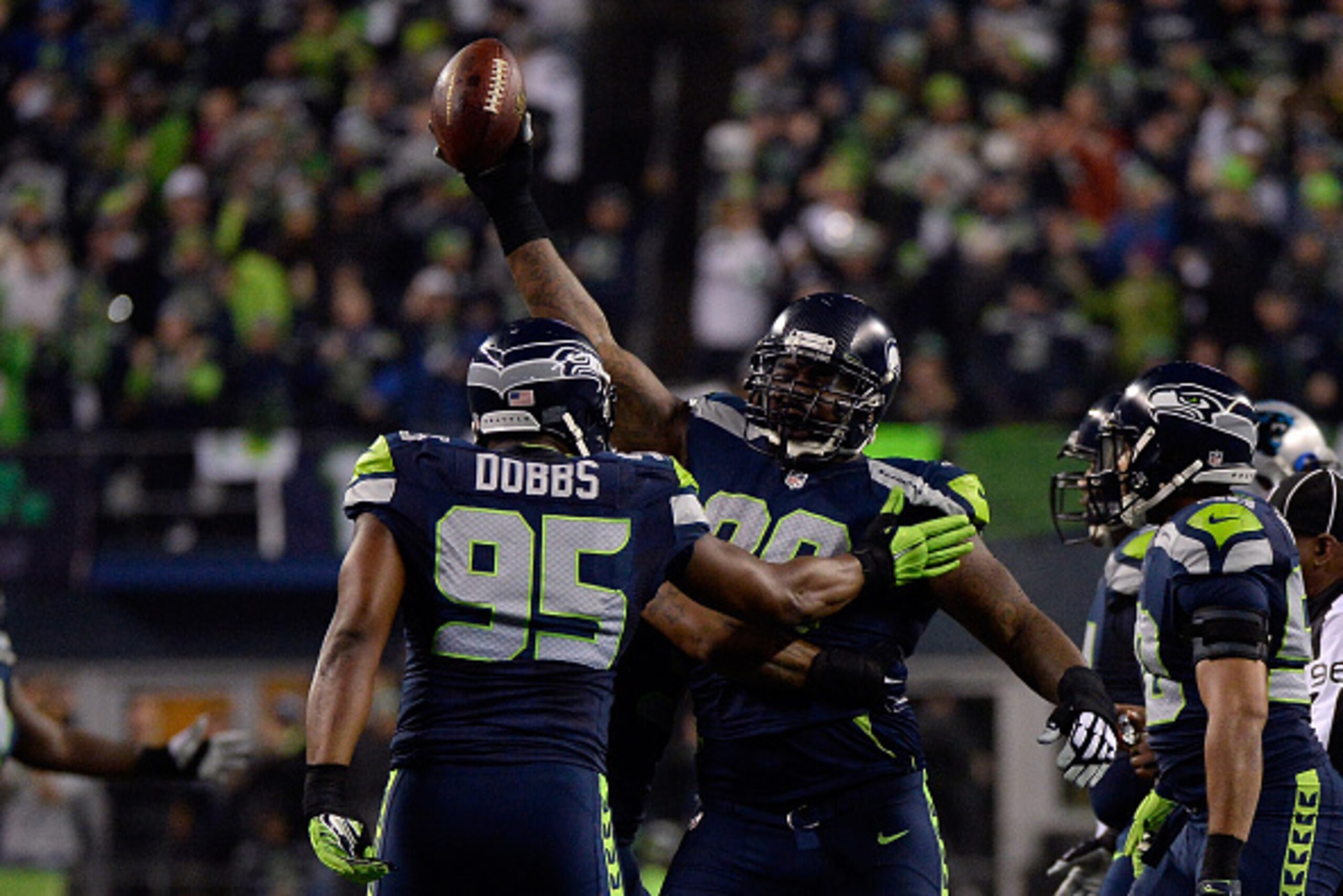
Through the regular season, Wilson only had four games of 250-plus passing yards and never threw for more than two touchdowns. But he led the Seahawks to victory against the Panthers with his arm, throwing for 268 yards and three touchdowns, finishing with his highest passer rating of the season (149.2).
Kearse's return from injury proved to be pivotal, as he connected with Wilson on a 63-yard touchdown in the second quarter that gave the Seahawks a lead they would never relinquish.
Wilson found Doug Baldwin and Luke Willson for the other two scores.
The real hero of the day for Seattle, however, was Chancellor. The safety returned an interception 90 yards for a touchdown—the first of his career—and demonstrated his hurdling skills on two Carolina field-goal attempts. Chancellor also tied for a team-high 11 total tackles and had one pass defended in addition to his interception.
Unfortunately, the Seahawks couldn't escape the Panthers completely unscathed. Unger re-injured his knee, leading to a fourth-quarter exit, while wide receiver Paul Richardson sprained his knee.
Lynch had a quiet day in comparison to Wilson's passing dominance, totaling 59 yards on 14 carries.
That dynamic would flip dramatically the following week against the Packers.
Green Bay
For as flawless as Wilson was against Carolina, he started off abominably against Green Bay. By halftime, Wilson was 2 of 9 for 22 yards and three interceptions, as the Seahawks trailed the Packers 16-0.
That score, however, didn't necessarily reflect the course of the game. Though Aaron Rodgers had connected with Randall Cobb on a touchdown as time expired in the first quarter, Green Bay's other nine points came from Mason Crosby field goals.
Twice on 4th-and-1, Mike McCarthy had elected to go for the field goal rather than attempt a conversion...at the Seattle 1-yard line.
And both those field goals came as the direct result of mistakes by Seattle's offense: the first, a Wilson interception by Packers safety Ha Ha Clinton-Dix, and the second, a fumbled kick return by Baldwin.
In the second half, it was McCarthy's continued conservative play-calling combined with Seattle recovering from its first-half gaffes on offense that turned the tide of the game.
The Packers only kicked two more field goals in the second half, but Seattle scored three touchdowns. First, a special teams trick play: On a fake field goal, holder Jon Ryan tossed the ball 19 yards to tackle Garry Gilliam.
It was, in fact, special teams play that undid Green Bay. The Packers still led 19-14 with less than five minutes left to go in the game when Seattle attempted an onside kick. Green Bay tight end Brandon Bostick was supposed to block on the play but felt he could make a play on the ball. But the ball bounced off his facemask and was recovered by Chris Matthews.
Lynch, who had a season-high 157 rushing yards in the win, turned that possession into points with a 24-yard touchdown run, and an improbable but successful two-point conversion gave Seattle a three-point lead.
An injured Rodgers got Green Bay far enough down the field for Crosby to kick a field goal to tie the game as time ran out, but Seattle scored on its first overtime possession when Wilson, who just got more effective as the game wore on, connected with Kearse for a 35-yard touchdown.
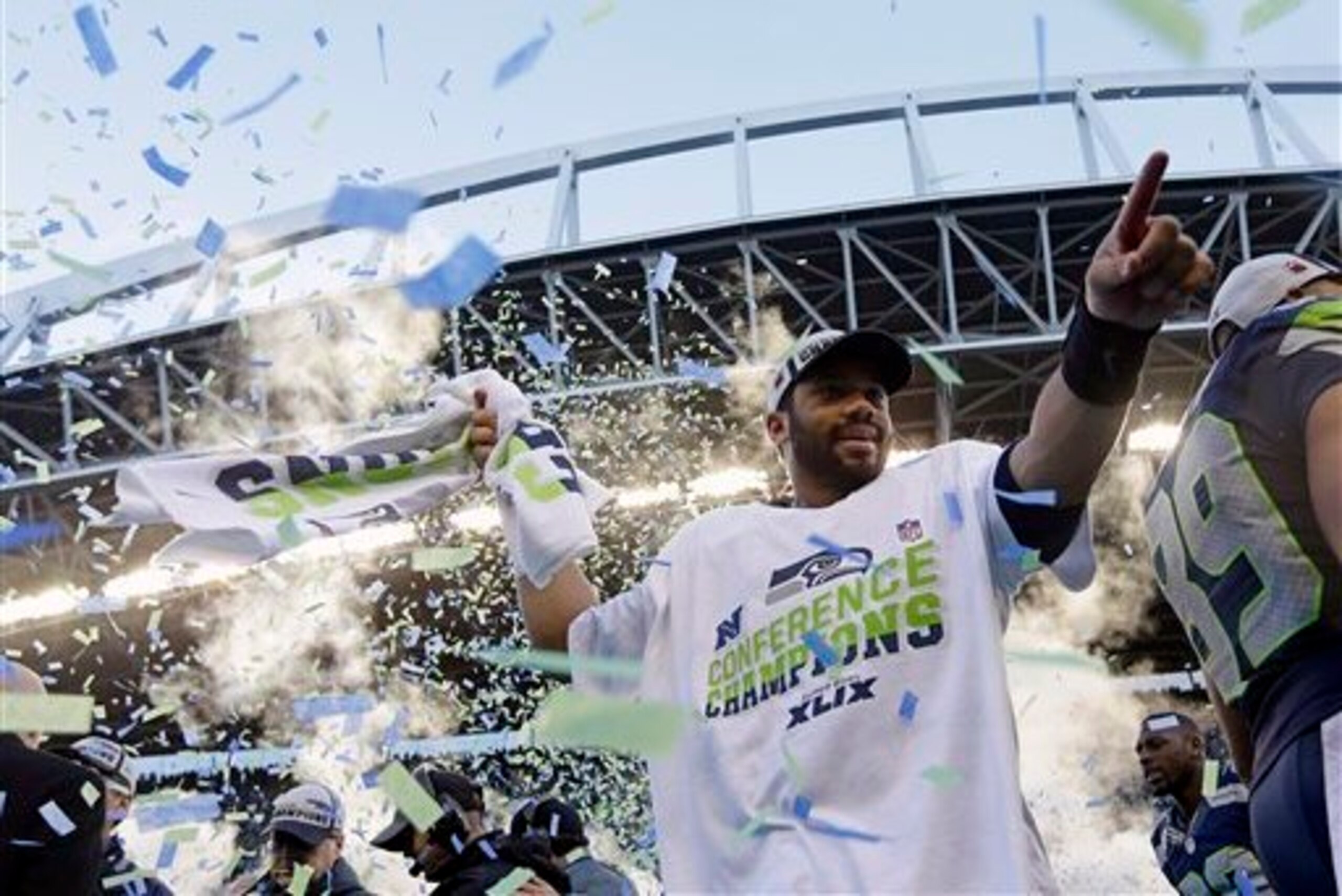
It was a Super Bowl-caliber game, and an emotional Wilson, tears streaming down his face, celebrated leading his team to its second consecutive Super Bowl.
Super Seahawks: Super Bowl XLIX
Though Seattle intercepted Tom Brady twice on the night, both picks came with injury consequences. Late in the first quarter, Jeremy Lane intercepted Brady at the goal line but was injured when he attempted to return it and was carted off the field.
In the third quarter, Bobby Wagner picked off Brady in New England territory, but Avril suffered a head injury on the play and was taken to the locker room to be evaluated for a concussion.
Early on, New England did a good job containing Seattle's run game up front, and the secondary made it difficult for Wilson to get the ball out. On his first five plays, Wilson was sacked twice and threw two incomplete passes after a seven-yard run.
On his second completion of the night, however, Wilson found Chris Matthews for 44 yards, setting up Lynch's three-yard touchdown run and putting Seattle on the board for the first time.
Later, as time expired in the first half, Wilson and Matthews connected again for an 11-yard touchdown, tying the game heading into halftime.
New England's secondary play broke down considerably in the second half. Though Baldwin was limited by Darrelle Revis in the first half, his first reception of the night was a masterful three-yard touchdown catch on which he was virtually alone on his side of the end zone.
As NFL.com's Bucky Brooks noted, it was a veteran move by Baldwin, who used the official to elude Revis' coverage for the score. The play put the Seahawks up by 10, and their win probability rose to 86.4 percent.
Though New England would go on to score two more touchdowns and take a four-point lead, Seattle had two minutes left to answer at the end of the fourth quarter, and by all counts, it appeared it would. Wilson led an efficient drive down the field, throwing passes of 31, 11 and 33 yards to set the Seahawks up at the Patriots 38-yard line with 1:06 left on the clock.
The 33-yard completion to Kearse was one of the most bizarre plays in Super Bowl history, though it was the third such time the Patriots watched in disbelief as an opponent brought in a seemingly impossible catch in the fourth quarter of the championship game.
Kearse failed to bring in the catch as he fell to the turf, but he kept the ball in play with his legs and eventually secured the incredible juggling catch.
A four-yard Lynch run on 1st-and-goal took Seattle to the Patriots 1-yard line, and the outcome seemed all but decided. But then, in a mind-boggling call, as Seattle let the clock run down the Seahawks didn't put the ball in Lynch's hands but instead called a slant to Ricardo Lockette.
That pass ended up Patriots cornerback Malcolm Butler's hands, and Seattle was forced to look on as the Patriots won their fourth Super Bowl in the Belichick-Brady era.
Season in Review
It didn't end on the note that they would have hoped, but the Seahawks' 2014 season was indeed remarkable. Overcoming the loss of major talent both in the offseason, to injuries and even to trades during the season, Seattle nevertheless built a top-10 offense and defense, finishing at No. 9 overall in the former and first in the league in the latter.
Positive takeaways from the season? Take your pick. Wilson passed for the most yards of his career, and though his touchdowns were down from his last two seasons, so were his interceptions.
Though Seattle lost weapons in Tate and Harvin, it saw a surprising surge at the end of the season from rookie receiver Chris Matthews, who hadn't had an NFL catch until the Super Bowl. An unexpected postseason hero, Matthews had the key onside kick recovery that helped seal the conference championship against Green Bay, and then had four receptions for 109 yards and a touchdown against New England. He was Seattle's leading receiver in the Super Bowl and will be an important target for Wilson's arsenal next season.
Kearse, too, saw more targets and therefore had more yards than any season in his young career. The former undrafted free agent proved to be an important weapon for Wilson throughout the postseason, catching a touchdown in each of the playoff games prior to the Super Bowl, and his incredible juggled catch against New England gave Seattle a chance to win it all.
This offseason, the Seahawks will continue to improve on what they've built, and a key step in that direction will be signing Wilson to a new contract that will make him one of the highest-paid quarterbacks in the league.
All in all, the Seahawks improved from 17th in offense in 2013 to ninth this season and kept their No. 1 defensive ranking for the second year in a row. Though the Super Bowl loss stings, their season was far from a disappointment.
.jpg?w=2560 "Rams Eagles Football")

.jpg?w=2560 "Grading WWE Raw 🔠")


.jpg?w=2560 "Injury-stricken Seahawks signing veteran RB")
