Washington Wizards Must Change Offensive Identity Without Bradley Beal
Bradley Beal's broken left wrist has the Washington Wizards retooling at a time when they should be refining.
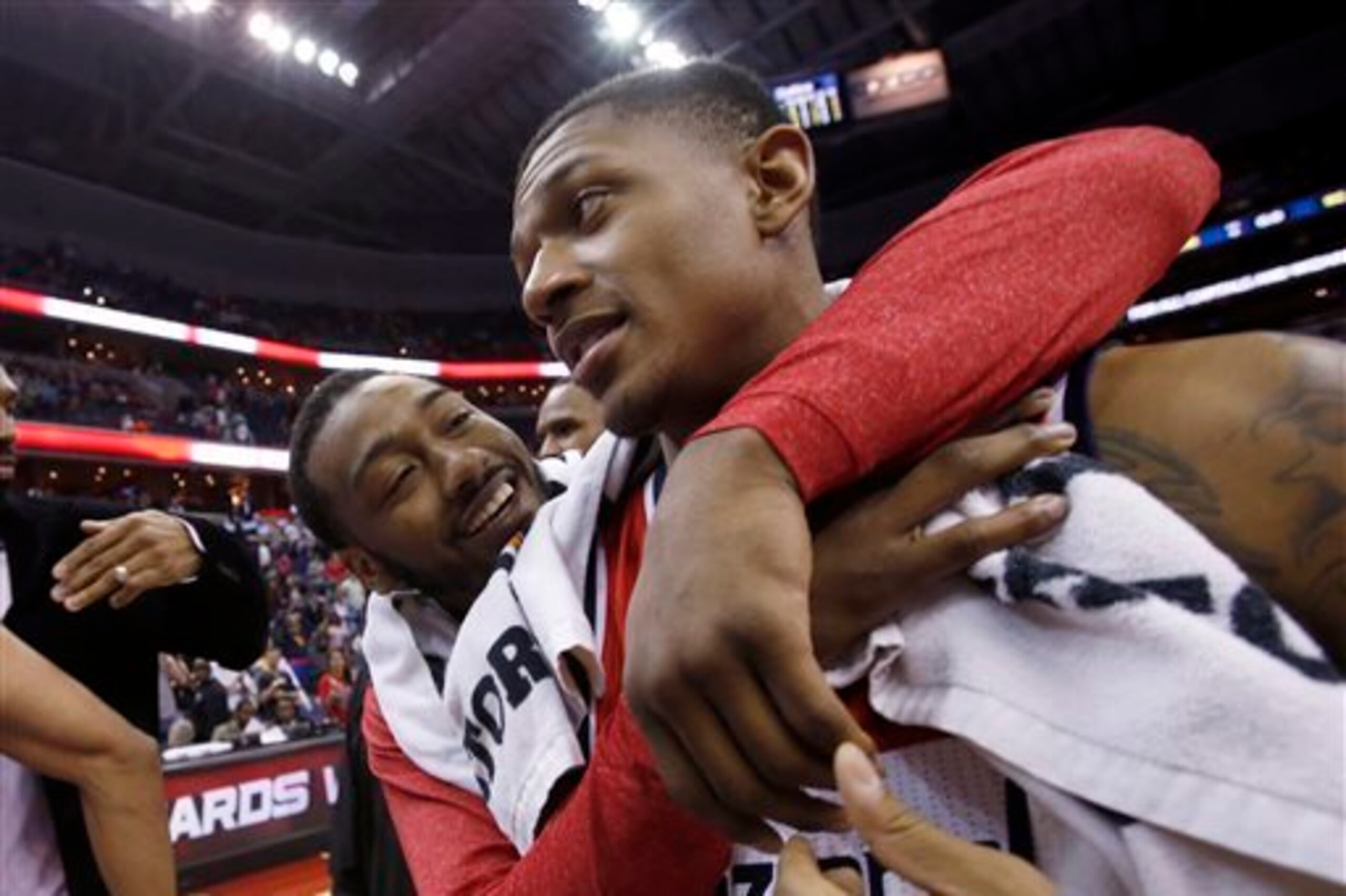
The 21-year-old shooting guard is a star in the making, and his pairing with John Wall forms one of the scariest future backcourts in the NBA.
Coming off a strong showing in the Eastern Conference Semifinals against the Indiana Pacers, Washington is looking to take the next step into the league's elite and contend for a title. Though they haven't quite reached that level yet, the Wizards' blossoming guard duo is constantly exceeding expectations.

With just enough progress from their young studs and the steady contributions of their monster frontcourt in Nene and Marcin Gortat, it isn't out of the realm of possibility that they could reach the Eastern Conference Finals.
It just requires a bit of good fortune. A disappointing season from Chicago and a dearth of other serious Eastern Conference threats could leave the door open, and Washington might be talented enough to walk through it.
The bigger puzzle piece, however, will be how quickly Wall and Beal develop.
It's Beal in particular that has fans and scouts alike drooling. He's already one of the more effective shooting guards in the league at such a young age, and his weaknesses continue to disappear at an alarming rate.
After only shooting 33.9 percent from three-point range in college, he somehow turned it around on a longer arc to shoot 38.6 percent and 40.2 percent in his first two seasons as a pro.
His ball-handling, which was a bit loose at Florida, is now a secondary threat to his game.
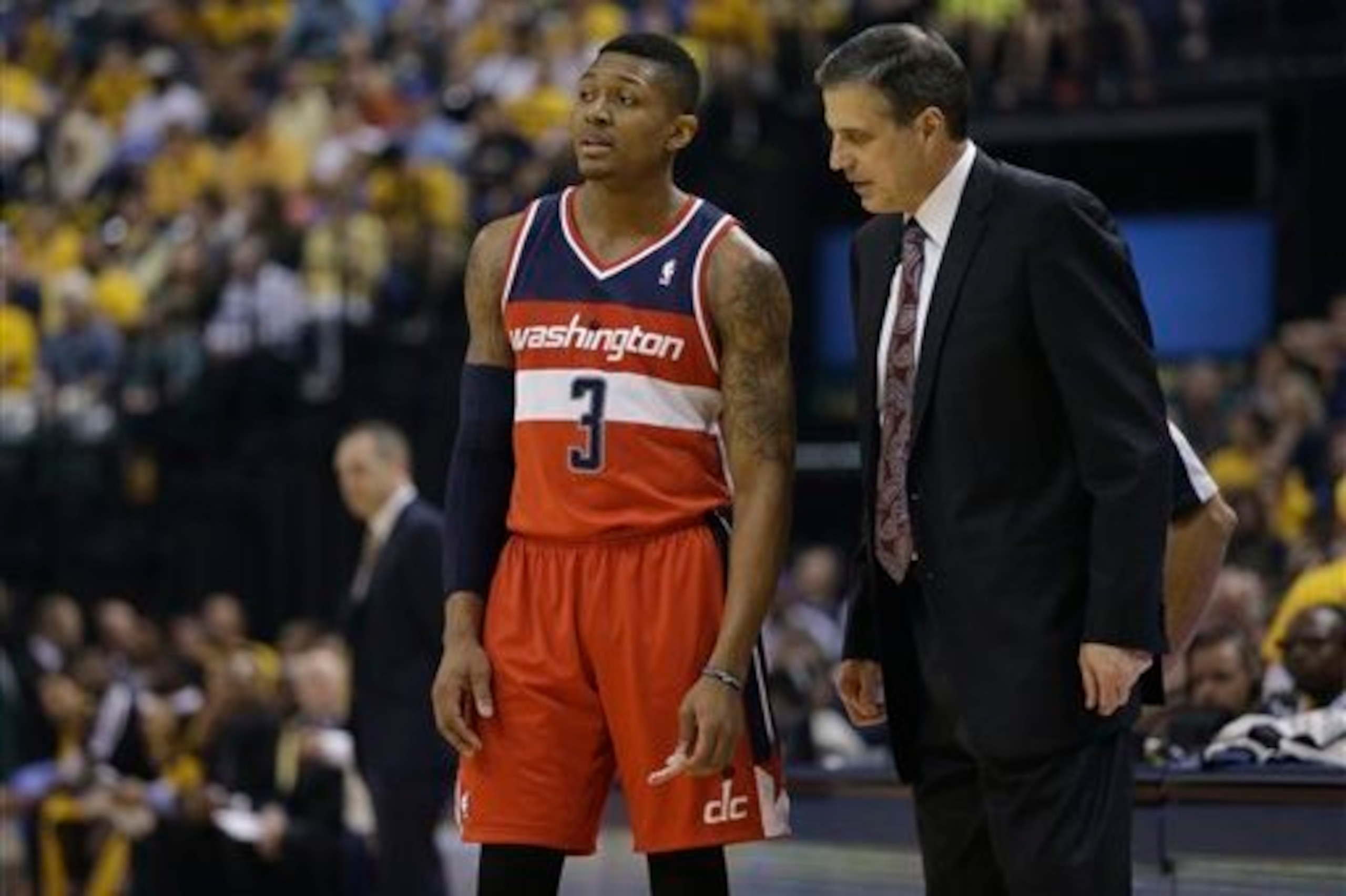
Wizards head coach Randy Wittman says it's even better after a summer's worth of work improving it, via the Washington Post's Michael Lee:
"We’ve really put a lot of work this offseason in him, from a standpoint of growing and being able to handle the ball and put the ball on the floor more…I think he’s put a lot of hard work in and we’ll see, hopefully starting Saturday, how much improvement he had there.
"
The playmaking, which was nowhere to be found when he first crashed the national scene as a freshman, is there in spurts now. His defense, which suffered due to his thin frame and young age, has improved as he's filled out physically.
Beal, quite simply, is improving at a rate well beyond his years.
An unfortunate reality of his exploding prowess is the growing expectations placed on both himself and his Wizards team.
There's a current window for success in the Eastern Conference. Only Cleveland and possibly Chicago appear to be true contenders, but it's unclear whether the new superstar trio of Kevin Love, Kyrie Irving and LeBron James will mesh right away. Chicago is also looking at shiny new parts in Doug McDermott, Nikola Mirotic and Pau Gasol while facing similar issues.
That's why some have the Wizards sneaking into the Eastern Conference Finals.
It's also why the Beal injury is so devastating.
While his six-to-eight week projected recovery time doesn't appear to be that long, it's particularly painful in terms of the Wizards' long-term goals.
In an Eastern Conference with a clear alpha dog in Cleveland, avoiding the No. 4 or No. 5 seed and a potential matchup with them in the second round of the playoffs is crucial.
That will be challenging for Washington this year even with a healthy Beal. The West is clearly the stronger conference overall, but there's an unusually large clump of above-average teams in the East. Charlotte, Atlanta, Toronto, Brooklyn and Miami will all be fighting for those middle playoff spots and could finish in any number or orders.
Losing Beal means the Wizards will drop a few more games than they can probably afford, and that could be the difference between the third seed and the fourth or fifth seed.
Whereas Oklahoma City can survive Kevin Durant's absence due to a broken foot—sliding down a seed or two could hurt in the later playoff rounds, but it's not a complete deal-breaker for their season—Washington needs to muster every win it can.
Beal's ability to serve multiple functions in the offense is irreplaceable in Washington. The acquisition of Paul Pierce should ease Wall's burden somewhat, but his advanced age has limited his effectiveness in breaking down defenses.
The other wings on the roster are Glen Rice Jr., Xavier Silas, Garrett Temple, Rasual Butler, Damion James, Otto Porter and Martell Webster, none of whom appear to be ready to make a significant impact. Two-point guard lineups with backup Andre Miller and Wall could be an option, but two non-threats from three-point range would hurt spacing.
Guards that can create in non-primary option opportunities are rare in today's NBA, and it's especially crucial for a Washington team that features a point guard who is not dangerous away from the ball.
Beal is a chameleon in that way. If you need him to stand on the weak side of the floor to suck defenders away from the strong side, he will. He shot 38.7 percent in spot-up situations last year, according to Synergy Sports (subscription required), and understood how to drift as a shooter.
Notice here on this Wall drive that Beal reads his defender, Shaun Livingston, sliding inside to help. To create a better passing angle for Wall and force Livingston to relocate upon the pass, Beal heads to the corner.
Livingston loses him completely because Beal's few steps sideways create a new and greater distance for recovery.
Not every player has this feel for the game.
He wasn't just a one-dimensional, flat-footed player on spot-ups, either. The threat of his deadly three-pointer drew overzealous closeouts more often than not. For most players, that leads to a straight-line drive with a questionable pull-up or difficult basket attack against size in the paint.
Only a small percentage of guards can put the ball on the floor amidst the chaos of defensive rotations and make the right secondary pass, and Beal is one of those players. He was also an accomplished finisher himself, shooting 56 percent in the restricted area, according to NBA.com.
That limited defensive options against him. Stick with shooters on Beal drives and he's scoring himself. Collapse too far and he's finding another player spotting up.
Even more crucial for Washington was his responsibility as a secondary ball-handler. Sometimes a simple pick-and-roll on one side of the floor yields nothing, but it generates enough defensive movement that a quick ball swing can leave the opponent vulnerable.
Whether that's for a quick catch-and-rip or a secondary pick-and-roll, multiple attackers on the floor is bound to create a mistake as the defense adjusts.
Beal's case is even more troublesome because he must be accounted for as a shooter as well. The decision to stick with him closely leaves defenders at risk of running into screens more easily, especially in Washington's offense.
Wittman has Beal running off multiple screens all day long, forcing defenders to chase him all over the floor. The primary option, of course, is to find open jumpers. Last year, Beal did that quite often and well, attempting 127 field goals off screens and making nearly 41 percent of such shots, according to Synergy Sports—a high number considering many of those looks came from beyond the three-point line.
Beal was crafty enough to leverage the threat of his shooting the basketball to create opportunities for teammates. He's particularly adept at flying off screens into dribble handoffs and penetrating into the lane by turning sharply around the Wizards' bigs and wrapping clever pocket passes back to the screener.
The second he draws two defenders, Beal's distribution light flickers on. If he's solo-covered after receiving the basketball, he'll attack and score.
What Beal was able to do for the Wizards relieved much of the pressure on Wall. Without the requisite depth to account for Beal's absence, Washington will have to scrap this uptempo, multiple-screening portion of the offense.
We might see Wall adopt a Tony Parker-style role in which he dumps the ball off to a teammate, weaves through some screens and gets the ball back on the move. Though most teams (Washington included) reserve this role for wing players, Washington seems primed to make this adjustment in order to get some offense outside of simple high pick-and-roll play with Wall and a big.
The Spurs, however, have the luxury of multiple options besides Parker. Though he's technically the lead ball-handler, he's able to function in other capacities within the San Antonio offense.
Wall might have to wear multiple hats now with Beal gone.
Whether or not it will work remains to be seen.

.jpg?w=2560 "NFL House in Paris Closes for Protests")
.jpg?w=2560 "Trevon Diggs Cut by Seahawks")