MLB Metrics 101: Potential 2017 MLB Trade Deadline Steals
This time of year, every team in Major League Baseball is looking for a good steal at the non-waiver trade deadline. It's a shame that only a select few players are steal material.
Who are those players this year? Sounds like a job for Bleacher Report's MLB Metrics 101.
Hello, and welcome back. This week's goal is to look the biggest potential steals of the 2017 trade deadline Monday. There aren't any ground rules for who's eligible. Nor is there any overarching methodology for what defines a "steal."
Instead, it's about eight players—five of whom are pitchers who fit with the widespread need for arms in today's offense-heavy environment—and their individual merits. These range from skills that are downplayed or ignored by traditional stats to specific abilities that could make a big difference on the right team.
Let's get to it.
Jeff Samardzija, SP, San Francisco Giants
1 of 8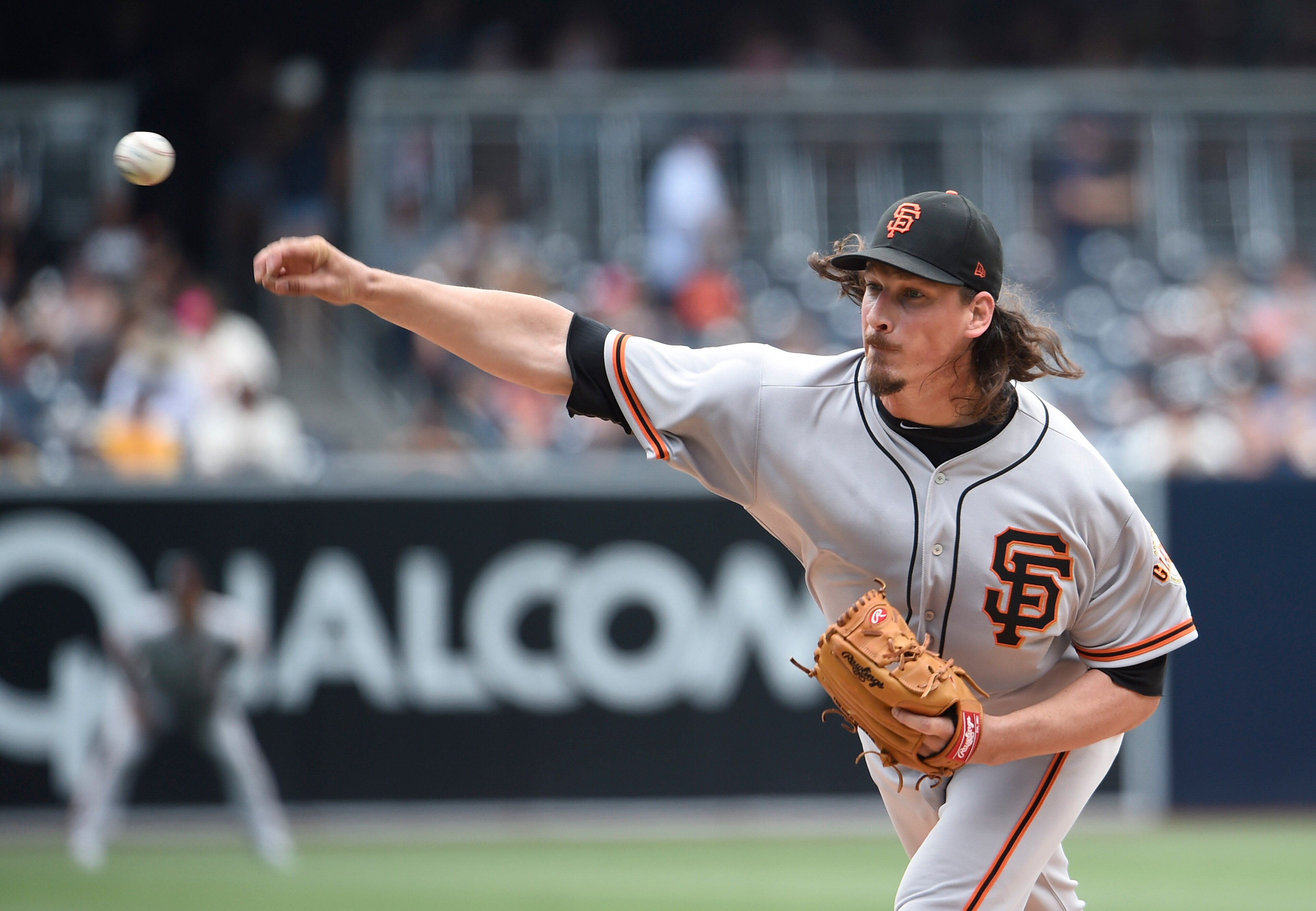
There's been plenty of speculation about Jeff Samardzija's availability, and now ESPN's Buster Olney is reporting the San Francisco Giants are "open to talking" about the right-hander.
On the surface, why the heck anyone would want Samardzija is a mystery. Sure, he eats innings. But he's also a 32-year-old with a 4.85 ERA through 21 starts. And he's owed $59.4 million over the next three years.
Yet with 146 strikeouts and only 17 walks, "Shark" at least has an 8.6 strikeout-to-walk ratio this season. That's on track to be the eighth-best mark of all time.
He's not benefiting more from his K/BB ratio because he's gotten killed when hitters have made contact. He's allowed 21 home runs and a .329 average on balls in play. However, the exit velocity against him is the lowest it's been. He's also had to pitch in front of a woefully inefficient Giants defense.
It's no surprise that Baseball Savant reveals the difference between hitters' expected production—or xwOBA, which is based on the speed and trajectory of batted balls—and actual production against Samardzija is among the largest of all pitchers. Translation: He's been unlucky.
Giving credit where it's due, MLB.com's Mike Petriello covered all this and used it to argue for Samardzija as an alternative to Oakland Athletics right-hander Sonny Gray.
That's an especially good idea for a team with more money than prospects. And as Andrew Baggarly of the Mercury News, Samardzija left a couple teams like that off his no-trade list.
Dan Straily, SP, Miami Marlins
2 of 8
The Miami Marlins are a lousy team that should be smashing the "sell" button over and over. Instead, MLB.com's Joe Frisaro reported they're clamping down on their top trade chips.
That includes Dan Straily. So, take his inclusion here with a grain of salt.
Still, Straily is an attractive trade target. He was solid with a 3.76 ERA in 191.1 innings with the Cincinnati Reds in 2016. With a 3.84 ERA through 117.1 innings, he's dependable again this year—if not even better than that.
With a career-high strikeout rate (8.2 K/9) and career-low walk rate (2.5 BB/9), the right-hander is doing two important things better than ever. Meanwhile, the expected production against him is lower than that of Marcus Stroman, Yu Darvish and Carlos Carrasco.
Like Samardzija, Straily does have a home run problem (1.5 HR/9) that you can't ignore. But he's nonetheless improved as a contact manager. His exit velocity is down, and he's inducing infield fly balls better than any other pitcher.
All told, Straily has simply become better. And he's controllable through 2020 to boot.
That doesn't mean he would come cheap in a trade. But compared to, say, Jose Quintana—who recently joined the Chicago Cubs for multiple prospects, including the organization's top two—Gray or Darvish, he should come cheaper, anyway.
Brad Ziegler, RHP, Miami Marlins
3 of 8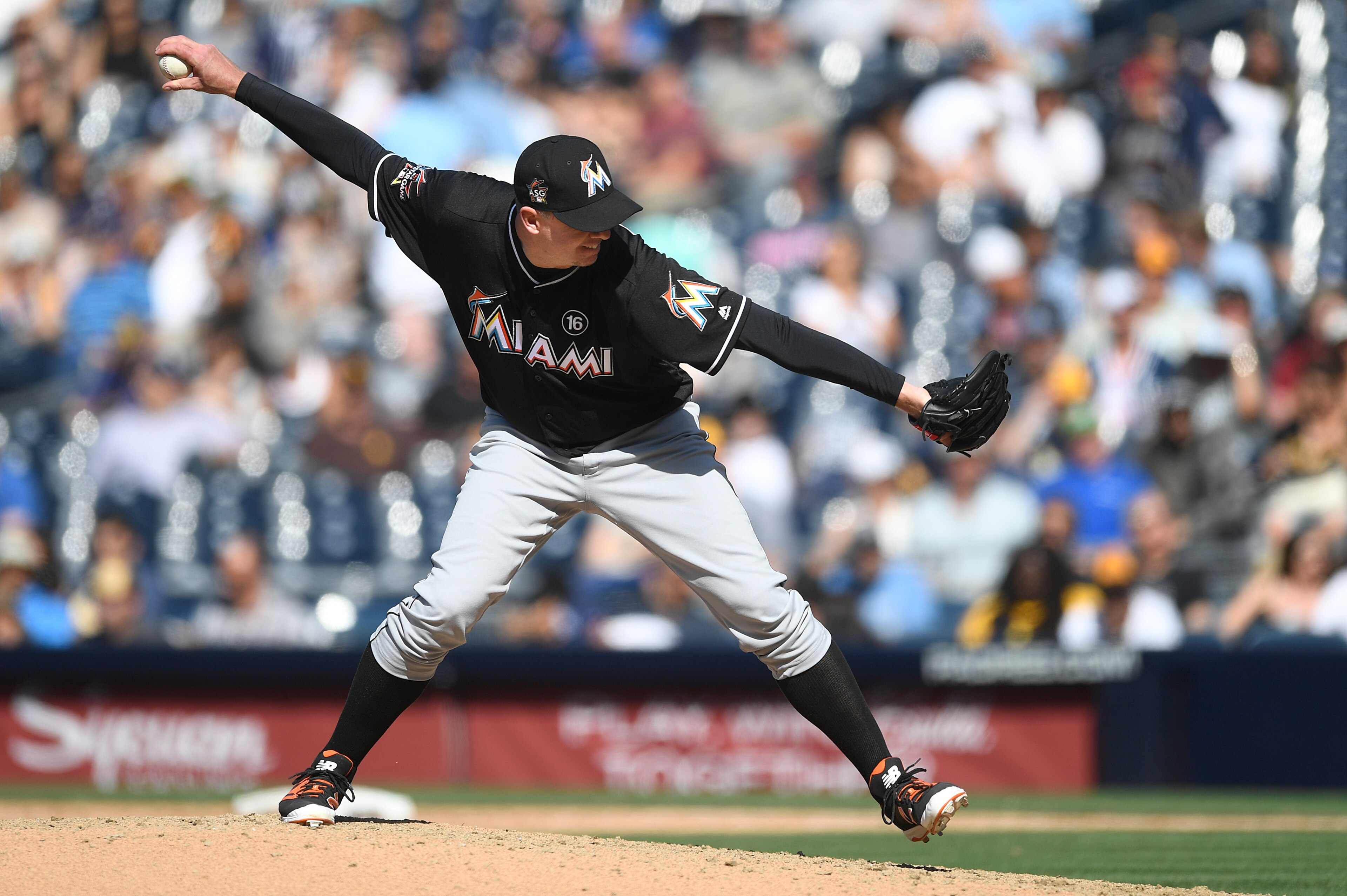
Sticking with the Marlins, here's a player who is available.
According to a mid-July report from Mark Feinsand of MLB.com, the Marlins are not only willing to trade Brad Ziegler, but also open to eating a "substantial amount" of the money left on his two-year, $16 million contract.
That alone gives an idea of how bad the 37-year-old has been in his first season with the club. But here are the gory details anyway: He has a 6.52 ERA in 34 appearances and is just coming off the disabled list.
Ziegler was no slouch before 2017, however. He posted a 2.44 ERA across the previous nine seasons, one of the lowest among relievers.
And now, a proposition: He hasn't actually been that bad in 2017.
Ziegler's walk (4.0 BB/9) and strikeout (5.3 K/9) rates aren't solid, but those aren't his specialties. He's more about getting ground balls and being impossible to square up. And he's continued to do both in 2017.
His ground-ball rate is a par-for-the-course 64.6 percent. His exit velocity is the lowest it's been. Best of all, he's avoided barreled balls—balls hit with an ideal combination of launch angle and exit velocity—better than anyone. No wonder there's a huge gap between Ziegler's expected production and actual production.
So, any team that can get Ziegler in a salary dump would soon be pleased.
Jim Johnson, RP, Atlanta Braves
4 of 8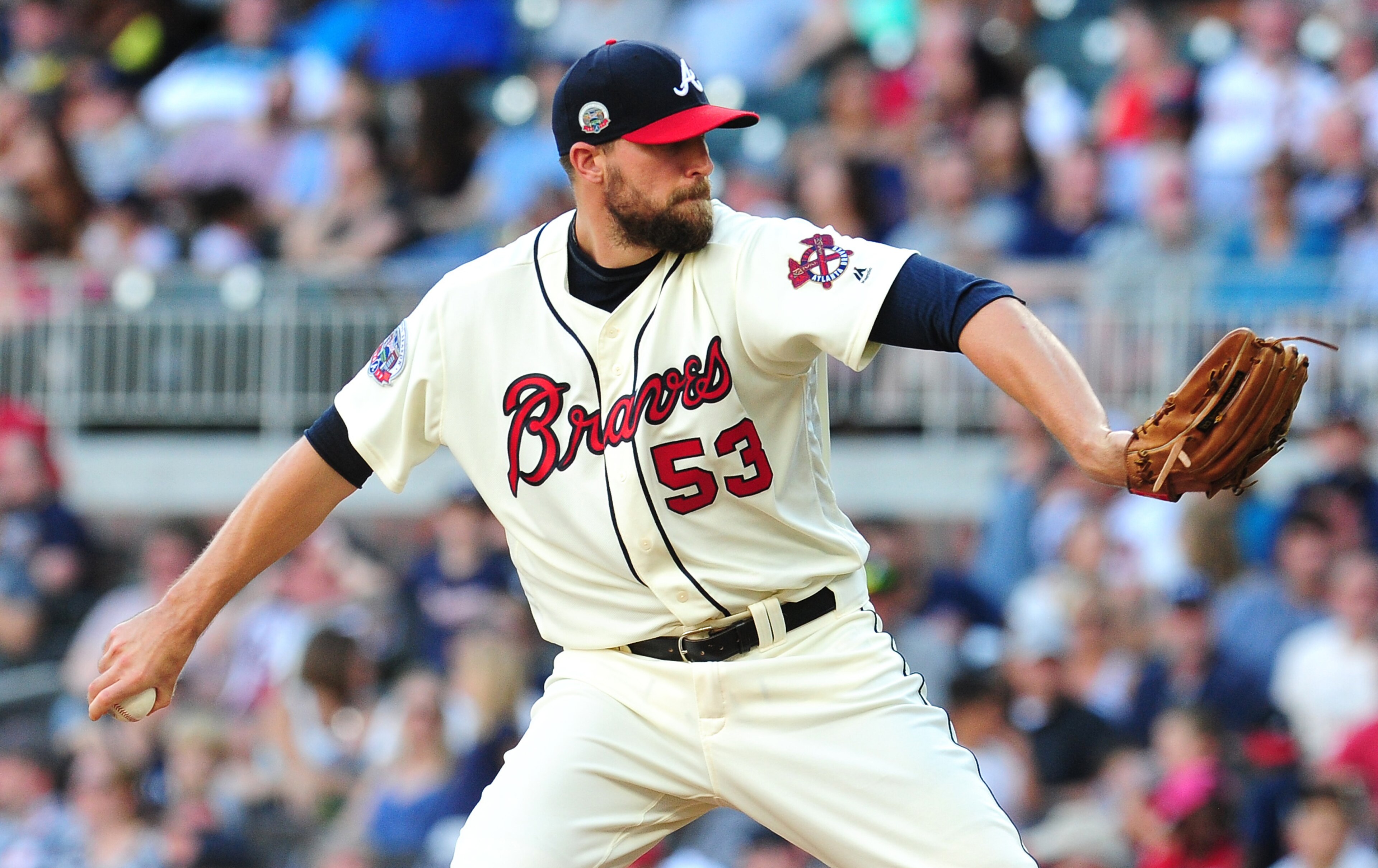
Since he's on a two-year contact with a non-terrible Atlanta Braves team, Jim Johnson may be available only in theory. But as Nick Cafardo of the Boston Globe reported in May, there's interest in him anyway.
The 34-year-old has had ups and downs over the years, and he seems to be experiencing one of the downs this season. He has a modest 4.10 ERA in 42 appearances.
But despite his ugly ERA, Johnson has pushed his strikeout rate to a career-high 10.8 per nine innings. His walk rate remains solid at 3.2 per nine innings. And while he's not the ground-ball magnet he once was, his 50.5 GB% is solid.
What's hurting him is that his ground balls aren't turning into outs as often as he's used to. He's allowing a .241 average on grounders. Not his highest but up from .224 last year.
Here's a related story: In allowing a .249 average on ground balls, Atlanta's defense ranks in the back half of MLB in that department.
There are plenty of relief-needy contenders at the top of that chart. If one of them were to get Johnson, more of his grounders should turn into outs.
To boot, the cost for him shouldn't be nearly what it would be for, say, a Brad Hand or a Zach Britton.
Brad Brach, RHP, Baltimore Orioles
5 of 8
Speaking of Britton, he's a standout Baltimore Orioles reliever who's under control through 2018. But the same can be said of Brad Brach, who might be more available and a better trade option.
Brach wasn't on Britton's level—no reliever was—in 2015 and 2016, but he was plenty solid with a 2.39 ERA and 2.9 K/BB ratio across 133 appearances
And as Britton has spent much of 2017 injured, Brach has kept rolling with a 2.70 ERA and 3.5 K/BB ratio in 43 appearances.
He's also fixed what had been a big weakness in '15 and '16. He was only dominant against right-handed batters, who had a .555 OPS against him. With a .652 OPS, lefty batters did much better.
This year, however, lefties have just a .387 OPS against Brach. There does seem to be some good luck going on there. But according to the ol' Baseball Savant metric, his performance against lefties is still much-improved even after luck is accounted for.
The catch is that right-handed batters are doing better against Brach. But split his season at May 19, and righties have gone from slugging .474 against him to just .362 against him.
The takeaway is that Brach is transitioning from a good reliever into a great reliever. With the trade market unlikely to treat him as such, relief-needy teams should get after him.
Daniel Nava, OF, Philadelphia Phillies
6 of 8
Pitchers are all well and good, but how about some hitters? Starting with Daniel Nava.
Leave it to Philadelphia Phillies manager Pete Mackanin to sum up his trade value.
"Well, I think if you're looking for a good hitter and a pretty good defender, and that's a need, I wouldn't see why you wouldn't," he said, per Todd Zolecki of MLB.com.
All true, and Nava's bat is what carries the most intrigue.
His overall .808 OPS in 2017 makes it look pretty good, but what makes it look even better is its isolated performance against right-handed pitchers. He has a .941 OPS against righties, which places him ahead of heavy-hitting trade chips such as Yonder Alonso, Marcell Ozuna, Zack Cozart and Jay Bruce.
This would invite skepticism if it were coming out of nowhere. But it's not. Nava may be a switch-hitter, but he was such a masher of righties that he made a name for himself with the Boston Red Sox between 2012 and 2014. Following some lean years, he's back to it.
And it's legit. His expected production against righties also ranks as elite, even outpacing guys like Robinson Cano, Daniel Murphy and Giancarlo Stanton.
The late-breaking catch is that Nava went on the DL with a hamstring strain on Wednesday. That does hurt the odds of him being dealt before July 31.
However, he could always be moved via the August waiver wire. If he goes that route, he'll be crushing righties for a contender after all.
David Freese, 3B/1B, Pittsburgh Pirates
7 of 8
For a hitter who can handle lefties, teams should call the Pittsburgh Pirates about David Freese.
The Pirates are not enthused with the idea of selling, but Ken Rosenthal of Fox Sports reported that Freese is one guy they'll listen on. Although he's signed through 2018 with a club option for 2019, he has real trade value.
That's mainly because of his bat, which has produced a solid .762 OPS in nine seasons. To really amplify his hitting ability, however, a team need only put him in the box against left-handed pitchers.
He has an .855 OPS against southpaws for his career and is up to a .963 OPS against them this season. And while that doesn't put him too high in the rankings, high up is where he actually belongs.
Freese's expected production against lefties is tied for 14th among qualified hitters. He shares the tie with teammate Andrew McCutchen and is ahead of guys like Jose Abreu, Edwin Encarnacion and Khris Davis.
In the past, the catch with Freese was his defense would be less of a positive than his bat. But he's now pleasing the defensive metrics at third and, albeit with limited exposure, doing fine at first too.
The Pirates could just decide to keep Freese. But on a contender that needs a good right-handed stick to platoon at the corners, he'd be worth what should be a modest price.
Alex Avila, C, Detroit Tigers
8 of 8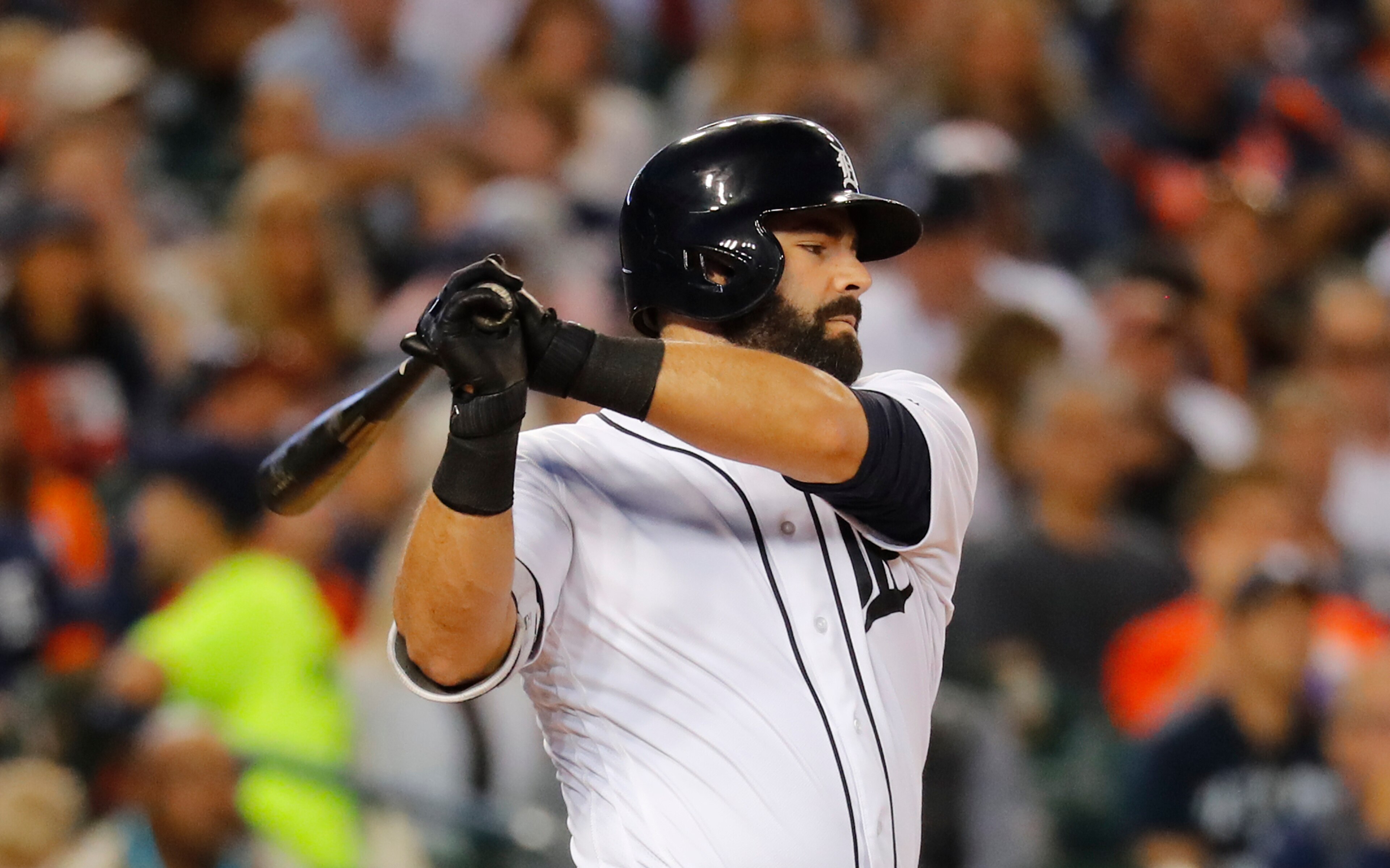
Lastly, how about a near-everyday catcher with a bat full of thunder? Or, as his friends call him, Alex Avila.
The Detroit Tigers veteran has an .879 OPS this season. Among catchers who've come to the plate over 200 times, only Buster Posey is doing better.
Mind you, Avila has logged all but 22 of his 257 plate appearances against righties, so he's also a platoon hitter. And he's cooled over the last month.
However, don't think for a second that he lucked his way to his hot start.
Among the leaders in expected production, Avila ranks fourth behind Aaron Judge, Mike Trout and Freddie Freeman, respectively. This traces back to the aforementioned thunder. Avila ranks seventh in average exit velocity and, at FanGraphs, No. 1 in hard-hit percentage.
This is certainly out of line with what Avila had done at the plate in recent years. But he broke out as an excellent hitter in 2011 and is now healthy after years of aches and pains.
"[The] injuries I've had were things you can't necessarily control. It always seemed I had to deal with them for a period of time every year," he said in June, per Chris McCosky of the Detroit News.
Avila is on just a one-year, $2 million contract, yet Bob Nightengale of USA Today speculates he could be had for a mere mid-level prospect. Teams should be more than willing to meet that.
Stats courtesy of Baseball Reference, FanGraphs, Baseball Prospectus and Baseball Savant.
.jpg?w=3840 "Kickers Talk Proposed New Rule")
.jpg?w=3840 "Aiyuk Rips NFLPA 😶")
.jpg?w=3840 "Must-See NFL Offseason Moves ✍️")