Biggest Takeaways from Chicago Bears' Week 3 Loss
It was going to be difficult for the Chicago Bears to come away with a victory in Week 3 with a backup quarterback against the Seattle Seahawks, and the reigning NFC champions came away with an easy 26-0 victory over the Bears on Sunday afternoon.
The Bears controlled the football for just over 18 minutes in the first half and went into halftime down 6-0, but the Seahawks broke the game open in the second half.
According to Chicago Bears radio network sideline reporter Zach Zaidman, the Bears were shut out on Sunday for the first time since 2002.
Seattle finished Sunday's game with 371 yards of total offense, while Chicago finished with just 146 yards of total offense. After finishing the first half with an edge in time of possession, the Bears managed to control the clock for just over nine minutes in the second half.
After dropping to 0-3 on the season, the Bears will head back home in Week 4 to take on the 2-1 Oakland Raiders.
What are our biggest takeaways from Chicago's loss to the Seattle Seahawks in Week 3?
Special Teams Needs to Improve on Both Kick and Punt Coverage
1 of 5
A week after giving up a 108-yard kickoff return for a touchdown to Arizona Cardinals return man David Johnson, Chicago's kickoff unit struggled to contain Seattle's Tyler Lockett on his one return in Week 3.
Lockett returned the opening kick of the second half 105 yards for a touchdown, and he was not touched by a Bears special teamer during the return.
“We come out and the opening kickoff, I don’t know how far it was, but I know the guy wasn’t touched. The ball was put where it needed to,” said head coach John Fox, per ChicagoFootball.com's Kevin Fishbain. "It wasn’t really a great way to start the second half. Then we just couldn’t generate anything.”
Chicago's return unit did a nice job of getting down the field, but they were unable to disengage from Seattle's blockers.
Earlier in the week, special teams coordinator Jeff Rodgers talked about Lockett's ability as a return man.
“He’s proved that he can not only hit the sideline, but weave up the field,” Rodgers said, per Patrick Finley of the Chicago Sun-Times. “Productive guy. Big challenge. Looking forward to getting back on the horse and testing ourselves out.”
Because of Chicago's struggles on offense, the Bears only kicked off once during the game. In addition to struggling on kickoff coverage, Chicago's special teams struggled on punt coverage.
Pat O'Donnell punted the football 10 times for 477 yards and dropped three inside the 20-yard line, but Chicago's punt coverage unit was fooled on a trick play.
Lockett dropped back in what appeared to be a booming kick from O'Donnell, and that forced Chicago's coverage unit to charge to his side of the field. Cornerback Richard Sherman received the punt on the opposite side of the field and returned the ball 64 yards before he was taken down.
Wide receiver Josh Bellamy explained the confusion after the game.
"It was a left punt, but…I thought [O'Donnell] might have mishit it," Bellamy said, per the Chicago Tribune's Rich Campbell.
Chicago's special teams unit struggled mightily in 2014, and it looks like not much has changed since last season. The unit needs to play more disciplined, and players need to do a better job of getting off blocks—particularly on kickoffs.
Passing Game Was Flat with Jimmy Clausen Under Center
2 of 5
Playing on the road in Seattle is tough, but playing on the road in Seattle without your starting quarterback is even tougher.
Quarterback Jay Cutler missed Sunday's game due to a hamstring injury, and veteran Jimmy Clausen got the start in his place. The Bears were committed to running the football early, and Clausen attempted just nine passes in the first half and completed five of his passing attempts for 22 yards.
For the afternoon, Clausen completed nine of his 17 passing attempts for a meager 63 yards. He was sacked twice and finished the game with a 61.6 quarterback rating.
The former Notre Dame standout was not asked to do much in the passing game, but he looked uncomfortable in the pocket all afternoon. He appeared to struggle with pre-snap reads and calls at the line of scrimmage, and that forced the Bears to call a timeout early in the game to keep from getting called for a delay of game penalty.
It did not help that Clausen was without No. 1 wide receiver Alshon Jeffery in the passing game, but he either rushed his throws or held onto the football for too long.
Chicago ran the football well with Matt Forte early in the ballgame, but Clausen struggled to push the football down the field off of play action. His longest pass of the day was a 21-yard completion to backup tight end Zach Miller in the second half.
“It was tough,” Clausen said, per Mark Potash of the Chicago Sun-Times. “Our focus was [to] run the ball against these guys. That was the game plan—just stick with it, run the ball, try to take shots when shots were there.”
Chicago ran the football early with a lot of jumbo sets and emphasized the power-running game, but when it came time for Clausen to make a play down the field, the former second-round pick struggled.
If Cutler is unable to play in Week 4 against the Oakland Raiders because of his injury, the Bears may have to consider starting 2014 sixth-round pick David Fales just to see what they have in the former San Jose State standout.
Chicago Needs to Improve Its Discipline
3 of 5
A week after being called for 14 penalties for 170 yards, the Bears started off Sunday's contest with a delay of game penalty.
"Have to love a delay of game penalty on the very first offensive play of the game," tweeted former Baltimore Ravens head coach and current NFL Network analyst Brian Billick, "a play that was called at least 24 hours prior."
Chicago did not reach the same level with its penalties on Sunday that it did in Week 2, but the team was penalized six times for 40 yards.
On offense, the Bears were called for two delay of game penalties, one offensive holding penalty and one false start penalty.
According to the Chicago Tribune's Brad Biggs, starting right guard Vladimir Ducasse was penalized for the fifth time this season on Sunday in Seattle. Penalties slowed down Chicago's first two drives of the game, and WGN Radio's Adam Hoge pointed out how penalties ended Chicago's early drives on offense.
"This game plan is fine, but there’s no margin for error," Hoge tweeted early in the game. "Can’t have any penalties. No loss of yardage. Has to be max effort on every play."
Teams can live with some holding plays, but whenever a team commits false start penalties or delay of game penalties, that means it is struggling with discipline.
Playing in Seattle is difficult because of how loud the stadium can be, and Chicago will have to do a better job with its discipline this week when it heads back home to take on the Raiders.
.jpg?w=2560 "Green Bay Steelers Football")
.png?w=2560 "APTOPIX Cowboys Seahawks Football")
.jpg?w=2560 "Patriots Camp Football")
The Running Game Was Strong Early
4 of 5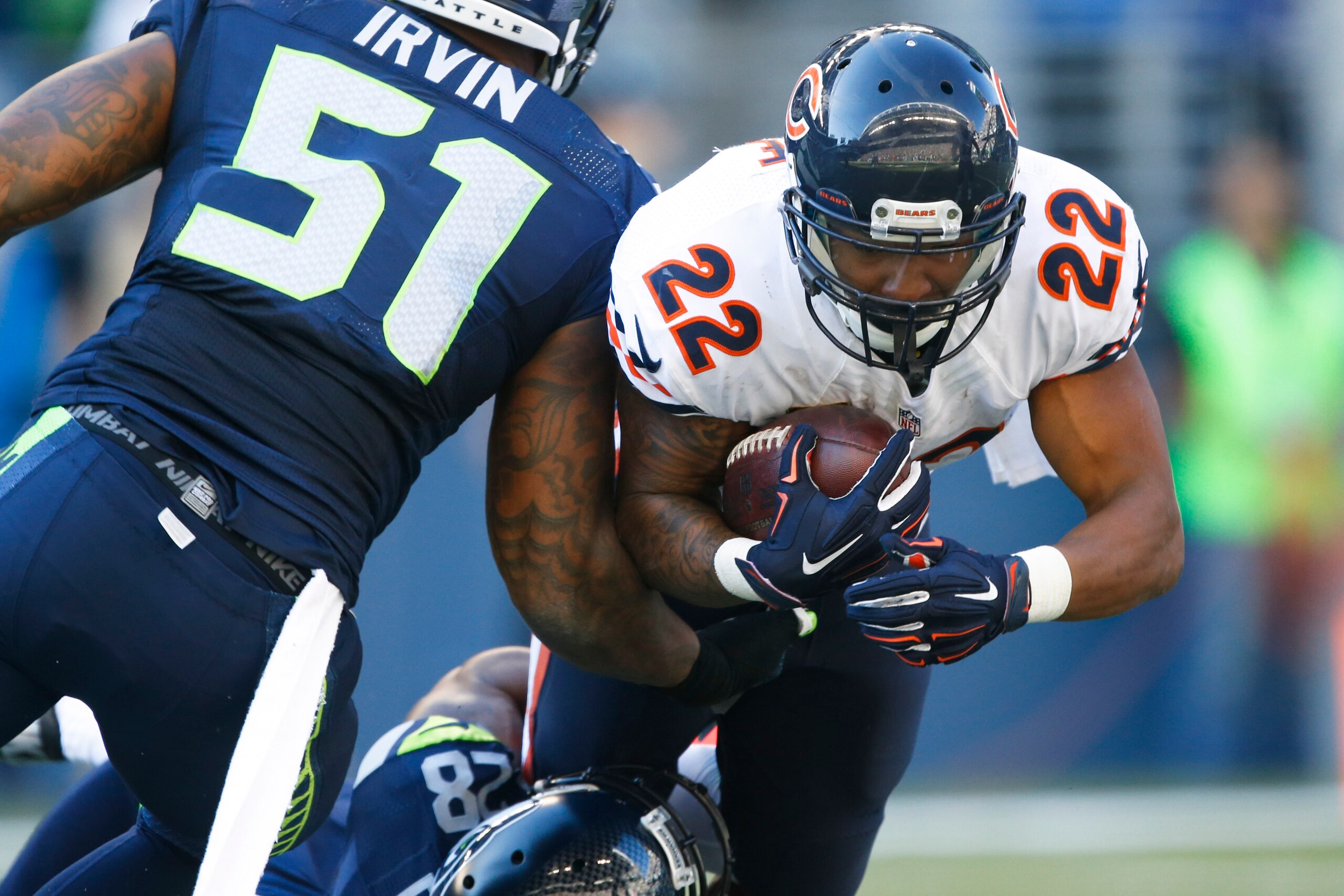
Even though the Bears struggled to move the ball through the air on offense with Clausen, Forte put together a solid outing against one of the league's best defenses.
Forte carried the ball 20 times for 74 yards, and he was still able to be productive even though the Seahawks stacked the box and dared the Bears to throw the football.
Chicago's offense failed to get in the end zone, and Forte was frustrated about that after the game.
“Our job is to score touchdowns," Forte said, per the Chicago Tribune's Dan Wiederer. "So now six quarters without one, obviously frustration is going to build.”
The Bears ran the ball a total of 27 times on Sunday for 98 yards, and guard Matt Slauson was happy with how well the offensive line performed early. But the veteran lineman admitted the offense needs to do a better job of finishing drives.
"We wanted to utilize Matt a lot," Slauson said, per Fishbain. "We felt like we could get physical on them up front, and we did a good job with it at the beginning. But we couldn’t finish drives. That was the biggest problem. We would put together nice drive on the ground, really pounding it, and then we would stall."
Chicago's offense did a nice job of running the football early and often, but Seattle's defense got stronger as the game wore on. Even though the Bears struggled to run the football in the second half, Forte complimented his offensive line after the game.
“Those guys up there are really good,” Forte said about his offensive line, per Fishbain. “Even if the box is stacked, they can still open up holes. As much as [offensive coordinator Adam Gase] is confident, I’m confident as well.”
If the Bears are without Cutler in Week 4 against the Raiders, expect Forte to once again be a focal point on offense. The Raiders allowed just 39 rushing yards on 14 carries to the Cleveland Browns in Week 3, but they gave up 127 yards rushing to the Cincinnati Bengals in Week 1 and 109 yards rushing to the Baltimore Ravens in Week 2.
Chicago's Pass Rush Showed Improvement
5 of 5
The Bears failed to record a sack in the team's first two games, but they were able to sack Seattle's Russell Wilson four times in Week 3.
Chicago's defense played well at times on Sunday, and two pass-rushers stood out in the team's loss.
Outside linebacker Pernell McPhee finished the game with seven tackles, two sacks, two tackles for loss and four quarterback hits.
McPhee's sacks came on back-to-back plays in the third quarter. He easily beat tight end Jimmy Graham off the edge for his first sack, and he then beat right tackle Garry Gilliam for his second sack of the game.
“Pernell’s going to be successful when they’re singling us and we’re getting pressure inside. When we get pressure inside, they start bringing those tackles down,” Fox said, per Fishbain. “That leaves him one-on-one on Jimmy Graham, and you know how that result was, he had two sacks."
After playing two solid games to start the season, defensive end Jarvis Jenkins broke out against Seattle. The former Washington Redskin finished the game with 10 tackles, two sacks, one tackle for loss and two quarterback hits.
Seattle's offensive line struggled in the team's first two games of the year, and Jenkins was able to take advantage of that.
"One of our game keys coming in, Seattle guard play awful," tweeted ChicagoFootball.com's Hub Arkush. "Jenkins beating J.R. Sweezy like a drum."
Jenkins was able to record his first sack because of his great jump off the ball against Sweezy. He then showed off his motor on his second sack. After rushing too far upfield, Jenkins did a great job of working his way back to Wilson to bring him down for the sack.
In addition to Jenkins and McPhee recording their first two sacks of the year, outside linebacker Jared Allen and defensive lineman Will Sutton both recorded one quarterback hit, and outside linebacker Lamarr Houston registered two quarterback hits.
Chicago did a nice job of applying pressure to Wilson all afternoon, but it wasn't enough to keep Seattle's offense off the scoreboard.
Statistical information courtesy of ESPN.com unless otherwise noted.
Matt Eurich is a Chicago Bears featured columnist for Bleacher Report and a member of the Pro Football Writers of America.
.jpg?w=2560 "Dolphins Bears Football")