Playbook Additions for 2015: How Teams Can Make the Most of Their New Weapons
Now that the draft dust has settled and teams have begun rookie camps and other on-field activities, we can take a moment to really examine depth charts and realize…man, some of these teams are really stacked!
The Colts are now loaded at the skill positions. The Jets have more cornerbacks and 3-4 defensive linemen than even head coach Todd Bowles knows what to do with. The Titans have undergone an extreme offensive makeover worthy of the Bravo network. The Rams are not just a great defensive line in search of a team anymore, but they still have more outstanding defensive linemen than they can put on the field at any one time, unless they get creative.
These newly loaded teams may need a little help figuring out the best way to deploy all of their new toys. And if there is one thing every coaching staff craves, it's unsolicited advice from the media! The following play designs will inspire coaches around the NFL who may be at a loss about the best way to line up all of those new wide receivers or defensive backs.
These diagrams all come from game film, coaching guides or the caches of old playbooks that can be found with a little Internet browsing. None of this is exactly cutting-edge stuff for coaches, and we won't go into insane playbook depth about variations and adjustments. Think of these as playbook appetizers, but don't be surprised if you see plays just like them on the menu in September.
(Note: When a rookie's uniform number was unknown when the diagrams were finished, his draft round was used instead).
Indianapolis Colts: Vertical Option Routes
The Colts added so many weapons in the offseason to an offense that was already pretty loaded that it's hard to imagine how they will get everyone enough snaps and touches. First-round pick Phillip Dorsett joined veteran free agents Frank Gore and Andre Johnson as additions to an offense that already boasted T.Y. Hilton, speedy up-and-comer Donte Moncrief and versatile tight ends Coby Fleener and Dwayne Allen. Even if you consider Johnson a one-for-one swap for departing veteran Reggie Wayne, the Colts have clearly increased their capability to both burn opponents deep and consistently run between the tackles.
"Verticality" should be the name of the game for the Colts offense this year. Yes, head coach Chuck Pagano and offensive coordinator Pep Hamilton will want to run the ball effectively with Gore and his backups. But with Andrew Luck throwing to all of those downfield burners, there is no reason to settle for four-yard chunks of yardage when 40-yard chunks should be easy to come by.
The play below is nothing exotic; it's adapted from an old college football coach's guide from my personal collection. The Colts, and many other teams, have plays like it in their playbooks. But while lots of teams can run this play, only the Colts can run it with Hilton, Johnson, Dorsett and Moncrief.
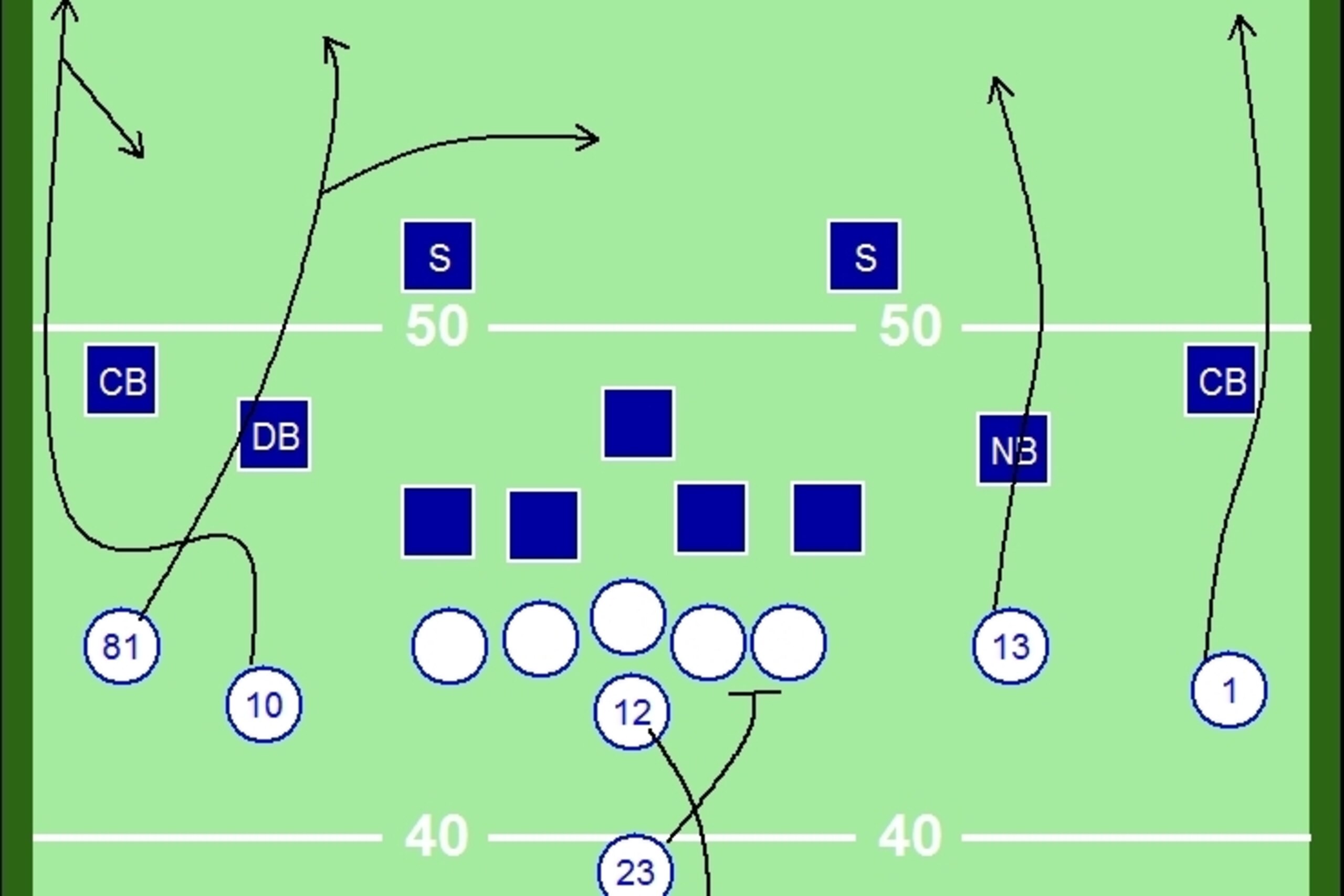
The diagram shows Hilton (13) and Moncrief (10) lined up as inside receivers, with Johnson (now wearing 81) and Dorsett (1) split wide. Obviously, Hilton is looking for a mismatch against a safety, nickel or dime defender in the slot. After a play fake to Gore (that No. 23 looks weird on Gore, but it's his uniform number now), Luck can read the safety as Hilton runs up the seam and Dorsett up the sideline. Depending on the defensive coverage, one of these receivers is likely to get open.
The interesting stuff happens on the opposite side of the field. Moncrief runs a wheel route, starting into the flat before suddenly cutting up the sideline. Johnson releases to the inside and runs a seam route parallel to Hilton's route. But both Moncrief and Johnson have options. If Johnson reads Cover 3, with two cornerbacks and a safety (or one cornerback and two safeties) backpedalling to cover deep zones, he'll race up the seam to give the midfield defender more deep receivers than he can handle. If the middle of the field is uncovered (because the safety has peeled off to chase Hilton, for example), he runs a crossing route in the 15- to 17-yard range. Moncrief has a similar option: If deep defenders keep him in front of them, he breaks off his wheel route and comes back for the ball at about 15 yards downfield.
Our Colts play isn't going to fool the defense. It will simply spread the defense too thin. Opponents will respond to route concepts like this by playing lots of "Quarters" coverage, with both safeties and both cornerbacks backpedalling to play deep while linebackers and/or nickel defenders work underneath zones. With opponents in quarters coverage, life will be easy for Gore—and for Luck as an underneath passer.
Just to show how deep the Colts are and how versatile a play like this can be, here's a variation on the same pass pattern with Fleener (80) and Allen (83) on the field as twin tight ends.
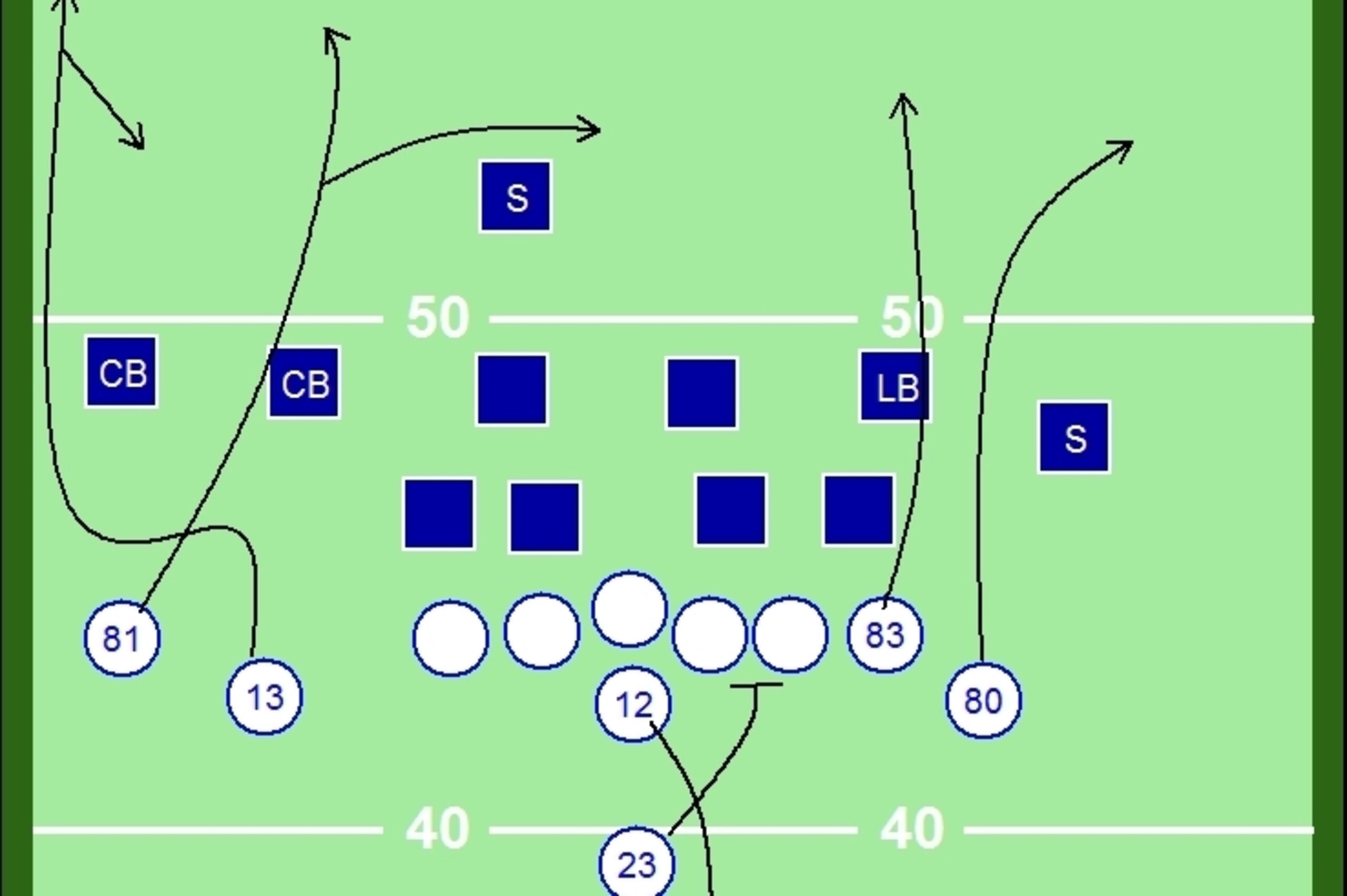
Because the Colts are in a 1-2-2 personnel grouping (one running back, two tight ends and two receivers), the defense is likely to respond with its base personnel. That means somebody is likely to get covered by a linebacker. Allen runs the seamer against a linebacker in this play variation. That safety in the middle of the field probably won't do much to stop him, as he will be busy with Johnson, Hilton and those option routes on the left side.
New York Jets: Unbalanced Fronts and Hybrid Coverage
First, the Jets got the band back together in the secondary, reuniting Darrelle Revis with Antonio Cromartie and adding Buster Skrine for good measure. Then, Leonard Williams fell into their lap in the draft. With Muhammad Wilkerson and Sheldon Richardson in the lineup, the Jets already had the best pair of 3-4 defensive ends in the NFL. Williams now gives them three outstanding ends, and basic geometry tells us that no defensive line segment can have more than two.
Todd Bowles knows how to mix and match linemen. He also knows how to deploy his secondary in unusual ways: Cardinals opponents never knew which defensive backs were blitzing, dropping into deep coverages, lurking in underneath zones or locking on in man-to-man. But even a tactician like Bowles could use a little inspiration, and that's what this article is all about.
The diagram below is taken from an old Rex Ryan playbook, so many of the old and new Jets will recognize it. It is meant for use on passing downs when the opponent has a pass-heavy personnel group on the field. The play uses an unbalanced defensive line to get Wilkerson, Williams and Richardson in position to do damage, making a four-man rush with plenty of deep safety support look like an all-out blitz.

Richardson (91) starts out as the nose tackle. He crosses the guard's face to engage the right tackle; it's a nasty assignment, but Richardson is quick enough to handle it, and he is simply a containment player on this play. Wilkerson (96) and Williams (1) rush from the offensive left, with Big Mo sacrificing himself to the left tackle so either the Big Cat or linebacker David Harris (52) can get a free shot at the quarterback.
On the other side of the formation, Quinton Coples (98) keys the running back and makes sure the opponent cannot simply audible to an off-tackle plow to the right side. Safety Calvin Pryor (25) is in charge of the tight end in coverage. The original play the diagram is based upon had a linebacker covering the tight end, but one look at the current tight ends of the AFC East (Rob Gronkowski, Charles Clay, Jordan Cameron) confirms that to be a bad idea.
As for those Jets cornerbacks, Revis (24) is on an island with the outside receiver on the blitz side. Cromartie (31) locks down the No. 2 receiver on the blitz side. Skrine (41) gets a little help on the other side from dime cornerback Dee Milliner (27). Skrine and Milliner play "thumbs" coverage, with Milliner working underneath on short routes while Skrine handles deep coverage. Free safety Marcus Gilchrist (21) rounds out the cast. He is assigned to half-field coverage on the Revis-Cromartie side. Both Cromartie and Milliner have the luxury of gambling to try to jump a route with Skrine and Gilchrist behind them: At its core, this defense is just Man 2 with a four-man rush, but the details make it devious.
It can be hard to envision how a defense will work against a variety of formations based on a single diagram. Thankfully, NFL playbooks usually show seven or eight variations on the same defensive call. So here's a bonus diagram. Let's say the Patriots empty the backfield against the Jets. How will our unbalanced line look against an opponent trying to play hide-the-Gronkowski?

At first, this looks like a win for the Patriots. Coples must cross the formation to cover the tight end. But that does not mean there will be an automatic Gronkfest in the end zone. Pryor is still in deep coverage, and he knows Coples will need him more than Revis or Cromartie. The tight end is also under full-on assault from Williams, Wilkerson and Harris before the snap. He's likely to get a protection assignment during the pre-snap reads. And coverage everywhere else is likely to be tight; even the "thumbs" double-coverage concept is still in the mix. Finally, no one has to worry about run defense. So this is a trade-off Bowles is likely to be comfortable with, at least once in a while.
Three great defensive ends and a completely rebuilt secondary will allow Bowles to slide chess pieces all over the board. Unbalanced lines and hybrid coverages like the ones diagrammed are just tips of the Jets' defensive iceberg.
Tennessee Titans: Running (and Gunning) with Scissors
No team did more to alter its offensive image on draft weekend than the Tennessee Titans. Before the draft, the Titans had no offensive image. Now they have one. That's a heck of an alteration.
With Marcus Mariota pulling the trigger and newcomers Dorial Green-Beckham, David Cobb, Jalston Fowler and Tre McBride joining incumbents like Kendall Wright, Bishop Sankey and Justin Hunter, the Titans should have a dynamic, unpredictable and explosive offense this season. Much depends on head coach Ken Whisenhunt, whose system does not appear suited to the talents of a mobile, less-than-Howitzer-armed passer like Mariota. According to the Football Outsiders internal database, the Titans only rolled the pocket on pass plays last season 43 times, and the only designed quarterback run the team attempted all year was a sneak.
The Titans offense needs a dose of Chip Kelly to make Mariota more comfortable. The following diagram is adapted from a play the Eagles used against the Giants in 2013. DeSean Jackson caught a 28-yard pass using this play. Let's adapt it for Wright, whose big-play potential has gone untapped for three years as the Titans coped with a never-ending quarterback crisis.
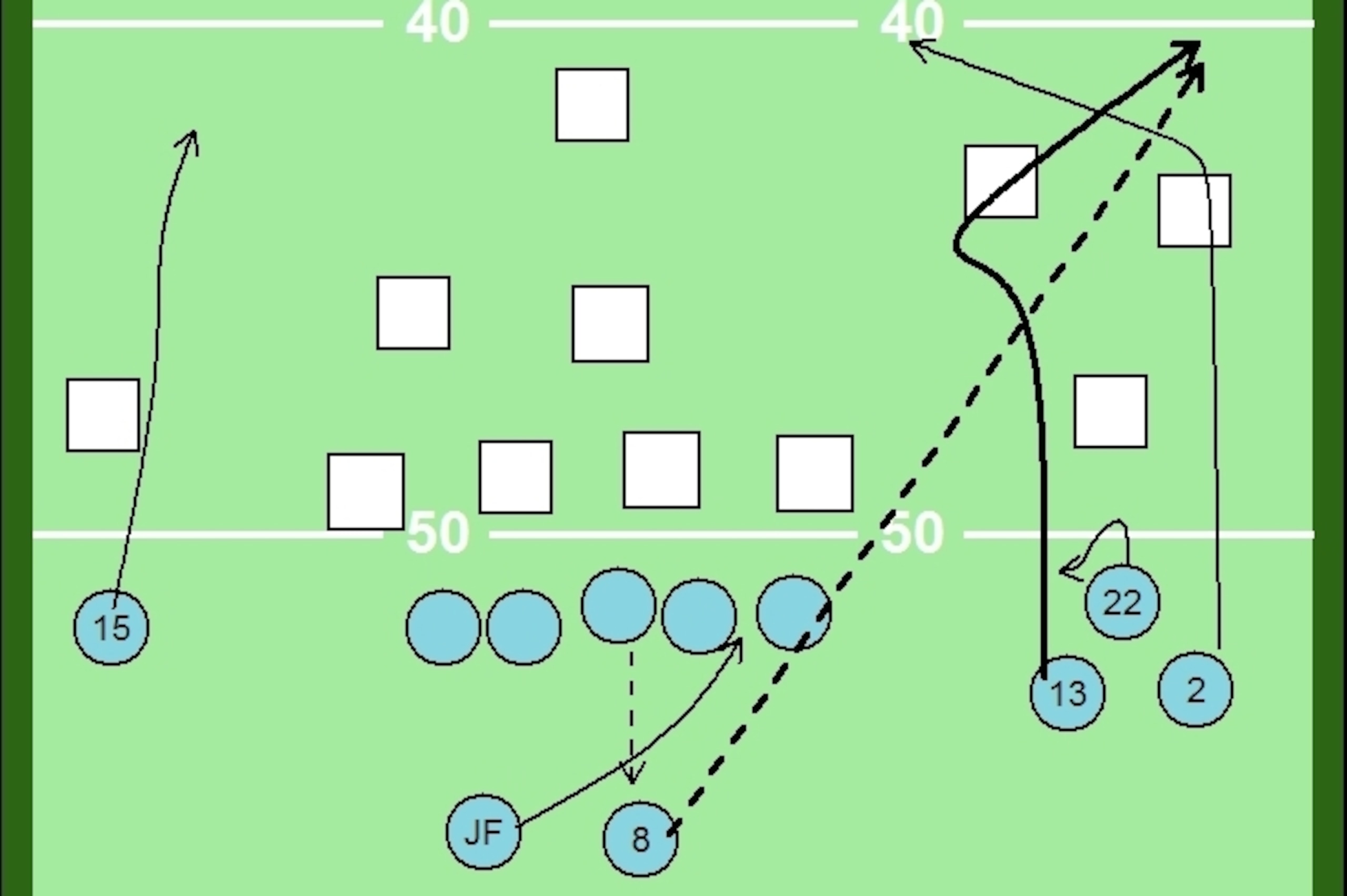
The three receivers bunched to the far right are Wright (13), Green-Beckham (2 for now) and rusher/receiver Dexter McCluster (22). Fowler (JF, because his uniform number was not officially announced when the diagram was drawn, and a "4" would just look weird) is in the backfield because the presence of a fullback or H-back on the field, along with a running back, should keep the defense out of its dime package. Hunter (15) is split left.
A brief inside-zone fake to Fowler starts the play, but otherwise the only "spread option" wrinkle is McCluster's fake screen route. Green-Beckham runs a post. Wright starts his route more slowly, allowing Green-Beckham to clear his defender. Wright then puts an inside move on his defender before running a corner route.
The Titans are essentially running "scissors" with Wright and Green-Beckham here. Defenses will often cover bunched receivers with a man-zone concept: The defenders switch assignments if receivers crisscross, for example, or the outside defender might take the short flat while the inside defender handles anything deep. The fake screen action and precise timing of the routes is designed to isolate Wright against an out-of-position nickel cornerback or safety: An easy win for Wright.
The best feature of this play is that everyone gets to do something he does well. McCluster is a true threat on a receiver screen, so defenders will account for him. The inexperienced Green-Beckham only has to use his size and speed on a clear-out route. Similarly, the dangerous Hunter keeps the middle safety from cheating to his right—or becomes a threat himself if the defense leaves him isolated one-on-one. Wright is quick and smooth in the open field. And Mariota (8) gets a downfield throw that he can put a little air underneath and a play that might look a little familiar from his college days.
We haven't even scratched the surface of what the Titans can do with their current playmakers. Heck, we didn't even roll Mariota out of the pocket. Let's not throw too much at Whisenhunt too quickly.
St. Louis Rams: Nifty 50 Defense
Even before the Rams signed Nick Fairley, they were prime candidates to bring back the old 5-2 defensive front. Last year, the Rams boasted Robert Quinn, Chris Long, Michael Brockers and rookie star Aaron Donald along the defensive line, with quality backups like William Hayes and Kendall Langford in rotation roles. The Rams play in a division where the running game is king, quarterbacks are mobile and offensive lines are often rickety. Why not bust out a five-man defensive line once in a while?
A quick glance at the Football Outsiders internal database shows that head coach Jeff Fisher was never tempted: The Rams only used five or six linemen in goal-line situations. But now that Fairley joins Donald and Brockers in the middle, it's time for Fisher to get medieval, at least in the football strategy sense, and see if he can threaten some of those NFC West offenses with a 5-2 look.
The diagram below is adapted from an old 46 defense playbook, so Fisher should be familiar with it. The 46 used four defensive linemen, but the strong-side linebacker was often a huge guy, so Quinn can channel his inner Wilber Marshall for this personnel package. The play is designed for early downs against an opponent that has base or run-heavy personnel on the field. As you can see, the goal is pretty simple: Bring some extreme heat.
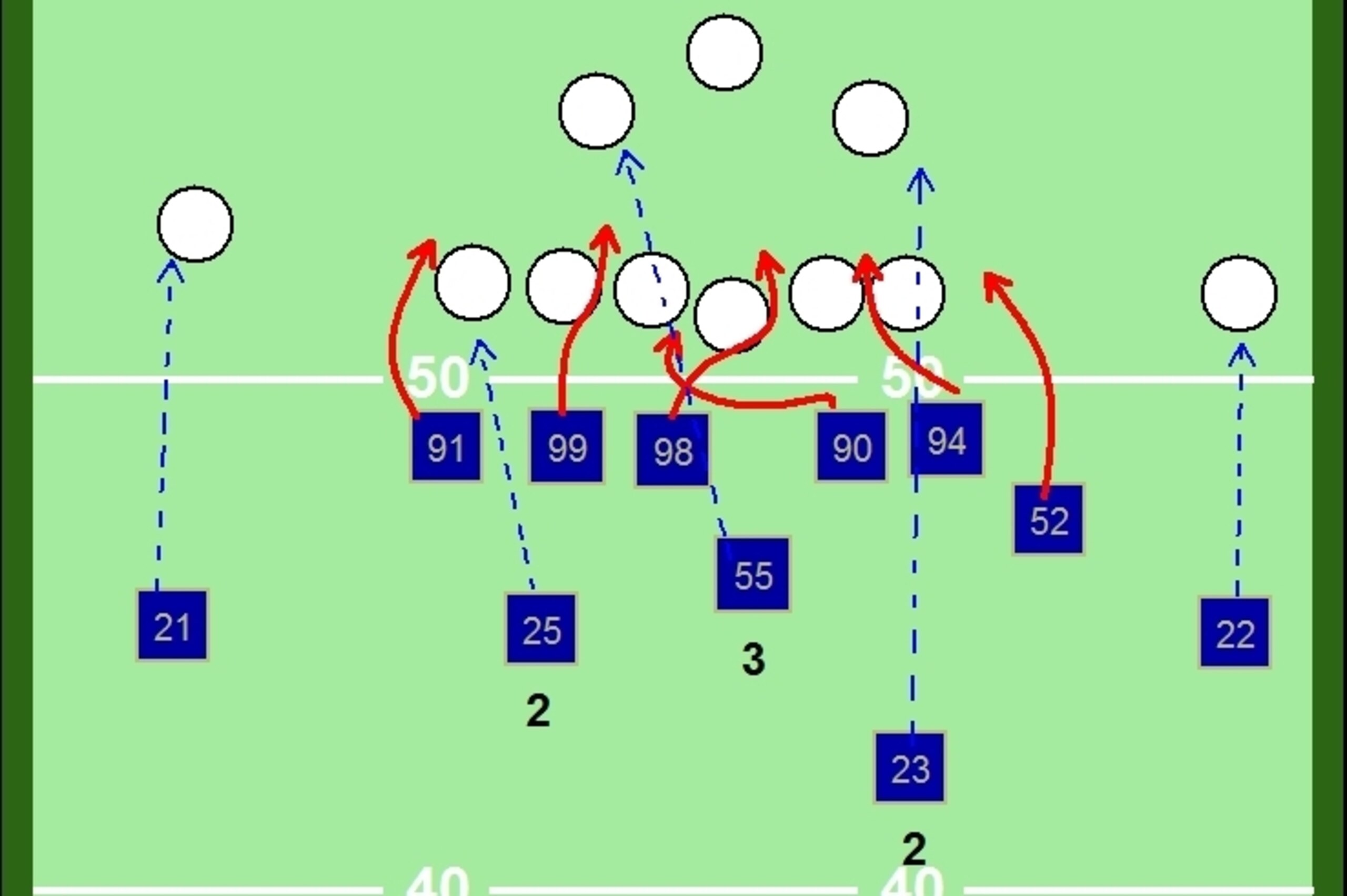
Quinn (94) and Donald (99) crash the two B-gaps between the guard and tackle on each side. They will keep offensive linemen away from Long (91) and Alec Ogletree (52), blitzing from the edges. Long and Ogletree each have run-containment responsibilities on their way to the quarterback. If the opponent is planning any read-option chicanery, Long and Ogletree will persuade Russell Wilson or Colin Kaepernick to just hand off up the middle.
Speaking of the middle, Fairley and Brockers are running a stunt. Fairley (98) crosses the center's face and attacks a backside A-gap. Brockers (90) twists behind Fairley. Keep in mind that the guards must worry about Quinn and Donald. Unless the offense gets the tight end and backs involved, any blocking scheme is going to get obliterated.
Any six-man rush is going to force the defense to play short-handed in the secondary. The diagram shows the Rams playing simple man coverage, with no deep safety. The numbers represent the receivers the middle linebacker and safety are responsible for in coverage. The safeties get the second eligible receiver from the sideline on each side of the formation. So if Reggie Bush starts in the 49ers backfield, then motions to the slot on the offensive left, the right-side safety (No. 23 Rodney McLeod in the diagram) picks him up. Middle linebacker James Laurinaitis (55) takes the "middle" receiver. With clever motion, an offense could isolate Laurinaitis against a really fast running back or tight end. Fat load of good it will do in the 0.35 seconds the quarterback will have to throw the football.
We could diagram a Rams offensive play, but the team just wants to hand off to Todd Gurley 40 times per game off tackle, and you know what an off-tackle run looks like. The defensive line is where all the action is in St. Louis, and the occasional 5-2 wrinkle could be just the thing to turn some 12-6 divisional losses into 12-6 divisional wins.
Mike Tanier covers the NFL for Bleacher Report.
.jpg?w=2560 "Saints Falcons Football")